
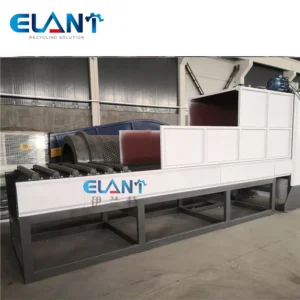
Label removal is one of the most important control points in a PET bottle recycling line. When labels remain on bottle flakes, the final rPET quality can decline quickly. Poor label separation can increase PVC, paper, ink, glue, and film contamination, reduce flake purity, create downstream pelletizing problems, and lower the commercial value of recycled PET flakes.
What Label Removal Means in PET Bottle Recycling
Label removal is the process of separating labels from PET bottles before or during washing. The goal is to prevent label materials, ink, glue, and incompatible plastics from entering the final PET flake stream.
A typical PET bottle recycling process includes bale opening, sorting, label removal, crushing, washing, friction washing, hot washing, floating separation, rinsing, dewatering, drying, and flake collection. For a full process view, see Elant Machinery’s PET bottle washing recycling line solution.
| Process Stage | Role in Label Control | Common Risk |
|---|---|---|
| Bale opening | Loosens compressed bottles | Labels remain trapped in dense bales |
| Manual or optical sorting | Removes non-PET bottles and obvious contaminants | PVC bottles, colored bottles, and foreign plastics enter the line |
| Label remover | Scrapes or separates labels before crushing | Blade wear or wrong speed reduces removal efficiency |
| Crusher | Cuts bottles into flakes | Labels are cut into smaller pieces if not removed early |
| Friction washer | Scrubs flakes and removes loose labels | Low friction or overloaded flow leaves label residue |
| Hot washing | Removes glue, oil, and dirt | Poor temperature or chemical control leaves adhesive on flakes |
| Float-sink separation | Separates PET from light label and cap materials | Incorrect water flow reduces separation accuracy |
| Drying | Prepares clean flakes for sale or pelletizing | Remaining paper labels increase moisture and dust |
Why Label Removal Efficiency Drops
Label removal efficiency can drop because of feedstock changes, mechanical wear, water system problems, incorrect operating settings, or poor upstream sorting. In practice, several causes often appear at the same time.
1. Bottle Bale Quality Changes
PET bottle bales are not always consistent. Some batches contain more full-wrap labels, PVC labels, paper labels, glue-heavy labels, dirty bottles, flattened bottles, or mixed plastics. When bale quality changes, the same machine settings may no longer remove labels effectively.
Elant’s article on common PET bottle bale problems explains why incoming material control is critical for stable PET recycling performance.
| Bale Problem | Impact on Label Removal | Recommended Fix |
|---|---|---|
| High full-wrap label content | Labels cover more bottle surface | Adjust label remover speed and increase pre-sorting |
| More paper labels | Paper breaks into fibers and sludge | Improve pre-removal and water filtration |
| Heavy glue labels | Adhesive remains on PET flakes | Optimize hot wash temperature and detergent dosage |
| Flattened bottles | Machine contact becomes uneven | Improve bale loosening before label removal |
| Mixed PVC labels or bottles | Contaminates PET flakes | Strengthen sorting and detection |
2. Label Remover Blade Wear
Label remover performance depends heavily on blade condition, rotor speed, gap control, and bottle contact. Worn blades may still rotate normally, but they no longer create enough scraping force to separate labels before crushing.
Operators should check blade sharpness, blade angle, rotor balance, bearing condition, and screen blockage. Preventive maintenance is usually cheaper than allowing label contamination to move into the washing and drying stages.
3. Incorrect Feeding Rate
If the PET bottle recycling line is overloaded, bottles pass through the label remover too quickly. The machine may not have enough contact time to scrape labels from the bottle surface. Underfeeding can also reduce efficiency because bottles may not rub against each other or against the machine surface properly.
| Feeding Problem | Visible Symptom | Correction |
|---|---|---|
| Overfeeding | Many labels remain attached after label remover | Reduce feed rate or increase pre-buffering |
| Underfeeding | Low bottle-to-bottle friction | Stabilize feed with conveyor control |
| Uneven feeding | Efficiency changes every few minutes | Use bale opener and controlled conveyor speed |
| Too many compressed bottles | Labels are not exposed to machine contact | Improve bale loosening and pre-sorting |
4. Poor Crushing Control
If labels are not removed before crushing, the crusher cuts labels into smaller fragments. Small label particles are harder to separate later and may travel through the washing line with PET flakes.
For crusher-related control points, see Elant Machinery’s article on PET bottle crushing machine control.
5. Weak Friction Washing
A friction washer helps remove label fragments, dirt, glue, and fine contaminants from PET flakes. If friction washing is weak, the line may produce flakes that look clean at first but still contain label residue and adhesive contamination.
Common causes include worn paddles, low rotor speed, excessive water flow, poor drainage, overloading, or insufficient retention time. For related washing-line issues, read Elant’s guide on plastic recycling washing line water circulation problems.
6. Hot Washing Parameters Drift
Hot washing is important for removing glue, oil, sugar residue, and dirt. If the temperature, chemical concentration, retention time, or water cleanliness is not stable, adhesive removal becomes inconsistent.
Elant Machinery’s article on stable performance during hot washing explains why hot wash control is important for PET bottle recycling machines.
| Hot Wash Parameter | If Too Low | If Too High |
|---|---|---|
| Temperature | Glue may remain on flakes | Higher energy cost and possible process instability |
| Detergent or caustic concentration | Poor oil and adhesive removal | Higher chemical cost and rinsing burden |
| Retention time | Incomplete cleaning | Reduced throughput |
| Water cleanliness | Contaminants redeposit on flakes | More wastewater treatment demand |
7. Float-Sink Separation Is Not Stable
Many label and cap materials are lighter than PET, so float-sink separation can remove them from PET flakes. However, poor water flow, high sludge load, incorrect tank design, or excessive turbulence can reduce separation accuracy.
8. PVC and Incompatible Label Materials Enter the Line
PVC contamination is especially harmful in PET recycling because it can reduce rPET quality and create downstream processing problems. Some labels, sleeves, seals, or mixed bottles may introduce incompatible materials into the PET stream.
For more detail, see Elant Machinery’s article on PVC in PET bottle recycling. The Association of Plastic Recyclers also provides an external APR Design Guide that discusses packaging design considerations for recyclability.
How to Fix Label Removal Efficiency Problems
Improving label removal requires a system approach. The label remover alone cannot solve every issue if bale sorting, crushing, washing, water circulation, and drying are unstable.
| Problem Area | Recommended Action | Expected Result |
|---|---|---|
| Incoming bales | Set bale quality standards and reject high-risk contamination | More stable label removal |
| Pre-sorting | Remove PVC, colored bottles, large foreign materials, and non-PET containers | Cleaner input material |
| Label remover | Check blade wear, rotor speed, gap, and feed rate | Higher label separation before crushing |
| Crusher | Maintain blade sharpness and proper screen size | More uniform flakes |
| Friction washer | Adjust rotor speed, water flow, and loading level | Better removal of label fragments and dirt |
| Hot washing | Control temperature, chemical dosage, and retention time | Improved glue and oil removal |
| Float-sink tank | Stabilize water flow and remove floating contaminants continuously | Better separation of light labels and caps |
| Dewatering and drying | Control final moisture and dust | Higher-value clean PET flakes |
Quality Targets for Clean PET Flakes
The final goal is not only to remove visible labels but to produce clean, stable PET flakes that can be sold, pelletized, or used in downstream manufacturing. The required quality depends on the end market, but common targets include low PVC content, low label residue, low glue residue, stable moisture, and consistent flake size.
For more quality control points, read Elant’s guide on control points for quality rPET flakes and flake moisture control in a PET bottle washing line.
| Quality Indicator | Why It Matters | Control Point |
|---|---|---|
| Label residue | Reduces purity and appearance | Label remover, friction washer, float-sink tank |
| Glue residue | Causes yellowing, odor, and processing issues | Hot washing and rinsing |
| PVC contamination | Damages rPET quality during heating | Sorting and detection |
| Moisture content | Affects storage and pelletizing | Dewatering and drying |
| Flake size consistency | Improves washing and downstream processing | Crusher blade and screen control |
| Fine dust | Creates handling and quality problems | Washing, rinsing, and drying control |
Maintenance Checklist for Label Removal Stability
Routine maintenance is essential because label removal problems often come from gradual wear rather than obvious machine failure.
| Inspection Item | Check Frequency | Why It Matters |
|---|---|---|
| Label remover blades | Daily or weekly | Worn blades reduce scraping force |
| Rotor and bearings | Weekly | Vibration affects contact and machine life |
| Conveyor feed rate | Daily | Stable feeding improves removal efficiency |
| Crusher blades | Weekly | Dull blades create uneven flakes |
| Friction washer paddles | Weekly | Worn paddles reduce scrubbing effect |
| Hot wash temperature | Each shift | Temperature drift affects glue removal |
| Water circulation system | Each shift | Dirty water can redeposit contamination |
| Dewatering screen | Daily | Blockage increases final moisture |
Safety and Environmental Considerations
PET bottle recycling lines include conveyors, rotating blades, crushers, hot washing tanks, pumps, electrical systems, and moving material. Operators should follow machine guarding and lockout procedures according to local workplace rules. OSHA’s machine guarding overview is a useful external safety reference.
Water, sludge, label waste, and chemicals from washing lines should also be managed responsibly. The U.S. EPA provides general guidance on reduce, reuse, and recycle, while ISO 15270 offers guidance for plastics recovery and recycling.
FAQ
Why does label removal efficiency drop in a PET bottle recycling line?
Common causes include poor bale quality, more full-wrap labels, worn label remover blades, incorrect feed rate, weak friction washing, unstable hot washing, poor water circulation, and PVC or paper label contamination.
Should labels be removed before or after crushing?
Labels should be removed as much as possible before crushing. Once labels are cut into small fragments, they become harder to separate from PET flakes.
How does a friction washer improve label removal?
A friction washer scrubs PET flakes at high speed, helping remove loose labels, dirt, adhesive residue, and fine contaminants from the flake surface.
Why is hot washing important for PET flakes?
Hot washing helps remove glue, oil, sugar residue, dirt, and other contaminants. Proper temperature, chemical concentration, and retention time are critical for stable cleaning results.
Can PVC labels damage PET recycling quality?
Yes. PVC contamination can reduce the quality of recycled PET and create downstream processing problems, especially when PET flakes are heated during pelletizing or manufacturing.
What role does water circulation play in label removal?
Clean and stable water circulation helps carry away label fragments, dirt, and light contaminants. Poor water circulation can cause contaminants to redeposit on PET flakes.
How can operators tell that label removal is failing?
Warning signs include more labels after the label remover, floating label fragments in tanks, glue residue on flakes, dirty wash water, higher PVC risk, and lower final flake value.
Does higher hot wash temperature always improve label removal?
No. Higher temperature may help remove some adhesives, but excessive heat can increase energy cost and process instability. Temperature should be optimized with chemical dosage and retention time.
What machine maintenance improves label removal?
Key maintenance includes checking label remover blades, rotor condition, crusher blades, friction washer paddles, screens, water pumps, filters, and hot wash controls.
What is the best way to improve clean PET flake quality?
The best approach is to control the entire line: bale sorting, label removal, crushing, friction washing, hot washing, float-sink separation, rinsing, dewatering, drying, and final quality inspection.
Conclusion
Label removal efficiency in a PET bottle recycling line depends on much more than a single label remover machine. Feedstock quality, machine wear, feeding rate, crushing control, friction washing, hot washing, water circulation, and final drying all affect whether the line produces high-quality clean PET flakes.
When label removal efficiency drops, plant managers should check the whole PET bottle washing line instead of only increasing labor or chemical usage. By improving sorting, maintaining blades, stabilizing feed rate, optimizing hot washing, and controlling water circulation, recycling plants can reduce contamination and improve the value of recycled PET flakes.
For more related solutions, explore Elant Machinery’s PET Bottle Washing Line, Plastic Bottle Recycle Machine, PET Bottle Recycling Machine, PET Recycling Machine Selection Guide, and Contact Us pages.