
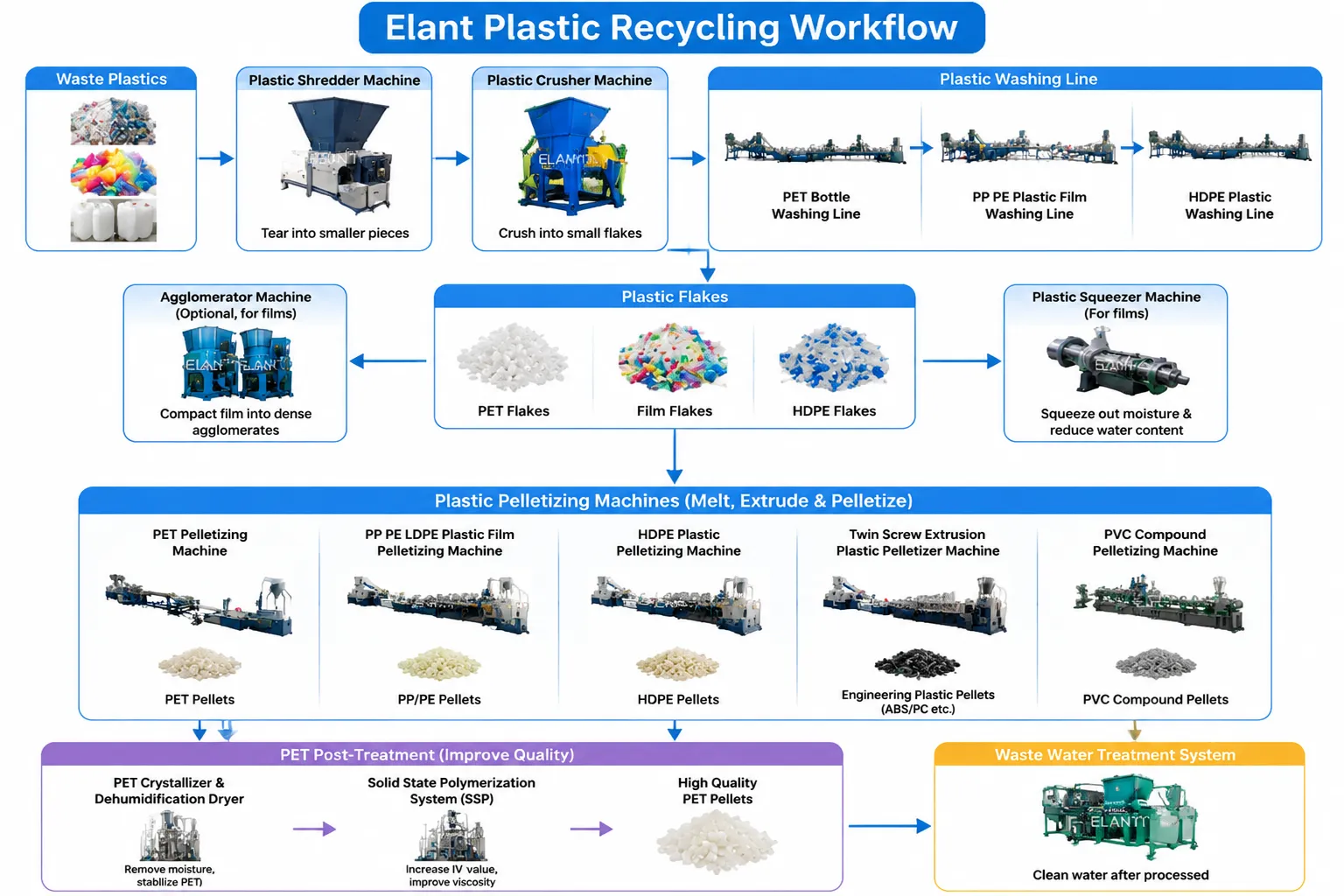
A Plastic Shredder Machine plays a key role in modern plastic recycling workflows by reducing bulky plastic waste into smaller pieces for further processing. This guide explains where industrial shredders fit in a recycling line and how manufacturers can build an efficient recycling process.
At a glance
| Item | Detail |
|---|---|
| Core function | Reduces large plastic waste into smaller pieces for recycling and further processing |
| Typical output size | 10–50 mm shredded pieces depending on rotor design and screen configuration |
| Materials handled | PET bottles, HDPE, PP, PE film, ABS, and mixed plastic waste |
| Typical workflow stages | Collection → Sorting → Shredding → Washing (if required) → Drying → Pelletizing |
| Throughput range | 100–2,000+ kg/hr depending on machine design, motor power, and material type |
| U.S. considerations | OSHA safety requirements and local waste management regulations |
| Sustainability payoff | Reduces landfill waste, lowers virgin plastic demand, and supports circular manufacturing |
Why manufacturing waste management demands a structured approach
Manufacturing facilities typically generate plastic waste from production scraps, packaging materials, rejected parts, and returned products. Each stream carries different contamination profiles, different material compositions, and different downstream recycling requirements.
That diversity is exactly why a one-size recycling bin approach fails most manufacturing operations. The plastic waste coming off an injection molding line is not the same as the PE film from incoming packaging, which is not the same as the ABS from end-of-life electronic components. Industrial shredding is the step that begins to resolve those differences — converting irregular, bulky waste into consistent feedstock that downstream recycling processes can actually work with.
According to the U.S. EPA’s waste characterization data[3], plastics remain a significant component of waste streams, creating opportunities for better recovery and recycling. Shredders often serve as a critical first step in recycling operations because downstream equipment such as washing systems, drying lines, and pelletizers depend on consistent feed material.
Do this: Before selecting a shredder, evaluate your waste streams based on material type, size, contamination level, and required output. Choosing the wrong machine configuration can reduce overall recycling efficiency and increase operating costs.
What is an industrial shredder?
An industrial shredder is a mechanical size-reduction machine that converts large, irregular plastic waste materials into smaller, more manageable pieces for recycling and further processing.In plastic recycling workflows specifically, shredders produce the consistent particle size that makes downstream washing, drying, and pelletizing economically viable.
The term “industrial shredder” covers a wide family of machines. What they share is a cutting mechanism (rotating cutters mounted on one or more shafts working against fixed knives or cutting elements), a means of controlling output size (screens (where used), cutter design, gap settings, and shaft speed), and a drive system scaled to the material’s toughness and volume.
Industrial shredders are not pelletizers. Shredders reduce bulky plastic waste into smaller pieces, while pelletizers melt and convert processed plastic material into reusable pellets.
Size range matters in practice. A single-shaft shredder handling 200 kg/hr of clean production scrap is not the same class of machine as a twin-shaft shredder processing 1,500 kg/hr of mixed plastic waste. Both are “industrial shredders” by category. Matching machine scale to actual waste stream volume is the first equipment decision, and getting it wrong in either direction — undersized or oversized — creates problems the rest of the workflow inherits.
Industrial shredder designs and how they differ
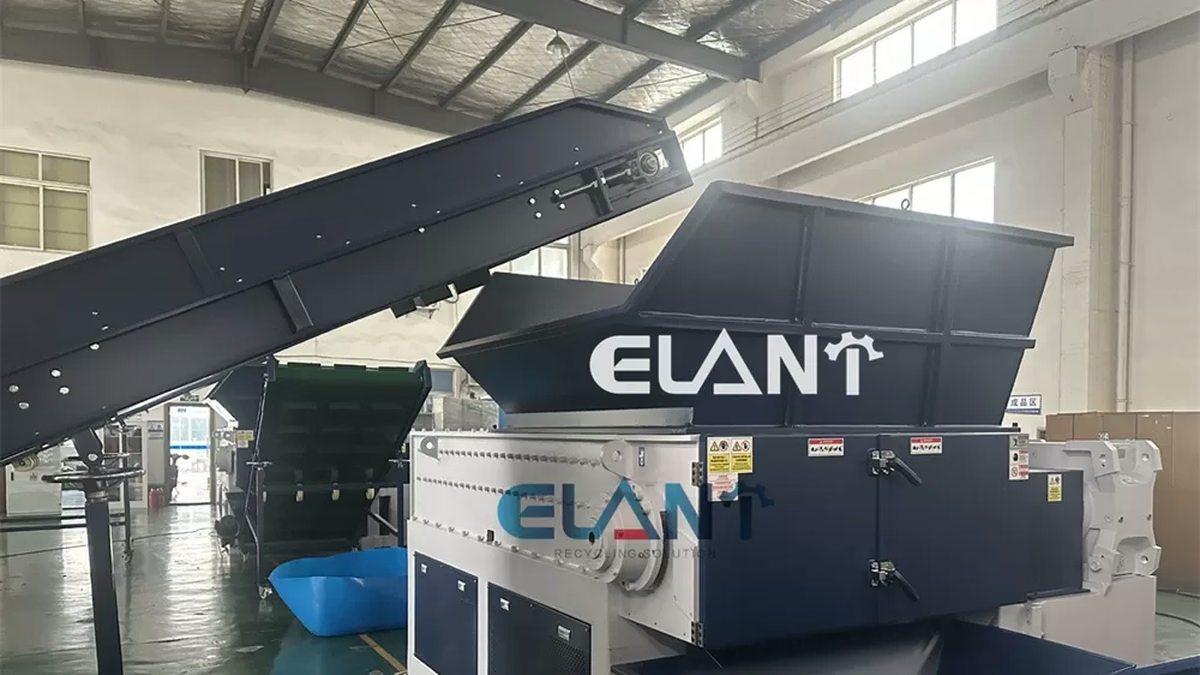
The cutting geometry of a shredder determines what materials it handles well, how tightly it controls output size, and what its maintenance profile looks like. Four common designs are widely used in plastic recycling and manufacturing applications.
Single-shaft shredders use a single rotating blade rotor working against a fixed counter-knife bed, with a screen (on many models) that helps control output size. They deliver precise size control and are the standard choice for clean, relatively uniform production scrap — PET packaging, HDPE containers, rigid PP. Throughput typically runs 200–800 kg/hr. Maintenance centers on the counter-knife gap and screen condition.
Twin-shaft shredders use two counter-rotating shafts with interlocking cutting discs. The geometry generates higher torque than single-shaft machines, which makes them effective on bulky, mixed, or tough-to-cut materials — large molded parts, baled film, mixed plastics. Output size control is less precise than single-shaft designs because there is no bottom screen. Throughput commonly ranges from hundreds of kilograms per hour to higher capacities depending on machine size and material.
Four-shaft shredders ause two pairs of interlocking shafts to provide multiple cutting stages and more controlled size reduction. They are more capital-intensive and typically appear in high-volume centralized recycling operations rather than on-site manufacturing floor installations.
Pelletizer machines are downstream recycling equipment that melt, filter, and convert processed plastic flakes into reusable plastic pellets. Unlike shredders, which perform size reduction on bulky waste, pelletizers focus on material regeneration after sorting, washing, and drying. In a complete recycling workflow, the pelletizing stage comes after preparation processes and produces consistent pellets for manufacturing applications.
Worth checking: Screen size is one of the main factors affecting output size on single-shaft shredders. A smaller screen can produce finer material for downstream processing, while a larger screen may improve throughput when handling bulky or tough plastic waste. Ask for throughput data at multiple screen sizes for your specific material before ordering.
How shredder-based recycling workflows process materials step by step
Understanding the full process sequence matters before selecting any single piece of equipment. Each stage creates a dependency — skip or underinvest in one, and the next stage absorbs the cost.
Waste collection and preparation
Plastic waste enters the workflow from three primary sources:manufacturing scraps, packaging waste, post-industrial recycled materials, and post-consumer plastics.
Preparation means removing gross contaminants before materials reach the shredder. Industrial shredders can handle some contamination, but metal ingestion damages cutting tools and drives up maintenance costs. A pre-shredding inspection or inline metal detection step pays for itself quickly at any meaningful volume.
Material sorting
Sorting determines what can be recycled together and what must run separately through dedicated shredding machines. Three decisions matter: plastic type (PET, HDPE, PP, PE, ABS, and mixed plastics each carry different melt temperatures and recycling requirements — commingling incompatible resins degrades final feedstock quality); contamination level (lightly contaminated production scrap goes straight to shredding; heavily contaminated post-consumer materials need washing before or after shredding depending on shredder design); and end-use pathway (some materials qualify for closed-loop return to the original production process; others are downcycled into lower-grade applications).
Manual sorting, conveyor-based sorting, and near-infrared (NIR) optical sorting systems are all used in U.S. recycling facilities. NIR sorting technology[4] can identify resin types at line speeds above 3 m/s, which makes it practical for high-volume mixed-plastic waste management operations.
Plastic shredding
This is where industrial shredders do the structural work. Shredding serves three functions: size reduction (converting large, irregular plastic waste into smaller, manageable pieces); feedstock creation (producing output sized to match the feed requirements of washing, drying, and pelletizing systems); and surface area increase (improving washing efficiency and preparing material for downstream processing).
The choice between shredder designs is a material question, not a brand question. Match the cutting geometry to the feedstock.
Downstream recycling processing
Shredded plastic moves through three downstream stages before becoming usable production input:
- Washing — removes surface contamination, adhesives, food residue, and processing oils. Friction washers and float-sink tanks are standard in industrial recycling operations.
- Drying — reduces moisture content to levels that won’t cause defects during pelletizing. Centrifugal dryers and thermal dryers are both used depending on material type and final application.
- Pelletizing — re-melts and extrudes clean, dry regrind into uniform pellets. Pelletized recycled material meets the dimensional consistency required by injection molding and extrusion equipment downstream.
Shredder Type Best Material Output Size Control Typical Throughput Single-shaft Clean production scrap, rigid plastics High 200–800 kg/hr Twin-shaft Bulky parts, mixed plastics, film rolls Moderate 300–2,000 kg/hr Four-shaft Dense industrial waste, mixed streams High 500–1,500 kg/hr
Materials processed in shredder-based recycling workflows
Not every plastic type runs through the same workflow configuration. The material determines shredder selection, washing chemistry, drying parameters, and pelletizing temperature.
PET (polyethylene terephthalate) is the most commonly recycled thermoplastic in U.S. industrial and post-consumer streams.PET bottles, packaging, and fiber waste can be processed through shredding and size-reduction systems before washing and pelletizing. The U.S. PET recycling rate[5] has historically trailed the material’s recyclability — on-site shredding capacity is one constraint that manufacturing facilities can directly address.
HDPE — found in containers, pipe, and industrial packaging — shreds well on standard industrial shredders. Its stable processing characteristics make it a common recycled feedstock for closed-loop manufacturing.
PP (polypropylene) appears in automotive parts, packaging, and textiles. PP film requires higher-torque shredding compared to rigid PP. Automotive manufacturers commonly generate PP waste from interior components and production scrap, making PP a suitable candidate for in-house recycling programs.
PE film is the problem child of industrial shredding. Thin film wraps around standard cutting rotors, reducing efficiency and increasing jam frequency. Industrial shredders designed for film use friction-reducing coatings, slower rotor speeds, and anti-wrap geometries.
Counterintuitively, the lightest material in a recycling workflow — PE film — can cause significant mechanical downtime on undersized shredders. Most facilities initially assume film is easy to process because it’s thin; the wrap-around failure mode is the first thing that corrects that assumption.
Running PE film through a shredder configured for rigid plastic is how facilities learn this lesson the expensive way.
ABS (acrylonitrile butadiene styrene) is common in electronic waste and consumer goods. ABS processing can generate fine dust, so appropriate dust collection and ventilation should be considered.Dust extraction systems are not optional when shredding ABS — they are a safety requirement, not an upgrade.
Mixed plastics are the most economically variable stream. Mixed plastics often require higher-torque shredder designs, such as twin-shaft or four-shaft systems, depending on material composition and typically produce lower-grade recovered material unless separated before shredding. Mixed plastics recycling infrastructure[6] in the U.S. is still developing — most manufacturing facilities shredding mixed streams target energy recovery or lower-grade product applications rather than food-contact or engineering-grade recycled resin.
How shredder-based workflows support sustainable manufacturing
Sustainable manufacturing practices mean different things depending on who’s defining them — but at the operational level, three concrete outcomes matter: reducing what goes to landfill, recovering production inputs that replace virgin feedstock, and supporting the kind of closed-loop manufacturing that reduces a facility’s dependence on external supply chains.
Shredder-based recycling workflows address all three directly.
Waste diversion is the most immediate impact. Disposal costs vary significantly by region, waste type, and transportation requirements, but reducing landfill volume can lower long-term waste management expenses depending on material type and location. Shredding and recycling plastic waste in-house converts a disposal cost into either a recovered feedstock or a commodity sale — the economics flip entirely. The actual financial impact depends on waste volume, disposal costs, recovered material value, and equipment utilization.
Feedstock recovery is where the long-term value sits. Recycled PET, HDPE, and PP pellets produced from in-house recycling workflows re-enter the production process as input materials, directly displacing virgin feedstock purchases. For facilities running high volumes of production scrap — injection molding operations are the clearest examples — significant reductions in virgin feedstock consumption are achievable with properly configured shredding and pelletizing machines. That’s not a marginal efficiency gain; it’s a material reduction in production input spend that compounds year over year.
Closed-loop manufacturing is the framing that connects shredder-based workflows to the broader sustainable manufacturing picture. A facility that shreds its own scrap, washes and pelletizes it, and feeds it back into its own production process has reduced its external dependencies in one specific, measurable way. This is not a conceptual sustainability goal — it is an operational configuration with defined inputs, outputs, and cost structures. Recycling processes built around material recovery close the loop at the factory level, rather than relying on third-party waste management facilities to handle streams that could stay on-site.
The EPA’s sustainable materials management framework[7] explicitly prioritizes source reduction and material recovery over disposal — shredder-based recycling workflows can support this hierarchy by enabling more efficient material recovery.Regulatory compliance drives some of this investment, but Many manufacturers evaluate in-house shredding when disposal costs, waste volume, and material recovery opportunities justify the investment. the waste management savings justify the capital before the sustainability reporting benefits are even calculated.
Do this: Calculate your current plastic waste disposal cost per year before evaluating shredder capital expenditure. A waste stream audit helps determine whether equipment investment is justified by current disposal costs and potential material recovery value, measured against waste management savings and recovered input materials, is consistently shorter than expected. The single most common stall we see isn’t capital reluctance; it’s that the waste stream audit hasn’t been done yet.
One point worth stating plainly: industrial shredding machines do not make recycling easy. They make recycling possible at scale. The workflow still requires trained operators, consistent waste stream management, and maintenance discipline to sustain material recovery rates. Efficiency gains compound over time, but only if the process upstream of the shredder — sorting, contamination control, volume consistency — is managed with the same rigor as the machines themselves.
Safety guidelines for industrial shredding operations
Industrial shredder safety requirements are influenced by OSHA machine guarding requirements, including 29 CFR 1910 Subpart O, which addresses machinery hazards and protective guarding. They also involve OSHA lockout/tagout requirements under 29 CFR 1910.147[8], which control hazardous energy during maintenance and servicing. Both requirements are relevant to shredding equipment used in U.S. manufacturing facilities.
Machine guarding prevents contact with moving parts during operation. Feed openings, rotating components, and access areas should use appropriate guards, such as fixed barriers or interlocked panels, depending on the machine design and feeding method.
Lockout/tagout (LOTO) is required before maintenance, jam removal, or blade replacement. Operators must isolate all energy sources, including electrical power and stored mechanical or hydraulic energy, before servicing the machine.
Dust control is also important when processing materials such as ABS plastics. Fine plastic dust may create safety concerns under certain conditions, so suitable ventilation and dust collection systems should be considered.
Operator training completes the safety program. Machine-specific training helps operators understand emergency stops, safe operation procedures, and early signs of equipment problems.
Choosing equipment with proper guarding, safety features, and maintenance procedures helps reduce operational risks and improve long-term reliability.
FAQ
What is the role of a shredder in plastic recycling?
A plastic shredder reduces large and irregular plastic waste into smaller pieces that are easier to wash, dry, and process. It serves as an important first step in many recycling workflows by preparing consistent feedstock for downstream equipment.
What types of plastic can industrial shredders process?
Industrial shredders can process various plastic materials, including PET, HDPE, PP, PE film, ABS, and mixed plastic waste. The suitable shredder design depends on material type, size, contamination level, and required output.
Is a shredder enough for complete plastic recycling?
No. A shredder only performs the size-reduction stage. A complete recycling workflow may also include sorting, washing, drying, and pelletizing equipment to convert plastic waste into reusable pellets.
How do I choose the right plastic shredder machine?
The right shredder depends on the material being processed, required capacity, contamination level, output size requirements, and the downstream recycling process. A waste stream analysis should be completed before selecting equipment.
Sources
[1] National Overview: Facts and Figures on Materials, Wastes … — epa.gov
[2] List of Machine Safety Standards — machinesafetyspecialists.com
[3] Municipal Solid Waste Factsheet — css.umich.edu
[4] Near Infrared (NIR) Sorting of Whole Rigid Packages in the … — plasticsrecycling.org
[5] 2024 PET Recycling Report — napcor.com
[6] Recycling Infrastructure and Market Opportunities Map — epa.gov
[7] Sustainable Materials Management Resources — sbeap.org
[8] 1910.147 – The control of hazardous energy (lockout/tagout). — osha.gov