
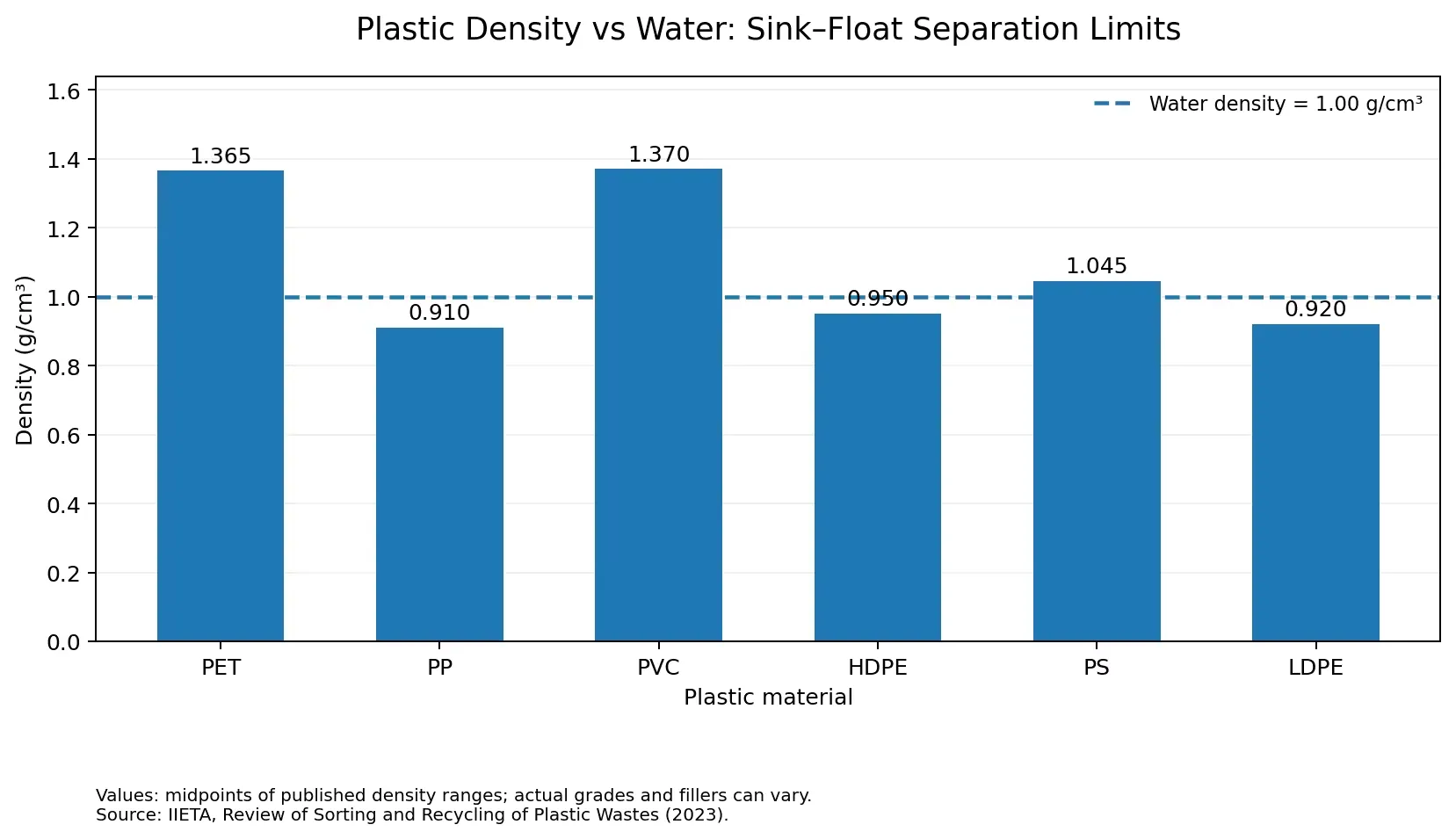
A PET flake sinks at about 1.38 g/cm³ while PP and PE caps float near 0.90–0.96 g/cm³ — that gap of roughly 0.4 g/cm³ is the whole reason a sink-float separation tank sorts a PET stream at all, and sizing the tank wrong throws that physics away. Size it too small and clean PET drags caps down with it.
Size it too big and you pay for water, floor space and energy you never recover.
This guide is for buyers specifying a sink-float tank for a PET washing line, not for readers wanting a general recycling primer. The goal is narrow: translate your throughput and feed data into tank dimensions a vendor can actually quote. If you first need to see where this step sits in the broader PET washing line layout, start there and come back.
At a glance
- Density separation: PET flakes (~1.38 g/cm³) sink in water, while PP/PE caps and most compatible label films (~0.90–0.96 g/cm³) float.
- Key sizing inputs: Target throughput (kg/h), flake size, bulk density, and incoming contamination level.
- Residence time: No universal value applies. Required separation time depends on flake characteristics, contamination, water flow, and agitation.
- Working volume: Use the effective water-filled separation volume rather than the total tank shell volume, accounting for freeboard and internal components.
- Throughput factors: Water surface area and flow affect floating contaminant removal, while discharge auger capacity limits the removal of sinking PET flakes.
- Tank layouts: Single-row tanks provide a simpler layout, while triple-row designs can extend the effective separation path within a limited floor footprint.
How a Sink-Float Tank Separates PET From Caps and Labels
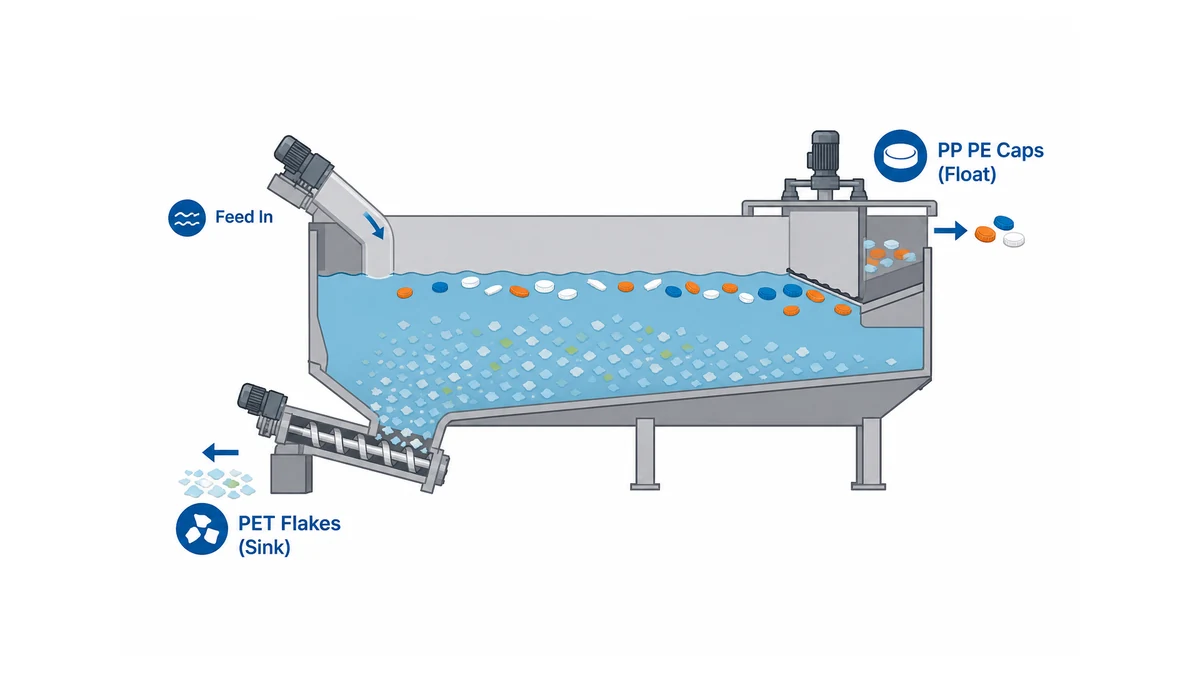
A sink-float tank is a water-filled basin where shredded PET flakes meet a liquid tuned to a specific density. Heavier PET sinks; lighter plastics float. The method is called density separation, and for PET it is the cheapest, most reliable way to pull mixed contaminants out of the stream before drying.
Why PET Sinks and PP/PE Floats
Plain water sits at 1.00 g/cm³. PET lands above it, so PET flakes sink. Polypropylene and polyethylene — the plastics used for bottle caps, cap rings and most label films — sit below water, so they float. The tank uses that split directly, with the float-sink boundary being water’s own density.
🔍 Worth checking: Ask the vendor whether the tank is designed for plain-water density or a brine-adjusted density. Most PET lines run on plain water; if a supplier quotes salt dosing, question why.
Where the Tank Sits in the Wash Line
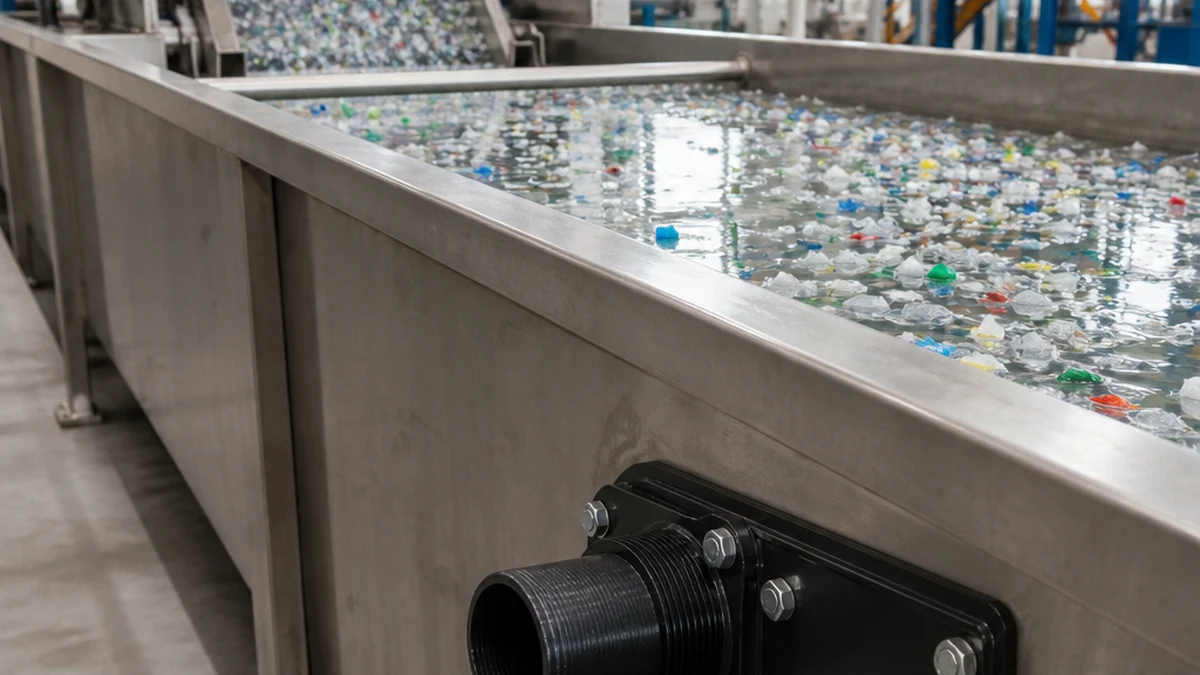
The sink-float tank comes after crushing and a hot or friction pre-wash, and before the final rinse and flake drying stage. By the time flakes reach it, they should already be loose, roughly uniform and mostly label-free, making upstream label removal an important factor in the incoming contamination load. The tank is the cleanup step that removes the last floating contaminants PET would otherwise carry into drying.
How Tank Size Affects Separation Performance
Tank size is not a comfort spec — it directly controls whether separation is clean or sloppy. An undersized sink-float tank crowds flakes together before they have time to sort. PET that has not fully sunk rides over the weir with the floaters; caps that have not surfaced get augered out with the clean PET.
You lose material in both directions.
An oversized tank fails differently. It separates fine, but you pay for it: more water to heat and treat, more floor space, slower flake velocity that can let waterlogged flakes stall, and a bigger pump bill. The right size is the smallest tank that still gives every flake enough time and surface to reach its correct layer at your real throughput.
Buyers often oversize “to be safe” — counterintuitively, the safer move is to size for measured feed with a modest margin, not to double the volume.
The Inputs You Need Before Sizing a Sink-Float Tank
You cannot size a tank from a catalog number. Three pieces of feed data drive every dimension, and a vendor who skips them is guessing.
Target Throughput in kg per Hour
Everything scales from throughput. A line running 500 kg/h of flakes needs far less tank than one at 2,000 kg/h. State your target in kg/h of PET flakes entering the tank — not bottles per hour, and not annual tonnage. If you need to establish that figure from your incoming bottle feed, calculate the PET washing line capacity after accounting for material losses. If the line is rated to 1,000 kg/h but you typically feed 700, size for the realistic 700 with headroom, not the nameplate.
Flake Size and Bulk Density Range
Flake geometry changes how fast material sinks and how it packs. A 12 mm flake behaves differently from a 6 mm flake in the same water. Report your post-crusher flake size range and your flake bulk density — the as-poured density of loose flakes in a container, well under the solid polymer value because of all the air gaps.
Keep bulk density and solid polymer density separate in your head. The 1.38 g/cm³ figure decides whether a flake sinks. Bulk density only tells you how much volume a given mass of loose flakes occupies — a conveyor and hopper number, not the one governing float-sink behavior.
Contamination Level in Incoming Feed
Dirtier feed needs more tank. If 15% of incoming mass is caps, label film and fines, the tank must handle a larger floating load and give stubborn pieces more time to separate. Clean, pre-sorted feed can run through a smaller tank. Give your vendor the contamination percentage your material yard actually shows, not the brochure ideal.
Calculating Tank Volume and Residence Time
The amount of PET flakes present in the tank can be estimated from the material throughput and average residence time:
In-process flake mass (kg) = Throughput (kg/h) × Residence time (s) ÷ 3,600.
This estimates the mass of flakes in the tank at steady state, not the required working water volume. Final tank dimensions must account for separation performance, water flow, floating contaminants, discharge capacity, and internal tank configuration.
Residence Time and Material Flow
Residence time is how long a flake spends in the tank before it exits. Enough time lets PET settle and caps surface; too little and separation is incomplete. There is no published industry standard here — targets vary line to line, trending longer with heavy contamination, waterlogged flakes or large flake size. Treat any number a vendor gives as a starting band to confirm against your material.
Residence time depends on the whole flake-and-water system. Flow rate, agitation and auger speed all shift it. A single flake’s density tells you if it sinks, not how long the batch needs.
Working Volume Versus Total Volume
Working volume is the water-filled portion where separation happens. Total tank volume is larger, because you need freeboard above the waterline, space for the overflow weir, and room for the discharge auger. Size your calculation around working volume; the fabricated shell will always be bigger.
Vendors differ on how much freeboard and weir geometry they build in, so ask for both numbers — otherwise you compare one supplier’s working volume against another’s total.
✅ Do this: When comparing two quotes, confirm both state working volume, not total shell volume. Mismatched definitions make the smaller tank look like a bargain until it under-separates.
Sizing the Water Surface Area and Flow Rate
Volume governs sinkers; surface area and flow govern floaters. Caps and label film only leave the tank by riding the water surface to the weir, so the top of the tank is its own sizing problem.
Surface Area per Hourly Load
The water surface has to be wide enough that the floating load spreads out instead of piling into a mat. A thick raft of caps and film traps PET flakes underneath and refuses to skim cleanly. More hourly load, or dirtier feed, means more surface area.
For a given throughput, a long, relatively narrow tank gives floaters a longer travel path to the weir than a short square one — one reason PET recycling lines favour elongated float sections.
Water Flow and Overflow Velocity
A gentle current carries floaters toward the skimming weir and over it. Flow that is too slow lets contaminants stall; too fast drags unsettled PET over with the caps. Overflow velocity at the weir is the number to watch — it should move floaters without pulling sinkers. That is why flow rate and surface area are sized together, not in isolation from the working-volume math.
Inside the Tank: Augers, Weirs and Multi-Row Builds
Two tanks with the same volume can perform very differently depending on internal layout and discharge gear.
The internals decide how reliably sorted material actually leaves the tank.
Single-Row Versus Triple-Row Layouts
Row count is how you buy float-path length without buying floor length. A single-row tank is simplest and fits small lines. A triple-row build folds the material path back on itself, so flakes travel a longer effective distance for the same footprint — useful density separation gain where floor space is tight.
| Layout | Best for | Trade-off |
|---|---|---|
| Single-row | Low throughput, limited budget | Shortest float path for its length |
| Triple-row | High throughput, tight floor space | Longest effective path, higher build cost |
Discharge Augers and Skimming Weirs
The discharge auger drags sunk PET along the tank bottom and lifts it out dewatered. Its capacity has to match throughput — an undersized auger becomes the bottleneck even if the tank volume is perfect. The skimming weir, or paddle skimmer, pushes floating caps and film over the overflow edge. Together they move sorted material out: PET out the bottom, contaminants over the top.
Matching Tank Capacity to the Rest of the PET Line
Its throughput must match the crusher and pre-wash feeding it and the dewatering and drying taking its output. If the tank processes 1,000 kg/h but the dryer downstream handles 700, the tank backs up or the dryer floods. Size it to the same realistic kg/h the rest of the plastic recycling line is built around.
The failure buyers hit most is matching the tank to the crusher’s peak rate instead of the line’s sustained rate. A crusher may spike, but the sink-float stage needs steady, buffered feed. Confirm rated capacity against the sustained throughput of upstream washing and downstream drying — not against any single machine’s maximum.
✅ Do this: Before signing, ask the factory for a single kg/h figure the whole line is balanced around, and verify the tank’s rated capacity meets it with modest margin.
Tank Installation Space and Layout Requirements
The footprint on your floor plan is more than the tank’s shell. You need clearance to reach the discharge auger drive, the weir, and the inlet and overflow plumbing. Leave walking space on at least one long side for cleaning and inspection, plus overhead room if the auger lifts flakes upward out of the tank.
Account for the filled weight and water load on the floor slab, and plan a drain route for maintenance emptying. Inlet, overflow and sludge drainage all need connection points where your utilities already run. Position the tank so its inlet lines up with the pre-wash discharge and its PET outlet feeds dewatering directly — a straight material path beats an elegant plan that forces extra conveyors.
🚫 Avoid: Specifying tank dimensions from the shell alone. A tank that fits the footprint but leaves no auger-access clearance forces awkward retrofits and slows every cleanout.
Specifying the Right Tank for Your Line
Before any deposit, get these in writing:
- A single sustained kg/h the whole line is balanced around.
- Whether quoted volumes are working or total shell volume.
- Flake size range, bulk density and realistic contamination % reflected in the sizing.
- Discharge auger and weir capacity matched to that throughput.
- Footprint that includes auger-access and inspection clearance, not just the shell.
Lock those answers down and the physics does the rest — PET down, contaminants up, at the rate your line was built to run.
Have a project or a spec sheet in hand? Talk to elantmachine.com — real engineers answer.
FAQ
Can a sink-float tank remove PVC contamination from PET flakes?
No. Both PET and PVC are denser than water, so they generally sink together in a conventional sink-float tank. PVC contamination requires additional sorting, such as optical sorting before crushing or suitable flake-sorting equipment. Increasing tank size alone will not solve the problem.
Can a sink-float tank separate PP from PE?
No. Both polypropylene (PP) and polyethylene (PE) typically float in water, so a standard sink-float tank cannot reliably separate them from each other. The tank is more suitable for separating floating PP/PE contaminants from sinking PET flakes.
Does a PET sink-float tank need salt water for separation?
No. Standard PET sink-float separation generally uses plain water because PET sinks while PP and PE float. Adding salt changes the liquid density but is unnecessary for this common separation. Any modified separation medium should be selected based on the actual materials being processed.
Sources
[1] Polyethylene Terephthalate (Pet) — shobeirshimi.com
[2] Plastic Material Density Chart | PDF — id.scribd.com
[3] Float Sink Tank – Plastic Separation — prsi.com
[4] PET Bottle Washing Line Manufacturer — plasticwashingmachine.net
[5] Plastic PET Bottles Washing and Pelletizing line — torontech.com
[6] Material Density and Processing Temperatures | PDF — scribd.com