
A rigid plastic washing line is often priced as a single sticker number, as if one quote covers every buyer the same way. It doesn’t. The same throughput target can swing the equipment budget widely once you factor in build quality, the number of washing stages, and how dry you need the finished flakes.
The honest version: the machine price is the floor, and your feedstock decides how far above it you land.
We’re Elant Machine, and we build rigid plastic washing line systems for recyclers. This guide breaks the cost into the four levers that actually move it — construction, capacity, washing stages, and drying — so you can read a quote the way an engineer configures one.
If you handle clear bottle bales, the logic shifts again toward a dedicated PET bottle washing line, and if your stream is film rather than rigid, a plastic film recycling washing line changes the configuration more than the price math.
Here’s the short version: for HDPE/PP rigid plastics in the 1,100 lbs/hr to 4,400 lbs/hr range (roughly 0.5–2 metric t/h), prioritize a well-sized crusher, adequate hot and cold washing, and a drying stage matched to your flake moisture target. Expect price to track capacity and washing-stage count more than any single component.
At a glance: what moves the cost
- Capacity tiers that change the quote: ~660–1,100 lbs/hr (small), 1,100–2,200 lbs/hr (mid), 2,200–6,600 lbs/hr (large) — larger tiers need bigger motors, tanks and conveyors.
- Washing stages that add cost: pre-wash/crushing, hot washing tanks, cold washing, friction scrubbing, float-sink separation.
- Drying options: mechanical dewatering (centrifugal dryer) → optional thermal drying for lower residual moisture.
- Target flake moisture: downstream pelletizing generally wants low residual moisture, especially for a non-vented extruder; the drier the spec, the more drying equipment you buy.
- Material scope here: HDPE and PP rigid plastics — bottles, drums, buckets, crates.
- Cost beyond the machine: water, power, consumables, spare wear parts, installation and commissioning.
A full rigid line is not a cheap purchase, and nobody should pretend otherwise. Published equipment listings and recycler case studies put complete, mid-tier HDPE/PP wash lines in a wide price band once drying and water handling are included — a span wide enough that two “mid-tier” quotes can differ by a factor of two. That spread is exactly what the rest of this article explains.
🔍 Worth checking: The scariest quote is not the highest — it’s the lowball. A number far below the band usually means thin steel, no water treatment, or a drying stage that quietly got left off the scope.
What Drives the Base Price of a Rigid Plastic Washing Line
Before capacity or stage count enters the math, the construction of the line sets a baseline. This section is about that baseline — capacity, stages and drying get their own sections below.
Build Quality and Machine Construction
The frame, tank walls, welds and bearing housings decide how long a washing line survives abrasive, wet, around-the-clock service. Elant builds wash tanks and screw conveyors from 304-grade stainless in the wet zones, with the gauge stepped up on the larger-capacity frames so the tank walls don’t flex under a full load of flakes and water.
A heavier gauge tank costs more up front and far less over a decade of running.
Thin tanks flex. Welds crack at seams. Water finds every weak joint.
The base price difference between a light build and a service-grade build is real, and it shows up again later as either low maintenance or constant downtime.
🔍 Worth checking: Ask for the steel gauge of tank walls and the bearing brand on rotating equipment before comparing two quotes. A cheaper line is often cheaper there.
Material Grade and Wear Components
Wet plastic recycling is corrosive. Any surface touching water, caustic residue or wet flakes should be stainless steel — tanks, screw conveyors, scrubbing screens. Carbon steel in those zones rusts, stains the product, and gets replaced.
Wear parts carry their own cost logic. Crusher blades, scrubber screens and screw flights abrade with every ton. A quote that uses hardened wear components costs more and spreads the cost of ownership across more tons before replacement.
Automation and Control Level
A manual line with basic starters is cheaper than one with a PLC, variable-speed drives and level sensors on the tanks. The automation premium buys steadier output, less operator dependence, and tighter control over water and power.
For a single-shift plant, light automation may be enough. For continuous running, the control package pays back in consistency. Automation is a line item you choose, not a fixed cost.
Matching Line Capacity to Your Feedstock Volume
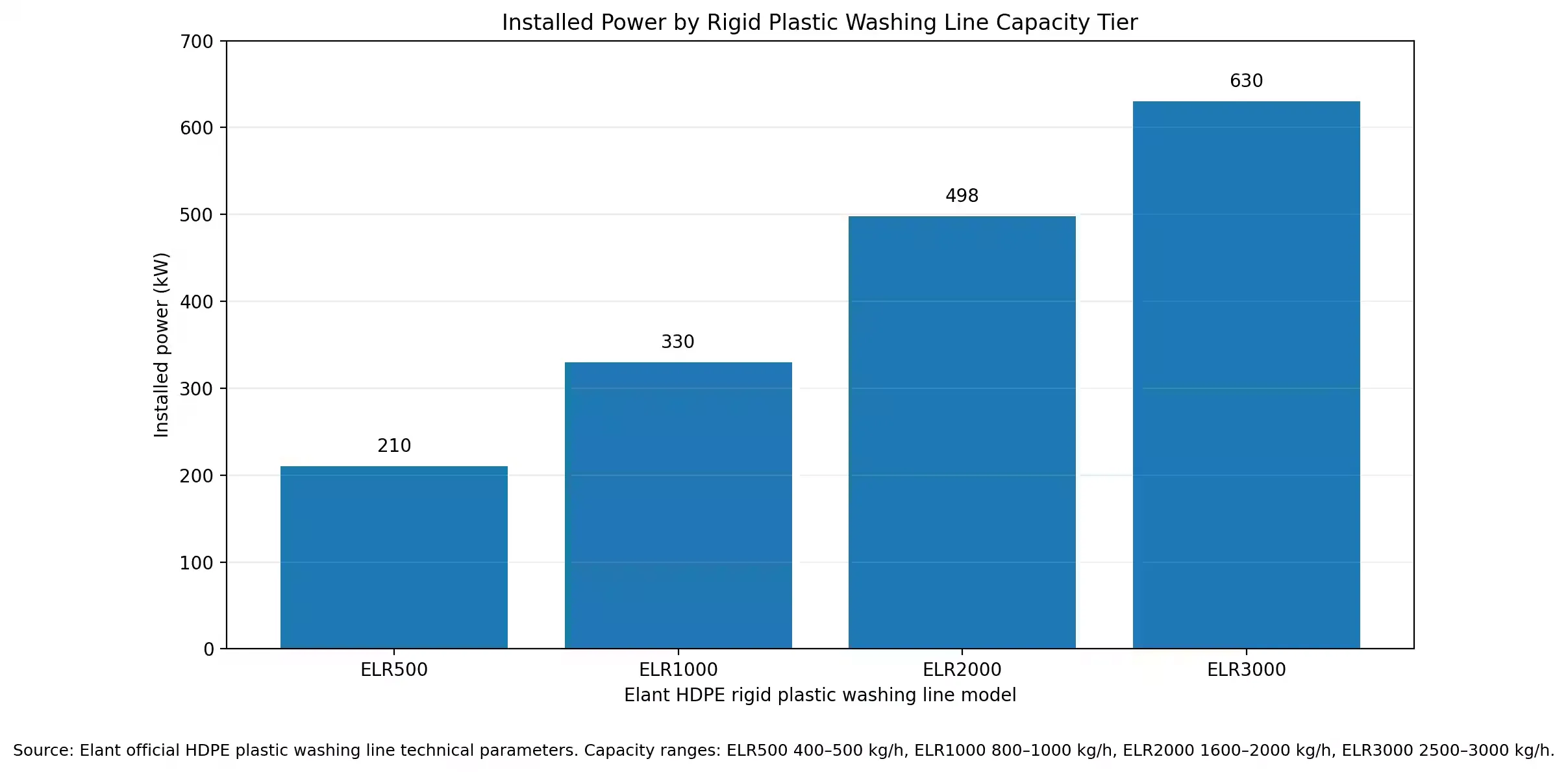
Capacity is the single biggest driver of total line cost. More throughput means bigger crushers, larger washing tanks, higher-power motors and wider conveyors — the whole system scales, not one box.
Common Capacity Ranges and Their Price Effect
Rigid plastic washing lines are commonly sold in throughput bands. The jump between bands is where the price steps up.
| Capacity band | Typical output | What scales up | Relative cost |
|---|---|---|---|
| Small | ~660–1,100 lbs/hr | compact crusher, smaller tanks | lowest |
| Mid | 1,100–2,200 lbs/hr | larger scrubber, bigger float tank | moderate |
| Large | 2,200–6,600 lbs/hr | high-power motors, wide conveyors, bigger dryer | highest |
The cost doesn’t rise in a straight line. Doubling throughput often means a bigger dryer and more water handling, so the increment between mid and large is usually steeper than between small and mid.
Sizing for Current Production Volume
Size the line to the feedstock you actually have, in short tons per month, divided across realistic operating hours. The EPA’s recycling data is worth reviewing, but national plastics recycling rates vary by source and definition — confirm the current figure with the EPA or the relevant authority before relying on it, since secure, steady feedstock is harder to lock down than most first-time buyers assume.
A line sized for a number you hope to hit later runs half-empty today — and half-empty still draws power and water.
Over-buying capacity is a common and expensive mistake. The washing line should match the slowest-sustainable supply of material you can secure, not the peak week.
✅ Do this: Calculate required lbs/hr from your monthly tonnage and real running hours before you ask for a quote. “I need about 1,800 lbs/hr on single shift” gets a far better configuration than “a big line.”
Allowing Capacity for Future Expansion
There’s a middle path between buying only for today and over-buying. Specify a line whose tanks and conveyors can accept a larger crusher or an added scrubbing stage later, without replacing the whole system.
Modular design costs a little more at purchase. It costs far less than scrapping an undersized line in two years. Ask whether the frame and layout leave room for a bolt-on stage.
Washing Stages and How Each Affects the Price
Each washing stage is a piece of equipment with its own motor, tank and footprint. Add a stage, add cost. The washing stages you choose depend on how dirty your rigid plastics are.
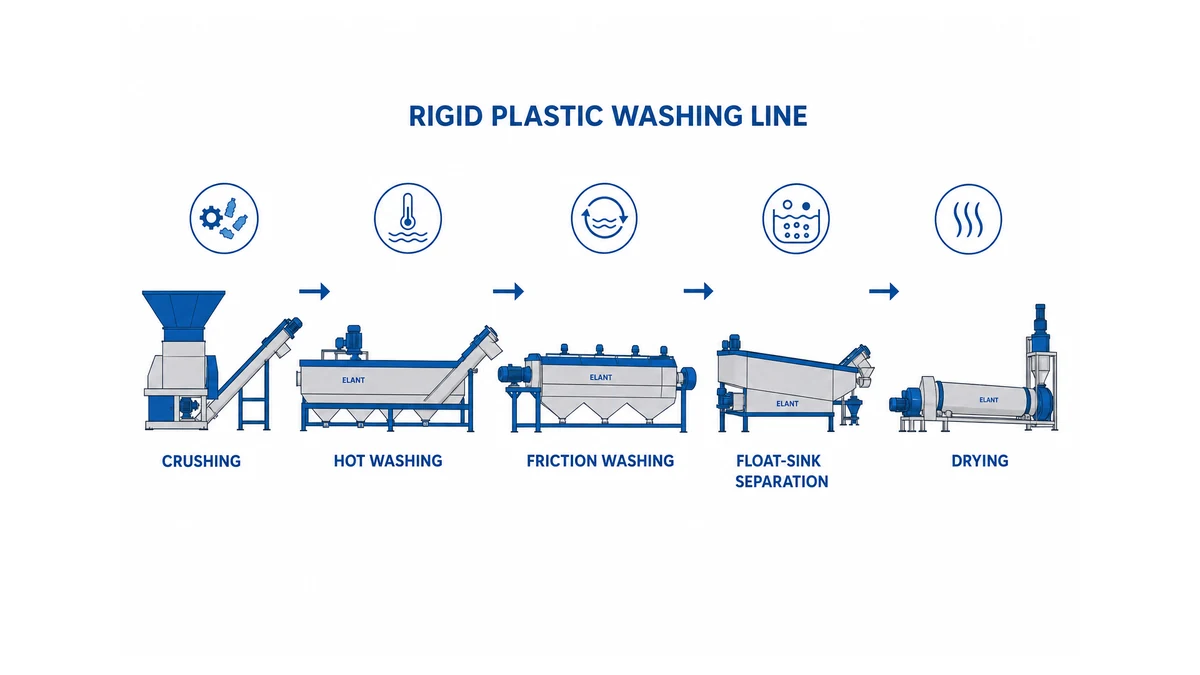
How a rigid plastic washing line works, stage by stage
Walk the material through once and the cost structure makes sense. Rigid scrap enters a pre-wash and crusher, moves through hot and cold washing tanks, gets scrubbed, splits by density in a float-sink tank, then dewaters and dries. Each handoff is a separate machine.
The sequence matters as much as the parts. Grit removed early protects the blades and screens downstream; a stage skipped at the front shows up as faster wear at the back. That is why a line that looks over-specified on paper can be cheaper to run than a stripped one.
Pre-Washing and Crushing
Material usually enters through pre-washing and a crusher. Pre-washing knocks off loose dirt and stones before they hit the crusher blades; the crusher reduces drums, buckets and crates to flakes sized for the rest of the line.
Crusher size scales with capacity, and blade grade affects both price and wear cost. Skipping a dedicated pre-wash saves money but pushes more grit downstream, wearing every stage faster.
Hot and Cold Washing Tanks
Hot washing tanks lift greasy residue and soften stubborn contamination; cold washing rinses and cools. A hot wash tank adds a heating system and the energy to run it — a meaningful line item.
Not every feedstock needs hot washing. Clean HDPE buckets may run on cold washing alone, while greasy drums justify the hot stage. The honest trade-off: hot washing raises both the equipment price and the running power bill, so specify it only if your contamination demands it.
Friction Washing and Float-Sink Separation
A high-pressure friction washer scrubs flakes against each other and against screens, stripping off labels, dirt and residue. It’s one of the harder-working stages, and its screens are a recurring wear part.
Float-sink separation uses a water tank to split materials by density. Because HDPE and PP both have densities below water, they float while heavier contaminants sink — which is also why mixing in a sinking resin like PET defeats the separation. For a single clean polyolefin stream this stage may be optional; for mixed input it earns its keep.
Each added separation step is more tank, more water, more cost.
Drying Systems and Their Cost Impact
Drying is where the finished flake condition is set, and it’s a frequently under-budgeted part of the line. Wet flakes can’t go straight to good pelletizing. The question is how dry you need them, and how much drying equipment that answer requires.
Centrifugal and Mechanical Dewatering
Most lines start with mechanical dewatering — a centrifugal dryer spins water off the flakes using a high-speed rotor and a screen. It’s energy-efficient relative to heat, and it handles the bulk of free surface moisture.
For many HDPE/PP applications, a well-sized centrifugal dryer alone brings moisture low enough for the next step. It’s the baseline drying stage and the first one to size correctly.
Thermal Drying Equipment
When the flake spec calls for lower residual moisture than spinning alone delivers, a thermal drying stage follows — hot air moving through the flakes to drive off bound moisture. This is the costlier drying path, in both equipment and the power it draws.
Treat drying as a curve. Mechanical dewatering clears the easy free water fast. Then the rate slows as you chase the last bound moisture — and that final stretch is where thermal drying earns its cost. Not every line needs it.
🚫 Avoid: Specifying a thermal dryer “to be safe” without a moisture target. The last few points of moisture are the most expensive to remove — buy them only if your downstream process actually requires them.
Final Moisture Requirements for Recycled Flakes
Your target residual moisture drives the whole drying budget. A pelletizing step with a venting extruder tolerates more moisture than one without; the looser your downstream requirement, the less drying equipment you buy.
Define the moisture spec before you configure drying. Washed HDPE and PP flakes headed to a well-vented extruder often need only centrifugal drying, while a tighter spec pulls in thermal drying and its cost.
Choosing Equipment to Match Your Input Material
Two plants buying the “same” rigid plastic washing line can end up with different configurations because their input material differs. Resin type, physical form and contamination level each change what equipment you actually need.
Identifying resin type and contamination before you buy
Before you spec anything, confirm what you’re actually feeding. Resin identity governs float-sink behavior, and contamination governs stage count. Buyers who assume a bale is “clean HDPE” and discover 15% mixed resin or heavy adhesive after startup end up retrofitting — the costliest way to buy a stage.
The resin identification codes stamped on rigid containers stamped on rigid co) are the first screen: resin type governs whether a flake floats or sinks, so some resins separate out while others belong on a different line — confirm the behavior of your specific resins with the relevant standard or authority before relying on it.
A simple float test in a bucket of water confirms the stream before a dollar is spent on equipment, and a quick survey of label coverage and residue tells you whether hot washing is optional or mandatory.
HDPE and PP Rigid Plastics
HDPE and PP are both polyolefins that float in water, which makes float-sink separation effective for pulling out sinking contaminants. They tolerate washing well and are the core feedstock these rigid lines are built around.
The practical difference is contamination, not chemistry. Post-consumer HDPE drums carry more residue than clean industrial PP crates, and that residue — not the resin — decides whether you need the hot washing stage.
Bottles, Drums, Buckets and Crates
Physical form drives the crusher and feeding system. A thin PET bottle, a thick-walled drum and a stackable crate feed and crush very differently, and the infeed has to handle the bulkiest item you process.
Drums and buckets may need a dedicated pre-cut or ripper ahead of the main crusher; thin-wall bottle streams feed more easily. Spec the infeed to your heaviest, bulkiest input, not the average.
Labels, Dirt and Residue Levels
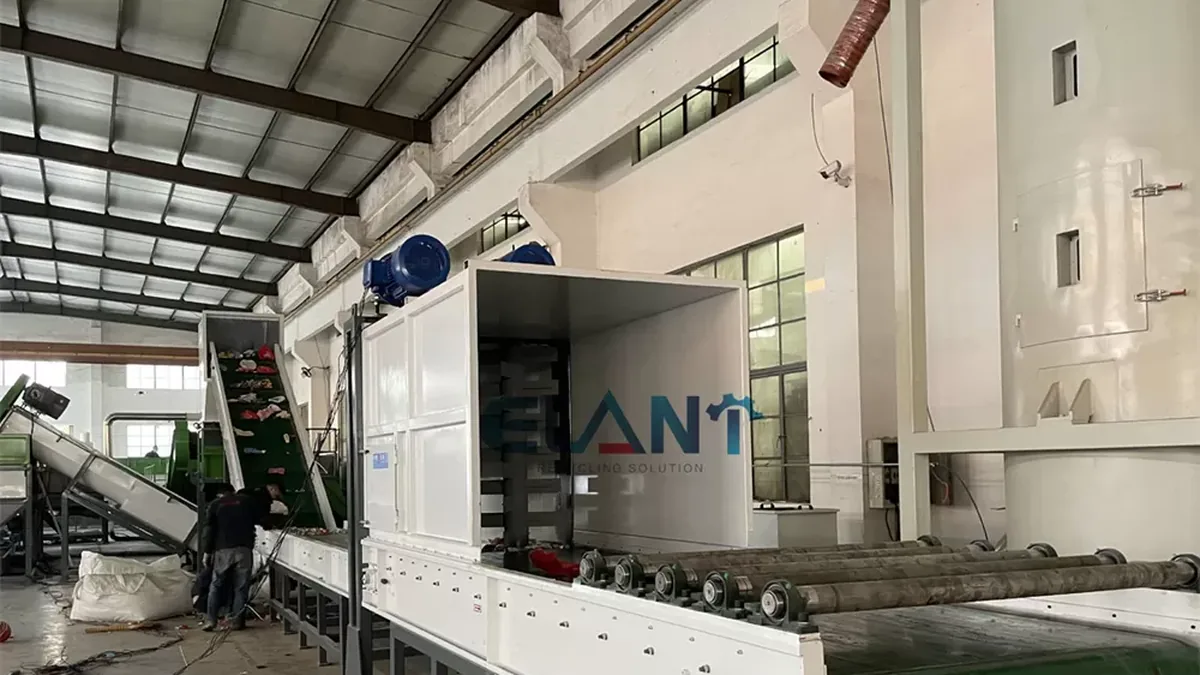
Contamination level is the quiet cost driver. Heavy labels and adhesive demand a strong scrubbing stage; caked dirt argues for pre-washing; greasy or food residue is the main reason to add hot washing.
Clean, source-separated material lets you run a leaner line. The dirtier and more mixed the input, the more washing stages the configuration needs — which loops straight back to the price.
Operating and Installation Costs Beyond the Machine Price
The quote covers the equipment. The budget has to cover running it. These recurring and project-level costs are separate from the purchase price and often decide whether the line is actually affordable.
Water, Power and Consumables
Washing is water-intensive, and power runs every motor, heater and dryer. Larger capacity and more washing stages raise both.
Lines that recirculate and filter wash water cut fresh-water draw, trading a higher purchase price for lower running cost — and depending on your location, an industrial wastewater discharge permit may make water treatment less optional than it looks on a spec sheet, so confirm the applicable requirements with your local or state authority before you plan the line.
Consumables include any detergents or additives your contamination requires. Hot washing and thermal drying are the two biggest energy consumers in the line — worth knowing before you add either.
Maintenance and Spare Parts
Wear parts are the predictable recurring spend. Crusher blades, scrubber screens and screw flights abrade with throughput, and bearings and seals in a wet system need routine attention.
Budget a stock of fast-wearing spares from the start. The real question for a quote is not just price but how available and affordable the wear parts are over the line’s life.
🔍 Worth checking: Ask for a wear-parts list with expected service intervals and unit prices. A low machine price with scarce, costly spares is not a bargain.
Installation and Commissioning
Installation costs include foundations, utility connections for water and power, assembly, alignment, and commissioning. These project-level expenses vary with line capacity, equipment configuration, and site conditions. Larger pre-assembled modules may reduce on-site assembly work, while more complex washing and drying systems can require additional installation time.
Plant layout also affects installation cost. A rigid plastic washing line typically places crushing, washing, separation, dewatering, and drying equipment in sequence, so buyers need enough floor space for both the process flow and service access. Planning water and drainage routes, equipment clearance, and maintenance access before ordering helps avoid costly layout changes after delivery.
Before requesting a final quotation, confirm whether the supplier’s price includes equipment installation guidance, commissioning support, utility requirements, foundations, and any site preparation that must be completed separately.
Have a project or a spec sheet in hand? Talk to elantmachine.com — real engineers answer.
Frequently Asked Questions
Can sink-float separation separate HDPE from PP flakes?
No. HDPE and PP both have densities below water, so both materials normally float in a conventional sink-float tank. The tank is more useful for removing heavier contaminants such as PET, PVC, glass, or metal-linked material. If a recycler needs to separate HDPE from PP, additional sorting or downstream separation methods are required rather than relying on water density alone.
Can a rigid plastic washing line process LDPE film on the same equipment?
Usually not efficiently. Rigid HDPE and PP need stronger shredding or granulation and are commonly dried with centrifugal dewatering, while LDPE film behaves differently during feeding, washing, and moisture removal and often requires film-specific squeezing or drying equipment. A line designed mainly for rigid bottles, drums, buckets, and crates should not be treated as a direct replacement for a film washing line.
Can washed HDPE and PP flakes go directly to pelletizing after drying?
Yes, provided the flakes meet the moisture and contamination limits required by the downstream pelletizing system. Rigid washing lines are commonly configured to produce clean, dried HDPE or PP flakes for pelletizing, extrusion, compounding, or direct reuse. Buyers should therefore define the downstream process before setting the final drying and separation requirements for the washing line.
Do HDPE drums need a shredder before the crusher?
Often yes for large or thick-walled drums. Bottles and smaller containers may feed directly into a wet granulator, while bulky chemical drums, IBC-type containers, and heavy rigid parts often need a low-speed shredder or other primary size-reduction stage before granulation. This is why the front end of a drum washing line can differ significantly from a bottle washing line even when the downstream washing stages are similar.
Sources
[1] Plastics: Material-Specific Data — epa.gov
[2] ASTM D1505: Density Gradient Polymer Testing Services — infinitalab.com
[3] Resin identification code — ikiwand.com
[4] Standard Practice for Coding Plastic Manufactured Articles… — astm.org
[5] Life cycle assessment of enzymatic poly(ethylene… — pubs.rsc.org
[6] NPDES PERMIT NO. NM0028886 FACT SHEET — epa.gov
[7] Manufacturing | NIST — nist.gov