
Buyers assume the quoted price on a plastic pelletizing machine reflects a comparable, complete system. It rarely does. Two suppliers quoting the same capacity — say, 500 kg/h — can differ by 40–60% (commonly reported by buyers comparing full-line versus extruder-only offers) because one quote covers only the base extruder while the other includes the full recycling line.
The only way to interpret a price correctly is to read what the quote actually contains.
At a Glance: Key Facts About Pelletizing Machine Quotes
| Item | Detail |
|---|---|
| Primary cost drivers | Feedstock condition, throughput, screw configuration, filtration stage, pelletizing method |
| Biggest scope gaps | Pre-processing equipment, degassing, screen changers, pelletizing head type, electrical controls |
| Commercial items often excluded | FOB vs. CIF terms, spare parts, on-site commissioning, operator training |
| U.S. electrical standard | 480V / 60Hz three-phase (confirm this in every quote) |
| Import duty note | Chinese-origin machinery may be subject to U.S. Section 301 tariffs[1] — factor into total landed cost |
| Before requesting a price | Confirm feedstock type, contamination level, target throughput, and pellet application |
| When one quote is cheaper | Ask for a line-item equipment list — omissions, not better engineering, almost always explain the gap |
Plastic Pelletizing Machine Price Depends on the Full Configuration
A single capacity number on a quote tells you almost nothing about what you are actually buying. The plastic pelletizing machine price covers a system — a recycling line assembled from multiple pieces of machinery — and each component in that line carries its own cost. Comparing headline prices without matching the configuration is comparing different products.
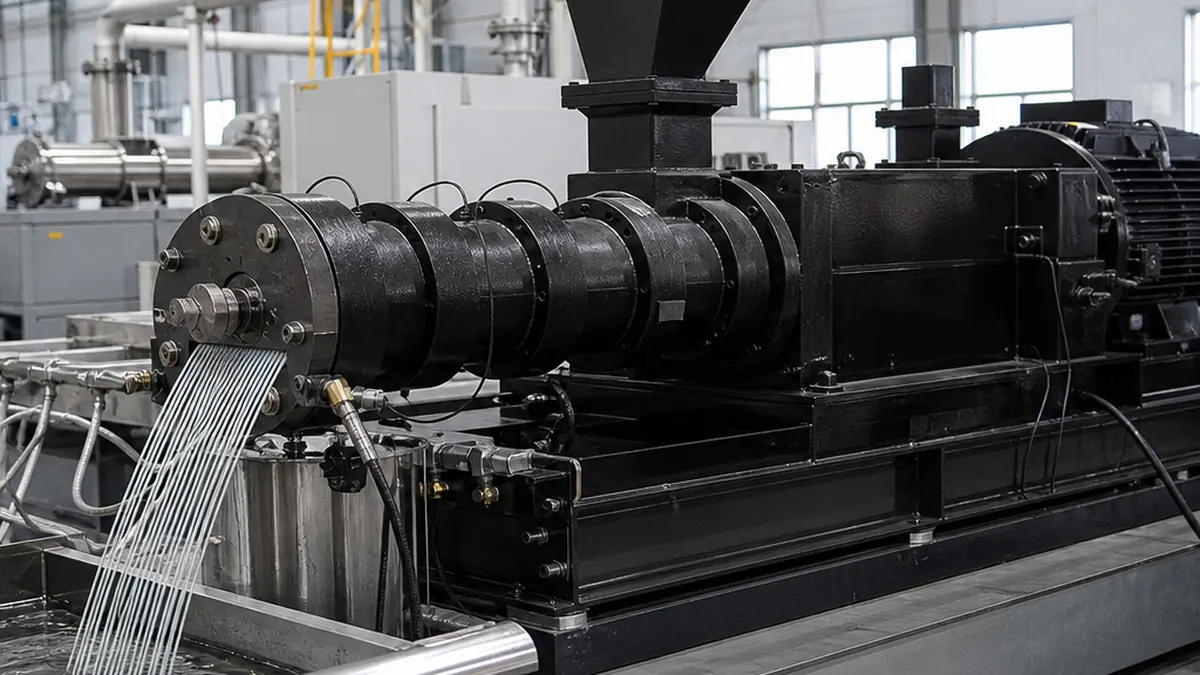
The plastic granulator, the extruder, the screen changer, the pelletizing head, and all upstream and downstream machinery are typically quoted together as a line. A buyer requesting a price for a pelletizer machine is asking for a system quote. That quote can be structured broadly or narrowly depending on what the supplier chooses to include.
🔍 Worth checking: Ask every supplier to list every piece of equipment included in the quoted scope — not just the extruder — before you compare prices.
Why the same rated capacity can have different prices
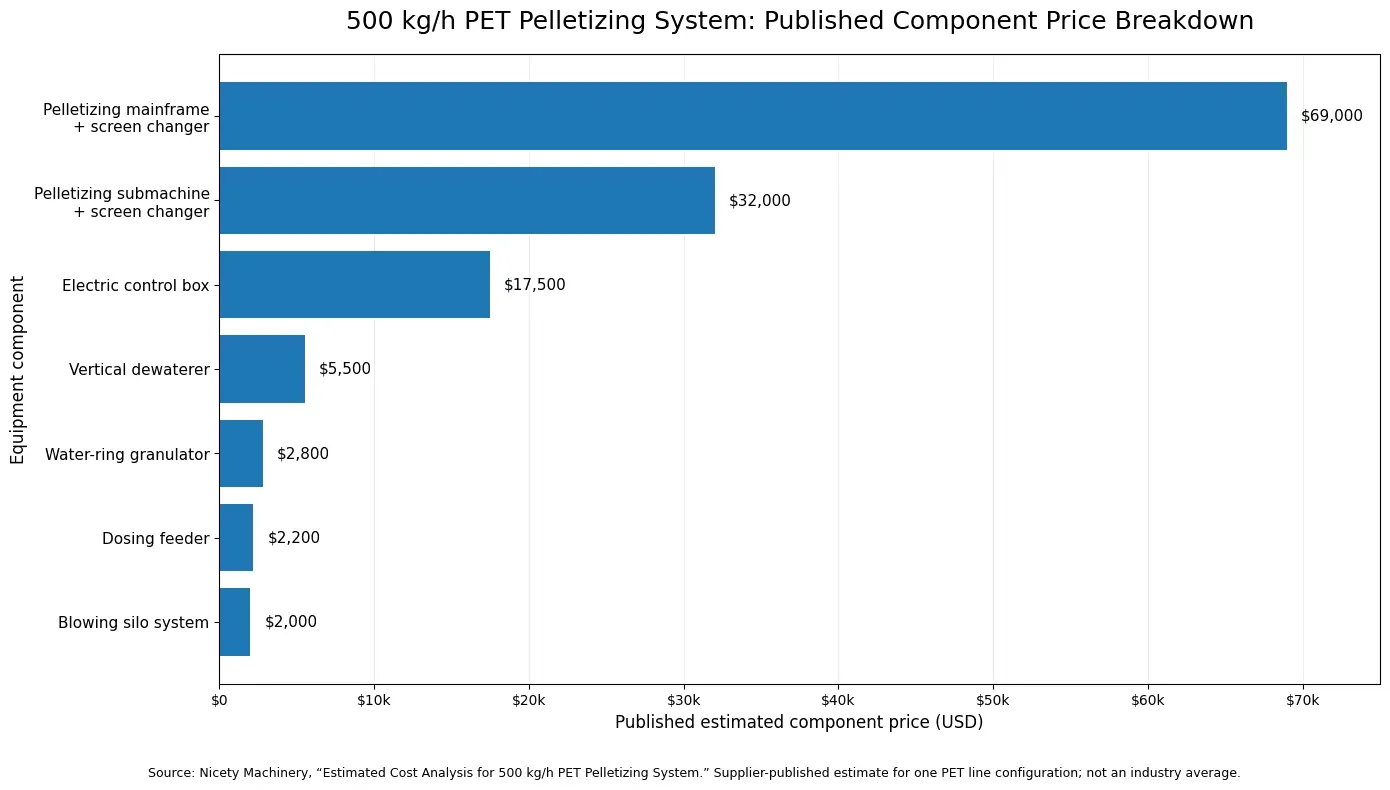
A 500 kg/h plastic pelletizing machine from one manufacturer may include a forced feeder, a 75 kW single-screw extruder, a hydraulic screen changer, a water-ring pelletizing head, a dewatering unit, and a vibrating screener. Another supplier’s 500 kg/h quote may cover only the extruder and pelletizing head, with all upstream and downstream machinery listed as options.
The throughput rating reflects the extruder’s mechanical output under ideal conditions. It does not tell you whether the quoted system can handle your feedstock, meet your pellet quality targets, or run without additional equipment you still need to source separately.
For context, a pellet making machine for sale covers a wide range of configurations. Understanding what is — and is not — in scope is the only reliable starting point for price comparison.
5 Factors That Drive Plastic Pelletizing Machine Price Higher
The technical requirements of your specific application determine how complex — and how expensive — the complete line needs to be. Five areas drive most of the variation in plastic granule machine price between otherwise similar capacity quotes.
1. Feedstock Condition and Required Upstream Machinery
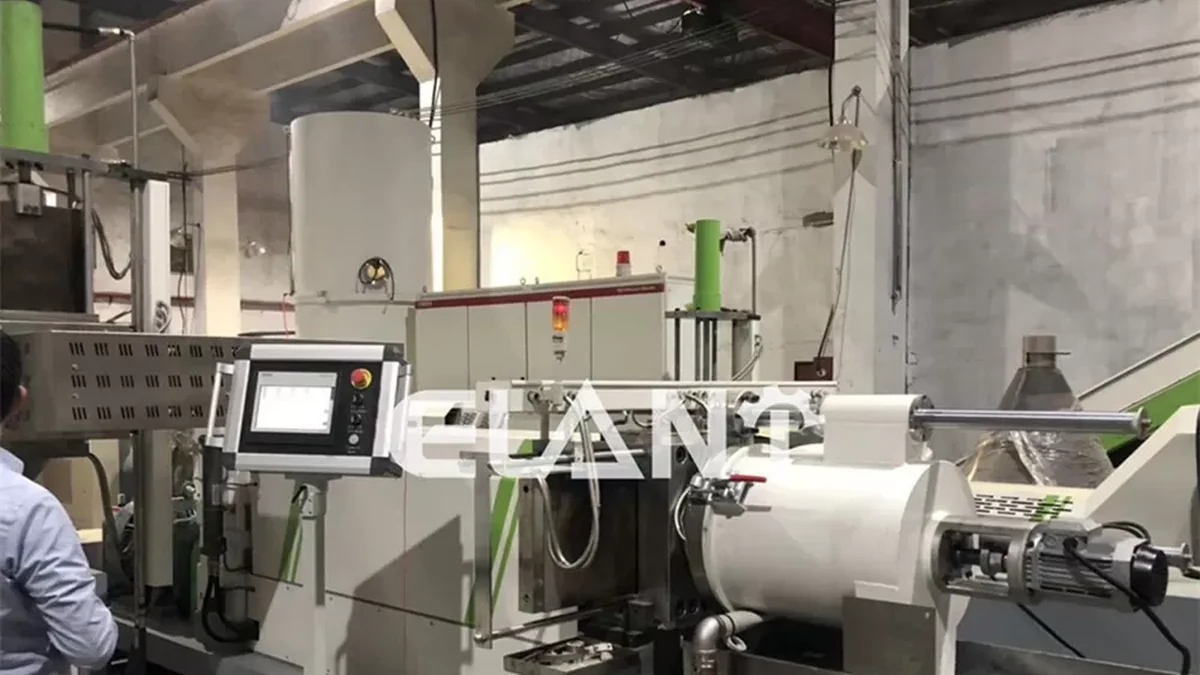
Clean, dry, pre-sorted plastic film processed through a film pelletizer recycling line has a very different equipment requirement than post-consumer mixed rigid plastic containing paper labels, moisture, or cross-contamination. Contaminated or wet feedstock requires pre-washing, drying, and sometimes crushing or shredding before material enters the extruder.
Each piece of upstream machinery — a plastic crusher, a friction washer, a centrifugal dryer — adds directly to system cost. A buyer pricing a plastic pelletizer machine for sale or a new line for clean industrial film will see a substantially shorter equipment list than a buyer processing mixed post-consumer waste. Feedstock condition is the single largest reason two lines with identical rated throughput carry different price tags.
2. Capacity and Extruder Configuration
Throughput scales with screw diameter and drive power. A 65mm single-screw extruder suitable for clean PE or PP film pelletizing typically runs at a lower price point than a 120mm or 150mm extruder required for higher-volume or more viscous materials — a relationship grounded in drive power requirements and barrel manufacturing cost that plastics processing engineers[2] have documented across standard machinery classes.
Where a twin-screw configuration is specified — for materials that need intensive mixing or compounding — the machine price increases considerably over a single-screw line at the same throughput.
Motor size, gearbox rating, and screw L/D ratio are the mechanical specifications that actually set extruder cost. L/D ratios above 33:1 cost more to manufacture and are generally specified only when degassing or extended mixing is required. A quote showing only “500 kg/h capacity” without these specs cannot be meaningfully compared to another.
3. Filtration, Degassing, and Screen Changer Type
The screen changer type — manual, semi-automatic, or fully continuous hydraulic — and the presence or absence of a degassing zone affect both equipment cost and pellet quality. High-contamination or moisture-bearing feedstock requires more aggressive filtration and often a degassing extruder.
A simple manual screen changer costs a fraction of a dual-pillar continuous screen changer, but it requires line shutdowns for screen replacement — a real production cost that doesn’t appear in the equipment price.
4. Pelletizing Method: Water-Ring, Strand, or Underwater
The pelletizing method changes the price more than most buyers anticipate. Underwater pelletizing systems produce uniform, spherical pellets suitable for demanding applications such as engineering compounds and color masterbatch, but their capital cost is significantly higher than water-ring or strand configurations. The Plastics Industry Association[3] notes that underwater systems are generally justified by pellet quality requirements rather than throughput alone.
Here’s the critical trade-off: underwater pelletizing produces superior pellet uniformity, but its higher capital cost is rarely recouped at throughput below roughly 800 kg/h. Buyers at the 500 kg/h level almost always choose water-ring. That’s not a compromise — it’s the right engineering call for the volume.
5. Electrical Controls and PLC Specification
The electrical control panel, motor starters, frequency inverters (VFDs), and PLC control system are significant cost items that suppliers handle very differently. Some include a full Siemens or Allen-Bradley PLC control system as standard; others quote a basic relay panel and present the PLC as an upgrade. For U.S. buyers, the panel must be configured for 480V / 60Hz three-phase supply — not simply “voltage and amperage” — and this localization work carries real cost that an overseas supplier may or may not include.

🚫 Avoid: Accepting a quotation that lists only “extruder + pelletizer” as the scope without confirming whether upstream feedstock handling, screen changer, dewatering, and electrical panel are included.
Machine Types, Price Ranges, and Who Buys Them
Generic capacity comparisons miss the most important pricing variable: machine type. Different plastic recycling machine categories serve different feedstocks, require different configurations, and land at very different price points in the U.S. market. Here is what distinguishes the most commonly quoted types.
Mini and Small-Capacity Granulators (HDPE, ABS, LDPE, PE, EPS, PP)
Small-capacity plastic granulators — typically rated at 50–200 kg/h — are the most price-sensitive segment of the market. These machines are purchased primarily by injection molders reclaiming their own sprues and runners, small recyclers processing a single clean resin stream, or compounders producing specialty batches.
Because the feedstock is usually clean and pre-sorted, the equipment scope is narrow: a single-screw extruder, a water-ring or strand pelletizing head, a basic screen, and a simple relay control panel.
Mini HDPE and LDPE pelletizers processing clean film or bottle flake are among the simplest configurations available. EPS (foam) granulators add a compactor or densifier stage ahead of the extruder to manage the bulk density problem — foam that arrives at 15–20 kg/m³ cannot be fed directly into a standard extruder without collapsing first. That one additional stage meaningfully changes the equipment list and the price.
For this category, U.S. buyers sourcing from Chinese manufacturers should account for Section 301 tariffs[4] in their landed-cost calculation. Depending on the HTS code classification of the specific granulator, tariff rates have ranged from 7.5% to 25% on Chinese-origin plastic processing machinery — a cost that does not appear in a FOB factory quote.
Waste Plastic Film Recycling Machines
Plastic film — LDPE agricultural film, stretch wrap, PE bags — presents a specific processing challenge: low bulk density, high surface moisture after washing, and sensitivity to heat. A waste plastic film recycling machine addresses these constraints with a combination of compactor-feeder or agglomerator technology ahead of the extruder, a vacuum degassing zone to remove moisture and volatiles, and a water-ring pelletizing system.
The agglomerator or compactor stage is the cost differentiator. It densifies incoming film before it reaches the extruder, protecting screw fill and output consistency. Lines without this stage can process clean, dry film adequately, but struggle with post-consumer agricultural film that arrives damp and contaminated.
Buyers processing washed film from a washing line should confirm whether the degassing specification is adequate for residual moisture — a single-stage extruder without degassing will produce bubbled, off-spec pellets from wet feedstock.
Two-Stage Pelletizing Extruders
A two-stage pelletizing extruder combines a first-stage shredder or single-screw plasticizing extruder with a second-stage extruder for filtration, degassing, and final pelletizing. This configuration is used when the material is too contaminated or heterogeneous to run reliably through a conventional single-pass line.
The cost premium over a single-stage line is real and typically justified only when feedstock contamination is high enough that a single-stage line would require frequent manual screen changes or produce inconsistent melt quality. For U.S. recyclers processing mixed post-consumer rigid plastics to meet ASTM D7209[5] or comparable quality specifications for reclaimed resin, the two-stage configuration is frequently the minimum viable process.
500 kg/h Pelletizing Lines
The 500 kg/h segment is the most heavily quoted capacity range in the commercial recycling market. It sits at the intersection of viable processing economics and manageable capital cost — large enough to generate meaningful output volume, small enough that a single operator can manage the line.
At this throughput, a screw diameter of 100–120mm is typical for PE and PP processing. The pelletizing method choice — water-ring versus underwater — has the greatest price impact at this capacity level. A full water-ring line at 500 kg/h is achievable at a significantly lower capital cost than an underwater system of equivalent output.
As noted above, the pellet uniformity advantage of underwater pelletizing is rarely worth the capital premium at this throughput for standard recycled resin production. CIF pricing to a U.S. West Coast port (Los Angeles or Long Beach) or Gulf Coast port (Houston) adds materially to the FOB factory figure — freight on a full container of recycling machinery from China typically runs in the range of a few thousand dollars, but port handling, customs clearance, and inland delivery to a processing facility add further.
HDPE/PE/PP Reprocessing Lines and PET Granule Lines
HDPE and PP reprocessing lines for bottle flake or rigid regrind are among the most standardized configurations in the market. The feedstock is relatively consistent and the processing requirements are well-established.
PET granule lines are a different matter: PET requires pre-drying (typically to below 50 ppm moisture, per equipment guidance from resin suppliers[6]) and crystallization ahead of pelletizing, and the temperature sensitivity of PET melt requires precise extruder control that adds cost relative to PE or PP lines of similar throughput.
U.S. buyers processing PET for food-contact recycled content should also account for FDA food contact compliance requirements, which affect both the processing specification and the documentation requirements for the line.
Plastic Granule Crusher and Cutting Combinations
Some recycling operations require size reduction — grinding or crushing — of incoming material before granulating, particularly for thick-walled HDPE or PC parts, painted automotive components, or mixed rigid bales. A line combining a plastic crusher with a granulator and a downstream cutting or pelletizing stage handles this in a single pass.
The crusher or grinder specification (rotor diameter, knife configuration, screen size) must match the incoming material’s maximum part size and wall thickness. Undersizing the crusher forces multiple passes or causes bridging and blockages. This upstream specification is frequently under-documented in initial quotes — a flat “crusher included” line item is not a specification.
7 Items Every Complete Pelletizing Machine Quote Must Include
A complete quotation for a plastic pelletizing line should account for every item a buyer needs to start production. Suppliers vary widely in what they include by default.
1–5: Main Processing Equipment
The core equipment list should identify: the extruder (with screw diameter, L/D ratio, and drive power), the pelletizing system type (water-ring, strand, or underwater), the screen changer specification, any degassing unit, and the die head. For waste plastic recycling lines, upstream equipment — shredder, crusher, washing section, drying — should be listed explicitly with model numbers or specifications, not implied.
Each item should carry its own specification, not just a collective capacity rating. A plastic granules machine price quoted as a lump sum without itemized equipment is a scope you cannot verify.
6: Electrical, Control, and Auxiliary Equipment
Auxiliary equipment — pellet conveyors, vibrating screeners, pellet storage, cooling water circulation — is frequently listed as optional. A quote that excludes these items may look cheaper but requires separate sourcing before the line can operate.
7: Commercial Scope, Spare Parts, and Commissioning
A quotation should state the Incoterms[7] (FOB factory, CIF port of destination, or DAP site), warranty period, spare parts package (wear items: screws, barrels, screen meshes), commissioning arrangement (remote guidance vs. on-site engineers), and operator training scope.
A quotation that omits commissioning is not cheaper engineering. It is a narrower commercial offer. These items cost real money to source separately.
How to Compare Plastic Pelletizing Machine Quotes
Two quotations for plastic pelletizing machinery are comparable only when they describe the same technical and commercial scope.
Match the technical scope first
Build a line-item equipment checklist from the more detailed of the two quotes, then ask the second supplier to confirm — in writing — whether each item is included, optional, or excluded. Anything marked optional should be priced separately and added to the base quote before comparison.
| Line Item | Narrow-Scope Quote (Typical Low-Price) | Full-Scope Quote |
|---|---|---|
| Extruder (screw dia., L/D, kW) | ✓ Included | ✓ Included |
| Screen changer type | Manual | Hydraulic continuous |
| Degassing zone | Not included | ✓ Included |
| PLC control system | Basic relay panel | Siemens / Allen-Bradley PLC |
| Upstream crusher / shredder | Excluded (buyer to source) | ✓ Included |
| Pellet dewatering / screener | Excluded | ✓ Included |
| On-site commissioning | FAT only | On-site engineers included |
| Incoterms basis | FOB factory | CIF U.S. port |
| Spare parts package | Not included | Initial wear parts included |
| Operator training | Not included | ✓ Included |
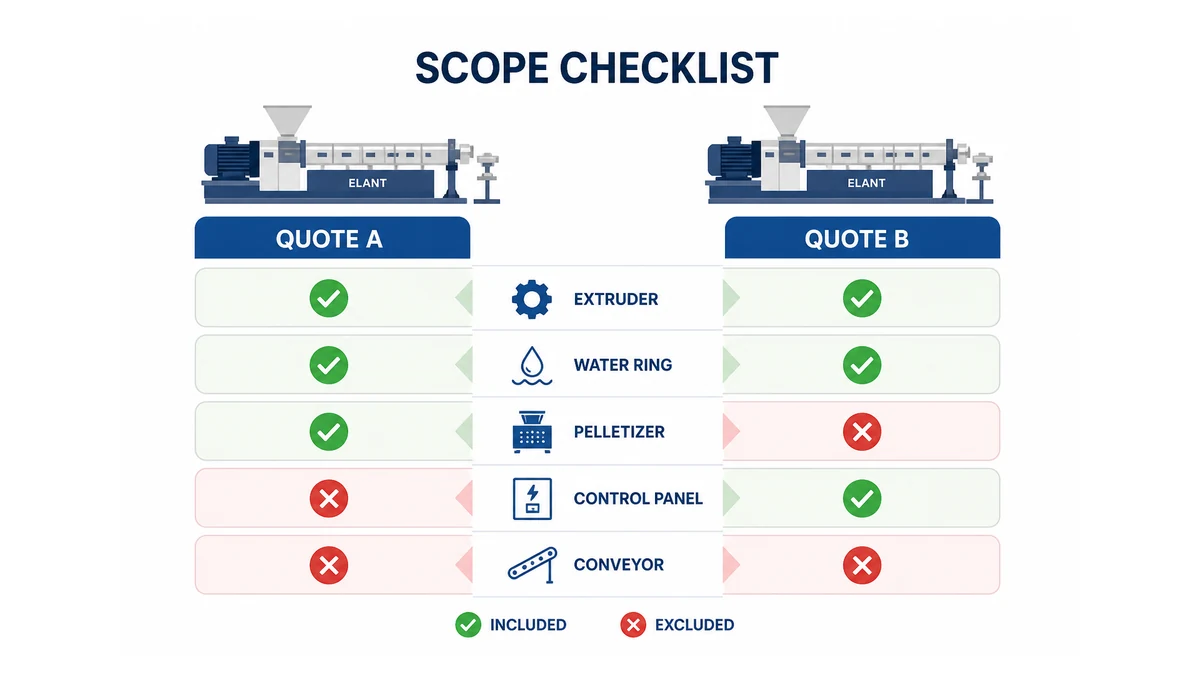
Compare total procurement scope, not only FOB price
FOB factory price is only one part of total landed cost. For Chinese-origin machinery, U.S. Section 301 tariffs apply and can add 7.5–25% to the customs value depending on HTS classification — an amount that does not appear anywhere in a supplier’s FOB quote. Freight, port handling at Los Angeles or Houston, inland delivery, installation labor, and commissioning engineer travel all belong in the comparison.
A counterintuitive reality: a higher-priced full-scope CIF quote from an overseas supplier can represent lower total spend than a lower-priced partial-scope FOB quote, once tariffs, freight, and the cost of locally sourcing excluded equipment are factored in. The FOB sticker is not the comparison point. Total landed cost is.
🔍 Worth checking: Request a CIF price alongside the FOB price. Ask explicitly whether commissioning engineers’ flights and accommodation are included or billed separately.
Why the Cheaper Quote Almost Never Means Better Value
Price differences between quotations for plastic recycling machinery are almost never explained by manufacturing efficiency. The cheaper quote usually reflects a narrower scope, a lower-spec configuration, or assumptions about what the buyer already has on-site.
Commonly Excluded Items in a Lower-Price Quote
The most common exclusions in a lower-price quotation for a plastic granulator or recycling line — based on the scope patterns described above — include: pre-processing equipment assumed to exist on-site; a manual screen changer in place of automatic or hydraulic; a single-stage extruder without degassing for material that requires it; basic relay control in place of PLC; factory acceptance test only with no on-site startup; and no initial spare parts package.
Each exclusion reduces the quote price. None reduces the buyer’s total cost.
✅ Do this: Request a written line-item exclusion list from every supplier. Explicitly excluded items are more reliable than assumed inclusions.
Information to Provide Before Requesting a Price
A supplier cannot prepare an accurate quotation without knowing your project specifics. Vague inquiries produce vague, incomparable prices.
Provide suppliers with at least the following:
- Feedstock type and form: PP film, HDPE bottles, mixed rigid post-consumer waste, EPS foam, or other — and whether it arrives pre-shredded, baled, or loose
- Contamination level: clean industrial scrap, lightly contaminated, or heavily soiled post-consumer material
- Target throughput: in kg/h, with the material specified
- Pellet application: whether output pellets are for direct re-use in your own production or for sale, and any quality requirements (including ASTM recycled resin standards[8] if applicable)
- On-site utilities: available electrical supply — specify 480V / 60Hz three-phase for U.S. installations — water availability and temperature, compressed air
- Quotation scope: complete turnkey line, specific processing sections only, or machinery to integrate with existing equipment
Supplying this upfront moves a quotation from a catalog price to a project-specific offer.
Questions to Ask When One Quote Is Much Cheaper
When one quotation comes in significantly below the others, the gap is almost always explainable. Ask these questions in writing and request written answers:
- Capacity basis: What feedstock type and condition was the throughput rating based on?
- Included equipment: Can you provide a full line-item list of every machine and component?
- Options: What items does a typical buyer add before installation?
- Filtration: What screen changer type is included? What does continuous filtration cost to add?
- Commissioning: Is on-site commissioning included? If not, who bears travel and accommodation cost?
- Spare parts: What wear items ship with the machine? What is lead time on replacement screws, barrels, and screen packs?
- Incoterms: Is this FOB factory, CIF U.S. port, or DAP site? What is the CIF equivalent?
- Warranty: What does the warranty cover — parts only, or parts and labor?
Any supplier that declines to provide a written line-item equipment list is telling you something important about the transparency of the offer.
🚫 Avoid: Comparing total quoted prices before confirming that each quote covers the same feedstock condition, capacity basis, equipment scope, and Incoterms. The comparison is invalid until those variables are aligned.
Evaluate the Full Scope Before the Final Number
Plastic pelletizing machine price is a project-specific number, not a catalog figure. The same stated capacity produces meaningfully different quotes because full equipment scope, feedstock requirements, filtration and pelletizing configuration, and commercial supply terms all vary between suppliers.
Before treating any quote as a reliable basis for a purchase decision, normalize the technical configuration and the commercial scope. Align the feedstock assumption, the complete equipment list, the Incoterms, and the commissioning arrangement. Then — and only then — does the final number tell you something true about price.
Have a project or a spec sheet in hand? Talk to elantmachine.com — real engineers answer.
FAQ
How much power does a plastic pelletizing line use?
Power requirements depend on throughput, screw diameter, feeding system, extrusion stages, pelletizing method, and auxiliary equipment. Buyers should compare total installed power rather than only the main extruder motor, because compactors, screen changers, dewatering units, pumps, conveyors, and cooling systems also consume electricity. Ask the supplier for both installed power and expected operating load for your actual material.
Should I choose a single-screw or twin-screw pelletizing machine?
A single-screw machine is generally suitable for relatively clean and consistent PE, PP, or HDPE feedstock where stable melting and filtration are the main requirements. Twin-screw systems are more appropriate when stronger mixing, dispersion, or devolatilization is required. The correct choice should therefore be based on feedstock condition and pellet specification rather than machine price alone.
Can one plastic pelletizer handle both rigid plastic and film?
Not always with the same configuration. Rigid regrind can normally be fed more directly, while low-bulk-density film often requires a compactor, forced feeder, or other feeding equipment. A supplier claiming one machine can process both should specify what feeding changes, throughput differences, and changeover requirements apply to each material.
How much throughput do I need from a pelletizing line?
Start with the amount of material that must be processed per operating hour rather than choosing a machine only by its advertised maximum capacity. Feedstock density, moisture, contamination, filtration requirements, and planned downtime can all reduce actual output. Ask suppliers to state the material and operating conditions used to establish the quoted kg/h rating.
Sources
[1] China Section 301-Tariff Actions and Exclusion Process — ustr.gov
[2] Optimization and Scale-Up for Polymer Extrusion – PMC – NIH — pmc.ncbi.nlm.nih.gov
[3] A Detailed Explanation of the Three Pelletizing Methods for … — aceretech.com
[4] Section 301 China Tariffs 2026 | Rates, Lists & HTS Codes — ustariffrates.com
[5] Subcommittee D20.95 on Recycled Plastics — astm.org
[6] Energy-Saving Compressed Air Resin Dryers — airbestpractices.com
[7] Incoterms® 2020 – ICC — iccwbo.org
[8] Plastics Standards – Standards Products — store.astm.org