
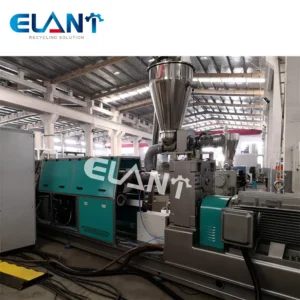
A production line runs clean for four hours, then pressure spikes and contaminated pellets start coming off the die. The operator stops the extruder, pulls the screen pack manually, and loses 40 minutes of output. That scenario is entirely preventable — and understanding the plastic pelletizer screen changer function tells you exactly how.
Quick takeaways
- A screen changer sits between the extruder barrel and the die, filtering molten plastic through a mesh screen pack before pellets are formed.
- Its core job is continuous impurity removal — catching degraded polymer, carbonized material, and solid contaminants that would otherwise damage the die or ruin pellet quality.
- Automatic and hydraulic screen changers allow screen changes without stopping production, maintaining consistent melt pressure.
- Screen mesh size (typically 40–200 mesh in plastic recycling lines) controls the size of impurities that pass through.
- Choosing the wrong changer type for your waste plastic input is the single most common cause of premature screen fouling and unplanned downtime.
Before you start
What you need to understand this guide: – Basic familiarity with a plastic extruder or pelletizing machine setup – Knowledge of your feed material (virgin resin vs. waste plastic vs. recycled plastic regrind) – Access to your machine’s current pressure readings (inlet and outlet melt pressure)
Key terms used throughout: – Screen pack — one or more mesh filter screens stacked in a holder – Breaker plate — the perforated steel plate that supports the screen pack and straightens melt flow – Melt pressure — hydraulic pressure of the plastic melt inside the extruder barrel and changer body
Step 1: Understand Where the Screen Changer Sits in the Pelletizing Line
Why this matters: If you don’t know where in the extrusion process the screen changer operates, you can’t diagnose pressure problems or optimize filter intervals.
The plastic pelletizer screen changer is installed downstream of the extruder barrel and upstream of the die head. In a typical plastic pelletizing machine layout the sequence runs: hopper → extruder barrel → screen changer body → die head → pelletizing cutter.
Molten plastic exits the extruder screw at temperatures between 180 °C and 280 °C depending on resin type. At that point it is under significant melt pressure — commonly 80–200 bar in a production-grade plastic extruder. The melt is forced through the screen pack inside the changer, where mesh screens physically block solid impurities, gel particles, and unmelted chunks before the filtered melt reaches the die.
The breaker plate behind the screen pack does two jobs simultaneously: it bears the mechanical load of the screen under pressure, and it converts the rotational flow from the screw into a straight, uniform flow toward the die. Without a properly supported screen pack, the filter deflects under pressure and passes impurities that compromise product quality.
⚠️ Warning: Running a plastic extruder with a damaged or missing breaker plate is a die-contamination risk. Even brief operation without it can push unfiltered melt directly into the die, requiring a full purge and die cleaning before production resumes.
Common mistake: Teams measure only outlet pressure and ignore inlet melt pressure. The differential between inlet and outlet is what tells you when the screen is actually loaded with impurities — not the absolute outlet number alone.
Step 2: Identify the Type of Screen Changer on Your Machine
Why this matters: The screen changer type dictates whether screen changes require a production stop, and how well the machine handles variable-contamination waste plastic feeds.
There are four configurations you’ll encounter on plastic recycling and pelletizing machines in the U.S. market:
| Changer Type | Screen Change Method | Production Stop Required? | Best Fit Feed Material |
|---|---|---|---|
| Manual (plate-type) | Operator slides plate by hand | Yes — full stop | Low-contamination virgin or clean regrind |
| Hydraulic single-piston | Hydraulic cylinder shifts one screen carrier | Brief pressure fluctuation | Moderate-contamination recycled plastic |
| Hydraulic double-piston (continuous) | Alternating carriers — one filters while other is changed | No | High-contamination waste plastic (post-consumer) |
| Backflush / backwash | Reverse-flow cleans screen in-place | No | Lightly contaminated melt, semi-automatic lines |
We see the hydraulic double-piston style most frequently specified on high-throughput plastic recycling lines processing post-consumer waste — HDPE bottles, PP film regrind, mixed polyolefin bales. The reason is simple math: a manual screen change on a 500 kg/h pelletizing line costs roughly 40 minutes of output per change. At 8–12 changes per shift on heavily contaminated feedstock, that’s over 6 hours of lost granulation production daily.
Common mistake: Buyers select changer type based on purchase price, not contamination load. A $4,000 manual changer on a post-consumer waste plastic line will cost more in downtime within 90 days than the price difference versus an automatic unit.
Step 3: Select the Correct Screen Pack Mesh for Your Plastic Feed
Why this matters: Mesh selection is the variable that directly controls product quality — too coarse and impurities pass through; too fine and the screen loads in minutes, spiking melt pressure and triggering premature changes.
Mesh count refers to the number of openings per linear inch. Common mesh sizes used in plastic pelletizing and recycling applications:
| Mesh Count | Opening Size (microns) | Typical Application |
|---|---|---|
| 20–40 mesh | 425–850 µm | Coarse pre-filter, high-impurity waste plastic |
| 60–80 mesh | 180–250 µm | Standard recycled plastic pelletizing |
| 100–120 mesh | 125–150 µm | Engineering resins, food-contact recycled plastic |
| 150–200 mesh | 75–105 µm | High-clarity applications, optical-grade products |
On most plastic recycling lines, a two- or three-layer screen pack is used: a coarse support screen (20–40 mesh) on the breaker plate side, a fine filter screen (80–120 mesh) in the middle, and a second coarse screen on the melt-inlet side. This sandwich configuration extends screen life by pre-catching large impurities before they load the fine filter layer.

| Item | Value |
|---|---|
| 40mesh | 8.5 |
| 80mesh | 4.2 |
| 120mesh | 1.8 |
| 200mesh | 0.6 |
| Mesh Count | Avg. Hours Between Changes (5% contamination feed) |
|---|---|
| 40 mesh | 8.5 h |
| 80 mesh | 4.2 h |
| 120 mesh | 1.8 h |
| 200 mesh | 0.6 h |
💡 Pro tip: If your screen is fouling in under 2 hours consistently, the fix is almost never a different screen changer — it’s moving one mesh step coarser, or adding a pre-filter hopper separator upstream to remove bulk contaminants before the melt stage.
Common mistake: Running a single-layer screen to reduce screen cost. Single-layer screens fail faster under pressure because the fine mesh has no coarse backing and deflects into the breaker plate holes, creating local rupture points and passing unfiltered melt.
How a Plastic Pelletizer Works: The Full Process Context
A plastic pelletizing machine converts raw plastic — whether virgin resin, industrial scrap, or post-consumer waste plastic — into uniform pellets or granules that downstream processors can run reliably. The extruder screw melts and pressurizes the plastic, the screen changer filters the melt, the die forms strands or droplets, and the pelletizing cutter (strand cutter or die-face cutter) sizes the pellets.
The screen changer function sits at the quality control point of this chain. Every contaminant that the screen stops is one that doesn’t cause a die blockage, a strand break, a pellet with visible inclusions, or a downstream processing defect in the recycled plastic product. In high-volume U.S. plastic recycling operations, maintaining consistent melt filtration directly determines whether recycled plastic pellets meet the purity specs that film extruders, injection molders, and blow molders will accept.

The Function of Screen Pack and Breaker Plate Together
The screen pack and breaker plate work as a unit — neither performs correctly without the other. The breaker plate (typically a 40–60 mm thick steel disc with 5–8 mm diameter holes arranged in a radial pattern) bears the full melt pressure load so the wire mesh screen doesn’t have to. This mechanical support allows finer mesh screens to operate at high melt pressures without rupturing.
The breaker plate design standard[1] specifies open area (the ratio of hole area to total plate area) at 30–50% for most plastic extruder applications. Below 30% open area, the plate itself becomes a restriction that raises melt pressure independently of screen pack loading — a detail that confuses many maintenance teams who assume rising pressure always means a dirty screen.
When a screen change is needed, the screen pack (mesh plus support screens) is replaced while the breaker plate stays in the changer body. On automatic screen changers, the hydraulic cylinder slides the carrier holding the screen pack laterally out of the melt flow path in 1–3 seconds, replacing it with a pre-loaded clean carrier on the opposite side. Melt pressure drops briefly (5–15 bar) during the transition, then stabilizes — the production line never stops.
What the Plastic Pelletizing System Handles Beyond Filtration
The screen changer also acts as a melt pressure regulator for the pelletizing system as a whole. Consistent melt pressure at the die directly controls pellet size uniformity. If pressure fluctuates because screens are changed manually and infrequently, strand diameter varies, the cutter produces off-spec pellets, and the recycled plastic pellets may fail bulk density specs required by U.S. buyers.
plastic recycling pelletizing line guide covers how die pressure settings interact with cutter speed to maintain pellet diameter within ±0.2 mm — a tolerance that most U.S. compounders require for gravimetric feeding systems.
📝 Note: On waste plastic lines processing mixed polyolefin (MFI range 0.5–20), melt pressure swings from impurity loading are amplified because viscosity varies batch to batch. An automatic screen changer on these lines isn’t a luxury — it’s how you keep the production line pelletizing within spec at all.
Step 4: Set Your Screen Change Trigger — Pressure Differential, Not Time
Why this matters: Changing screens on a fixed time interval wastes screens and risks missing actual fouling events if contamination loads spike.
The correct trigger for a screen change is differential pressure — the difference between melt pressure measured upstream (before the screen changer) and downstream (after the changer). A clean screen produces a differential of 5–20 bar depending on mesh and throughput rate. When differential pressure reaches 40–60 bar, the screen is loaded and requires replacement.
Set your automatic screen changer’s PLC trigger at the upper threshold for your mesh and throughput combination. Most U.S. suppliers of hydraulic screen changers for plastic extruders include a dual-pressure transducer port in the changer body for exactly this purpose. If your changer body has only one pressure port, you are operating without the data needed to manage screen changes intelligently — a common situation on older manual changers that should be addressed before scaling throughput.
For screen changer sizing and selection guide, the rule of thumb our team uses: size the changer body 25% above your extruder’s maximum output capacity so that at peak throughput the screen still reaches the pressure trigger threshold before the 2-hour minimum interval.
Key Facts at a Glance
| Parameter | Typical Value |
|---|---|
| Screen changer position | Between extruder barrel and die head |
| Typical operating melt pressure | 80–200 bar |
| Common screen mesh range | 40–200 mesh (plastic recycling) |
| Screen change trigger (differential) | 40–60 bar above baseline |
| Hydraulic slide time (automatic) | 1–3 seconds |
| Breaker plate open area | 30–50% of plate face |
| Production stop (automatic changer) | None |
| Screen pack layers (typical) | 2–3 (coarse / fine / coarse) |
Troubleshooting Common Screen Changer Problems
Problem 1: Pressure spike immediately after a screen change Cause: New screen pack installed without pre-warming — cold screen pack creates a localized viscosity increase and temporary blockage. Fix: Pre-heat replacement screen carriers in a temperature-controlled oven at the changer’s operating temperature (±10 °C) for at least 20 minutes before loading into the hydraulic carrier. Every automatic screen changer manual from U.S. suppliers specifies this step; most operators skip it.
Problem 2: Leaking melt at the changer body seam after a slide Cause: Changer body slide surfaces are worn or contaminated with solidified plastic. The carrier no longer seals cleanly against the body face. Fix: Disassemble the changer body, clean slide surfaces with brass scrapers (not steel — to avoid scratching the sealing faces), and inspect for wear marks. If wear depth exceeds 0.05 mm, the body requires re-machining before it will seal reliably.
Problem 3: Screen fouling in under 30 minutes on waste plastic feed Cause: Feed contamination level exceeds screen capacity — often seen when processing post-consumer waste plastic bales with high sand, aluminum foil, or cross-linked polymer content. Fix: Add a sink-float pre-wash tank or a hot-wash system upstream to remove bulk inorganic impurities before the plastic reaches the extruder feed zone. waste plastic pre-treatment and washing systems reduce the filter burden on the screen changer by 40–70% in most U.S. recycling plant configurations we’ve assessed.
What to Do Next
If you’re specifying a new pelletizing machine or retrofitting an existing plastic extruder with an upgraded screen changer, the next step is matching changer body diameter and flow channel geometry to your extruder’s output capacity. An undersized changer body raises melt pressure even with a clean screen — a problem that looks like screen fouling but isn’t.
For facilities processing commercial plastic recycling equipment selection checklist, we recommend requesting a full pressure-flow curve from any screen changer supplier before purchase. Any reputable U.S. distributor of plastic pelletizing equipment should provide this data for their changer bodies across the throughput range your line will operate in. If they won’t provide it, that’s the answer you need.
FAQ
How does a plastic pelletizer work?
A plastic pelletizer melts raw resin or recycled plastic, pushes the melt through a die to form strands or a flat sheet, then cuts the output into uniform pellets. The extruder screw builds pressure to move material forward, a screen changer filters out contaminants before the die, and the cutting system — either underwater, strand, or die-face — sizes each pellet. Output quality depends heavily on consistent melt pressure, which the screen changer directly controls.
What is the function of screen pack and breaker plate?
The screen pack filters solid contaminants such as gels, char particles, and unmelted resin from the polymer melt before it reaches the die. The breaker plate is a rigid, perforated steel disc that supports the screen pack against high melt pressure, which can exceed 1,500 psi in production. Together they also convert rotational melt flow from the screw into straight laminar flow, improving pellet uniformity and reducing die wear downstream.
What is the function of screen pack?
A screen pack removes solid impurities from molten plastic by forcing the melt through one or more wire-mesh layers rated by micron size. Finer mesh catches smaller contaminants but builds pressure faster and requires more frequent changes. In a pelletizing line, a clogged or absent screen pack allows defects to reach the die, producing off-spec pellets that fail downstream quality checks. Automated screen changers swap packs without stopping output, keeping pressure and quality stable.
Sources
[1] SFR Tooling — sfrtooling.com