
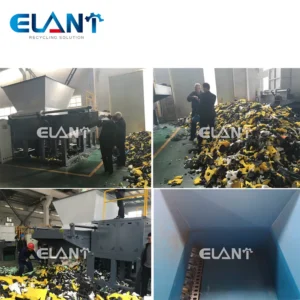
A plastic shredder doesn’t usually fail all at once. It gets noisy. The output gets stringy or inconsistent. Motor load creeps up. A bearing starts running hot. And one day you’re in a jam-clear situation during peak production.
This article is a field-usable plastic shredder maintenance checklist built for maintenance techs and line leads in plastics recycling — basically, industrial plastic shredder preventive maintenance you can run on a real shift. It’s organized by frequency (per shift, weekly, monthly, shutdown) and tied to the failure modes that actually cost you money: knife clearance drift, screen blinding, bearing damage, belt slip, hydraulic pusher issues, and the slow “mystery” loss of torque that ends in downtime.
We’ll stay away from made-up universal specs. Where your machine’s OEM numbers matter (knife clearance, bolt torque, grease type, oil grade), the checklist tells you what to verify and how to trend it.
before you touch anything: make the machine safe
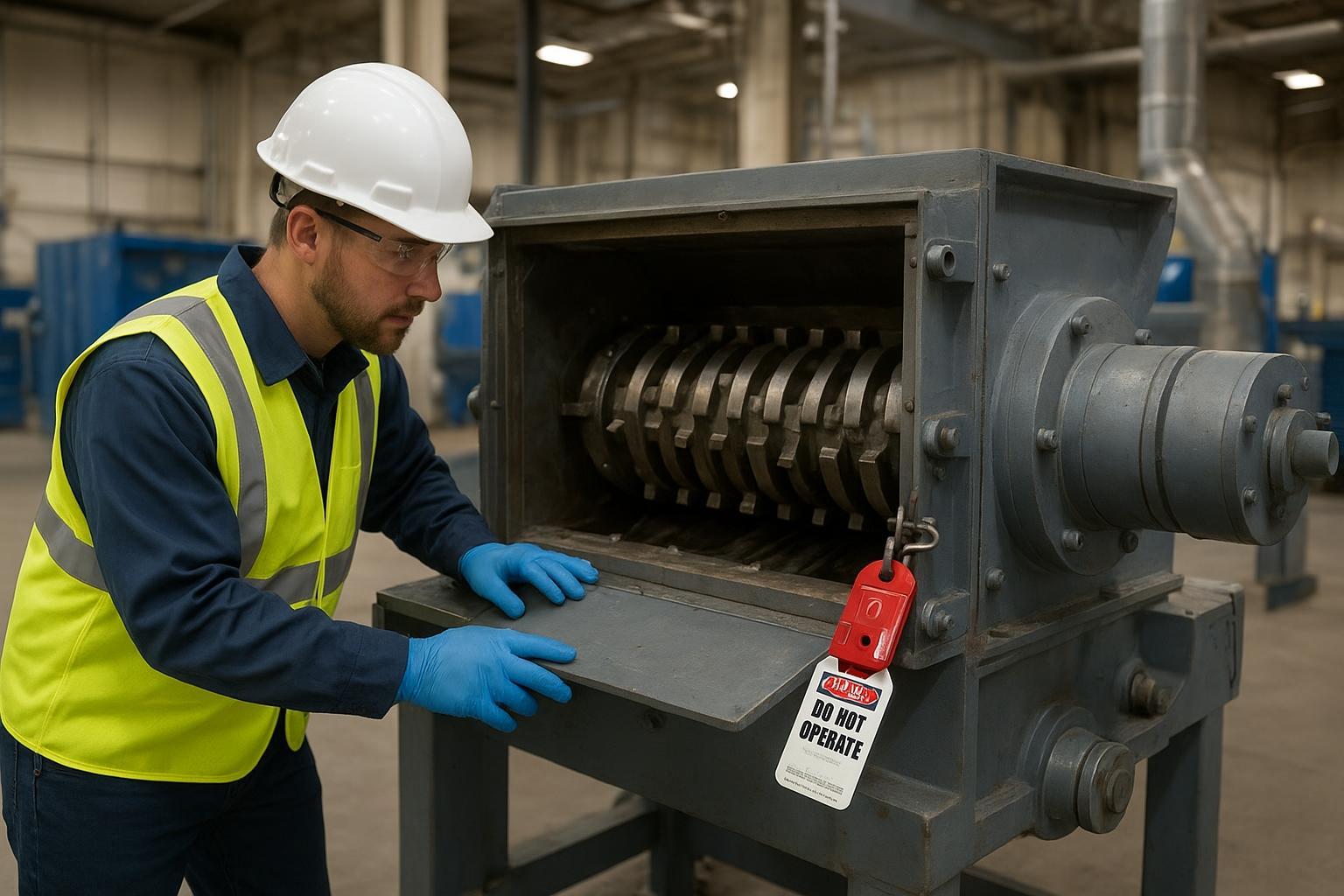
Shredder maintenance is not the place to “be careful.” You need a repeatable lockout/tagout routine, and you need it followed every time.
- OSHA’s overview of Control of Hazardous Energy (Lockout/Tagout) is the baseline expectation in the US.
- If your team needs a clear step sequence, MaintainX lays out a practical step-by-step LOTO procedure (identify energy sources, isolate, release stored energy, verify).
At minimum, your PM job should include:
- Identify all energy sources (electrical, hydraulic, pneumatic, stored mechanical).
- Isolate and lock them.
- Release stored energy (bleed pressure, secure suspended components).
- Verify zero energy (the “try-out” test).
- Only then open guards, panels, and cutting-chamber access.
⚠️ Warning: Jam clearing is a maintenance task. Lock out first. Don’t reach in. Use tools, not hands.
the maintenance mindset that keeps shredders running
A lot of plants “do maintenance” but still get surprised by downtime. The difference is usually not effort—it’s baselines and discipline.
pick a short list of baselines and trend them
You don’t need an advanced predictive maintenance system to catch most shredder problems early. You need a few values recorded the same way, consistently:
- No-load motor current (after warm-up, empty chamber)
- Loaded motor current on your most common feedstock
- Bearing temperature (same measurement point)
- Vibration / noise notes (even a simple pass/fail + brief description)
- Output quality (size consistency, fines/dust, tearing vs cutting)
- Hydraulic pusher behavior (smooth travel, hesitation, oil leaks)
Elant Machinery makes the business case directly: in recycling operations, torque shortfalls and downtime are major profit killers—their post on shredder torque and downtime frames why monitoring load and preventing unplanned stops matters.
treat knives, screens, and bearings as a wear system (not “parts”)
If you wait until knives are obviously dull, you’ve already paid for it in amps, heat, throughput loss, and extra stress on bearings and drive components.
Likewise, a blinded screen or buildup in the cutting chamber can make a shredder look like it “lost torque,” when it’s really fighting drag.
shredder blade, screen, and bearing maintenance: what matters most
If you’re trying to prioritize, focus on three areas first: shredder blade maintenance, shredder screen maintenance (if your machine uses a screen), and bearing health. Those are where small issues turn into load spikes, heat, and downtime.
know the systems you’re maintaining
Different plants run different shredder designs, but most plastics-recycling shredders share the same maintenance zones.
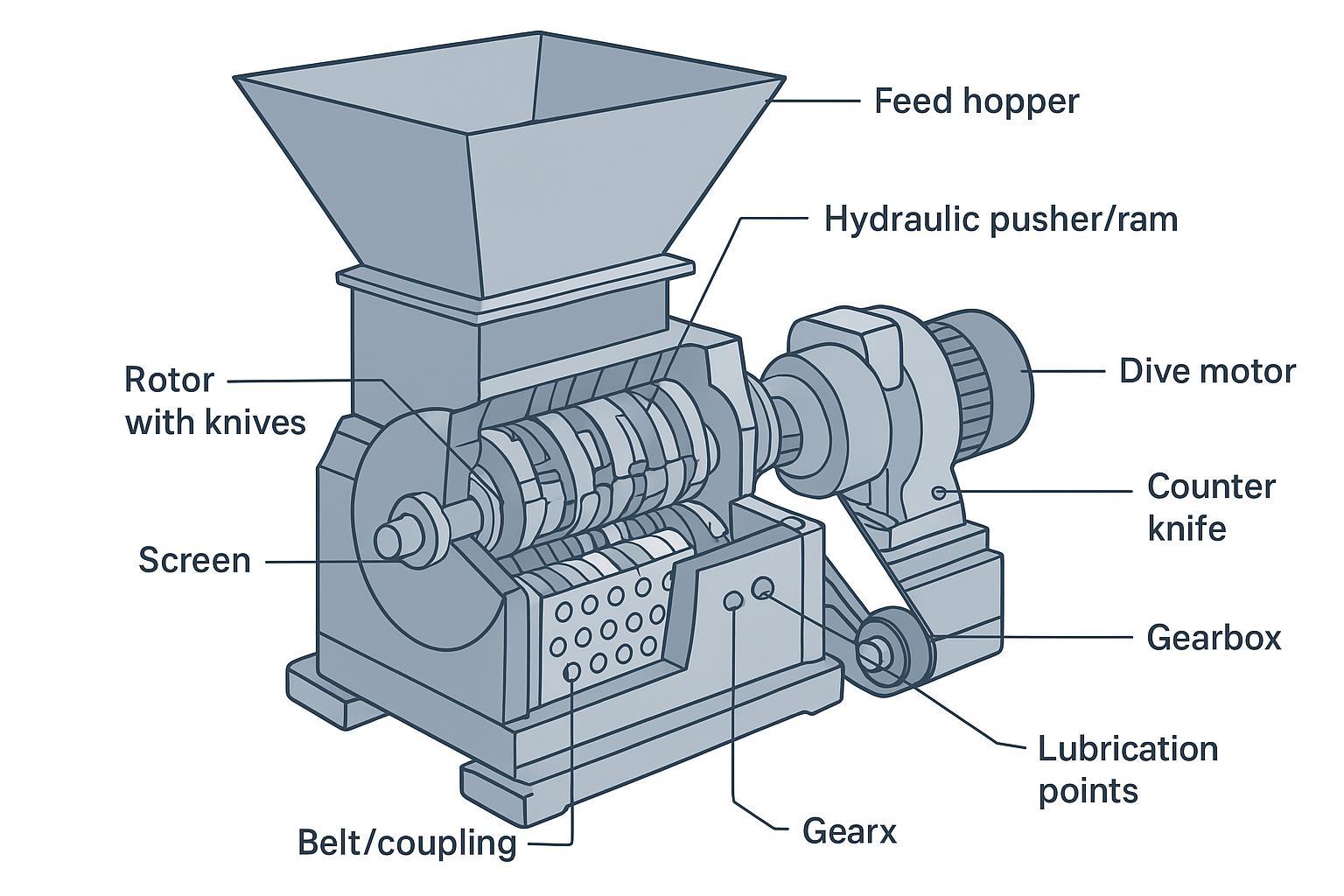
Before we get into the checklist, it helps to align on the basic cutting path (feed → rotor → counter knife → screen/discharge). If you need a quick refresher, Elant’s explainer on what a plastic film shredder machine is and how it works covers the fundamentals.
cutting zone (rotor knives + counter knife)
This is where most performance loss starts:
- knife edges dull or chip
- knife pockets pack with fines
- clearance drifts because hardware loosens, wear builds up, or alignment shifts
Elant Machinery’s write-up on knife clearance problems in plastic recycling shredders calls out a key reality: clearance issues can come not just from knife wear, but also from bearing wear, shaft misalignment, or structural fatigue that changes cutting geometry.
screen (if your shredder uses one)
If your shredder uses a screen to control output size, screen condition becomes both a quality and a load issue:
- blinded holes increase motor load
- warped or damaged screens cause inconsistent particle size
- fines buildup increases heat and drag
bearings and seals
Bearings don’t usually “suddenly” fail. They run hotter, get louder, or start vibrating. When a bearing finally seizes, you’re often looking at secondary damage (shaft, housing, coupling).
drive system (belts / coupling / gearbox)
Drive issues are easy to miss because the shredder still runs—until it doesn’t.
- belt slip looks like a torque problem
- misalignment can look like “mystery vibration”
- gear oil leaks slowly become a reliability event
hydraulics (pusher/ram)
If you run a single-shaft shredder with a hydraulic pusher, treat it like its own wear system:
- guide wear makes the pusher travel crooked
- seal wear shows up as oil on the pusher face or on the floor
- inconsistent pusher force causes uneven loading (and uneven knife wear)
plastic shredder maintenance checklist (by frequency)
Use this section as your core PM routine. Each item is written as a binary check (Yes/No). Add measured values where you can.
per shift / daily checks (10–15 minutes)
safety and controls
- Guards and access panels are installed and secure (no bypassed interlocks).
- Emergency stop functions correctly.
- Start/stop controls work normally (no sticking buttons).
cutting chamber and feed area
- Hopper and feed throat are clear of tramp metal, rocks, and nonconforming material.
- Cutting chamber is free of packed fines and plastic buildup.
- Screen (if used) is not visibly blinded or packed.
operating condition (fast sensory checks)
- No new abnormal noise (grinding, repeating impacts, high-pitch rubbing).
- No new abnormal vibration felt at the frame.
- Motor load is normal for the same feedstock (compare to your baseline, not yesterday’s memory).
lubrication and leaks
- No fresh oil/grease leaks at bearings, gearbox, or hydraulic components.
- Hydraulic oil level is within normal range (if applicable).
Pro Tip: If your operators can’t describe “normal” noise and load, your PM program is blind. Train them on what to report—and require a log entry.
weekly checks (30–60 minutes)
knives and counter knife
- Knife edges are not chipped, cracked, or visibly rounded.
- Knife hardware shows no signs of loosening (witness marks aligned, no fretting).
- Counter knife edge is not rounded or damaged.
screen and discharge
- Screen is clean enough to see open area (no heavy blinding).
- Screen has no cracks, deformation, or broken sections.
drive and powertrain
- Belts (or coupling) show no cracking, glazing, fraying, or abnormal dust.
- Belt tension and alignment look correct (no obvious tracking issues).
bearings and heat
- Bearing housings are not running hotter than their usual operating baseline (use the same measurement method each time).
- No new bearing noise (rumble, growl, cyclical clicking).
hydraulics (if applicable)
- Pusher/ram cycles smoothly without hesitation.
- No hose abrasion points or weeping fittings.
monthly checks (60–90 minutes)
knife clearance and cutting geometry
- Knife clearance has been checked per OEM method after any knife rotation/replacement.
- Knife pockets have been cleaned before reinstalling knives.
- Rotor and knife hardware has been torque-verified to OEM spec.
Because knife clearance problems can be driven by alignment issues—not just dull knives—include:
- Bearing condition and shaft alignment checks are scheduled if clearance drift is recurring.
(Again, use the manufacturer spec for your machine; Elant notes that bearing wear and misalignment can shift clearance in practice in their knife-clearance article.)
bearings, vibration, and structure
- Vibration trend is recorded (even a simple “OK / investigate” plus notes is better than nothing).
- Foundation and frame fasteners are torque-checked (vibration loosens what you didn’t think could move).
electrical
- Electrical cabinet is clean and dry (dust buildup and loose terminals become heat).
- Cables and conduit show no rubbing, cuts, or exposed conductors.
hydraulics
- Cylinder rod is clean and not scored.
- Filters/breathers are serviced per OEM intervals.
quarterly checks (half-day planning)
Quarterly work is where you prevent the “everything wore at once” shutdown.
- Gearbox oil condition is checked (and sampled if your plant does oil analysis).
- Cooling paths and vents are cleaned (motor cooling, cabinet cooling).
- Full inspection of the hydraulic power unit (hoses, fittings, pump noise, temperature trend).
- Review the last 90 days of logs: rising amps, repeated jams, recurring knife issues.
If you want a reference for cadence and log discipline, Kitech’s plastic recycling machine maintenance schedule shows how some plants formalize daily/weekly/monthly/quarterly checks and tie them to trend logs.
shutdown / semi-annual / annual checks (planned downtime)
This is where you restore the shredder, not just keep it limping.
- Full knife set is removed and inspected; worn knives are rotated/resharpened/replaced as a set.
- Counter knives are inspected and replaced if the edge is rounded or damaged.
- Cutting chamber wear plates/liners are inspected for grooves and deformation.
- Bearings and seals are inspected (replace if heat/noise/vibration trends show degradation).
- Rotor is checked for cracks, damage, or imbalance indicators.
- Drive components are inspected and replaced if worn (belts/couplings, keys, sprockets).
- Hydraulic seals and guide wear components are inspected and replaced as needed.
- Safety interlocks and guarding are verified after reassembly.
fast troubleshooting: warning signs → likely cause → what to check first
This is the section crews use most when problems start showing up — especially shredder bearing overheating and vibration troubleshooting.
Use this table when the shredder is still running but “not right.” The goal is to stop guessing and start checking in the right order.
| Warning sign | Likely causes | What to check first |
|---|---|---|
| Output gets stringy, torn, or inconsistent | Knife wear, clearance drift, packed knife pockets, screen blinding | Inspect knife edges and pocket cleanliness; verify clearance per OEM; check screen open area |
| Motor amps creep up on the same feedstock | Cutting drag from dull knives, buildup, bearing drag, belt slip | Check chamber/screen for buildup; check belt condition; check bearing temperature/noise trend |
| New high-pitch rubbing sound | Rotor rub, clearance too tight, foreign object contact | Stop safely; inspect chamber for contact marks and foreign material |
| Repeating impacts or “clunk” | Loose knife hardware, tramp metal, damaged screen | Check knife bolt witness marks; inspect for metal; inspect screen integrity |
| Frequent jams / stalls | Feed inconsistency, torque shortfall, dull knives, pusher issues | Confirm feed stream control; inspect knives; check pusher travel and hydraulic pressure |
| Bearing runs hotter than baseline | Lubrication issue, contamination, misalignment, overloading | Check lubrication condition/type; inspect seals/leaks; evaluate vibration and alignment |
Elant’s shredder torque and downtime post is worth sharing with operations leadership if you need support for planned downtime—unplanned stops are where the real money disappears.
spares to stock so a minor failure doesn’t become a week-long outage
Your spares list should match your shredder and your material stream, but for most plants the minimum kit looks like this:
- One full set of knives (or enough to rotate quickly)
- Counter knives
- One spare screen (or screen sections)
- Knife bolts/hardware kit (don’t reuse questionable fasteners)
- Belts (or coupling elements) for the drive
- Bearing and seal kit for the main rotor bearings
- Hydraulic hose and seal kit (if pusher-equipped)
- Grease and gearbox oil approved by your OEM (don’t mix incompatible products)
the maintenance log that makes this checklist work
If you implement only one thing from this post, make it this: a log that forces consistency.
At minimum, your log should capture:
- Date / shift / operator or tech name
- Machine ID / serial
- Feedstock category (film, rigid, mixed; note contaminants)
- No-load amps and loaded amps (baseline comparison)
- Bearing temperature measurement point and reading
- Noise/vibration notes
- Checklist pass/fail + corrective action
- Parts replaced (part number, quantity)
This is also how you defend maintenance decisions internally: you’re not “asking for downtime,” you’re showing trends.
next steps
If you want, I can turn this into a one-page printable checklist and a simple log sheet your operators can fill out on shift.
And if you share your shredder type (single-shaft vs twin-shaft), approximate rotor size, and your most common feedstock (film vs rigid, contamination level), Elant Machinery can help you map a realistic knife/screen/bearing maintenance cadence that matches your line instead of generic intervals.