
A plastic granulator machine is industrial cutting equipment that reduces plastic scrap, sprues, runners, and off-spec parts into uniform granules — called regrind — that feed directly back into injection molding or extrusion lines as part of a complete plastic recycling machinery system. By chopping waste plastics through a rotating-blade cutting chamber and sizing particles through a screen, the plastic granulation process converts production waste into recoverable regrind material rather than a disposal cost. U.S.
injection molders running typical scrap rates of 5–15% can recover meaningful resin value through in-house granulation — material that would otherwise be sold at commodity scrap prices or landfilled.
At a glance
| Item | Detail |
|---|---|
| Primary output | Uniform plastic regrind particles, typically 3–12 mm depending on screen selection |
| Core mechanism | Rotor-mounted blades cut against stationary bed knives; screen controls final particle size |
| Three main configurations | Central granulator, beside-the-press granulator, slow-speed granulator |
| Distinguishing feature vs. shredder | Plastic granulation produces consistent particle size; shredders do not |
| Common plastics processed | HDPE, LDPE, PP, ABS, PET, PVC, PS — most thermoplastics |
| Regrind blend ratio | Typically blended with virgin resin at 10%–30% depending on application quality requirements |
| Key wear parts | Rotor blades, bed knives, screens — scheduled replacement drives operating cost |
The Role of Plastic Granulation in Manufacturing and Recycling
Without size reduction, recovered waste plastics have inconsistent geometry — sprues, edge trim, thick runners, packaging materials trim — that cannot feed reliably into downstream processing equipment. Plastic granulation solves that problem mechanically, not thermally.
How Waste Plastics Are Processed into Consistent Regrind Material
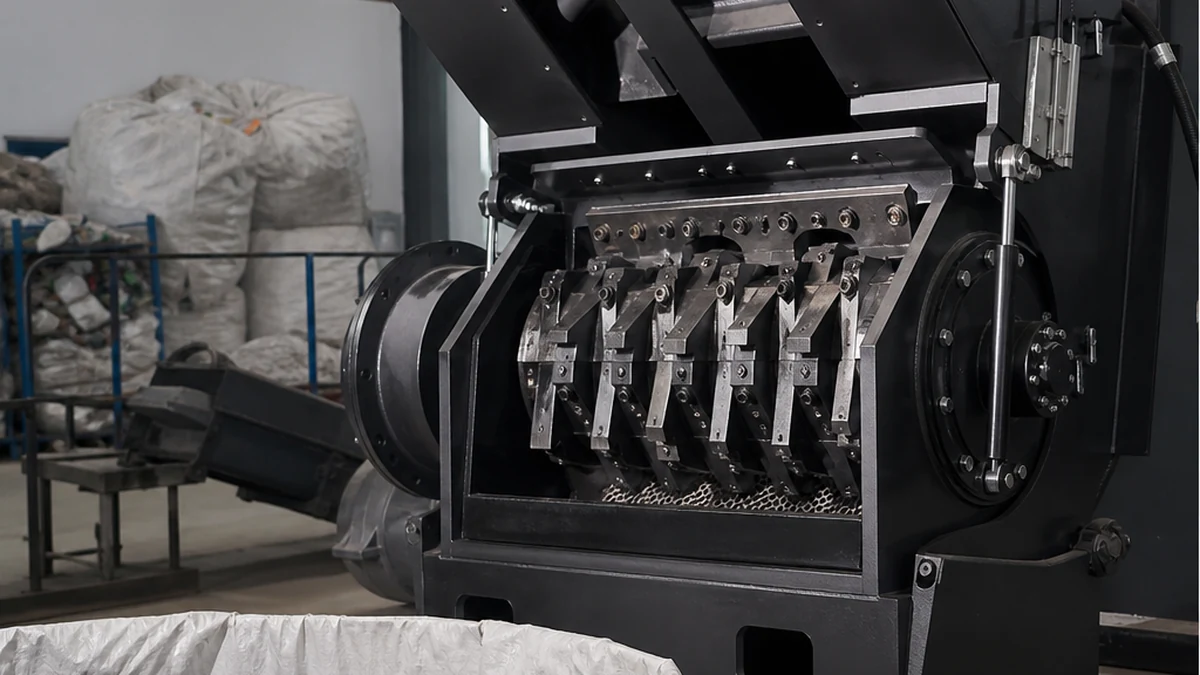
Plastic granulation takes irregular waste plastics — injection molding sprues, film trim, blow molding flash, post-consumer packaging materials — and converts them into granules within a controlled size range. Blades shear the plastic into progressively smaller pieces until each passes through a sizing screen.
The result is regrind material: a flowable, measurable feedstock that behaves predictably in a hopper or dryer. Regrind from a well-maintained plastic granulation system is dimensionally consistent enough to blend with virgin resin and re-enter a manufacturing line the same shift it was generated.
This closed-loop approach is central to how U.S. plastics manufacturers manage scrap, especially when integrated with a complete plastic recycling equipment setup designed to control contamination and output quality. According to the American Chemistry Council’s plastics recycling and recovery information, post-industrial plastic regrind can offer advantages over post-consumer waste streams because it typically has lower contamination levels and more consistent material quality.
Why Regrind Quality Matters for Recycling Applications
Inconsistent regrind causes real downstream problems: bridging in feed hoppers, variation in melt flow, and visual defects in finished plastic products. A tight particle size distribution — typically 90–95% of particles passing a target screen size — delivers regrind material that processors can trust.
Poor plastic granulation, by contrast, creates fines (dust-like particles smaller than 1 mm) and oversized chunks in the same batch. Fines degrade product appearance and can cause burning in injection molds. Oversized pieces stall feed screws.
🔍 Worth checking: Before accepting regrind from a supplier or your own plastic granulation system, sieve a 100-gram sample through the specified screen size. If more than 5% passes through a mesh half the target size, your blade gap or screen is due for inspection — a threshold many operators use as a maintenance trigger, though the exact figure varies by application.
How a Plastic Granulator Machine Processes Scrap into Regrind
Plastic granulation is a mechanical size-reduction process, not a thermal one, and it is often combined with upstream and downstream equipment such as shredders and pelletizing systems in larger plastic recycling lines. Understanding the three stages — feeding, cutting, and discharge — tells you where quality is made or lost.
Feeding System and Cutting Chamber Operation
Material enters the cutting chamber through a feed hopper. The rotor spins at typically 300–600 RPM for standard high-speed plastic granulation. As plastic pieces contact the rotor blades and stationary bed knives, a scissor-like shearing action reduces the material.
Blade geometry and the gap between rotor and bed knives are the single most important cutting variables. A tight blade gap — commonly 0.1–0.3 mm for thin-walled parts — produces clean cuts and minimal fines. A worn or improperly gapped blade tears rather than cuts, generating heat and degraded regrind material.
Screen Sizing and Particle Size Control
Below the cutting chamber sits a perforated screen. Granules small enough fall through; oversized pieces remain for further cutting. Screen hole diameter directly controls the upper bound of regrind particle size.
Common screen sizes range from 4 mm (fine regrind for thin-wall molding) to 12 mm (coarse regrind for profile extrusion). Changing the screen is a fast adjustment — most machines allow screen swaps in under 10 minutes — making one plastic granulation system adaptable across multiple materials and applications.
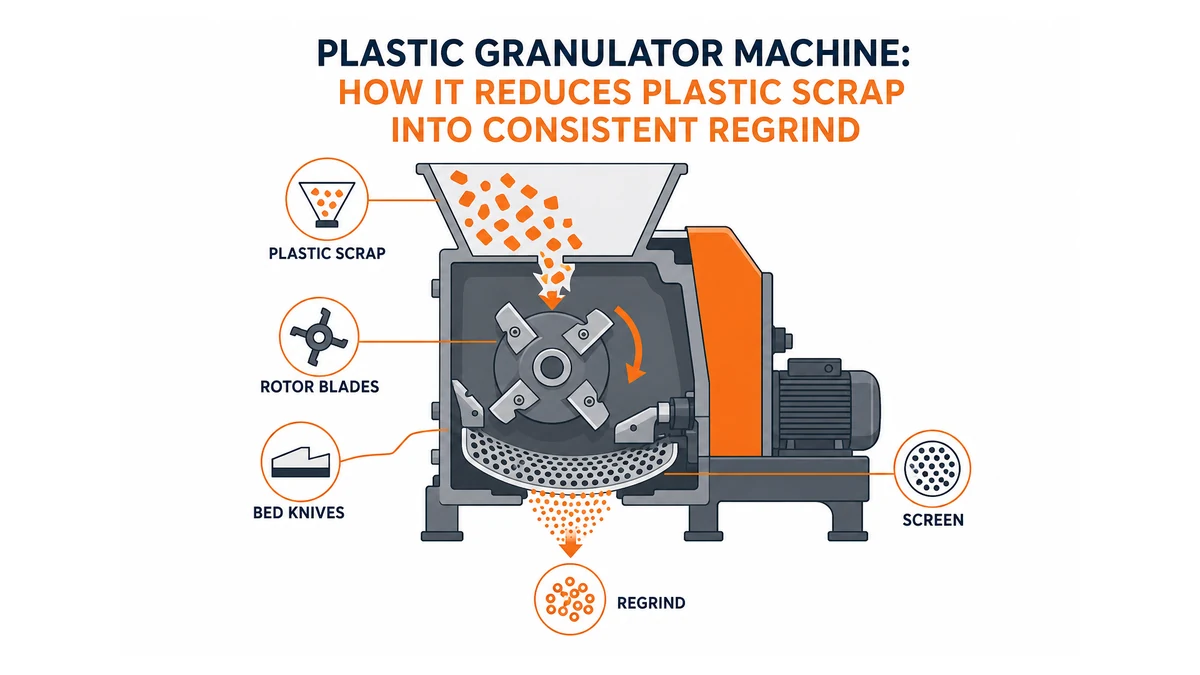
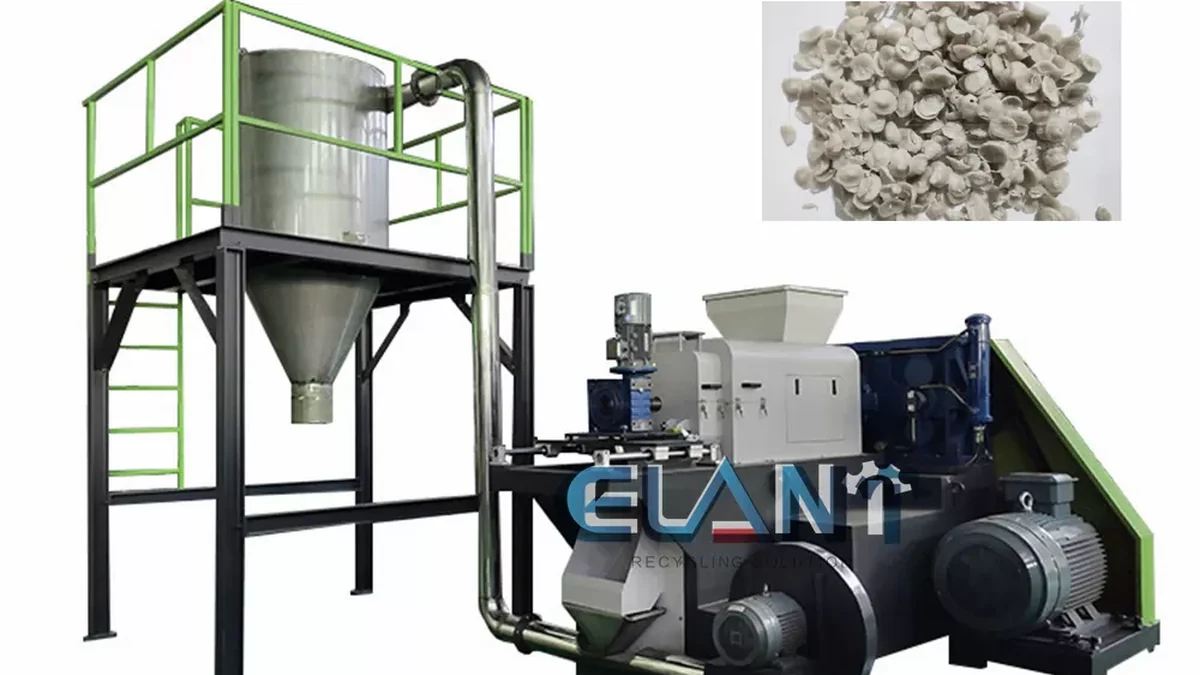
Regrind exits the screen into a bin or is pneumatically conveyed to a blending station. On central plastic granulation lines in high-volume manufacturing facilities, pneumatic conveying moves regrind material directly to a virgin resin blending system. Dust and fine particles are captured by an integrated cyclone separator — skipping this step contaminates the regrind material stream.
3 Types of Plastic Granulators and When to Use Each
No single plastic granulation configuration handles every waste plastics stream efficiently. The three main types differ in throughput, noise level, and the physical form of scrap they handle best.
Central Granulators for High-Volume Plastic Processing
Central granulators are high-capacity machines — typically rated from 200 kg/h to over 2,000 kg/h — fed by conveyor or pneumatic transport from multiple manufacturing lines. They process mixed waste plastics streams from an entire facility in one place.
The trade-off is contamination risk. Scrap conveyed from multiple presses can mix materials or pick up metal debris. Central plastic granulation installations require disciplined material segregation to keep regrind material acceptable for recycling back into production.
✅ Do this: Install magnetic separators and metal detectors upstream of any central plastic granulation system. Metal fragments in the cutting chamber destroy rotor blades and can cause catastrophic rotor failure.
Beside-the-Press Granulators for Immediate Scrap Recycling
Beside-the-press (BTP) plastic granulation sits directly adjacent to an injection molding or blow molding machine. A robot or conveyor drops sprues and runners into the granulator immediately after demolding, and regrind material drops into a bin for direct return to the press hopper.
This configuration is the most contamination-controlled approach to plastic granulation. For high-precision parts — medical devices, optical components, thin-wall packaging materials — beside-the-press granulation maintains material traceability that a central system cannot match.
🚫 Avoid: Running large, thick-walled parts through a BTP plastic granulation unit rated for thin-wall sprues. Overloading a small beside-the-press machine causes motor overload trips, accelerates blade wear, and generates heat that degrades the regrind material.
Slow-Speed Granulators for Sensitive Materials and Bulky Scrap
Slow-speed plastic granulation runs the rotor at typically 20–80 RPM rather than several hundred. The lower cutting speed generates significantly less heat and noise — the correct choice for heat-sensitive plastics such as PVC and for large, bulky waste plastics like hollow blow-molded containers or thick-wall pipe.
The slower rotor also produces fewer fines, protecting regrind material quality in polymers that cannot tolerate thermal degradation. Throughput is lower than a high-speed central plastic granulation system, but for the right waste stream, slow-speed operation protects material value.
Plastic Granulators vs. Shredders vs. Crushers
These three machine types are regularly confused — including by buyers writing equipment specifications. The distinction determines whether the output is usable regrind material or just reduced-size waste requiring further processing.
A plastic shredder machine uses low-speed, high-torque counter-rotating shafts to tear waste plastics into irregular chunks. Output particle dimensions vary widely and are typically too large and irregular to feed directly into an extruder or molding machine. Shredders are primary reduction equipment: they make large waste plastics handleable, not production-ready.
Crushers operate at medium speed using a combination of impact and compression, making them suitable as a preparation step before granulation in some plastic crusher machine applications. They are common in film recycling and PET bottle processing to reduce packaging materials volume before granulation or washing. Crusher output is more consistent than shredder output but still coarser than plastic granulation regrind. In a multi-stage line, a crusher typically sits between the shredder and the plastic granulation system.
The plastic granulation system is the only machine in this group that produces directly reusable regrind material. Its screen-controlled output has a defined upper particle size, and the scissor-cut mechanism minimizes fines.
| Machine | Mechanism | Output | Primary use |
|---|---|---|---|
| Shredder | Tear/shear | Irregular chunks, 50–200 mm | Primary volume reduction |
| Crusher | Impact/compression | Coarse, variable, 15–50 mm | Pre-granulation stage |
| Granulator | Scissor-cut + screen | Uniform regrind, 3–12 mm | Recycling back to manufacturing |
Integrating a Plastic Granulator Machine into Your Production Line
A production manager evaluating plastic granulation for scrap management needs to answer three placement questions before specifying equipment.
Where in the line does the plastic granulation system go? Beside-the-press placement captures sprues and runners at the source with zero cross-contamination risk — the right choice for single-material cells. A central plastic granulation system positioned downstream makes sense when multiple presses run the same resin family and scrap volumes justify the capital cost.
How does regrind material route back to the press? The cleanest closed loop uses pneumatic conveying from the granulator discharge directly to a blending hopper at the press. This eliminates manual handling, reduces contamination, and allows consistent blend ratios. For facilities without pneumatic infrastructure, a plastic recycling collection bin with a dedicated conveyor achieves similar traceability at lower installation cost.
What prevents cross-contamination of regrind material? Color coding bins and hoppers by resin type is standard practice in U.S. injection molding facilities. More critical is the purge protocol between material changes on a shared central plastic granulation system — inadequate purging is the most common source of mixed-resin regrind that fails quality checks.
Many manufacturers also use resin identification code labeling on scrap totes to ensure regrind material traceability back to the originating production run.
Why Plastic Recycling Is Challenging for U.S. Manufacturers
Post-industrial plastic granulation looks straightforward on paper. In practice, U.S. manufacturers face structural barriers that generic recycling guidance rarely acknowledges.
The most disruptive was China’s National Sword policy, implemented in January 2018, which banned imports of most mixed waste plastics and set contamination limits of 0.5% for accepted materials. U.S. facilities that had been exporting lower-grade scrap lost that outlet overnight, forcing investment in domestic plastic recycling solutions that could produce cleaner regrind material for domestic processors.
State-level regulatory fragmentation compounds the challenge. Unlike the European Union’s packaging EPR directives, the U.S. has no federal extended producer responsibility framework for plastics. California’s SB 54, signed in 2022, mandates that plastic packaging materials be recyclable or reusable by 2032 — but neighboring states have no equivalent requirement, creating inconsistent market signals for regrind material buyers.
The Plastics Industry Association tracks these state-level EPR developments, which are reshaping what counts as “recoverable” across different regional markets.
Resin identification code confusion also affects plastic granulation economics. Codes 3 (PVC) and 7 (other) cover dozens of incompatible chemistries that cannot be granulated together. Facilities processing mixed post-consumer packaging materials must sort by resin type before granulation — a sorting cost that post-industrial operations, with their clean single-resin scrap streams, do not face.
Turning Waste Plastics into a Valuable Resource
The financial case for in-house plastic granulation is specific, not generic. For a mid-size injection molder running a 10% scrap rate on commodity PP or HDPE, regrind material recovered and blended back at 20–25% of the feedstock replaces virgin resin purchases at a meaningful scale.
HDPE and PP command the strongest regrind premiums in U.S. secondary markets — both resins have well-established domestic compounding markets that accept certified post-industrial regrind material. PET regrind from packaging materials processing also has strong demand from fiber and sheet producers, especially when supported by efficient PET recycling equipment that maintains material quality.
Engineering resins such as glass-filled nylon are more challenging: the glass filler accelerates plastic granulation blade wear and the regrind material typically cannot be blended above 10–15% without mechanical property loss.
The EPA’s Sustainable Materials Management data consistently shows that post-industrial waste plastics have higher recovery potential than post-consumer streams because they are single-material, uncontaminated, and already in a form suited to plastic granulation. Facilities that produce clean, screened regrind material can supply compounders or film producers who cannot process raw waste plastics but will accept certified regrind — opening a revenue stream beyond internal reuse.
Critical Factors When Choosing a Plastic Granulator Machine
Processing Capacity and Motor Power
Match the plastic granulation system’s rated throughput to your actual scrap generation rate. Industry practice suggests sizing for 60–70% of peak load — plastic granulation systems running consistently above 85% of rated capacity wear faster and generate more heat than machines with headroom. Motor power scales with both throughput and material hardness: thin-wall PP sprues require far less power per kilogram than glass-filled nylon.
Consult the manufacturer with your specific plastic type, bulk density, and piece geometry before accepting a motor sizing based on throughput alone.
Rotor Design and Blade Materials for Your Waste Plastics Stream
Three rotor configurations dominate the market:
- Open rotor: high throughput, easy cleaning, best for dry clean regrind material
- Closed (staggered) rotor: aggressive cutting action, handles tough or bulky waste plastics
- Segmented rotor: allows individual blade section replacement, lower maintenance cost on large plastic granulation systems
Blade material — standard steel, hardened steel, carbide — should track the abrasiveness of the plastic being processed. For screen selection, starting with a hole diameter 1.5–2× the desired regrind particle size accounts for the angle at which particles pass through. Screen open area (commonly 30–50%) affects throughput: higher open area means faster discharge for the same motor size.
When evaluating regrind particle size and bulk density against your downstream process requirements, consult the relevant characterization test methods recognized by your industry or resin supplier, and confirm applicable standards with your local authority or customer specification — published standards vary and should be verified before specifying acceptance criteria.
Blade Wear and Total Cost of Ownership
Blade replacement frequency is the most variable — and least often disclosed — operating cost in plastic granulation. Before purchasing, ask for blade life estimates in operating hours for your specific plastic type, not a generic range. Request references from existing customers running the same waste plastics stream.
For PP recycling applications in high-volume manufacturing facilities, tracking regrind fines percentage against blade condition is a more reliable early-warning system for degrading cut quality than a fixed replacement schedule — some operators use a fines increase of roughly 3% by weight as a maintenance indicator, though the appropriate threshold varies with the application. Also confirm whether the machine supports in-situ blade sharpening or requires complete removal, which affects downtime per maintenance cycle.
Maintain regrind blend ratios between 10% and 30% of total feedstock (meaning regrind makes up 10%–30% of the blend, with virgin resin comprising the remainder) to protect melt flow consistency and finished-part appearance. The appropriate ratio within this range depends on resin type, part quality requirements, and the number of prior processing cycles the regrind material has undergone.
🚫 Avoid: Running mixed plastics through a plastic granulation system without confirming compatibility. PVC mixed with other resins releases hydrochloric acid vapor during granulation, corrodes the machine, and contaminates the regrind material beyond recovery.
Have a project or a spec sheet in hand? Talk to elantmachine.com — real engineers answer.
FAQ
What are the benefits of using a granulator?
A plastic granulator machine cuts scrap, sprues, and runners into uniform regrind that can be blended back into virgin resin, directly reducing raw material costs. Processors also lower landfill disposal fees and stay aligned with EPA waste-reduction expectations. On the production floor, inline or beside-the-press granulators eliminate manual scrap handling, speed cycle times, and keep regrind particle size consistent enough for predictable melt behavior in injection molding and extrusion lines.
What are common problems with granulators?
Dull or chipped rotor and bed knives are the most frequent issue, producing fines and irregular particle sizes instead of clean regrind. Screen wear or improper screen sizing lets oversized pieces pass through. Overfeeding causes motor overload and premature bearing failure. Heat buildup from continuous use can degrade heat-sensitive resins. Noise and vibration often signal loose knives or an unbalanced rotor. Regular knife sharpening schedules and proper feed rate control prevent most of these problems.
How much do granulator machines cost?
In the United States, a small beside-the-press granulator typically runs $3,000 to $10,000. Mid-size central granulators suited for higher throughput range from $15,000 to $50,000. Heavy-duty industrial units with large cutting chambers and high-horsepower motors can exceed $100,000. Price depends on cutting chamber size, rotor design, motor horsepower, and sound-enclosure options. Refurbished machines are available at roughly 40 to 60 percent of new-unit pricing from U.S. equipment dealers.
Sources
[1] ASTM D1895-17 – Apparent Density and Pourability of… — standards.iteh.ai
[2] Recycling & Recovery Goals – Plastics — americanchemistry.com
[3] Mastering particle size analysis: lessons, challenges, and… — pmc.ncbi.nlm.nih.gov
[4] How Heavy-Duty Granulators Work: Rotor Design, Cutting… — virtus-equipment.com
[5] SWHB1000 Plastic Granulator: Blade Replacement Guide — plasticrecyclingmachine.net
[6] Buy Low-Speed Granulators for Plastics Recycling — virtus-equipment.com
[7] Impact of China’s National Sword Policy on the U.S…. — mdpi.com
[8] EPR for Packaging Laws — plasticsrecycling.org