
At a glance
- Primary damage points: shredder blades, extruder screws and barrels, melt filters, pelletizer dies
- Most common ferrous sources: wire, staples, machine bolts, rebar embedded in baled scrap
- Most common non-ferrous sources: aluminum foil laminates, copper wiring insulation, electrical connectors
- Standard removal sequence: magnetic separator → eddy-current separator → inline metal detector with rejection gate
- Installation positions: before shredding, after shredding, before extrusion
- Detection sensitivity (typical inline detectors): ferrous particles down to ~1 mm; non-ferrous down to ~2–3 mm depending on product cross-section
- Regulatory note: facilities handling post-consumer plastic scrap containing hazardous materials must follow EPA hazardous waste guidelines for separation and disposal
Where Does Metal Contamination Come From?
Metal enters plastic recycling streams through more pathways than most sorting checklists account for. Understanding the specific sources — not just “metal in plastic” generically — is the first step to blocking them.
Ferrous metals from fasteners, wires, and machine parts
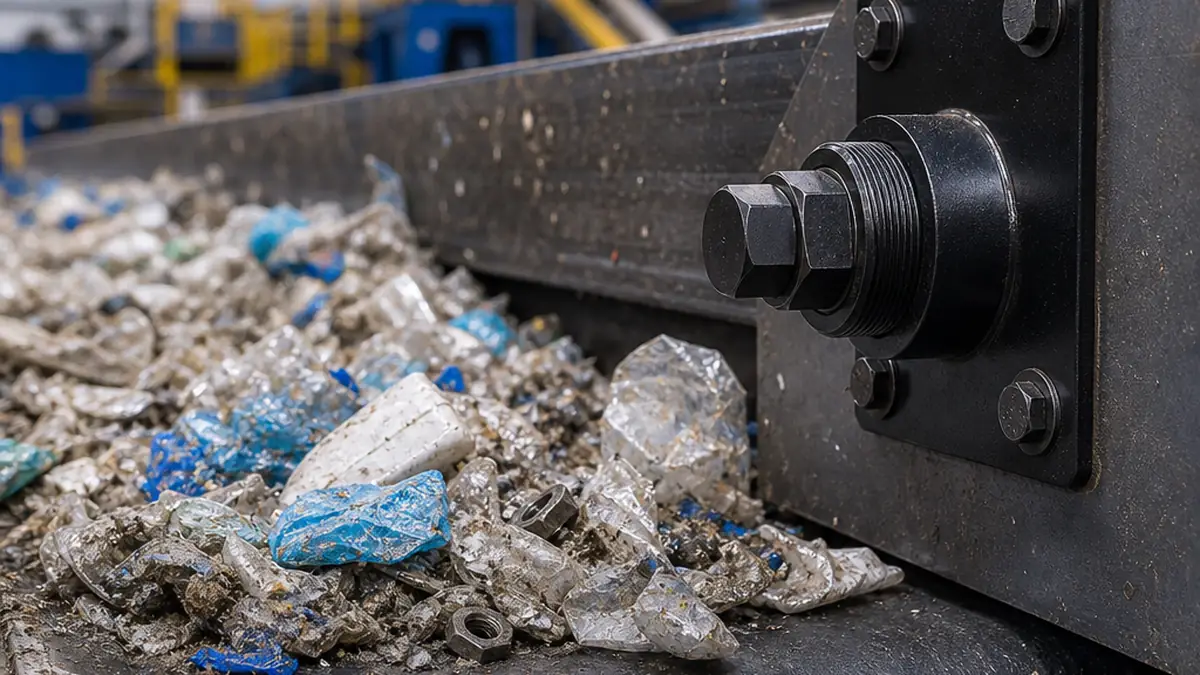
Steel and iron arrive in plastic scrap primarily as fasteners embedded in products: screws, staples, clips, and hinges that were never removed before baling. Wire ties used to bundle scrap are an especially frequent offender — they shred into short, sharp fragments that scatter through the entire material stream. Broken machine parts, including bolts from the feedstock’s original manufacturing process, also turn up regularly in industrial scrap.
Baled post-consumer scrap is particularly high-risk here. Baling presses can drive steel wire deep into the plastic mass, making visual inspection at intake nearly useless without a separator upstream.
Non-ferrous metals from packaging and electrical components
Aluminum is the dominant non-ferrous contaminant in plastic recycling. Flexible packaging commonly uses aluminum foil laminates bonded to plastic film — these are difficult to separate by hand and pass invisibly through a magnetic separator because aluminum is non-ferrous. Aluminum bottle caps and foil seals attached to HDPE or PET containers add to the load.
Copper shows up from electrical cables and electronic component scrap mixed into the plastic waste stream. Because copper has a density similar to some plastic compounds, it can survive basic float-sink sorting and reach the extruder. These non-ferrous contaminants are exactly what a standard magnetic separator cannot remove.
Different contamination risks in post-consumer and industrial scrap
Post-consumer scrap carries a wider variety of contaminants and higher hazardous material risk. Household waste streams mix food packaging, electronics, and construction materials — all of which contribute different metal types and surface coatings. EPA scrap metal recycling contaminant data shows that post-consumer streams can carry metals coated with lead-based paint or cadmium platings, creating both equipment and hazardous waste handling concerns.
Industrial scrap is more predictable in composition but often higher in metal concentration. Off-cuts from automotive plastic molding, for example, can contain steel inserts that were molded directly into the part. Knowing your feedstock source is not optional — it sets which separation methods and what inspection frequency you need.
How Does Metal Damage Recycling Equipment?
The damage is not random — it follows a predictable sequence through the processing line. Each piece of equipment has a specific failure mode tied to how it contacts metal.
Blade wear and jamming in shredders and granulators
Shredder rotors and granulator blades are hardened steel, but a single steel bolt passed through at full rotor speed creates an impact force that chips the cutting edge. Repeated impacts micro-fracture the blade geometry. The result is accelerated wear that multiplies cutting energy consumption and degrades particle size consistency long before a blade visibly fails.
Jamming is the acute version. A large piece of scrap metal — a bracket, a length of rebar, a thick hinge — can stall the rotor entirely. Emergency stops under full torque stress the rotor bearings and the drive coupling. Frequent jams mean frequent bearing replacements, not just blade changes.
🔍 Worth checking: After any unexpected jam, inspect the rotor bearings for radial play before restarting. A jam that stopped the rotor in under one second can pre-load bearing damage that only shows up as noise three weeks later.
Scoring and seizure in extruder screws and barrels
The extruder screw and barrel operate at tight clearances — typically 0.1 to 0.3 mm between screw flight and barrel wall on a production-grade plastics extruder. A metal fragment that enters the extruder gets dragged into that gap and scores the hardened barrel lining. One scoring pass removes material that took years of service life to preserve.
If the fragment is hard enough — high-carbon steel, hardened tool steel from a machine part — it can seize the screw entirely. Seizure under full motor torque breaks the screw shank or warps the barrel. Either failure means a full strip-down, and a replacement barrel for a 90 mm extruder can run $15,000–$40,000 depending on bimetallic liner specification.
Plastic melted to metal surfaces during a seizure event is a secondary problem: removing melted plastic bonded to a steel screw requires sustained high-temperature purging or mechanical scraping, both of which risk further scoring. This is why the process of clearing a contaminated extruder is almost as damaging as the contamination itself.
Blockages and quality defects in filters, dies, and pelletizers
Melt filters (screen changers) are the last line of defense before the die. A metal fragment in the melt stream loads the filter screen rapidly, driving up melt pressure. Pressure spikes above the screen’s rated limit rupture the screen, pushing both the metal fragment and unfiltered melt through to the die.
At the die, fragments score the die face and disrupt strand geometry. Pellets cut from distorted strands are out-of-spec in diameter and density. Downstream customers — compounders, injection molders — reject pellets with embedded metal inclusions because those inclusions cause tool wear in their own equipment. The contamination cost passes through the entire supply chain.
How Can Metal Contaminants Be Removed?
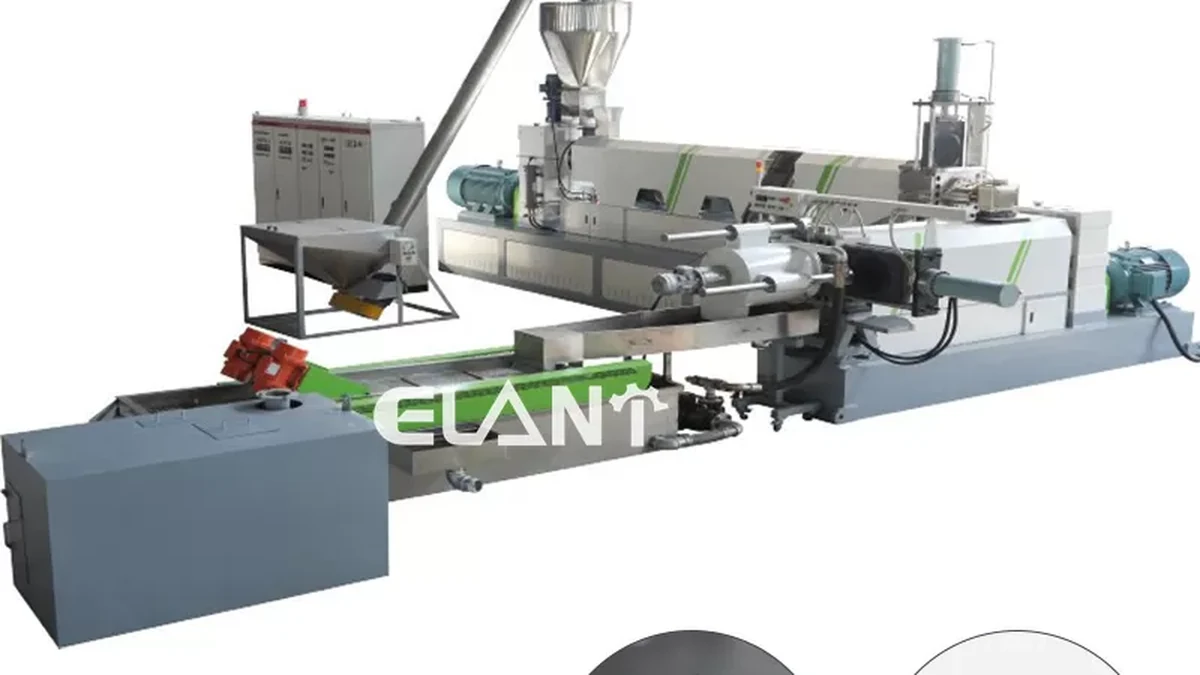
No single separator removes all metal types. The standard approach is a staged sequence, each stage targeting what the previous one missed.
Magnetic separators for ferrous metals
Permanent magnetic drums and overhead belt magnets are the first stage for ferrous metals. A magnetic drum installed at the head pulley of a conveyor belt captures ferrous particles as light as small wire fragments from the process stream. Overhead magnets suspended above the belt pull larger ferrous items — bolts, brackets — before they reach the shredder.
Magnetic separation is low-cost to operate and requires no electrical input for permanent magnet versions. The limitation is absolute: it removes nothing that isn’t ferrous. Aluminum, copper, and stainless steel pass straight through.
Eddy-current separators for non-ferrous metals
An eddy-current separator (ECS) uses a rapidly rotating magnetic rotor inside a conveyor drum to induce eddy currents in non-ferrous metals. Those currents create a repulsive magnetic force that ejects the non-ferrous material in a different trajectory than the plastic, allowing a splitter plate to separate the streams. Eddy-current separation reliably handles aluminum, copper, and brass.
ECS units work best on dry, free-flowing material after primary shredding, where individual particles are separated rather than clumped. Wet or fine material reduces separation efficiency significantly — a fact that affects facilities running wet-wash pre-cleaning processes before the ECS stage.
Metal detectors and rejection gates for remaining contaminants
Inline metal detectors with automatic rejection gates handle the fragments that survive magnetic and eddy-current separation — small stainless steel particles, fine copper wire, and any metal embedded inside a larger plastic chunk that the ECS could not eject. The detector generates an electromagnetic field across the conveyor or pipe cross-section; a metal particle disturbs the field and triggers a rejection gate to divert that portion of material.
Sensitivity limits are real: a standard pipeline metal detector on a 100 mm bore can detect a 2 mm ferrous sphere reliably, but a 1.5 mm stainless sphere at the edge of the detection coil may be missed. For critical applications — medical-grade regrind, food-contact recycled resin — a second detector stage after the first rejection pass is standard practice.
Where Should Metal-Removal Equipment Be Installed?
Position matters as much as equipment type. Installing separators in the wrong sequence leaves metal in the process stream at the worst possible moments.
Before shredding to protect blades and rotors
A magnetic separator before the shredder is non-negotiable for any line processing baled post-consumer scrap. Overhead magnets or magnetic drums on the infeed conveyor pull ferrous items before they reach the rotor. This is the cheapest insurance against a blade chip or rotor jam — the capital cost of an overhead magnet is a fraction of one emergency blade replacement.
Pre-shredder separation cannot catch non-ferrous metal embedded inside bales. It catches what it can reach: surface fasteners, wire ties, loose metal pieces mixed into the load.
After shredding to capture exposed metal fragments
Shredding exposes metal that was previously encapsulated — a steel insert inside a molded part, foil laminate freed from its plastic carrier, wire fragments cut to short lengths. A second separation stage after the shredder is where the eddy-current separator earns its placement. Material at this point is sized and relatively free-flowing, which maximizes ECS efficiency.
An inline metal detector immediately after the ECS stage confirms that the material entering the next process step is clean. If the detector triggers more than a set threshold of rejections per hour, the alarm indicates either separator malfunction or a change in feedstock contamination levels — both require immediate investigation, not just acknowledgment and reset.
✅ Do this: Log every rejection event from the post-shredder detector. A spike in rejections is your earliest warning of a separator problem or a contaminated batch — catching it here costs minutes; missing it costs a barrel.
Before extrusion to protect screws, barrels, and dies
A final metal detector with rejection gate installed on the extruder infeed is the last checkpoint before the highest-value equipment in the line. At this stage, the goal is not high-throughput bulk separation — it is catching the single fragment that survived all upstream stages.
Some facilities also run a melt filter screen changer guide with an automatic screen changer as an additional layer inside the extruder itself. The screen changer does not remove metal so much as contain it briefly at the screen — but it buys time to detect a pressure spike and shut down before the die is damaged.
How Can Plants Prevent Metal Contamination?
Separation equipment stops metal from destroying machinery. Prevention reduces how much metal the separators have to handle — and catches the contamination modes that no separator addresses.
Inspect incoming feedstock
Visual inspection of every incoming load is the minimum standard, but it is insufficient alone for baled or shredded scrap where metal is not visible at the surface. Weigh incoming bales and compare against expected plastic density — an anomalously heavy bale signals embedded metal. Request material certificates from suppliers documenting sorting methods and any known contaminants.
Facilities handling regulated hazardous waste streams should document chain of custody under applicable EPA hazardous waste management standards.
| Contamination Type | Example Rejection Rate |
|---|---|
| Ferrous Metal | ~8% |
| Non-Ferrous Metal | ~3% |
| Glass Fragments | ~1% |
| Mixed Contamination | ~10% |
Values shown are examples only. Actual metal rejection performance varies depending on equipment configuration, separator type, material composition, contamination level, and operating conditions.
Maintain and test separation equipment
A magnetic separator that has lost 15% of its field strength removes less metal but gives no visible indication that anything is wrong. Test magnetic field strength quarterly with a calibrated gauss meter. Test eddy-current separators monthly by running a known aluminum test piece through the stream and confirming rejection.
Test inline metal detectors daily using the calibration test pieces provided by the manufacturer — these tests take under two minutes and are the only way to confirm the detector is live before processing begins.
Equipment that cannot be verified is not separation equipment. It is decoration.
Trace repeated contamination to its source
When rejection rates climb, the instinct is to increase separation sensitivity. The correct response is to plastic recycling feedstock quality control checklist trace the contamination back to the specific supplier batch, product type, or collection route driving it. Post-consumer recycling facilities that audit their incoming sort quality at the source reduce metal contamination events by addressing the origin rather than just managing the symptom downstream.
Some contamination sources are structural. Certain flexible packaging formats — pouches with metallized barrier layers, foil-lidded containers — cannot be cleaned of their metal component regardless of how many separation stages follow. Those materials require a sorting decision at intake, not a separation solution midstream. The common contaminants you can remove with equipment are the ones worth investing in equipment for; the ones you cannot remove require procurement decisions.
🚫 Avoid: Treating every metal detector rejection as a calibration problem. A detector triggering on product that passed yesterday without rejections is detecting real contamination — investigate the feedstock batch before adjusting sensitivity downward.
If your line is seeing unexplained blade wear, rising filter pressure, or off-spec pellets, metal contamination is the first variable to audit — not the last. A staged separation system costs a fraction of one extruder rebuild, and the inspection protocol described here takes less time per shift than an unplanned shutdown takes per incident.
Have a project or a spec sheet in hand? Talk to elantmachine.com — real engineers answer.
FAQ
How do I remove plastic melted to metal?
Heat the metal component to the plastic’s softening temperature using a heat gun or oven, then scrape the softened plastic away with a brass or wooden tool to avoid scratching the metal surface. For extruder screws and barrel components, operators typically use a burn-off oven set between 700 and 900 degrees Fahrenheit, followed by wire brushing. Commercial purging compounds can also break the bond during normal machine operation before full disassembly is required.
What are 5 things that cannot be recycled?
Items that routinely contaminate plastic recycling streams and damage processing equipment include tanglers like garden hoses and wire hangers, metal-laminated packaging such as chip bags, ceramics and Pyrex glass, syringes and sharps, and electronics containing circuit boards. Many of these introduce hard metal fragments directly into shredders and extruders. A replacement barrel for a 90 mm extruder can run $15,000–$40,000 depending on bimetallic liner specification. Most U.S. curbside programs explicitly exclude these materials, and processors are encouraged to post accepted-materials lists at drop-off points to reduce incoming contamination.
Sources
[1] Resource Conservation and Recovery Act (RCRA) … — epa.gov
[2] Characterization of Municipal Solid Waste in The United … — nepis.epa.gov
[3] How to separate non-ferrous metal with eddy current … — sgmmagnetics.com
[4] Resource Conservation and Recovery Act (RCRA) Overview — epa.gov
[5] Evaluation of Sorting Potential for Plastic Articles Utilizing … — plasticsrecycling.org
[6] SPE Library | SPE — 4spe.org
[7] Metal Detection in Food Packaging | What You Should Know — alleratech.com