
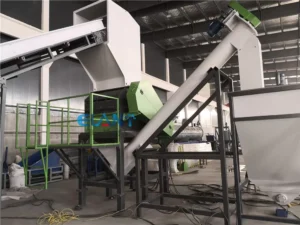
If you’re running a recycling line on a mixed stream (rigid + film + contamination), “shredder first or crusher first?” isn’t a theory question. It’s a downtime question.
A crusher (granulator) is great at making uniform flakes. It’s also easy to punish: one jammed lump, one metal bolt, one slug of wrapped film, and you’re changing knives, screens, or bearings when you should be washing and pelletizing.
This guide is written for decision-stage operators and engineers. It’s the practical way to decide when a shredder before a crusher is the right front end, what to spec, and what red flags to avoid.
The fast decision: when shredder-first is required
In real plants, you don’t add a shredder because it looks good on a flowsheet. You add it because it protects the rest of the line.
You almost always want shredder → crusher/granulator when one or more of these are true:
- Your infeed is bulky or unpredictable: big hollow parts, thick lumps, long profiles, purgings, bundled scrap, dense bales.
- You’re feeding a mixed stream where film and rigid show up together.
- Contamination is real (dirt, stones, labels, bits of metal) and you can’t guarantee clean, sorted feed.
- You need stable downstream performance (steady washing load, consistent drying, predictable extruder feeding).
A good shredder gives you a controlled “first bite.” It turns ugly input into something you can meter.
⚠️ Warning: If you’re seeing repeated granulator jams, cracked screens, or knife damage, that’s not “normal wear.” It’s a sign the machine is being used as a pre-shredder.
What changes in a mixed stream (rigid + film + contamination)
Mixed streams are where crusher-only layouts tend to fail, even if they look cheaper on day one.
Film doesn’t fail like rigid does
Rigid plastics usually fail by overload (too thick, too big, too hard to cut). Film fails by behavior:
- It wraps around shafts and rotors.
- It bridges across hoppers and chutes.
- It arrives as light, springy wads that feed in slugs.
A granulator wants a steady bite. Mixed stream feeding rarely gives it that.
Contamination turns into “hidden costs”
A shredder is not immune to contamination, but the slow-speed, high-torque cutting style typically tolerates dirty, irregular input better than a high-speed knife chamber. Conair’s overview of differences between granulators and shredders highlights that shredders are built for bulky, harder-to-handle scrap while granulators focus on uniform size reduction.
In a mixed stream, contamination also changes your risk profile:
- Metal (bolts, staples, wire) becomes a “when,” not an “if.”
- Stones and sand become screen and knife wear.
- Label glue and paper fragments become cleaning load.
A shredder-first layout gives you a natural point to add metal removal before the crusher (more on that below).
What each machine actually does (shredder vs crusher/granulator)
People use “crusher,” “granulator,” and “shredder” loosely. The line design gets much easier when you separate the roles.
Shredder: coarse reduction + feed conditioning
A shredder’s job is to take ugly input and make it manageable.
Typical reasons to run a shredder first:
- Reduce a large/irregular part into pieces that can enter a cutting chamber safely
- Turn a dense bale into a more even stream
- Break film/rigid mixes so you can meter material downstream
Shredders are generally low-speed, high-torque machines (often on the order of ~100–130 rpm for many industrial designs). They “tear and shear” instead of precision-cutting.
Crusher / granulator: final sizing for washing and pelletizing
A crusher/granulator is where you earn your consistency. It’s designed to produce flakes or regrind that match the needs of washers, dryers, and extruders.
The trade-off is that granulators are more sensitive to:
- sudden shock loads
- long, flexible pieces wrapping the rotor
- hard inclusions (metal, stones)
Recycling Product News’ discussion of the real difference between granulators and shredders makes a useful point: thin-wall plastics can sometimes be granulated in one step, but once you’re in thick-wall, bulky, or shock-load territory, the two-stage approach becomes the safer pattern.
The practical interpretation for a recycling line
- If you can feed the granulator clean, consistent, and already manageable material, you may not need a shredder.
- If your feed is mixed, dirty, bulky, or unpredictable, a shredder often becomes a protection device for the granulator.
For Elant’s own framing of this difference (and the model types), see plastic shredder vs plastic crusher.
Sizing targets that matter (washing vs extrusion/pelletizing)
A lot of lines “work” in the sense that plastic gets smaller. What you really want is size reduction that supports the next process step.
Washing needs surface area and predictability
Washing systems work better when:
- flakes have enough surface area to release dirt and glue
- you’re not feeding “random” shapes that trap contamination
- the washers see a steady load instead of slugs
Whole parts, big chunks, and long strips make washing harder. They also make drying less predictable.
Extrusion and pelletizing need stable feeding
Pelletizing equipment doesn’t like surprises.
If you feed big, uneven pieces into a compactor/extruder front end, you tend to see:
- inconsistent feed rate
- pressure swings
- uneven melting
- more contamination trapped in the melt
The specific target flake size depends on your line and product. The point is consistency.
Pro Tip: Think in two targets, not one: “What size makes the washer work well?” and “What size makes the extruder feed stable?” If you try to hit both targets in one aggressive step, you often create wear and jams.
Layout patterns that reduce downtime (and where to put metal removal)
A shredder-before-crusher decision is also a layout decision.
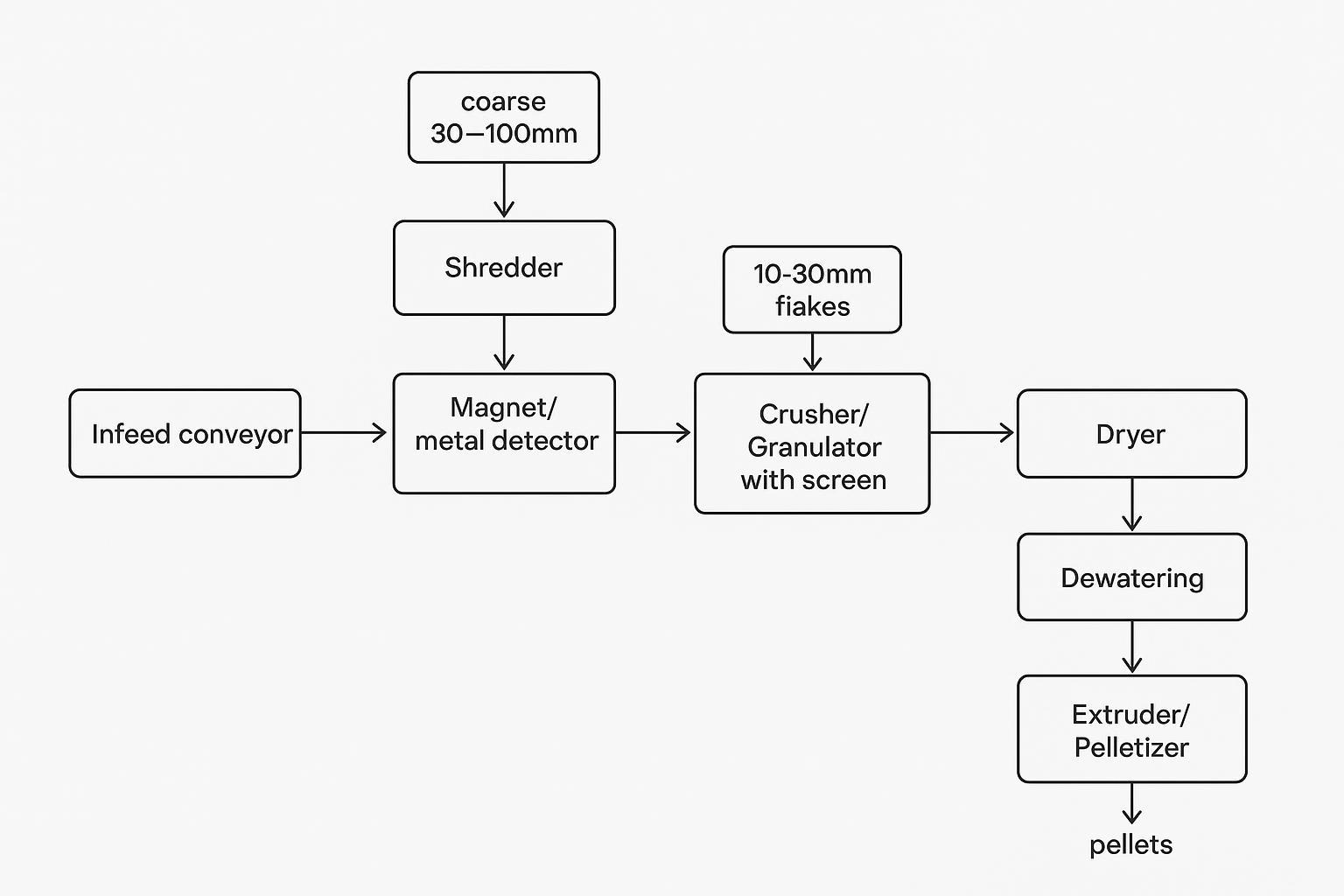
Here’s the common decision-stage pattern:
- Infeed and pre-sorting (as much as you can realistically do)
- Coarse size reduction (shredder) if needed
- Metal removal / detection
- Final sizing (crusher/granulator with screen)
- Washing, dewatering, drying
- Extrusion/pelletizing
Where metal removal usually belongs
If your stream is mixed/dirty, design the line so you can remove metal before the granulator/crusher.
Common approaches include:
- magnet(s) on a conveyor
- metal detector with reject
The best point varies by layout, but shredder-first often improves metal removal effectiveness because it liberates and exposes trapped items.
Don’t ignore feed control between machines
One common failure mode in shredder-over-granulator setups is shock loading: the shredder outputs irregular bursts, and the granulator gets flooded. The Recycling Product News article above calls out how shock loads shorten granulator life.
If you’re building a shredder-first front end, plan for:
- buffer / surge capacity
- controlled belt or auger feed into the crusher
- a way to keep film from “balling” at transfer points
The decision flow: do you need a shredder first?
This is the operator-grade logic. It’s not perfect, but it’s better than guessing.
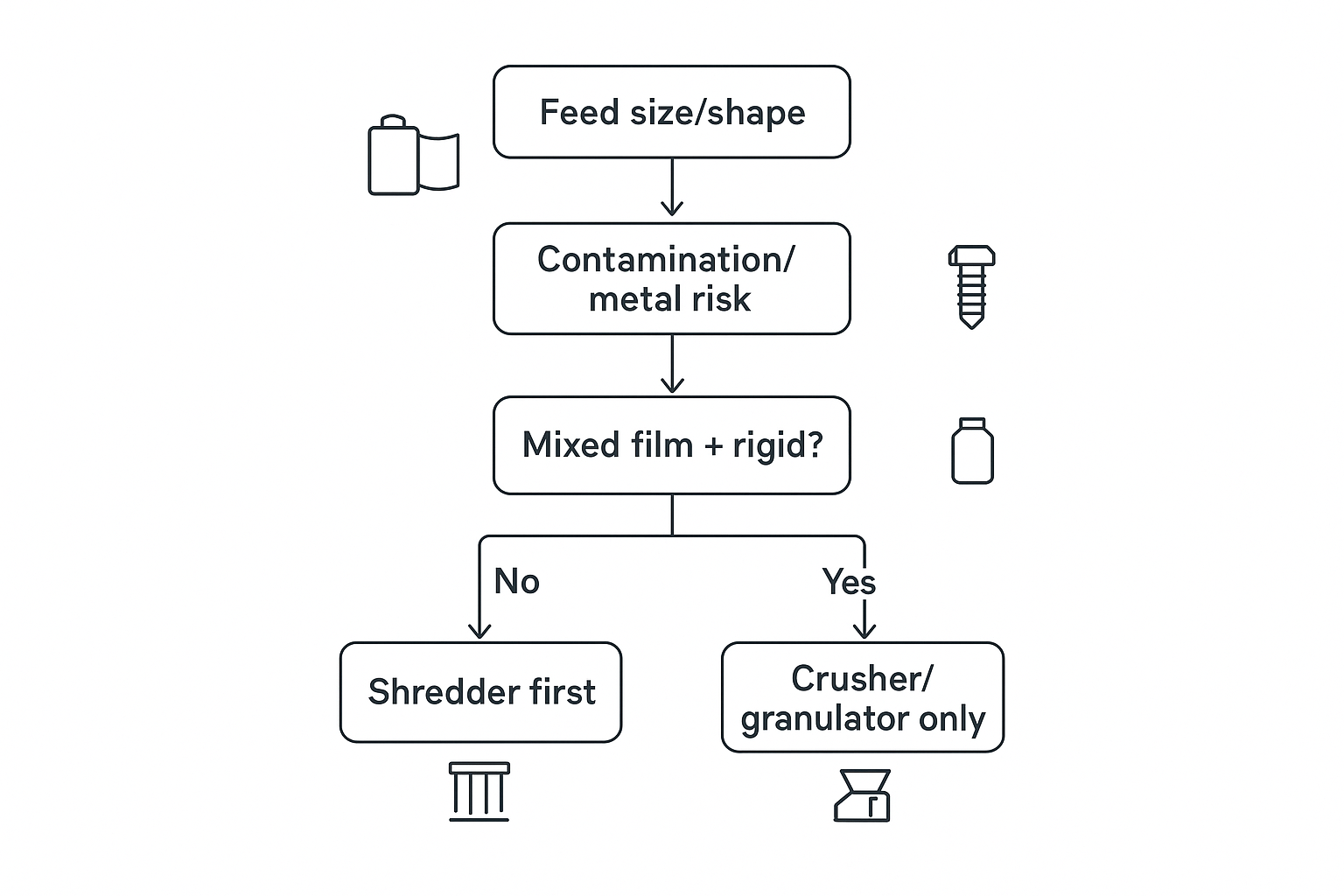
Use shredder-first if your answer is “yes” to any of these:
- Are your incoming parts too large or too irregular to fit the crusher safely and consistently?
- Do you see film + rigid together often enough that you can’t keep the feed stable?
- Is contamination (especially metal) a known risk?
- Are you trying to increase line uptime by reducing knife/screen damage?
If your feed is clean, consistent, and already near granulator-friendly size, you may be able to run crusher-only.
Spec checklist: what to ask for (and what to measure in a trial)
Decision-stage buying goes wrong when you buy on motor power alone or “capacity” numbers with no test conditions.
Step 1: define what “good output” means in your plant
Before you spec machines, write these down:
- feedstock mix (rough % rigid vs film)
- biggest expected piece size
- typical contamination (sand? stones? metal?)
- target throughput (and how many hours/day you truly run)
- downstream target (washed flakes for sale vs pelletizing)
If you don’t define these, every vendor can claim they’re a fit.
Step 2: shredder-side questions (if you think you need one)
Ask for:
- recommended feed opening and hopper design for your biggest items
- rotor type (single shaft vs twin shaft) and why it fits your stream
- knife type and expected wear behavior for dirty input
- discharge sizing method (screen/no screen) and expected output range
- how the machine handles film wrapping (design features + operating practices)
And ask the uncomfortable question: “What jams this machine on a bad day?”
Step 3: crusher/granulator questions (even if you shred first)
Ask for:
- knife layout and accessibility (how long a change really takes)
- screen size options and expected flake size distribution
- contamination tolerance limits (what’s a hard no?)
- anti-jam and overload protection features
Elant has a practical note on maintenance reality in crusher blade wear issues. Whether you run shredder-first or not, blade wear is where theoretical “capacity” turns into real cost.
Step 4: what to test (if you can run a sample)
If you can do a trial, don’t make it a beauty contest. Make it a stress test.
Bring:
- your worst mixed bales (film + rigid)
- representative contamination (labels, dirt; and if safe/legal, simulated metal risk that the test site approves)
Measure:
- throughput at steady feed (not peak bursts)
- how often the line needs operator intervention
- knife and screen condition after the test
- output size consistency and how it behaves in washing
Red flags: setups that look cheaper but cost you later
These are common “false economy” choices in mixed-stream lines:
“Crusher-only” on a mixed, dirty stream
It can run for a while. Then the hidden costs show up:
- unplanned stops
- knife/screen replacements
- bearing issues from repeated overload events
- inconsistent flake causing washing instability
No plan for metal risk
If your stream is mixed, plan for metal. A metal event is not just a damaged knife. It can be a rotor strike, a cracked screen, or worse.
No buffer between shredder and crusher
If you shred first and then dump output straight into the crusher, you’re inviting shock loading. Plan for controlled feeding.
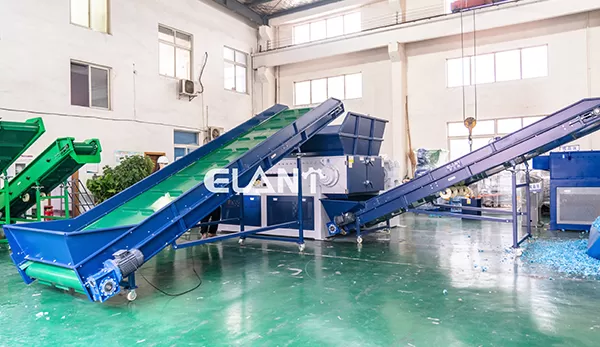
One real example photo (what a shredder looks like in the field)
Below is a real case photo from Elant’s site, included so the reader sees what we’re talking about when we say “shredder front end.”
FAQ
Is a shredder always required before a crusher?
No. If the feed is clean, consistent, and already manageable (often thin-wall and production scrap conditions), a granulator can sometimes do the job in one step. The problem is that many recycling streams aren’t that clean or consistent.
What’s the most common reason operators add a shredder later?
Unplanned downtime on the crusher/granulator: jams, knife damage, screen issues, and the labor to keep it running when the stream is mixed or dirty.
Does shredder-first always increase throughput?
Not automatically. It usually increases stable throughput (what you can run all shift) because it reduces stoppages. The total output still depends on feed prep, transfer design, and how well you control the flow between machines.
Where should size reduction sit relative to washing?
In most lines, you reduce size before washing so the washers can actually clean the material and you can dry it efficiently. Exactly how fine you go before washing is a design choice, but “whole parts into a washer” is rarely efficient.
Next step
If you want a shredder-first vs crusher-only recommendation that’s specific (not generic), share four things: your worst-case feed size, the rough rigid/film mix, what contamination you see in real life, and your target output (washed flakes or pelletizing).
From there, Elant Machinery can suggest a front-end layout and sizing approach that protects uptime instead of chasing peak “capacity” numbers.