
Buying a plastic recycling machine sized for your optimistic sales forecast — not your actual, verifiable material supply — is the single most expensive mistake recycling plant operators make in the United States.The result: a $300,000 extruder line running at 40% utilization, bleeding fixed costs while your ROI calculation quietly collapses.[5] This guide shows you how to size equipment against real production requirements, not projections.
At a glance
- Capacity math starts with material input, not output targets — reverse-engineer from what you can reliably source today.
- A standard utilization rate for plastic recycling equipment in commercial operations is 70–80% of nameplate capacity; plan around that, not the spec sheet maximum.
- Shredders, granulators, washing systems, extruders, and pelletizing lines each have distinct throughput ratings — mismatching them can create a plastic recycling line capacity bottleneck that caps your entire line.
- Machine price scales non-linearly with capacity: doubling throughput rarely doubles cost, but it does roughly double energy draw and floor space requirements.
- Modular designs let you add capacity in stages; locking into a single oversized machine at startup is a cash-flow risk most new recycling businesses underestimate.
- Profitability depends on plastic type: clean HDPE and PET consistently command the best margins on pellet resale in the U.S. market.
Understanding Plastic Recycling Machine Types Before Choosing Capacity
Choosing the right plastic recycling machine capacity is impossible until you know which machines you actually need — because each piece of equipment in a recycling line has its own throughput ceiling, and the slowest one determines your plant’s real output.
Shredders, granulators, and washing systems
Shredders reduce bulk plastic waste — baled bottles, film rolls, rigid containers — into flake or chip form. Industrial shredders for plastic recycling typically range from 200 kg/hr on the low end to 3,000+ kg/hr for high-volume operations. Granulators take that shredded material and reduce it further, producing uniform particle sizes that downstream equipment can process consistently.
Washing systems sit between size reduction and extrusion. For post-consumer plastic waste — the type most U.S. recyclers handle — washing is not optional. Contamination from food residue, labels, and adhesives directly degrades pellet quality and resale value.
A friction washer plus a hot-wash tank is standard for PET and HDPE lines; skipping or undersizing the washing stage to save money is a mistake that shows up in rejected pellets later.
🔍 Worth checking: Ask any recycling machine manufacturer for the washing system’s water consumption rate (liters per kg of material processed) before ordering. Water costs and wastewater disposal fees are frequently omitted from ROI projections but can be a meaningful annual expense for a mid-size U.S. plant; confirm actual figures with your local utility and wastewater authority before finalizing your financial model.
Extruders and pelletizing equipment
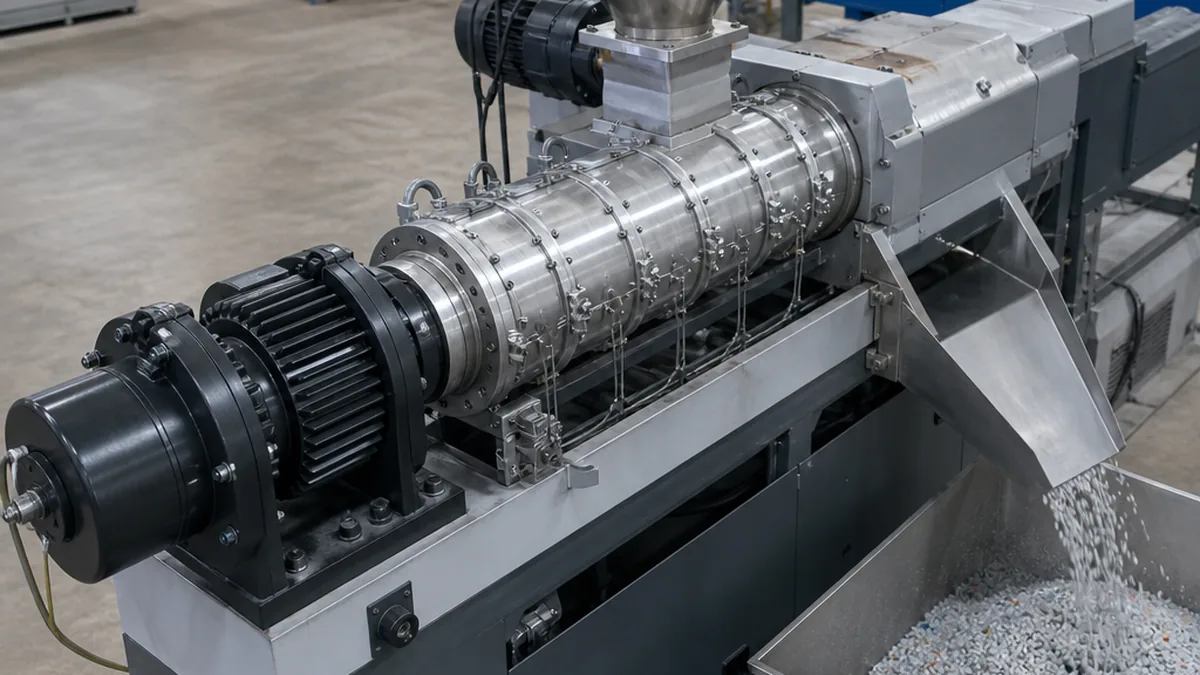
The extruder is where cleaned, shredded plastic becomes a sellable product: uniform pellets that resin buyers and compounders actually pay for. Single-screw extruders handle most commodity plastics (HDPE, PP, LDPE) at a lower capital cost. Twin-screw extruders offer better mixing and are necessary when processing contaminated or mixed-plastic streams that need compounding or additive integration.
Pelletizing line capacity is the number buyers care about most — because pellets per hour translates directly to revenue per hour. Pelletizing systems are rated by output weight, typically 100–1,500 kg/hr for mid-range commercial plastic recycling machines. That rating assumes clean, consistent input. Feed inconsistency — wet flake, variable particle size, mixed resin types — will drop actual output 20–35% below the nameplate figure.
How material type affects equipment selection
Different plastics demand different process configurations. This is where many buyers go wrong: they price a generic “plastic recycling machine” without specifying their actual material stream.
| Material | Typical Process Challenge | Equipment Implication |
|---|---|---|
| PET bottles | High wash demand; moisture sensitivity | Crystallizer dryer required before extrusion |
| HDPE (rigid) | Low contamination; high melt strength | Single-screw extruder adequate |
| LDPE / LLDPE film | Low bulk density; tangles in shredders | Agglomerator or force-feeder needed |
| PP mixed rigids | Variable MFI across sources | Filtration and melt-index testing critical |
| Mixed / unknown | Broad contamination range | Twin-screw preferred; output quality unpredictable |
The most profitable plastic to recycle in U.S. markets — consistently — is clean HDPE (bottles and industrial containers) and clear PET, because both have established domestic commodity buyers and predictable pellet pricing. Mixed or contaminated streams require more processing steps and sell at a significant discount.
How to Calculate the Plastic Recycling Capacity Your Plant Requires
The right approach is always input-first, not output-first. Start with what material you can reliably receive, then work forward to the machine size that handles it efficiently.
Calculate your material input and production target
Write down the maximum weekly tonnage of plastic waste you have confirmed supply contracts or collection agreements for — not what you expect to source in year three. Divide that by your planned operating days per week and operating hours per day.
Example: 60 tons/week ÷ 5 days ÷ 8 hours = 1.5 tons/hr (1,500 kg/hr) raw material input required.
That is your baseline figure. Everything else derives from it.
✅ Do this: Before approaching any recycling machine manufacturer, prepare a one-page material spec sheet: plastic types by percentage, contamination level, bale weight, and moisture content. Manufacturers who won’t size equipment to a spec sheet — and instead push a standard model — are a procurement risk.
Convert output requirements into hourly throughput
Raw plastic waste does not convert 1:1 into pellets. Process losses from washing, sorting rejects, and volatile purging typically run 10–20% by weight for clean post-industrial streams; post-consumer streams lose 20–35% depending on contamination.
Apply your loss factor to get net pellet output:
- 1,500 kg/hr input × 0.80 (20% loss) = 1,200 kg/hr pellet output
Financial Impact of Pellet Output
Note: the figures below reflect spot-market conditions at time of writing and are time-sensitive. Verify current pricing before using in financial projections.
At prevailing U.S. HDPE pellet spot-market prices (which fluctuate with commodity cycles), that line produces 1,200 kg/hr of pellets at verified nameplate utilization — sufficient to support multi-hundred-ton-per-month resale contracts. Gross revenue per hour depends entirely on the pellet price you can contract at the time of sale; do not lock a capacity decision to a specific $/kg figure without confirming current market rates with your intended buyers.
This pellet output figure — 1,200 kg/hr — is the capacity anchor for your equipment selection. The investment decision should be grounded in confirmed offtake pricing, not a spot-price snapshot.
Yield varies significantly by material type because contamination, sorting losses, and processing requirements affect how much input material becomes usable output.

Account for utilization rate and planned downtime
No recycling machine runs at 100% of nameplate capacity continuously. Industry-standard utilization for plastic recycling equipment in U.S. commercial operations is 70–80%, accounting for shift changes, cleaning cycles, screen pack changes on the extruder, and scheduled maintenance.
If your calculation requires 1,200 kg/hr of pellet output, size your equipment to deliver that at 75% utilization — meaning select a line rated for 1,600 kg/hr at nameplate.
The difference between production vs. production capability is exactly this gap: what the machine can do versus what it reliably does across a full operating year. Buyers who ignore this gap consistently underperform their pro forma projections.
Matching Machine Capacity to Your Recycling Production Goals
Undersized equipment destroys margins slowly; oversized equipment destroys them immediately through fixed cost drag. Neither failure is obvious at the purchase decision — which is why matching machine capacity to real production requirements deserves its own discipline.
A recycling plant processing 30 tons/day of HDPE operates in a fundamentally different cost structure than one processing 5 tons/day. The 30-ton plant amortizes its recycling machine investment over far more kilograms of pellets; its cost per kg drops dramatically. That scale advantage is why accurate capacity selection determines whether a recycling business is viable, not just profitable.
For U.S. operators, the practical capacity tiers break into three groups. Small-scale lines (200–500 kg/hr output) suit niche or specialty plastic waste streams — regional collection programs, industrial scrap consolidators. Mid-range lines (500–1,500 kg/hr) are the commercial sweet spot for most independent recyclers with reliable municipal or industrial material supply. High-capacity lines (1,500+ kg/hr) require long-term offtake contracts for both material input and pellet output before the investment is defensible.
🔍 Worth checking: Ask the recycling machine manufacturer for a cost-benefit analysis specific to your material stream before signing. A credible manufacturer will model gross pellet revenue, energy cost per kg, labor per shift, and maintenance reserve — not just quote a machine price. Manufacturers who skip this step are selling equipment, not solving your production problem.
One honest trade-off most articles skip: smaller machines from reputable manufacturers often outperform larger machines from unknown suppliers in total cost of ownership. A 600 kg/hr line with documented service history, available spare parts in the U.S., and local technical support is worth more than a 1,000 kg/hr line where a screen pack replacement takes six weeks to arrive.
What are the profit margins for plastic recycling? Well-run U.S. operations processing clean HDPE or PET can achieve stronger net margins than those handling contaminated or mixed streams, but actual figures vary considerably depending on feedstock costs, local labor rates, energy prices, and offtake contract terms; confirm realistic margin expectations with your accountant or a sector-specialist financial adviser before committing capital. Contaminated or mixed-plastic streams routinely compress margins to 5–10% or turn negative if sorting costs are high.
Plastic Recycling Machine Price Factors After Capacity Selection
Price is not the output of a capacity decision — it is an input to it. Once you know your required throughput, you can evaluate whether the investment makes financial sense before you buy.
Plastic recycling machine costs in the U.S. market vary across a wide range depending on throughput, automation level, and configuration. A basic single-stage granulator and extruder line for 200–400 kg/hr output typically starts around $80,000–$150,000 installed (note: a granulator unit alone can be sourced for significantly less, but that figure does not include an extruder, washing system, or installation). A complete washing, shredding, extruding, and pelletizing line for 800–1,200 kg/hr runs $300,000–$700,000 depending on washing system complexity and automation; mid-range complete lines in the $500,000+ range therefore fall within this bracket.
High-capacity lines above 2,000 kg/hr with full automation can exceed $1.5 million.
Three cost factors buyers consistently underestimate:
- Energy consumption: extruders are the largest power draw in any plastic recycling line — a 1,000 kg/hr line typically requires 150–250 kW installed capacity. At U.S. industrial electricity rates, energy can represent 20–30% of operating cost per kg of pellets produced.
- Spare parts availability: for U.S. buyers sourcing recycling equipment internationally, confirm that wear parts (screw and barrel sets, screen packs, cutter blades) are stocked domestically or can ship within 2 weeks. Downtime at $500–$1,500/hr erases margin fast.
- Installation and commissioning: budget 10–15% of equipment cost for site preparation, electrical work, and factory commissioning time. Many quotes exclude this entirely.
The experience and reputation of your recycling machine manufacturer matters precisely here — a supplier who has commissioned similar lines in the U.S. market will have realistic numbers for all three of these factors. Before committing a deposit, seek references from existing customers and verify that the manufacturer has demonstrated expertise with the specific plastic types in your material stream; a general catalog range is not a substitute for documented experience with your resin. Confirm independently that any claims about throughput, energy draw, or service availability are supported by verifiable customer references.
🚫 Avoid: Selecting a recycling machine based on price per kg/hr of nameplate capacity alone. A $200/kg-hr machine that runs at 60% utilization with high maintenance costs outspends a $280/kg-hr machine running at 80% utilization with low downtime — every time.
Planning Future Capacity Expansion
Build expansion into your initial layout, not your initial purchase. The single most cost-effective recycling capacity decision most plant operators never make is reserving floor space and electrical infrastructure for a second line before the first one is commissioned.
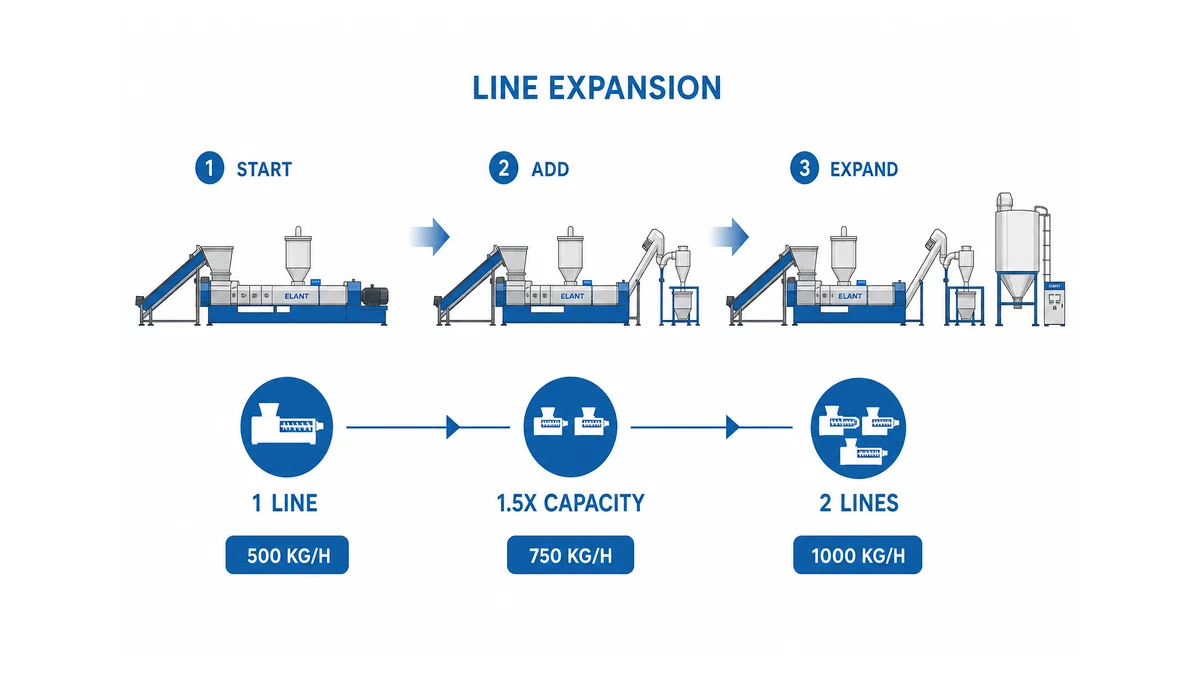
Modular recycling equipment designs allow you to add shredding capacity, a second extruder, or additional washing capacity as your material supply and market contracts grow. Starting with one 600 kg/hr line and adding a second 18 months later — if material supply justifies it — is a lower-risk capital strategy than commissioning a 1,200 kg/hr line on day one.
Before expansion, confirm three things: your material supply contracts support the additional throughput, you have a committed buyer for the additional pellet volume, and your facility’s electrical service can handle the load increase without a costly utility upgrade.
✅ Do this: When evaluating recycling equipment suppliers, ask explicitly whether their line design is modular and what the incremental cost to add a parallel processing stage looks like. A supplier who has already engineered that upgrade path for your configuration can quote it accurately; one who hasn’t will give you a number that grows significantly once engineering begins.
The recycling business landscape in the United States is shifting toward higher-quality pellet standards as brand owners increase recycled content commitments. That means the quality of your pelletizing equipment — filtration, melt-screening, pellet uniformity — matters more now than raw throughput. Plan expansion with quality upgrades in parallel, not just volume increases.
For operators ready to move from capacity planning to supplier evaluation, PET bottle recycling equipment options and plastic film recycling machine solutions provide practical references for comparing equipment configurations and technical requirements.
Have a project or a spec sheet in hand? Talk to elantmachine.com — real engineers answer.
FAQ
How much does a plastic recycling machine cost?
A plastic recycling machine in the United States ranges from roughly $20,000 for a small single-stage granulator to over $500,000 for a full extrusion and pelletizing line. Capacity is the primary cost driver: a 500 lb/hr system sits in a different budget tier than a 2,000 lb/hr line. Installation, electrical upgrades, and auxiliary equipment typically add 20 to 40 percent to the base machine price, so build those figures into your capacity-sizing budget from the start.
What is the profit margin for plastic recycling?
Net profit margins for plastic recycling operations in the United States typically run between 5 and 15 percent, depending on feedstock cost, contamination rates, resin type, and machine utilization. Running a machine at 60 percent capacity versus 90 percent capacity can swing a profitable plant into losses because fixed costs — depreciation, labor, electricity — stay constant. Matching machine capacity to verified material supply is the fastest lever operators have for protecting margin.
What is the most profitable plastic to recycle?
HDPE and PET are consistently the most profitable plastics to recycle in the United States because demand from domestic buyers is strong and contamination rates are relatively manageable. Profitability depends on plastic type: HDPE and PET consistently command the best margins on pellet resale in the U.S. market, which is why choosing the right capacity for your actual HDPE or PET supply is critical before committing to equipment.
Sources
[1] Plastics Molding and Forming Effluent Guidelines — epa.gov
[2] 2022 U.S. Post-Consumer Plastic Data — plasticsrecycling.org
[3] ECONOMIC IMPACT — plasticmakers.org
[4] Latest Issue — ptonline.com
[5] How to choose the right plastic recycling machine … — pureloop.com
[6] 10 Must-Have Plastic Recycling Machines — hunterplastics.com