
Choosing the right PET washing line capacity is not simply a matter of buying the largest system your budget allows.
A 500 kg/h line may be sufficient for a plant with limited or irregular PET bottle supply, while a 3000 or 4000 kg/h system only makes sense when feedstock, utilities, sorting, washing, drying, storage, and downstream processing can all support that throughput.
For buyers comparing PET bottle recycling equipment, the key question is therefore not:
“Which line has the highest capacity?”
It is:
“Which capacity can my plant feed, operate, and utilize consistently?”
PET washing lines are commonly available in capacity levels such as 500, 1000, 2000, 3000, and 4000 kg/h. Each capacity range creates different requirements for feedstock supply, plant organization, upstream sorting, water circulation, drying, labor, and downstream material handling.
This guide explains how to compare those capacity levels without oversizing or undersizing your recycling plant.
Why Rated PET Washing Line Capacity Is Only the Starting Point
A PET washing line rated at 2000 kg/h does not automatically mean that every plant will continuously produce 2000 kg of saleable clean PET flakes every hour.
Rated capacity describes the designed processing level of the equipment under suitable operating conditions. Actual plant throughput can change depending on the quality and consistency of the incoming material.
For example, loosely packed bottles, heavily contaminated post-consumer PET, excessive labels and caps, sand, mixed plastics, inconsistent bale density, and unstable feeding can all affect how smoothly material moves through the line.
Capacity also depends on whether the surrounding equipment can keep pace.
A high-output washing section provides little benefit if the sorting stage cannot supply bottles consistently, the crusher becomes a bottleneck, the drying system cannot handle the washed flakes, or finished material accumulates faster than it can be stored or pelletized.
That is why buyers should treat nominal kg/h as one part of a complete production system rather than as an isolated equipment specification.
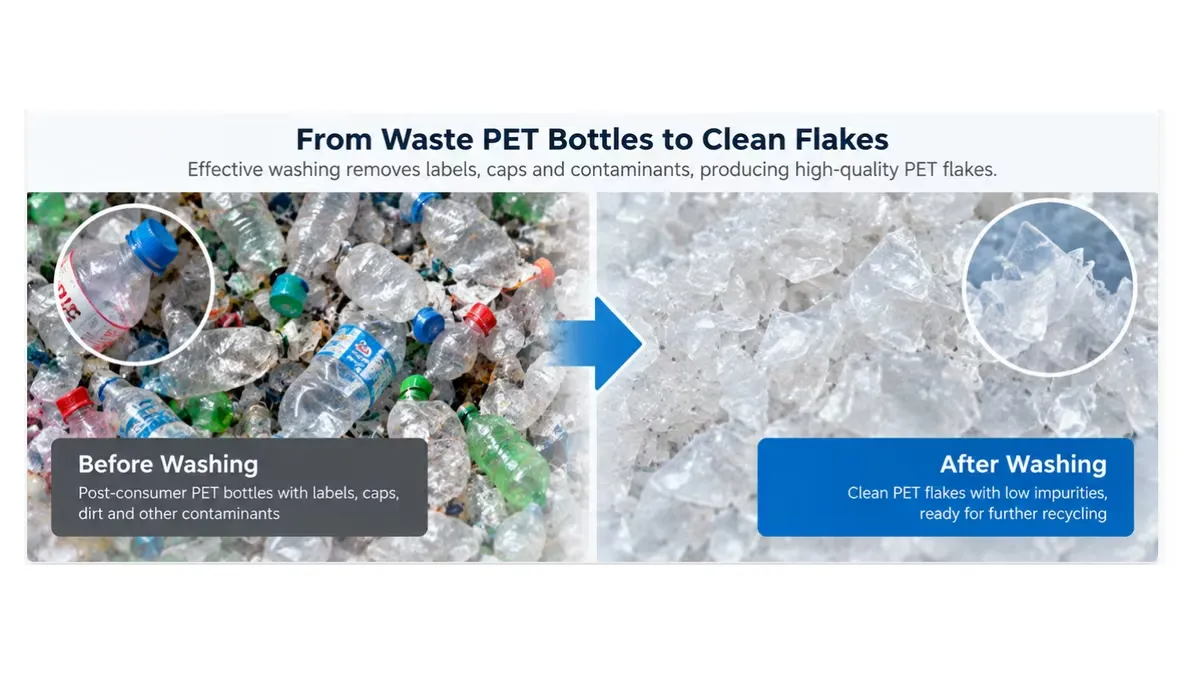
PET Washing Line Capacity Comparison: 500 to 4000 kg/h
The following comparison provides a practical way to think about the main capacity levels.
| PET Washing Line Capacity | Typical Buying Situation | Main Factors to Verify |
|---|---|---|
| 500 kg/h | Lower feedstock volume, initial recycling projects, or plants with limited throughput requirements | PET supply stability, daily operating schedule, room for future growth |
| 1000 kg/h | Commercial recycling operations with more consistent bottle supply | Material availability, sorting capacity, utilities, drying and storage |
| 2000 kg/h | Plants moving toward continuous medium-to-high-volume production | Line balance, automation, water circulation, drying capacity, downstream handling |
| 3000 kg/h | High-volume recycling operations with reliable feedstock sourcing | Feedstock logistics, continuous feeding, utilities, wastewater handling and plant layout |
| 4000 kg/h | Large-scale projects designed around high continuous throughput | Long-term PET supply, infrastructure capacity, automation, downstream demand and expansion planning |
These categories are not fixed definitions of plant size.
A 500 kg/h line operating for long production periods can process significant daily tonnage, while a poorly supplied 2000 kg/h line may spend much of the day running below its designed capacity.
The correct capacity therefore depends on how the entire recycling operation is organized.
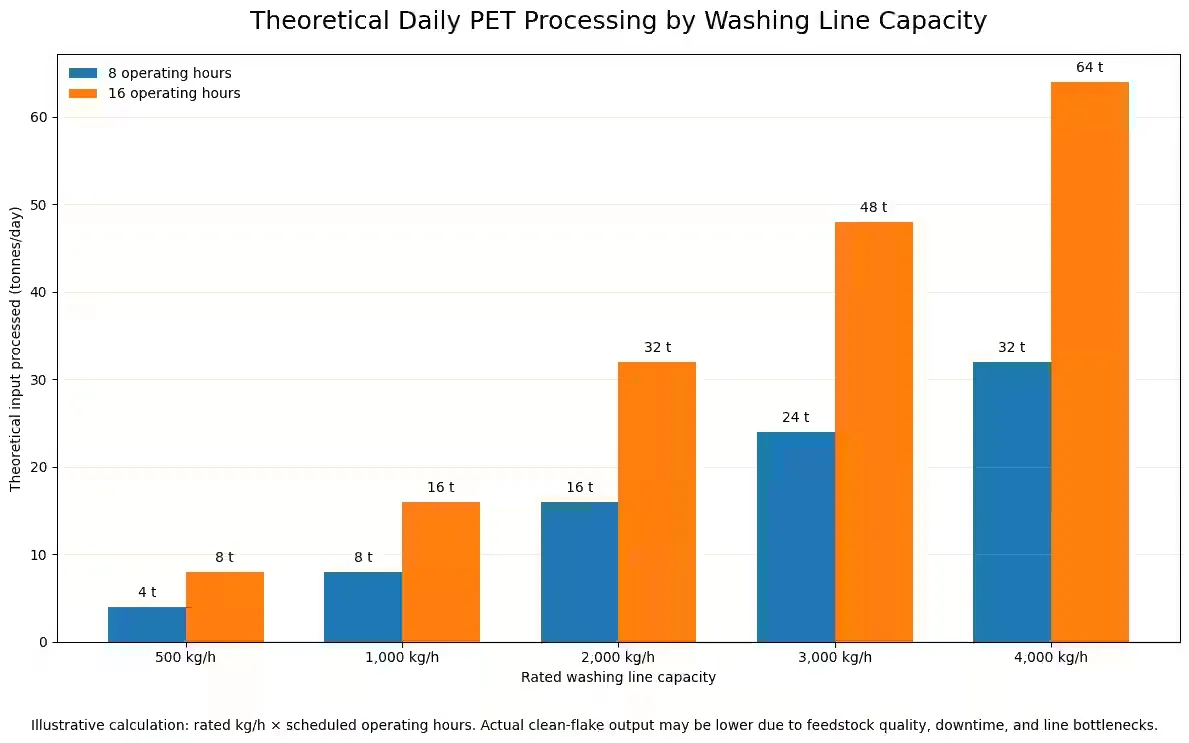
When a 500 kg/h PET Washing Line Makes Sense
A 500 kg/h system can be a practical starting point when the available PET bottle supply does not justify a larger installation.
This capacity is especially relevant when buyers are entering PET recycling gradually, sourcing bottles from a limited collection network, or operating in a market where feedstock volumes fluctuate.
Its main advantage is not simply that it is smaller. A lower-capacity line can reduce the risk of installing equipment that the plant cannot keep consistently supplied.
For a buyer considering 500 kg/h, the most important question is whether the current PET supply can keep the line running without frequent interruptions.
It is also important to consider future expansion.
If bottle collection volume is already increasing rapidly, choosing the minimum possible capacity may create another investment requirement sooner than expected. In that situation, buyers should compare the cost and operational implications of starting smaller against selecting a line with additional growth capacity.
A 500 kg/h configuration should therefore be selected because it matches the project—not simply because it represents the lowest capacity option.
When Moving to 1000 kg/h Becomes More Practical
A 1000 kg/h PET washing line represents a significant step up from smaller-capacity recycling systems because the plant must supply material more consistently.
At this level, feedstock planning becomes increasingly important.
Buyers should know how much PET bottle material can realistically reach the plant each week and whether that supply is predictable throughout the year.
The upstream process also matters more.
Sorting, bale opening, label removal, crushing, conveying, and feeding must work together so the washing section does not repeatedly wait for material.
At the same time, downstream equipment must be able to receive the resulting PET flakes without creating a new bottleneck.
For many buyers, the decision between 500 and 1000 kg/h therefore depends less on the machinery itself and more on whether the recycling business has moved from irregular material processing toward stable commercial production.
Why 2000 kg/h Requires More Attention to Line Balance
At around 2000 kg/h, capacity selection becomes increasingly dependent on the performance of the complete recycling line.
Simply increasing the size of one machine is not enough.
The front end must continuously receive, separate, and prepare PET bottles. Washing equipment must maintain stable material flow. Drying must keep up with washed flake output. Finished flakes then need sufficient transport, storage, bagging, or downstream pelletizing capacity.
If one section operates significantly below the rest of the system, the nominal washing-line capacity becomes less meaningful.
This is why buyers considering a 2000 kg/h system should pay particular attention to line balance.
For example, increasing washing capacity while retaining undersized drying or material-handling equipment can cause accumulation between process stages. Similarly, unstable feeding can cause a large line to repeatedly operate below its intended load.
At this capacity level, buyers should compare complete system configurations rather than judging suppliers only by the advertised kg/h figure.
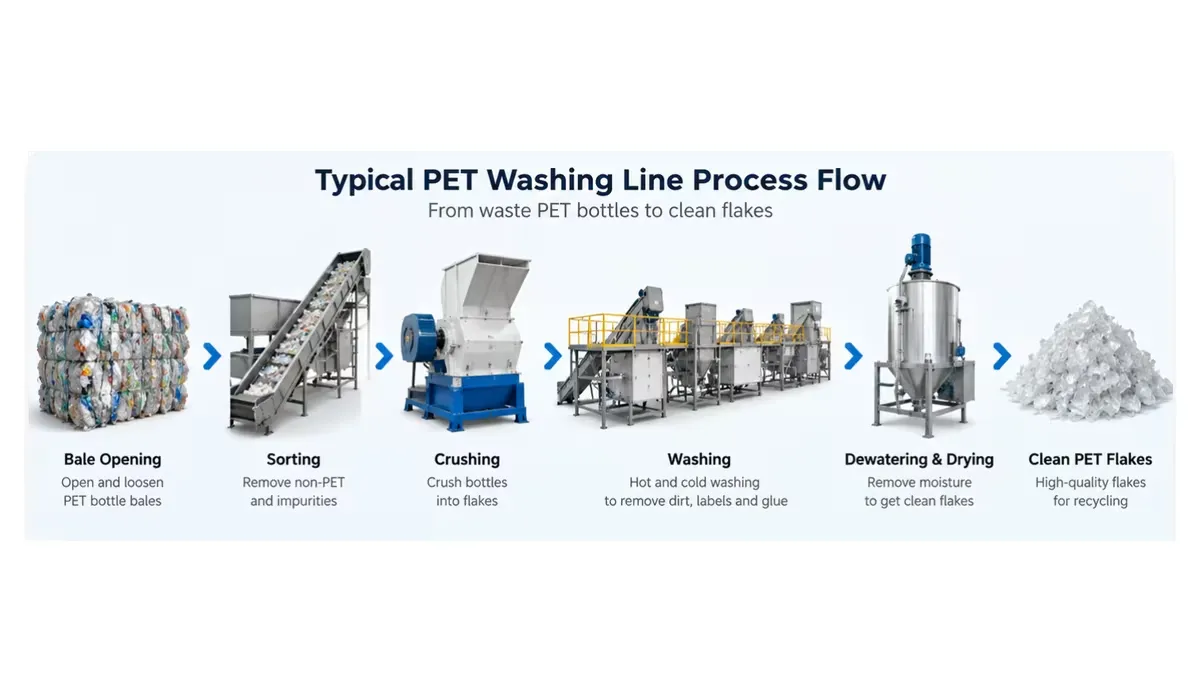
2000 kg/h PET Bottle Washing Line in Operation
When 3000 and 4000 kg/h PET Washing Lines Become Justifiable
The jump from 2000 kg/h to 3000 or 4000 kg/h should normally be supported by the overall recycling business, not just by plans for higher production.
Higher-capacity plants require a dependable flow of incoming PET bottles.
A line cannot deliver the intended commercial benefit if material shortages repeatedly force it to operate below capacity.
Feedstock logistics therefore become increasingly important. Buyers need to consider how bottles are collected, transported, baled, stored, opened, sorted, and continuously delivered to the processing line.
Utilities also require closer evaluation.
Higher throughput places greater demands on water circulation, wastewater treatment, electrical infrastructure, conveying, drying, and finished-flake handling. The exact requirements depend on the final equipment configuration and should be confirmed with the supplier rather than assumed from capacity alone.
Plant layout becomes another important consideration.
Higher throughput means more material is moving through the facility at the same time. Poorly planned storage areas, narrow material routes, or insufficient space between processing stages can undermine the advantages of larger machinery.
A 3000 or 4000 kg/h PET washing line therefore makes the most sense when the entire plant has been designed around sustained high-volume operation.
What Changes as PET Washing Line Capacity Increases?
Larger capacity affects much more than the size of the washing equipment.
| Factor | What Changes as Capacity Increases |
|---|---|
| Feedstock supply | More PET bottles must arrive consistently to prevent underutilization |
| Sorting | Manual or upstream sorting must keep pace with higher material flow |
| Material feeding | Stable feeding becomes increasingly important for continuous operation |
| Water management | Water circulation and wastewater handling must support higher throughput |
| Drying | The drying section must match the output of the washing section |
| Automation | Higher-capacity plants often benefit more from reducing unnecessary manual handling |
| Plant layout | Conveying routes, storage areas and equipment spacing become more important |
| Finished-flake handling | Bagging, silos, storage or downstream pelletizing must accept the output |
| Maintenance planning | Downtime has a greater production impact as hourly throughput rises |
| Feedstock logistics | Collection, bale storage and material scheduling become critical to utilization |
This is why comparing PET washing lines only by kg/h can be misleading.
The larger the plant becomes, the more important the surrounding process infrastructure becomes.
Do Not Choose Capacity Based Only on Your Current Bottle Supply
Current PET availability matters, but buyers should also think about how feedstock supply may change after the recycling plant begins operating.
Installing excessive capacity can leave expensive equipment underutilized.
However, choosing a line that exactly matches today’s maximum material volume can also create problems if the collection network expands soon after installation.
The more useful question is whether future PET supply growth is reasonably predictable.
If additional suppliers, collection contracts, municipal sources, or commercial waste streams are already being developed, additional capacity may be justified.
If future material availability is uncertain, buying a much larger line based purely on expected growth can increase investment risk.
Capacity planning should therefore distinguish between confirmed material supply and possible future material supply.
Avoid Oversizing the PET Washing Line
Oversizing does not automatically create a more efficient recycling plant.
A 4000 kg/h line running well below its designed loading conditions may not deliver the expected economic advantage over a properly utilized smaller line.
Underutilization can also make it harder to justify the infrastructure required around higher-capacity equipment.
This includes feedstock storage, sorting systems, water treatment, material conveying, drying, electrical supply, finished-product storage, and maintenance resources.
Before choosing a larger capacity “for safety,” buyers should confirm that enough material will actually be available to use that capacity.
Future expansion should be considered, but it should not replace realistic feedstock planning.
Avoid Undersizing the Line as Well
Selecting too little capacity creates a different set of problems.
If PET bottles consistently accumulate faster than they can be processed, the plant may need longer production schedules, additional shifts, more intermediate storage, or an earlier-than-planned equipment upgrade.
A line that appears economical at the purchasing stage may therefore become restrictive once the recycling business grows.
This is especially relevant for buyers with established bottle collection networks or long-term supply agreements.
The goal is not to choose the smallest possible machine.
The goal is to select enough capacity to handle realistic production demand while maintaining reasonable room for operating variation and future growth.
Higher Capacity Does Not Mean the Price Increases at the Same Rate
Capacity and investment are related, but PET washing line pricing should not be treated as a simple price-per-kg/h calculation.
A higher-capacity system may require changes to several sections of the line rather than simply larger versions of the same machines.
Automation level, contamination level, hot washing requirements, drying method, water treatment, sorting configuration, electrical components, material handling, and final flake specifications can all change the total project cost.
Two PET washing lines with the same nominal capacity can therefore have substantially different configurations.
For that reason, capacity selection and price comparison should remain separate purchasing decisions.
First determine the appropriate throughput range. Then compare the equipment configuration and quotation required to achieve that throughput.
When Should You Move Up to the Next Capacity Level?
Buyers should consider the next capacity range when several operating conditions begin pointing in the same direction.
The strongest signals include consistently increasing PET bottle supply, regular material backlog, extended operating schedules needed just to keep up with incoming bottles, planned expansion of collection channels, sufficient utility infrastructure, and downstream equipment capable of accepting additional output.
However, one factor alone should not determine the decision.
For example, having enough factory space for a 3000 kg/h system does not mean the plant can supply enough bottles to utilize it. Likewise, having abundant feedstock does not help if the drying or downstream pelletizing system cannot process the additional flakes.
Moving to the next capacity level should therefore be based on the complete material and production flow.
Information to Prepare Before Asking a Supplier for Capacity Recommendations
Before requesting a PET washing line proposal, buyers should prepare the following information:
- Expected PET bottle volume per day or month
- Planned daily operating hours
- Bottle condition and contamination level
- Whether bottles arrive loose or baled
- Approximate proportion of labels, caps and non-PET material
- Required final PET flake quality
- Available factory space and utility conditions
- Whether washed flakes will be sold directly or processed further
- Current production requirement and expected future expansion
Providing this information allows the supplier to recommend a complete line configuration instead of simply quoting the nearest advertised capacity.
Which PET Washing Line Capacity Should You Choose?
There is no single capacity that is best for every PET recycling plant.
A 500 kg/h line may be more appropriate than a 2000 kg/h system when bottle supply is limited.
A 1000 kg/h line may provide a better balance when feedstock volumes have become more stable.
A 2000 kg/h system requires stronger coordination between sorting, washing, drying, and downstream handling.
And 3000–4000 kg/h configurations become most valuable when a recycling operation has the feedstock logistics, utilities, plant infrastructure, and downstream demand required to keep a high-capacity system productive.
The correct decision is therefore not:
Buy the largest PET washing line possible.
It is:
Choose the capacity your entire recycling operation can support consistently, while allowing reasonable room for future growth.
For a final equipment recommendation, capacity should be confirmed together with feedstock condition, required flake quality, process configuration, available utilities, and downstream production plans.
FAQ
How much water does a PET washing line use at different capacities?
Water demand generally increases with throughput, but the exact requirement depends on the washing process, contamination level, hot-wash configuration, and water-recirculation system. Buyers should ask suppliers for fresh-water consumption and recirculation requirements for the exact proposed line rather than estimating from kg/h alone.
How much factory space is needed for a high-capacity PET washing line?
The required area includes more than the machine footprint. Buyers also need space for PET bale storage, sorting, conveying, water treatment, finished-flake storage, maintenance access, and forklift movement. The supplier should therefore confirm the complete layout after reviewing the factory dimensions and target capacity.
Do baled PET bottles require a debaler before entering the washing line?
For plants receiving compressed PET bottle bales, a debaler can provide more consistent opening and feeding before sorting and washing. Manual bale opening may be possible at lower production volumes, but continuous higher-capacity operation usually places greater importance on stable upstream feeding.
Does a higher-capacity PET washing line require more automation?
Usually, the value of automation increases as throughput rises because interruptions, inconsistent feeding, and manual handling have a larger effect on hourly production. However, the necessary automation level depends on labor costs, feedstock condition, sorting requirements, and the overall line configuration.
Can a larger PET washing line reduce the processing cost per ton?
Potentially, but it is not guaranteed. The result depends on utilization, automation, labor, utilities, maintenance, feedstock availability, downtime, and downstream capacity. A smaller line running consistently may be more economical than a larger system operating far below its designed throughput.
Sources
[1] Design for Recycling Guidelines – Packaging — recyclass.eu
[2] PET Design & Bale Spec Guidelines — napcor.com