
A PET washing line nameplate rating tells you flake output capacity — but nameplate ratings are measured under ideal lab conditions, not with real post-consumer bales.
Start from bale feed rate instead, apply each yield-loss stage, and you get a number you can actually build a procurement decision around.
At a glance
- Bale feed rate (kg/hr gross input) is the anchor for all capacity math on a PET bottle washing line
- Post-consumer PET bales typically carry 10–20% yield losses before clean flake exits the dryer
- The feed rate formula: Net flake output = Gross bale feed rate × (1 − contamination fraction) × mechanical yield factor
- A 1,000 kg/hr washing line nameplate = roughly 800–870 kg/hr net PET flakes under real operating conditions; delivering that nameplate output requires approximately 1,200 kg/hr gross bale feed rate
- The slowest single stage — not the nameplate — caps the whole recycling line
- Pre-purchase: always request OEM data sheets for each machine stage, not just a bundled line specification
Why Bale Feed Rate Is the Right Starting Point for Capacity Planning
Vendors quote washing line capacity in kg/hr of clean PET flakes output. That number sounds definitive. It isn’t — because it assumes the input material is already clean, dry, and uniformly sized. Real post-consumer PET bottle bales are none of those things.
Starting from bale feed rate anchors your math to what you’re actually buying: compressed, mixed, wet PET bottles with labels, caps, moisture, and varying contamination. Every loss stage downstream is predictable and measurable from there.
If you start from flake output and work backward, you’ll consistently undersize the front end of your washing line — which is why you should match your plastic recycling machine capacity to real feed conditions rather than nameplate output alone.
For a broader look at the equipment used across these stages, see our PET bottle washing line solutions.
What bale feed rate actually measures
Bale feed rate is the mass of compressed PET bottle bales fed into the bale breaker per hour — measured in kg/hr. It is a gross input figure, not a net output figure. It includes everything inside the bale: PET bottle material, residual liquids, paper and film labels, HDPE and PP caps, dirt, and any non-PET contamination sorted out during pre-sorting.
The difference between feed rate and final flake output is the sum of all those losses. Treating the two numbers as interchangeable is the single most common sizing error buyers make.
How bale density and compaction affect the number
Bale density for post-consumer PET bottles varies considerably depending on baler type and bottle crush ratio; published industry figures span a wide range, and actual values depend on your specific baler and collection stream. Confirm the bale density with your bale supplier before sizing equipment, and check with your local authority or equipment OEM for applicable guidance [1].
This matters for bale breaker sizing: the machine is rated by volume throughput, not mass. Always convert your target kg/hr feed rate to m³/hr using your supplier’s actual bale density before specifying the bale breaker conveyor speed. If you skip this step, a 1,000 kg/hr line spec can physically receive only 700 kg/hr of light bales from your actual bale supplier.[5]
The Hidden Losses Between Bale and Clean Flake
Every stage in a PET bottle washing line removes something — which means every stage also removes mass. Engineers who size a line on output alone consistently underestimate how much gross feed rate they need. Here’s where the mass goes.
Moisture and label weight reduction
Wet post-consumer PET bottles carry some residual liquid by weight; commonly cited figures vary, and the actual amount depends on collection method, climate, and bottle type. Treat any specific percentage as an estimate and confirm with your own bale quality testing or your local authority [2]. Labels and adhesive add additional non-PET mass to each bale. Paper and film labels are often cited as comprising approximately 1% of total bottle weight, but together with other non-PET materials — residual liquid, adhesives, and mixed contaminants — the combined non-PET fraction from labels and related materials can plausibly reach 3–8% of bale weight depending on regional collection standards and bottle type mix; this broader range is not directly confirmed for labels alone, so verify it against your own bale quality data [6].
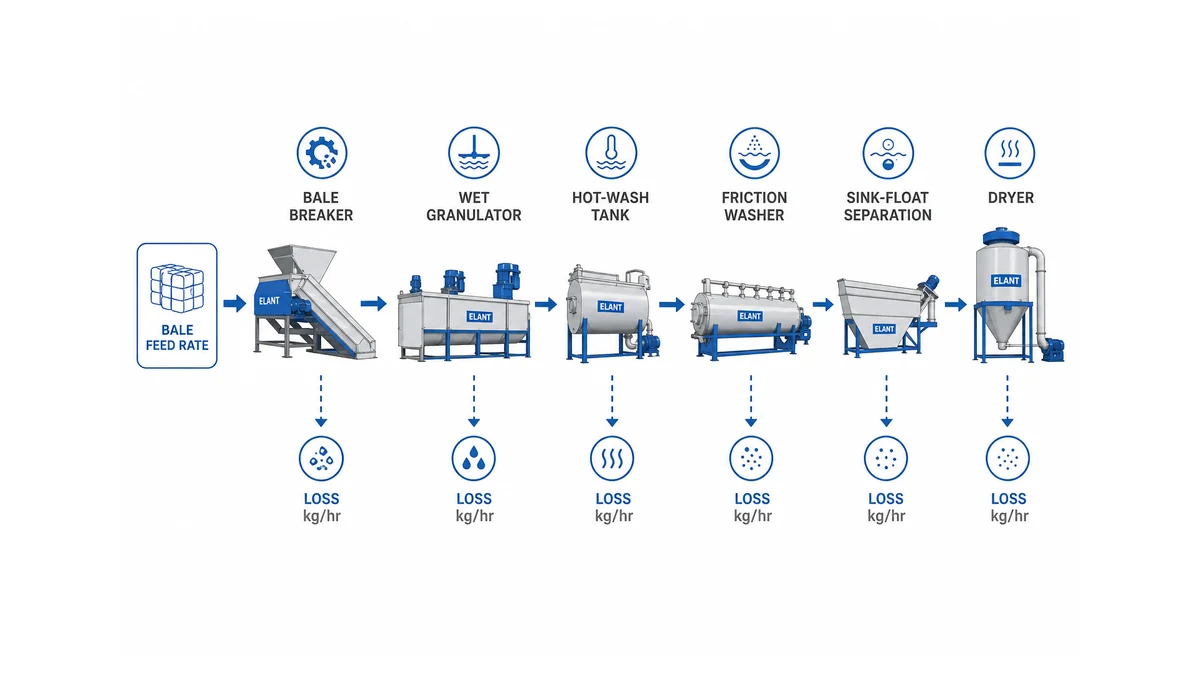
The washing process removes both moisture and labels. A hot-wash tank at elevated temperature with caustic solution detaches label adhesive; the friction washer strips film. By the time bottles reach the crusher, effective wet-weight input has already dropped measurably versus the original bale mass. This reduction is not “waste” — it’s the washing line doing its job — but it must be factored into your feed rate formula.
Fines, caps, and contamination losses
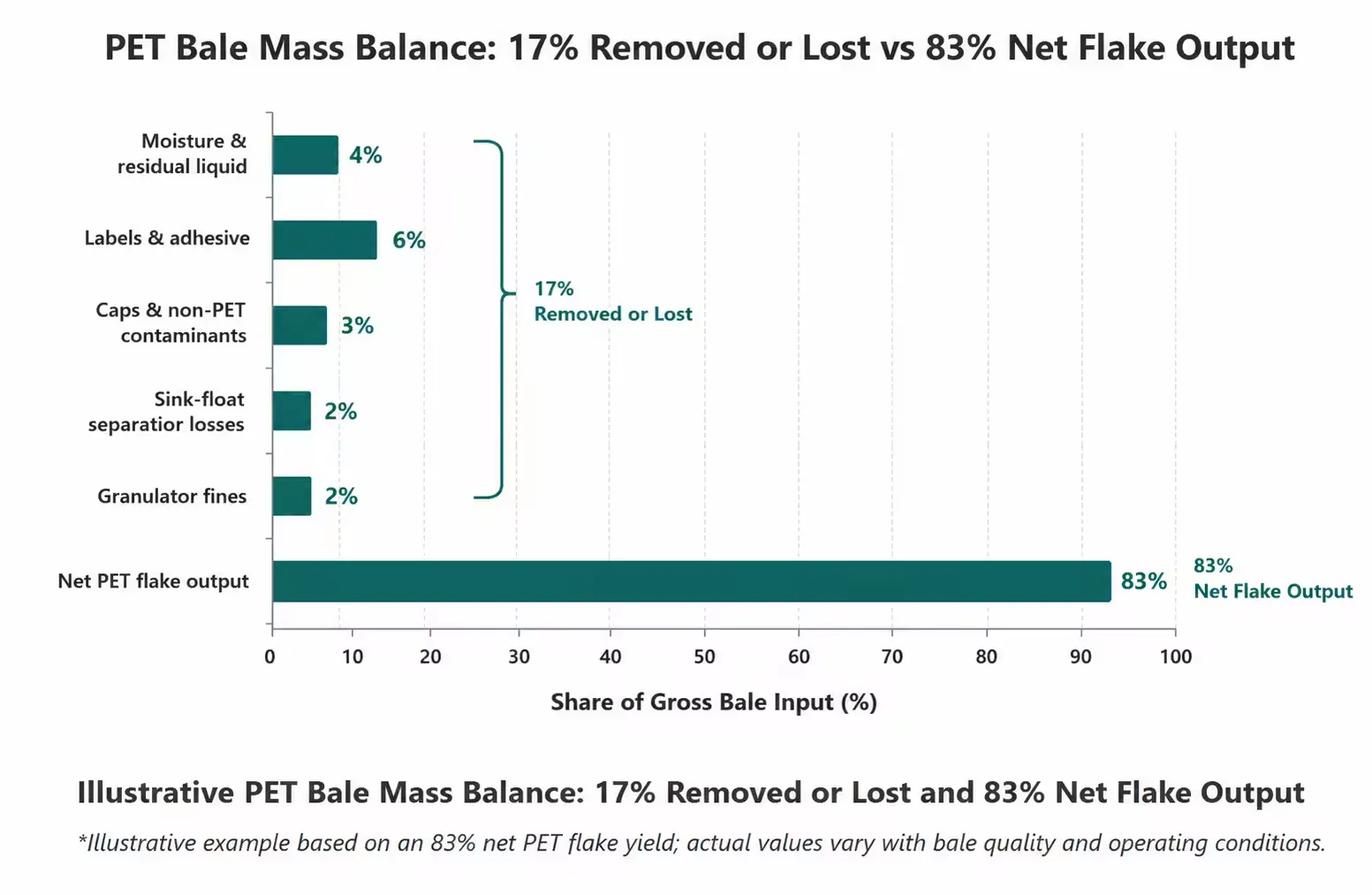
Post-sort separation of HDPE caps, PP caps, and non-PET contaminants (glass, metals, PVC bottles mixed into the bale) typically accounts for 2–5% mass loss. The sink-float separation tank then separates PET flakes (density ~1.37–1.38 g/cm³, which sink) from HDPE and PP (density <1.0 g/cm³, which float), removing an additional 1–4% depending on cap-removal efficiency upstream.
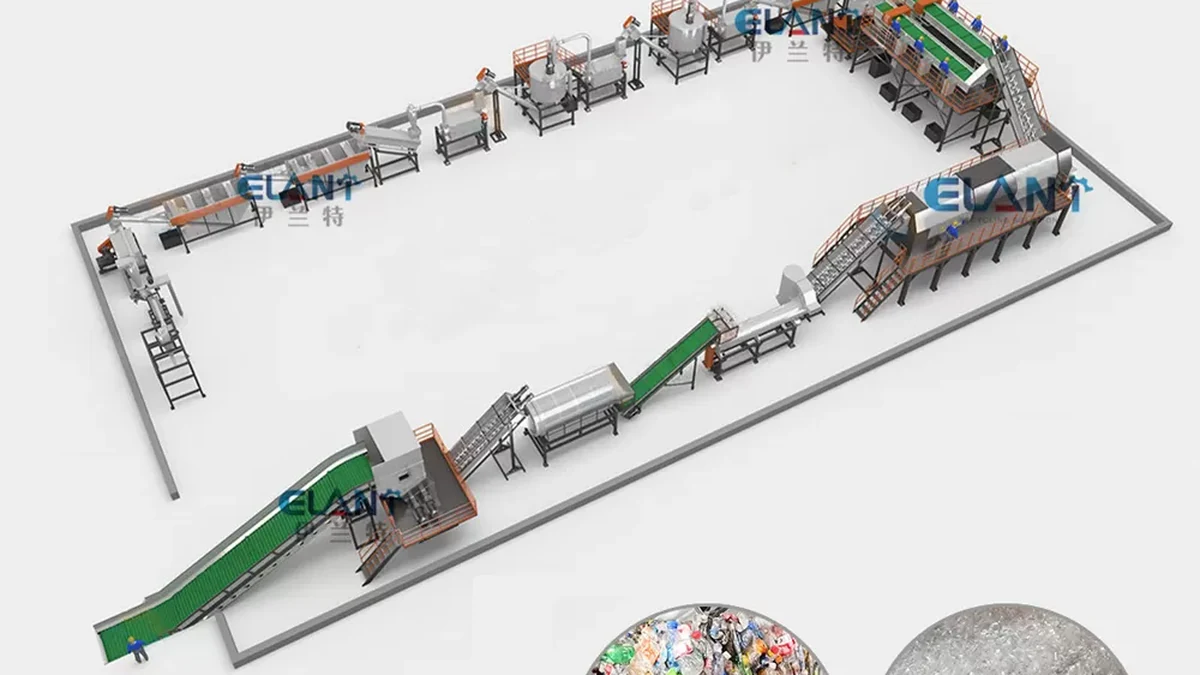
Fines generated in the wet granulator — fragments too small for food-grade flake specifications — add another 1–2% loss. These numbers are individually small. Combined, they accumulate fast.
Typical overall yield range for post-consumer PET bales
Across a properly functioning PET recycling line processing standard post-consumer clear and light-blue PET bottles, overall yield — clean PET flakes out ÷ bale weight in — typically runs 80–90% [3]. Mixed-color or heavily contaminated bales drop to 75–82%. Food-grade hot-wash lines processing high-quality single-stream bales can reach 88–92%.

Use 83% as a conservative working assumption for mixed post-consumer PET bottle bales. You can tighten this once you have actual bale quality data from your supplier.
Step-by-Step Formula: Converting Bale Feed Rate to Net Flake Output
This is the core calculation. Work through it in order. Skipping a step produces an optimistic number that will haunt you at commissioning.
Step 1 — Establish gross bale feed rate (kg/hr)
Start with your target annual production, then work backward. If you need 7,000 metric tons/year of clean PET flakes and your line runs 330 days/year at 22 hours/day (allowing 2 hrs/day for maintenance), your required net output rate is:
7,000,000 kg ÷ (330 × 22) = ~965 kg/hr net flake output required
That’s your target output. Now you need the gross bale feed rate.
Step 2 — Apply contamination and moisture deductions
Estimate total non-PET content in your bales. For mixed post-consumer PET bottles sourced through U.S. municipal recycling programs, a reasonable starting figure is 15% combined moisture, label, and contamination fraction. Note that this contamination fraction represents the estimated non-PET mass fraction present in the bale — it is a material composition factor, not a stage-by-stage mechanical yield loss factor (which is applied separately in Step 3).
Gross feed rate (pre-contamination) = Net output target ÷ (1 − contamination fraction) = 965 kg/hr ÷ 0.85 = ~1,135 kg/hr
Step 3 — Apply mechanical yield factor per process stage
Each machine stage has a mechanical yield factor — the fraction of input mass that exits as usable product. A typical PET bottle washing line with granulator, hot-wash tank, friction washer, and sink-float separation runs a combined mechanical yield of approximately 0.97–0.99 (i.e., 1–3% loss from fines, foam, and residual moisture not captured by the contamination deduction in Step 2).
Adjusted gross feed rate = 1,135 kg/hr ÷ 0.97 = ~1,170 kg/hr gross bale input required
Step 4 — Arrive at rated net flake output
Cross-check: 1,170 kg/hr gross × 0.85 (contamination yield) × 0.97 (mechanical yield) = ~965 kg/hr net PET flakes. That matches the target. Round up to the next standard line tier — in this case, a 1,000 kg/hr washing line is undersized; specify a 1,200 or 2,000 kg/hr line depending on your growth plans.
✅ Do this: Run the formula twice — once with your best-case bale quality estimate and once with a worst-case 20% contamination assumption. The spread between those two outputs tells you how much buffer capacity you actually need.
How Individual Machine Stages Constrain Your Line’s True Throughput
A washing line’s true throughput is set by its slowest stage, not its nameplate rating. This is the bottleneck principle applied to PET recycling, and ignoring it is expensive.
Bale breaker and pre-sort throughput ceiling
The bale breaker and pre-sort conveyor define the maximum physical throughput of the entire line. If your bale breaker can only process 900 kg/hr of bales, the downstream hot-wash tank and friction washer are irrelevant — the whole washing line is capped at 900 kg/hr input. Specify the bale breaker with 15–20% headroom above your calculated gross feed rate.
Crusher and wet-granulator sizing match
The wet granulator (crusher) is typically sized to match the bale breaker output. Mismatch — an undersized granulator behind a high-feed bale breaker — causes bottle accumulation, increased fines generation, and granulator motor overload. Check that the granulator’s rated kg/hr input matches or exceeds the bale breaker output, not just the downstream wash tank design flow.
Hot-wash tank and friction washer residence time
Hot-wash tank capacity is a function of residence time, not just volume throughput. PET flakes require sufficient time at elevated temperature with caustic solution to remove label adhesive and surface contamination effectively; the specific temperature, duration, and chemical parameters depend on your flake quality targets and equipment design — confirm the required conditions with your OEM and verify against applicable local specifications [4]. If the feed rate pushes flakes through the tank faster than the residence time design allows, washing quality drops and the output fails food-contact cleanliness specifications.
The friction washer downstream operates at high rotational speed to strip film labels from PET flakes through mechanical friction and water flow. Its throughput ceiling is tied to rotor speed and internal volume — typically published in the OEM data sheet as kg/hr at a specified moisture-in / moisture-out ratio.
Dryer and pelletizer downstream limits
The centrifugal dryer and thermal dryer are often the most under-specified stages in a PET bottle washing line. They are specified last and often sized to match the wash tank design output — which already has buffer stripped out by the time engineers get there. A dryer undersized by 10% relative to peak washing line output means wet flakes, failed moisture specs, and pelletizer jams.
🔍 Worth checking: Request the OEM’s drying curve data — moisture content (%) versus residence time at rated throughput. Confirm it achieves <0.5% moisture at your calculated net feed rate, not at a reduced test rate.
Matching Calculated Capacity to Standard Line Size Tiers
PET washing lines are manufactured in standard tiers. In the U.S. market, the common configurations are 500 kg/hr, 1,000 kg/hr, 2,000 kg/hr, and 3,000 kg/hr net flake output. Custom intermediate capacities exist but carry longer lead times and higher capital cost.
| Calculated Net Output | Standard Line Tier | Typical Gross Bale Feed Rate | Typical Installed Power |
|---|---|---|---|
| Up to 430 kg/hr | 500 kg/hr line | ~600 kg/hr | 150–200 kW |
| 430–860 kg/hr | 1,000 kg/hr line | ~1,200 kg/hr | 250–350 kW |
| 860–1,720 kg/hr | 2,000 kg/hr line | ~2,400 kg/hr | 450–600 kW |
| 1,720–2,580 kg/hr | 3,000 kg/hr line | ~3,600 kg/hr | 650–900 kW |
Gross bale feed rate estimated at 83% yield. Power figures are indicative ranges — confirm with OEM data sheets.
When to round up versus accept the next standard tier
Round up when your calculated output lands within 10% of the lower tier’s ceiling. A 1,000 kg/hr line running at 95% of nameplate has no buffer for bale quality variation, scheduled maintenance windows, or a hot-wash temperature drop during a cold startup. Running any washing line above 90% of nameplate continuously accelerates wear on the granulator, friction washer bearings, and dryer seals.
Buffer capacity and planned downtime allowance
A 15–20% buffer above your calculated peak requirement is standard engineering practice for PET recycling lines. Plan for a minimum of 10% downtime annually for blade changes on the granulator, screen replacements on the friction washer, and caustic solution changeouts on the hot-wash tank. Factor this into your annualized throughput calculation before specifying the line tier.
Verify Your Numbers Before You Commit: a Pre-Purchase Checklist
The formula gives you a defensible number. The checklist below is how you confirm that the equipment you’re buying actually delivers it.
Get bale quality data in writing before you finalize the line spec. Request certified test reports from your bale supplier showing moisture content, PET content percentage, cap and label fraction, and non-PET contamination rate. If your supplier cannot provide these, budget for an independent bale quality audit — it costs far less than specifying a line tier too small for your actual input.
Request OEM data sheets for every individual machine stage, not just a bundled line specification sheet. The data sheet for each stage should show: rated input kg/hr, rated output kg/hr, power draw at rated throughput, and the test conditions under which those figures were measured. Mismatches between stages are the most common cause of a washing line underperforming its nameplate.
Ask specifically about the hot-wash tank residence time at your calculated feed rate. This is the most frequently glossed-over specification in PET bottle washing line quotations. A tank sized for 1,000 kg/hr nominal may only deliver the required 20-minute residence time up to 800 kg/hr actual throughput. Confirm the dwell time calculation, not just the tank volume.
Verify sink-float separation tank dimensions against your PET flake particle size distribution. If your wet granulator produces a wide particle size distribution — common with mixed PET bottle types — fine PET flakes can carry over into the float fraction, reducing yield and contaminating your HDPE/PP byproduct stream.
Run a cold-commissioning test at 110% of your planned daily average throughput before accepting the line. If the OEM will not guarantee performance at that rate in the commissioning protocol, negotiate it in before signing the purchase contract — not after the washing line arrives on-site.
The math behind a PET washing line capacity calculation is straightforward. The error almost always happens before the calculation: either using the wrong input (flake output instead of bale feed rate) or accepting a bundled nameplate spec without verifying each stage independently. Get the bale quality data, run the formula, and ask the OEM to defend each stage data sheet individually.
That sequence closes the gap between what’s promised and what the recycling line delivers.
Have a project or a spec sheet in hand? Talk to elantmachine.com — real engineers answer.
FAQ
What PET bale contamination percentage should I use when sizing a washing line?
For mixed post-consumer PET bottle bales, a 15% combined contamination and moisture allowance is a reasonable starting point for preliminary capacity calculations. However, actual bale quality can vary significantly. It is better to calculate both a normal case and a worst-case scenario using up to 20% contamination, then size the washing line with enough capacity margin to handle poorer-quality feedstock.
What clean PET flake yield can I expect from post-consumer bottle bales?
A properly operated PET bottle washing line typically recovers about 80–90% of the incoming bale weight as clean PET flakes. Mixed-color or heavily contaminated bales may yield only about 75–82%, while higher-quality single-stream PET feedstock can reach roughly 88–92%. Actual yield depends on moisture, labels, caps, contamination, fines generation, and separation efficiency.
Why does a PET washing line produce less than its rated kg/hr capacity?
Rated capacity is normally based on controlled operating conditions, while real PET bales contain moisture, labels, caps, adhesives, dirt, and non-PET materials. These materials are removed during sorting and washing, reducing the mass that becomes usable PET flakes. Actual throughput can also fall when one machine in the line cannot process material as quickly as the other stages.
What happens if PET bale feed rate exceeds crusher capacity?
If bale feed enters the line faster than the crusher or wet granulator can process it, bottles can accumulate upstream and the crusher may operate under excessive load. This can increase fines generation, raise motor load, reduce throughput stability, and create a bottleneck for the entire washing line. The crusher’s rated input should therefore match or exceed the maximum bale feed rate.
Sources
[1] Model Bale Specifications — plasticsrecycling.org
[2] 2023 US PET Bottle Recycling Rate Reaches Highest … — napcor.com
[3] APR Design Guide Overview — plasticsrecycling.org
[4] PET Flakes Recycling Process Overview | PDF | Adhesive — scribd.com
[5] PET Bottle Washing Line Capacity Sizing Guide — energycle.com
[6] PET Bottle Washing Line: Selection Guide, Costs & ROI – Kitech — kitech-recycling.com