
The mistake recycling operations make isn’t buying the wrong shredder — it’s buying a shredder optimized for tonnage when the buyer’s actual problem is contamination. A procurement manager running a post-consumer plastics line learns this after the first batch of regrind gets rejected by their pelletizer supplier: throughput is irrelevant when material quality fails the purity spec.
Plastic shredders for high-purity recycling are a specific equipment category where blade geometry, chamber sealing, and particle-size control determine whether your output is sellable resin or mixed-fraction waste.
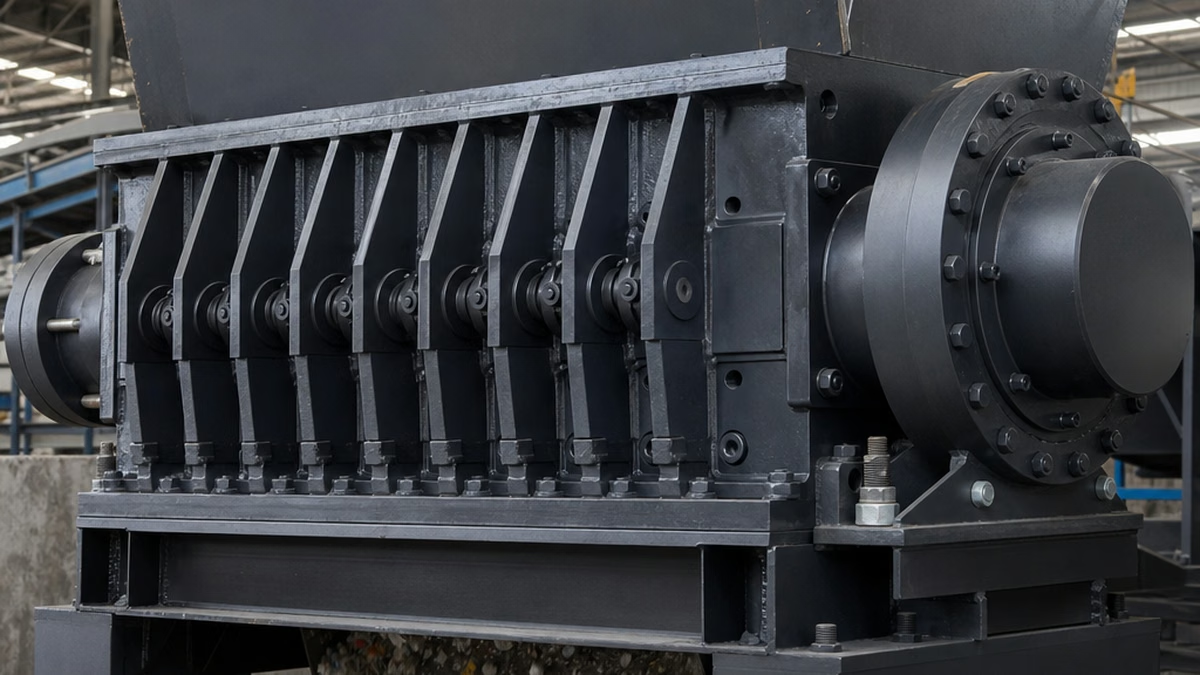
At a glance
- Core function: Reduce plastic waste into smaller, more uniform pieces for downstream sorting, washing, and recycling processes.
- Purity lever: Proper blade clearance helps reduce contamination carry-over and improves cutting consistency. The required clearance depends on shredder design, plastic type, and target output size.
- Output particle range: Shredders typically reduce bulky plastic waste into smaller pieces suitable for sorting, washing, or further size reduction. Output size depends on rotor design, screen size, and processing requirements.
- Critical material quality factor: Cross-contamination between different plastic types (e.g., PET mixed with HDPE) can reduce recycled material value and limit suitable applications.
- Motor power range: Industrial shredders handling rigid plastic waste cover a wide range of motor configurations; consult manufacturer specifications for your specific material and capacity requirements.
- Key certifications for U.S. operations: Electrical and safety requirements vary by jurisdiction. Confirm applicable requirements with your local authority having jurisdiction (AHJ). CE marking is mainly used for European market compliance and does not replace U.S.-specific requirements.
- Maintenance window: Blade replacement cycles vary depending on plastic type, hardness, operating conditions, and maintenance practices.
Why High-Purity Recycling Requires Better Shredder Design
High-purity plastic recycling demands shredder design that actively prevents cross-contamination, not just one that reduces size. Standard industrial shredders move plastic waste through as fast as possible. High-purity shredders slow that process down — deliberately — to give each fraction controlled exposure to the cutting mechanism.
The reason is chemistry. PET, HDPE, PP, and PVC all require separate downstream processing streams. Once these plastics are shredded together into sub-20mm particles, optical sorting and float-sink separation become the only recovery paths — both of which add cost and lose yield. A shredder that allows mixed-resin throughput destroys margin before the plastic reaches the wash line.
U.S. recyclers targeting food-grade rPET or automotive-grade recycled PP face high purity requirements from their end buyers — verify the exact threshold required with your specific buyers and applicable industry standards, as these figures vary by application and market.
That threshold is set not by preference but by the reprocessing equipment downstream — single-screw extruders and compounders can foul at relatively low contamination levels; consult your equipment supplier for the tolerance applicable to your specific process [2].
This is where shredder selection stops being a purchasing line item and becomes a material quality control decision.
Key Shredder Design Factors That Affect Recycling Purity
Shredder design affects material quality through four specific mechanisms. Get these right, and your output particle consistency improves enough to skip a secondary screening step.
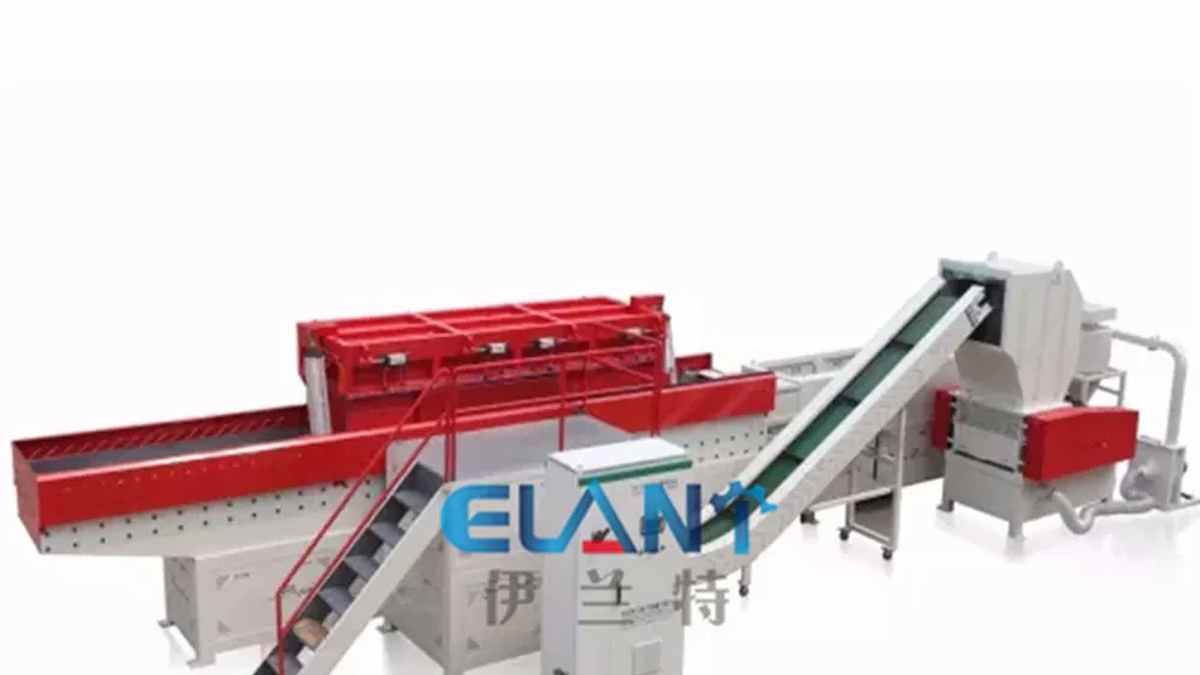
Blade configuration and gap tolerance
The gap between rotor blades and counter-knives is one of the most important settings affecting cutting performance and output quality. For rigid plastics such as HDPE bottles, PP crates, and ABS housings, proper blade clearance helps achieve consistent cutting performance and reduce excessive fines generation.
For film plastics and flexible packaging, rotor geometry and staggered blade designs can help reduce film wrap-around and improve feeding stability.
For film plastics and flexible packaging, the geometry shifts. A V-shaped rotor with staggered blades prevents film wrap-around, which is the failure mode that generates heat, degrades polymer chains, and introduces thermal contamination into an otherwise clean plastic waste stream.
Worth checking: Ask your shredder supplier for blade gap specifications under actual operating conditions. Gap performance may change because of thermal expansion, material loading, and machine wear.
Screen size selection
The screen size in size-reduction equipment helps control the final particle size. In systems equipped with screens, it is an important factor affecting downstream processing requirements.
| Screen Size | Typical Output Use | Contamination Risk |
|---|---|---|
| 25–50 mm | Pre-shredding before granulator | Low — larger particles are easier to identify and separate during downstream sorting |
| 10–20 mm | Common wash-line feed size for many rigid plastic recycling applications | Medium — downstream separation may still be required depending on material mix |
| 5–10 mm | Smaller feed size for further processing or granulation applications | Higher if mixed materials or excessive fines are present |
| <5 mm | Fine regrind applications requiring additional quality control | Requires careful control of material purity, particle size distribution, and processing conditions |
Running a fine screen on mixed-plastics input without proper sorting can increase the risk of rejected output. Screens control particle size, but they cannot separate different resin types.
Rotor type and plastic compatibility
Not every rotor design handles every plastic type. This is where most buyers make their first costly specification error.
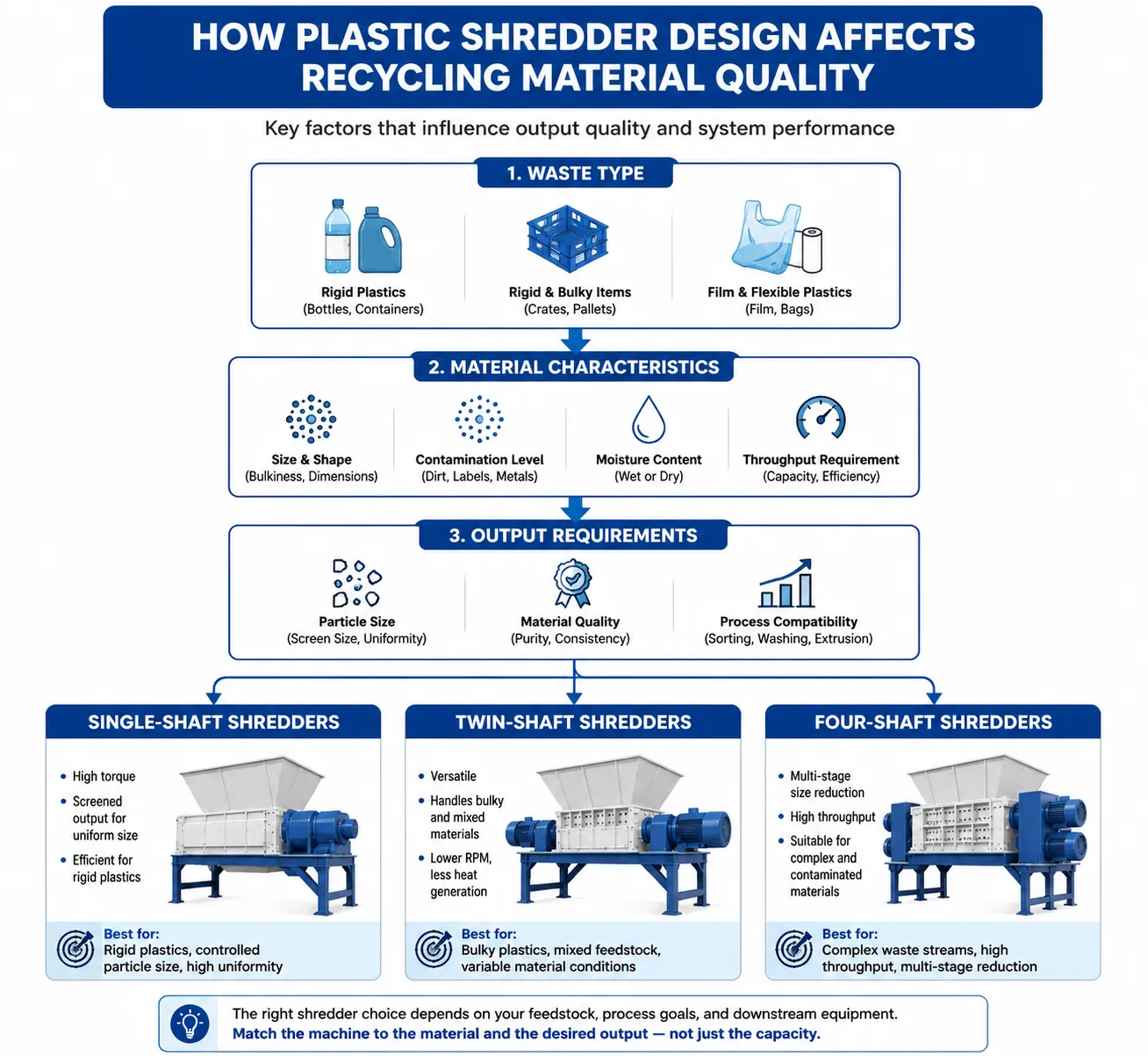
- Single-shaft shredders with a screen: best for rigid industrial plastic waste — bottles, pipes, profiles. Produce consistent particle size. Poor choice for film.
- Twin-shaft shredders: better for bulky plastic waste, bales, and mixed feedstock. They operate at lower RPM than single-shaft machines, which reduces heat generation, though particle size uniformity is generally lower than single-shaft.
- Four-shaft shredders: used for high-contamination mixed plastics or e-waste plastic housings where metal contamination is present. Built-in redundancy reduces downtime.
- Granulators (not technically shredders, but often confused): operate at high RPM for fine cutting after primary shredding. Never use a granulator as the first-stage machine for bulky plastic waste — the result is catastrophic blade damage and immediate particle-size failure.
Chamber sealing and contamination isolation
Industrial plastic shredders used in high-purity applications should feature sealed processing chambers and negative-pressure dust-extraction systems. Open-chamber designs may allow fine plastic particles to remain inside the equipment or migrate into the surrounding area, increasing the risk of cross-contamination between production runs—for example, when PVC and food-grade polypropylene are processed on the same line.
🚫 Avoid: Processing PVC and food-contact plastics with the same shredder unless a validated cleaning, purging, and inspection procedure is followed. Mechanical shredding of PVC can generate fine, potentially hazardous dust and leave residues on internal surfaces. These residues may contaminate subsequent material streams. Consult the equipment supplier and relevant occupational health and safety authorities to establish appropriate containment, cleaning, and handling procedures
Typical Particle Size by Shredder Type for Rigid Plastics
| Equipment Type | Typical Output Size Range |
|---|---|
| Four-shaft shredder | 20–60 mm |
| Twin-shaft shredder | 20–80 mm |
| Single-shaft shredder | 10–50 mm (depending on screen size) |
| Granulator | 5–15 mm |
How Shredder Design Affects Downstream Recycling Quality
The shredder’s output is the input spec for every machine downstream. That dependency runs tighter than most operations account for.
Particle uniformity determines wash efficiency. A wash line designed for a specific particle size will perform below its rated cleaning efficiency when fed significantly oversized particles mixed with fines — the fines don’t get adequate dwell time in the friction washer, and the oversized pieces don’t get fully wetted [3]. The result is residual surface contamination that shows up in the melt index of the finished pellet.
Optical sorting accuracy also degrades with non-uniform particle sizes. Near-infrared (NIR) sorting machines — the standard for PET/HDPE/PP separation in U.S. plastic recycling operations — are calibrated to a specific particle size window; consult your NIR equipment supplier for the size range appropriate to your system. Fines pass under the NIR beam without reliable identification. Oversized particles block neighboring particles from the sensor.
The downstream quality chain works like this:
- Shredder particle uniformity → determines wash-line mono-fraction purity
- Wash-line purity → determines NIR sort accuracy
- NIR sort accuracy → determines extruder melt quality and output pellet spec
- Pellet spec → determines whether end buyers accept the material
A specification failure at step one propagates through every subsequent stage. This is why material quality assurance in plastic recycling starts with the shredder, not the extruder.
| Particle Uniformity | Potential Impact on NIR Sorting |
|---|---|
| More consistent particle sizes | Easier material recognition and fewer overlapping pieces |
| Moderate size variation | May reduce sorting efficiency when particles overlap |
| Large size variation | Can make identification and separation more difficult |
The industrial shredder selection checklist we provide covers this step explicitly.
Why Purity Matters More Than Maximum Throughput
Maximum throughput is an attractive specification when comparing industrial plastic shredders. However, for recycling operations selling material into quality-sensitive markets, output consistency and purity requirements often have a greater impact on profitability than peak capacity alone.
A throughput-focused calculation can overlook an important factor: recycled material that fails customer specifications may need to be sold at a lower-value grade instead of meeting higher-value applications. The actual price difference depends on material type, market conditions, and end-user requirements, so recyclers should verify current market values with buyers and material partners before making financial projections[4].
For high-volume recycling operations, even a small amount of off-spec material can create significant losses over time. Factors such as incorrect particle size, excessive contamination, poor sorting efficiency, or inconsistent feed preparation can reduce the value of the final recycled product.
Throughput calculations often assume stable operating conditions, while real-world performance is affected by maintenance requirements, blade wear, material characteristics, and operating environment. Industrial plastic shredders processing hard plastics such as ABS, polycarbonate, or filled PP may experience different wear patterns compared with machines handling softer materials such as HDPE or PET.
When evaluating an industrial shredder purchase, recycling operators should consider:
- Define the required material quality specification first — downstream product requirements should guide shredding parameters and equipment selection.
- Understand your plastic waste composition — material type, contamination level, and whether the waste stream is mixed or single-material will influence the appropriate shredder configuration.
- Request material testing before finalizing specifications — particle size distribution (PSD) testing can help verify whether the selected shredder matches the application requirements.
- Evaluate blade replacement requirements and maintenance cycles — operating costs depend on wear conditions, maintenance frequency, and material characteristics, not only energy consumption.
- Check contamination control and chamber design — important for operations that process multiple resin types or require higher material quality consistency.
Recycling operations that consistently achieve high-quality output usually treat shredder selection as part of the overall material quality control process, rather than choosing equipment based only on maximum throughput.
As recycled content requirements and customer quality expectations continue to increase, producing consistent, specification-grade material is becoming increasingly important for long-term recycling operations. The right shredder configuration can help improve process stability, reduce quality issues, and support more reliable downstream processing.
Many recycling operators find that output quality problems are not always caused by insufficient machine performance, but by a mismatch between equipment configuration, material characteristics, and downstream processing requirements.
These issues can often be reduced by evaluating material properties, required particle size, contamination levels, and processing goals before selecting an industrial shredder.
Have a project or a spec sheet in hand? Talk to elantmachine.com — real engineers answer.
FAQ
Why Does High-Purity Recycling Require Better Shredder Design?
High-purity recycling requires a properly designed shredder because size reduction affects particle consistency, contamination control, and downstream processing efficiency. Poorly matched equipment or unsuitable operating conditions may increase fines generation, material mixing, or inconsistent output quality, which can reduce the value of recycled materials.
Features such as appropriate rotor design, durable cutting components, and suitable screen sizing help maintain consistent particle sizes and improve processing stability. However, achieving specification-grade recycled resin also depends on other stages, including sorting, washing, filtration, and quality control throughout the recycling process.
Sources
[1] Seven States and Counting: The 2025 Guide to EPR … — proskauer.com
[2] Recycled Plastics in Food Packaging — fda.gov
[3] Plastics Standards – Standards Products — store.astm.org
[4] ISRI SPECS — isrispecs.org
[5] Producer Responsibility for Plastics: 2024 State Policy … — ncelenviro.org