
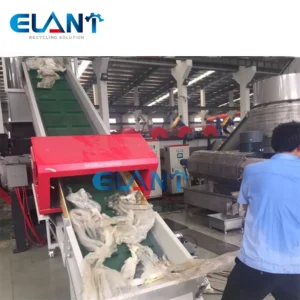
LDPE 4 recycling depends on more than collecting plastic film and sending it through a washing line. For recycling plants that process LDPE film, stretch film, shrink film, shopping bags, agricultural film, and mixed PE film, the dryness of washed film is one of the most important control points for stable output and clean recycled pellets.
For film recycling projects, Elant Machinery provides PP PE plastic film washing line solutions, plastic squeezer machines, and PP PE LDPE plastic film pelletizing machines for washed film processing and pelletizing.
What Is LDPE 4 Plastic?
LDPE stands for low-density polyethylene. It is identified by the resin identification code 4 and is widely used in flexible packaging because it is soft, lightweight, flexible, and moisture resistant. LDPE is commonly found in plastic bags, shrink film, stretch wrap, liners, flexible packaging, and some squeeze bottles.
Unlike rigid plastics such as HDPE bottles or PET containers, LDPE film is thin, flexible, and easily folded. These properties make it useful in packaging, but they also make it harder to wash, dewater, dry, and feed into recycling equipment.
| LDPE Feature | Benefit in Packaging | Challenge in Recycling |
|---|---|---|
| Flexible structure | Useful for bags, wraps, and film | Can fold and trap moisture or dirt |
| Low density | Lightweight and cost-effective | Difficult to feed evenly after washing |
| Moisture resistance | Protects packaged goods | Water can remain between folded film layers |
| Soft film form | Good for flexible packaging | Can wrap around shafts or clog equipment |
| Common contamination | Used in many consumer and industrial applications | Often mixed with labels, dirt, food residue, and other plastics |
Why Washed Film Dryness Matters in LDPE Recycling
After washing, LDPE film must be dewatered and dried before pelletizing. If the film remains too wet, moisture can carry contaminants forward and disrupt extrusion. Excess water also increases energy consumption because the pelletizing line must remove or evaporate moisture during processing.
Elant Machinery explains related operating risks in its article on LDPE film recycling dryness checks and the guide on how excess moisture leads to downtime and production losses.
| Moisture Problem | Impact on Recycling | Typical Result |
|---|---|---|
| Water trapped inside folded film | Contaminants remain attached to the film surface | Dirty flakes or unstable pellet quality |
| High moisture before extrusion | Steam forms inside the extruder | Bubbles, voids, or porous pellets |
| Wet film entering the compactor | Material temperature becomes unstable | Feeding fluctuation and output instability |
| Poor dewatering efficiency | Drying load increases | Higher power consumption |
| Moisture mixed with organic residue | Odor and microbial growth may increase | Lower recycled material value |
Common Sources of Contamination in LDPE Film
LDPE film waste often comes from post-consumer and post-industrial streams. The contamination level can vary widely depending on collection method, storage conditions, and previous use. Cleaner film is easier to recycle, while dirty film requires stronger washing, dewatering, and drying control.
For more detail on contamination cost, see Elant Machinery’s article on how dirty film contamination increases LDPE recycling costs.
| Contamination Type | Where It Comes From | Why It Matters |
|---|---|---|
| Dirt and sand | Agricultural film, outdoor storage, collection yards | Causes wear, reduces pellet quality, increases washing load |
| Food residue | Consumer bags and packaging | Creates odor and microbial risk |
| Paper labels | Retail packaging and mixed waste | Breaks into fibers and creates sludge |
| Adhesive and glue | Labels, tapes, stickers | Can remain on film after washing |
| Other plastics | Mixed PE, PP, PVC, PET, multilayer packaging | May reduce melt stability and final pellet quality |
| Moisture | Washing, rain, storage, folded film layers | Increases drying burden and extrusion defects |
How the LDPE Film Washing Process Works
A plastic film washing line is designed to remove dirt, labels, organic residue, and other contaminants before the material enters drying and pelletizing. A complete line may include pre-sorting, crushing or shredding, friction washing, floating washing, rinsing, squeezing, drying, and material collection.
Elant Machinery provides a detailed product page for the PE PP film washing line and an overview of the PP PE film washing line process.
| Process Stage | Main Function | Dryness or Contamination Control Role |
|---|---|---|
| Sorting | Removes large foreign materials | Reduces non-LDPE contamination before washing |
| Shredding or crushing | Reduces film size | Improves washing contact area |
| Friction washing | Scrubs film surface | Removes dirt, labels, and loose residue |
| Floating washing | Separates light film from heavy contaminants | Helps remove sand, metal, and dense foreign material |
| Rinsing | Removes detergent and remaining dirt | Prevents contamination from carrying into drying |
| Squeezing | Mechanically removes water | Critical for reducing moisture before pelletizing |
| Drying | Reduces remaining moisture | Improves feeding and extrusion stability |
Why Mechanical Squeezing Is Critical

Because LDPE film is thin and flexible, simple centrifugal drying may not be enough for high-moisture washed film. A plastic film squeezer can press and partially densify washed film, reducing moisture and making the material easier to handle before pelletizing.
For equipment details, see Elant Machinery’s plastic film squeezer machine and the article on how film squeezer control impacts pelletizing results.
| Without Effective Squeezing | With Effective Squeezing |
|---|---|
| Film remains wet and fluffy | Film becomes drier and more compact |
| Feeding into pelletizer is unstable | Feeding becomes more consistent |
| More steam forms during extrusion | Fewer bubbles and moisture-related defects |
| Higher energy use in drying and extrusion | Lower drying burden and improved efficiency |
| More contamination carryover | Cleaner material enters pelletizing |
How Moisture Affects Pelletizing Quality
Washed LDPE film usually needs to enter a compactor or pelletizing machine after dewatering. If moisture is too high, the pelletizing process becomes unstable. Water vapor can form inside the extruder, interrupt melt pressure, and create defects in recycled pellets.
Elant Machinery offers plastic film recycling machines, ECS85 compactor plastic film pelletizing machines, and ECS130 PE LDPE HDPE LLDPE film pelletizing machines for film recycling applications.
| Pelletizing Issue | Moisture-Related Cause | Possible Fix |
|---|---|---|
| Bubbles in pellets | Water vapor forms in the melt | Improve squeezing and drying before extrusion |
| Unstable output | Wet film feeds unevenly | Use controlled feeding and pre-densification |
| Odor during extrusion | Moisture carries organic contamination | Improve washing, rinsing, and drying |
| Poor pellet appearance | Contaminants remain attached to wet film | Strengthen friction washing and dewatering |
| Higher energy cost | Extruder must evaporate residual water | Reduce moisture before pelletizing |
Best Practices for LDPE 4 Recycling Dryness Control
Dryness control should be managed across the whole line, not only at the final dryer. Sorting, washing, rinsing, water circulation, squeezing, and storage all influence final moisture.
| Control Point | Best Practice | Expected Benefit |
|---|---|---|
| Incoming material | Separate clean industrial film from dirty post-consumer film | More predictable washing load |
| Pre-sorting | Remove paper, metal, PET, PVC, and heavy contamination | Lower contamination carryover |
| Film size reduction | Use consistent shredding or crushing size | Improves washing and dewatering uniformity |
| Friction washing | Adjust rotor speed, water flow, and retention time | Better dirt and residue removal |
| Water circulation | Prevent dirty water from recirculating without filtration | Reduces recontamination |
| Squeezing | Use stable pressure and avoid overloading | Lower moisture before pelletizing |
| Storage after drying | Keep dried film away from rain and humid conditions | Prevents moisture rebound |
Recycling LDPE Film vs. Rigid Plastics
LDPE film recycling differs from recycling rigid plastics such as HDPE bottles or PET containers. Film behaves differently in water, conveyors, crushers, dryers, and pelletizers. This is why a dedicated plastic film recycling line is often required.
| Comparison Point | LDPE Film | Rigid Plastics |
|---|---|---|
| Material form | Thin, flexible, lightweight | Hard, thicker, more stable shape |
| Feeding behavior | Can bridge, wrap, or feed unevenly | Usually easier to convey and meter |
| Moisture retention | Water trapped in folds | Surface moisture is easier to remove |
| Washing challenge | Dirt may remain between layers | Surface cleaning is more direct |
| Pelletizing need | Often needs compaction or squeezing | Can often feed more directly after crushing and drying |
Environmental and Recycling Context
LDPE 4 recycling supports resource recovery by turning used film into reusable material instead of sending it to landfill or incineration. However, successful film recycling depends on clean collection, proper sorting, and stable recycling machinery.
For broader recycling guidance, the U.S. EPA provides information on reduce, reuse, and recycle. ISO also provides guidance related to plastics recovery and recycling. For packaging design and recyclability considerations, the Association of Plastic Recyclers provides the APR Design Guide.
Maintenance Checklist for Washed Film Dryness
Dryness problems often come from gradual equipment wear or process drift. A preventive maintenance checklist helps operators identify problems before they cause pelletizing downtime.
| Inspection Area | What to Check | Why It Matters |
|---|---|---|
| Friction washer | Paddle wear, water flow, screen blockage | Controls dirt removal before drying |
| Water circulation | Filtration, sludge buildup, tank cleanliness | Prevents recontamination |
| Squeezer screw and barrel | Wear, pressure stability, temperature control | Controls moisture reduction |
| Dewatering screen | Blockage or damage | Affects water removal efficiency |
| Conveyor and feeding | Overloading or uneven feed | Prevents unstable drying performance |
| Storage area | Rain exposure and humidity | Prevents dried film from absorbing moisture again |
Safety Considerations
Plastic film washing and pelletizing lines include rotating shafts, cutters, conveyors, hot surfaces, electrical systems, and moving material. Operators should follow proper guarding, lockout, maintenance, and training procedures. OSHA’s machine guarding overview is a useful external reference for general machine safety principles.
FAQ
What does LDPE 4 mean?
LDPE 4 refers to low-density polyethylene identified by resin code number 4. It is commonly used in plastic bags, stretch film, shrink film, liners, and flexible packaging.
Why is LDPE film harder to recycle than rigid plastic?
LDPE film is thin, flexible, and lightweight. It can fold, trap water, wrap around equipment, and feed unevenly. These characteristics make washing, drying, and pelletizing more difficult than rigid plastic recycling.
Why does washed film dryness matter?
Washed film dryness matters because excess moisture can carry contaminants into pelletizing, increase energy use, create bubbles in pellets, destabilize extrusion, and reduce final recycled pellet quality.
What happens if LDPE film is too wet before pelletizing?
If LDPE film is too wet, moisture can turn into steam inside the extruder. This may cause bubbles, poor pellet appearance, unstable melt pressure, odor, and production downtime.
How can recycling plants improve LDPE film dryness?
Plants can improve dryness by optimizing friction washing, improving water circulation, using a plastic film squeezer, controlling feed rate, maintaining screens, and protecting dried material from humidity or rain.
Is a plastic film squeezer necessary for LDPE recycling?
For many washed film recycling lines, a plastic film squeezer is highly useful because it mechanically removes water and partially densifies film, making the material easier to feed into pelletizing equipment.
Can dirty LDPE film be recycled?
Dirty LDPE film can sometimes be recycled, but it requires stronger sorting, washing, dewatering, and drying. Heavy contamination increases cost and may reduce the value of the final recycled material.
What contaminants are common in LDPE film recycling?
Common contaminants include dirt, sand, food residue, paper labels, adhesives, moisture, other plastics, and organic waste.
How does moisture affect contamination control?
Moisture can help fine dirt, paper fibers, and organic residue remain attached to film. If moisture is not removed effectively, contamination can carry into the pelletizing stage.
What equipment is used in LDPE film recycling?
Typical equipment includes sorting systems, shredders or crushers, friction washers, floating washing tanks, rinsing systems, plastic film squeezers, dryers, compactors, and pelletizing machines.
Conclusion
In LDPE 4 recycling, washed film dryness is a key factor for contamination control and pelletizing stability. Clean washing is important, but washing alone is not enough. If moisture remains trapped in folded film, contaminants can carry forward, extrusion can become unstable, and final recycled pellet quality can decline.
Recycling plants should manage dryness as a full-line control point, from sorting and washing to squeezing, drying, storage, and pelletizing. With the right process design and maintenance routine, LDPE film recycling can achieve cleaner material, lower downtime, better pellet quality, and stronger recycling economics.
For related equipment and solutions, explore Elant Machinery’s PP PE Plastic Film Washing Line, Plastic Film Squeezer Machine, Plastic Film Pelletizing Machine, Plastic Agglomerator Machine, and Contact Us pages.