
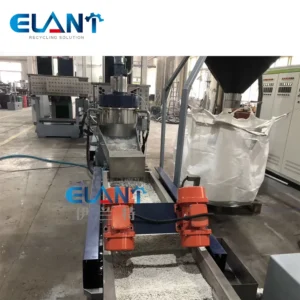
If you run a pelletizing line, you’ve seen the symptoms: bubbles inside pellets, strong odor that shows up again downstream, unstable extrusion, or a vent that suddenly starts spitting melt.
Most of the time, the cause is simple: gas is trapped in the melt—steam, VOCs, and low‑molecular compounds that didn’t get a clean way out.
This guide explains degassing in the plastic pelletizing process in plain plant-floor terms:
- where the gas comes from (especially in recycling)
- how a vented/vacuum zone actually works
- what settings and hardware changes move the needle
- a systematic troubleshooting path for the most common failures
Degassing in the plastic pelletizing process: the operating logic
In extrusion pelletizing, degassing (also called venting or devolatilization) is the controlled removal of moisture and other volatiles from the polymer melt through a barrel vent port.
The important point is how it works. A vent doesn’t magically “suck gas out” of a fully packed screw channel. A functional degassing section is typically:
- a partially filled zone where the melt has an exposed surface
- located under a vent connected to atmosphere or vacuum
- isolated by upstream and downstream melt seals (fully filled regions) so the vacuum is applied to the vent zone—not the feed throat
Plastics Technology lays out this “partially filled zone between melt seals” concept in “Compounding: Part 1—Demystifying Devolatilization”.
What degassing is trying to achieve
Degassing has three practical goals in recycling pelletizing:
- Prevent bubbles and voids in pellets (and downstream defects like silver streaks and gas marks).
- Reduce odor by removing VOCs from inks, adhesives, residues, and degradation products.
- Stabilize the melt (less surging and fewer pressure swings caused by gas pockets).
Key takeaway: Degassing is a system function. Pump capacity matters, but zone geometry, melt seals, surface renewal, and feed prep decide whether you degas or just make a mess.
Where the gas comes from (recycling reality)
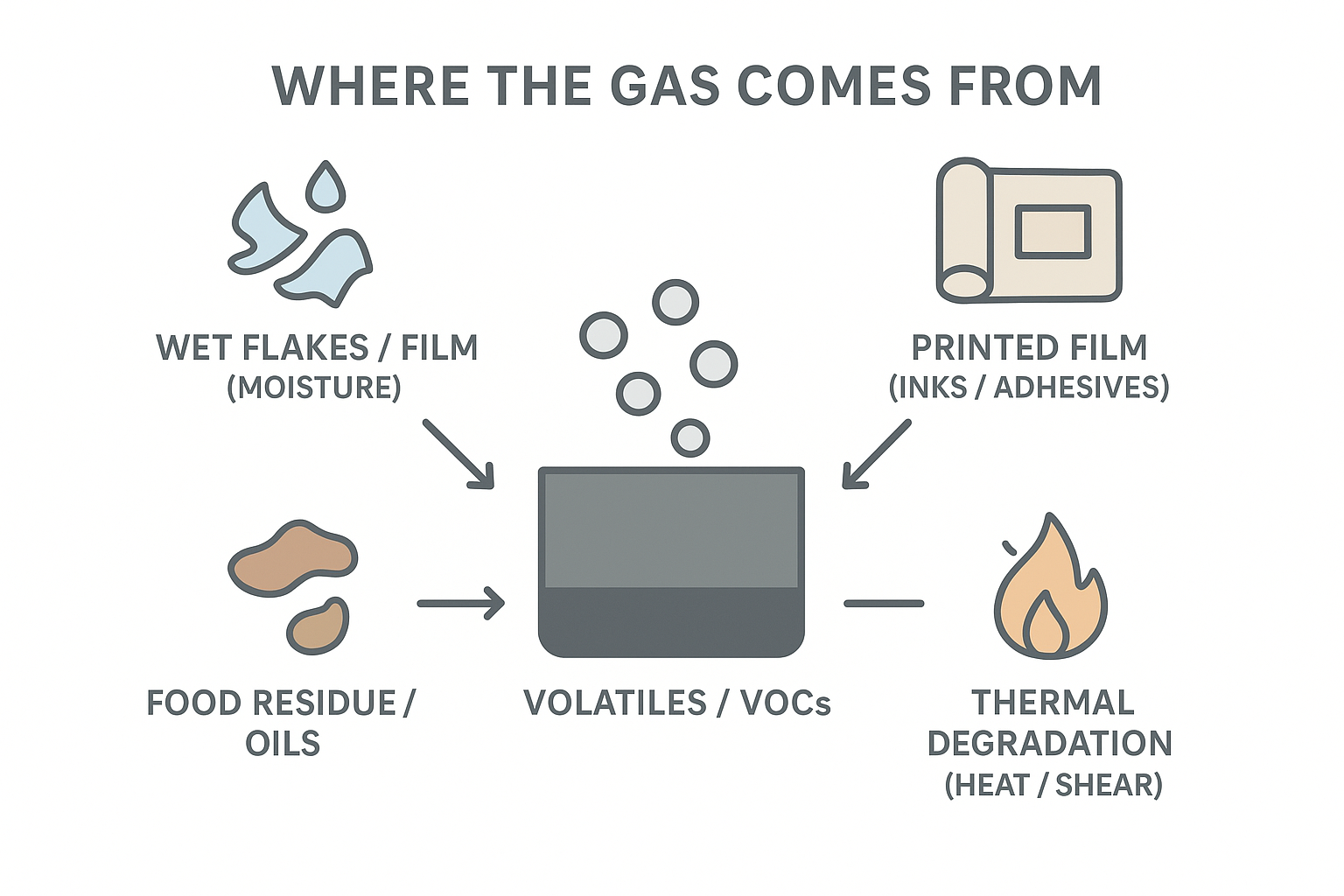
In virgin resin processing, “volatiles” can be modest. In recycling, the feedstock is the wild card.
Moisture
Washed film and flakes almost always carry water:
- surface water trapped in folds, pores, and fines
- absorbed water in hygroscopic resins (PET, PA, PBT)
Moisture creates steam in the melt. In PET, moisture also drives hydrolysis (molecular chain scission). Degassing helps, but it can’t replace correct drying for moisture-sensitive resins.
VOCs from inks, adhesives, and residues
Printed film, laminated packaging, and label systems can bring:
- solvents and ink carriers
- adhesive plasticizers
- oils and food residues
- washing-chemistry carryover
These compounds are the typical root cause of odor removal in recycled plastic pelletizing becoming difficult. They also load the vacuum line with condensables.
Degradation products
If temperature, residence time, and shear are too high, you can generate extra volatiles inside the extruder.
Edwards Vacuum flags the tradeoff clearly: degassing efficiency depends on residence time, surface area/renewal, and vacuum level, but oxygen, shear, time, and temperature can contribute to degradation during processing. See “Why is vacuum needed for plastics extruder degassing?”.
How a vented extruder degassing zone actually works
A good vent section is basically a controlled “open surface under vacuum.” The screw and barrel are doing two jobs at the same time:
- Create exposure: the melt needs a free surface (partially filled channel), otherwise vapor has nowhere to escape.
- Maintain separation: the vent zone has to be isolated by melt seals so the vacuum doesn’t just pull air from the hopper or collapse from downstream pressure.
Melt seals: the hidden make-or-break detail
If you see chronic degassing problems with “good vacuum on the gauge,” the issue is often seal behavior.
- If the upstream seal is weak, you’ll pull air from the feed area.
- If the downstream seal is too restrictive (or backpressure is too high), melt backs up and floods the vent.
This is why melt pressure behavior and degassing behavior are linked in practice.
The levers that actually move degassing performance
When operators say “degassing isn’t working,” the fastest fix is usually not a random parameter change. Work through the levers below in order.
1) Feed preparation (you can’t tune your way out of wet feed)
Start upstream:
- Are you dewatering effectively (not just “not dripping”)?
- Is your drying step actually stable (dew point, airflow, residence time)?
- Are you seeing residue carryover (detergent smell, oily film)?
For a full process context of where degassing sits in the line, Elant’s step-by-step guide to plastic pelletizing and degassing techniques is a useful internal reference.
2) Zone geometry and surface renewal
Effective venting requires an exposed melt surface that keeps renewing.
Edwards notes that surface area and surface renewal (rolling pools and partially filled screw channels) strongly affect degassing efficiency (same Edwards link above).
Practical implication: if the vent section packs full (throughput too high, wrong screw elements near the vent, or downstream restriction), the vent becomes decorative.
3) Vacuum level and vacuum stability
Vacuum level matters, but stability is the daily production target.
- Stable vacuum with persistent defects often points to a packed vent zone or wet/contaminated feed.
- Unstable vacuum often points to leaks, condensate restriction, or carryover.
In low-viscosity situations, overly aggressive vacuum can also increase carryover risk.
4) Melt temperature profile
Higher temperature increases vapor pressure and can help volatiles escape. But raising temperature to “fix odor” can backfire by creating degradation products.
A practical habit: if you adjust temperature, watch viscosity and vent flooding risk at the same time.
5) Throughput vs residence time
Residence time under the vent helps (Edwards), but throughput controls whether the vent zone stays partially filled.
Symptoms of pushing too hard:
- vent zone packs full
- odor/bubbles rise even though vacuum reading looks “OK”
- melt pressure becomes harder to stabilize
6) Melt filtration and pressure build-up
Restriction downstream changes pressure balance around the vent.
If melt pressure trends upward as a screen pack loads, you can see vent flooding, instability, or weaker devolatilization. Elant’s overview of how melt pressure affects stability and downtime connects the dots between pressure control and consistent output.
Vacuum degassing in plastic extrusion: what to check first
When you’re doing vacuum degassing in plastic extrusion, you want a short list of “first checks” that catch 80% of failures without tearing down the line.
- Is the vent flooding or is vacuum low? Decide the failure mode first.
- Is the vent zone open (partially filled)? If it’s packed full, the vacuum gauge can still look good while the melt isn’t actually exposed.
- Is vacuum stable under load? A vacuum that drifts or oscillates usually means leaks, condensate restriction, or carryover.
- Did backpressure change recently? A dirty filter or die restriction can push melt back into the vent.
- Did feedstock change? Small changes in contamination and moisture can create big changes in vapor load.
Troubleshooting table: symptom → cause → first checks
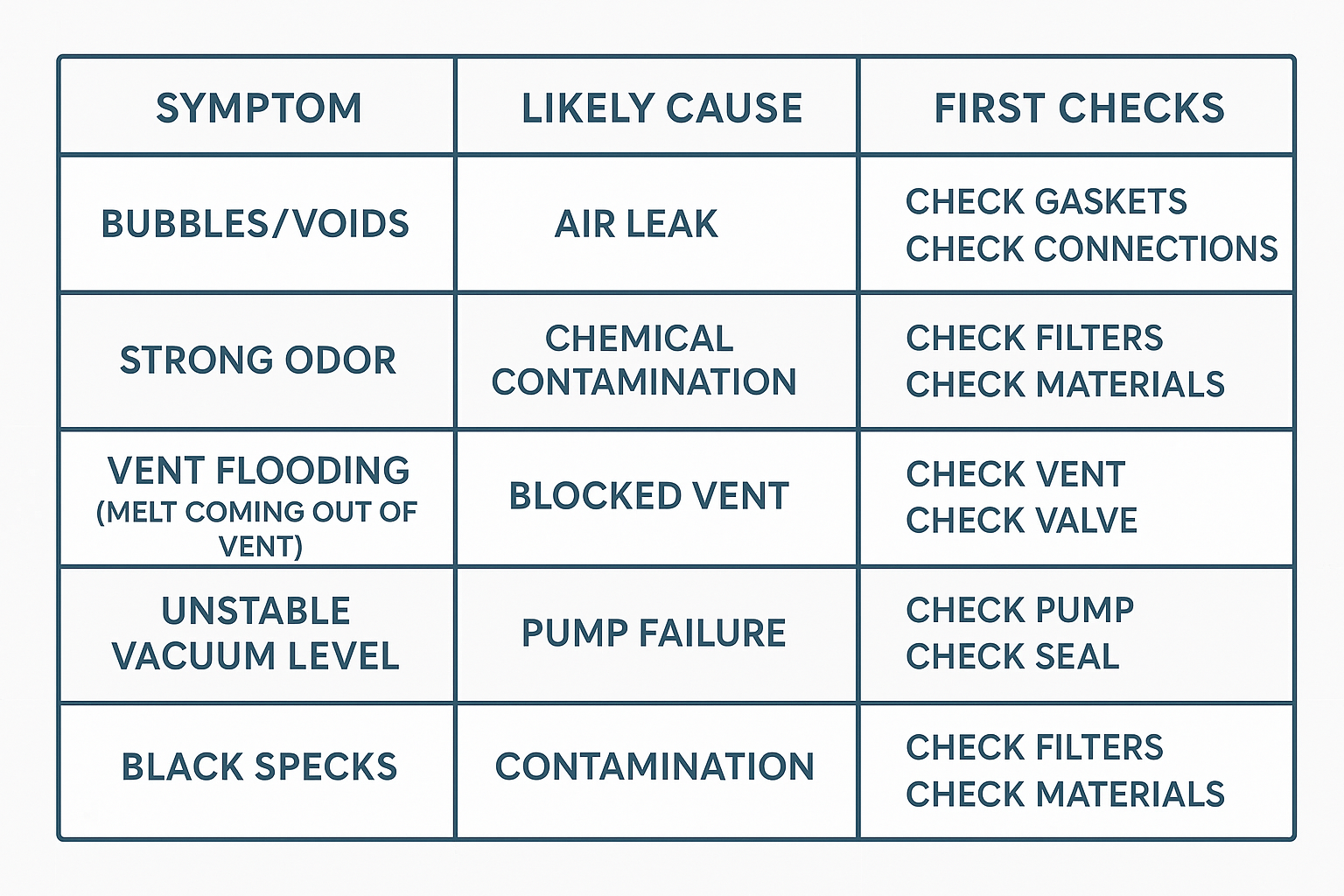
Use this as your “first pass” before you start changing multiple variables.
| Symptom | Likely cause | First checks (fast) |
|---|---|---|
| Bubbles/voids in pellets | Moisture or trapped volatiles; vent zone packed | Check feed moisture and dewatering; confirm vent is not packed full; confirm vacuum stability |
| Strong, persistent odor | High VOC load from printed film/adhesives/residues; insufficient devolatilization | Check feed mix change; check vacuum line condensate handling; confirm vent zone is open (partially filled) |
| Vent floods / melt comes out of vent | Backpressure too high; viscosity too low; insert issues | Check melt filter restriction and die pressure; check temperature/viscosity; verify insert orientation/type |
| Vacuum won’t reach setpoint | Leaks or restrictions | Check flap seal surfaces/gaskets; check joints; check traps/filters for restriction |
| Vacuum is unstable (oscillates) | Condensate pooling; intermittent carryover | Inspect low points in piping; check knock-out/condensate drains; look for polymer in elbows |
If the vent is flooding, follow a pressure-first diagnostic
Coperion’s guidance on vent blockage is practical and matches what operators see: material blowing up from the vent direction. Their troubleshooting chain—viscosity changes, insert direction/type, die/screen cleaning, and screw element checks—is in “How to solve common issues in the vacuum zone of your extruder?”.
If vacuum is low, stop treating the pump like a filter
In recycling, vacuum lines carry condensables and sometimes sticky vapors. If your system doesn’t knock them out, the pump becomes the sacrificial component.
Solberg outlines a robust approach using knockout tanks, demisters, condensation stages, and activated carbon adsorption in “Protecting Vacuum Pumps in Plastic Extrusion: Why Multi-Stage Filtration at the Barrel Vent Isn’t Optional”.
Devolatilization in extrusion: why “more vacuum” isn’t always the answer
Operators often reach for the vacuum setpoint first. Sometimes that works—especially if a leak was the real problem. But in devolatilization in extrusion, the vent is only as effective as the exposure you create.
If the vent section is fully packed, increasing vacuum can’t strip volatiles that never reach a free surface. You may even make carryover worse by pulling low-viscosity melt into the vent.
A better sequence is:
- make sure the vent zone is partially filled (exposure)
- make sure the seals are stable (containment)
- then tune vacuum level for the current vapor load
Causes of bubbles/voids in plastic pellets (and why they show up later)
If you’re chasing causes of bubbles/voids in plastic pellets, remember that the pelletizer is not always the first place you’ll see the problem.
Common patterns:
- Pellets look acceptable, but downstream molding shows silver streaks or gas marks.
- Strands look stable, but underwater pellets develop internal voids.
- Bubbles get worse after a feedstock change, even with the same line settings.
In practice, the “bubble problem” is often a combination of:
- moisture load that exceeds what the vent zone can handle
- a vent zone that is packed full at your current throughput
- backpressure shifts as filtration loads
That’s why the troubleshooting sequence in this article starts with failure-mode identification and pressure/flow checks—not just vacuum gauge readings.
Material-specific notes (what changes by resin)
PE/PP film (including printed film)
- Moisture hides in folds and fines; pre-dewatering and stable drying matter.
- Printed film increases VOC load; vacuum filtration and condensate handling become more important.
- If viscosity swings (blend changes), vent flooding risk goes up.
PET flakes
PET is less forgiving. If your PET feed carries moisture, you risk hydrolysis and molecular-weight loss. Degassing helps remove volatiles, but correct drying is still the primary defense.
If you’re evaluating PET pelletizing configurations, Elant’s PET pelletizing machine with strong vacuum degassing system is one example of how vacuum degassing is positioned alongside drying and filtration.
What to look for when buying or upgrading degassing hardware
If you regularly process wet or contaminated feedstock, a single vent may not be enough.
A practical evaluation checklist:
- vent access and cleaning time (how fast can you recover from a vent event?)
- single vs double venting, and whether side devolatilization is available
- vacuum filtration and condensate-handling design (don’t leave it to the pump)
- how degassing interacts with filtration and melt pressure control
Elant’s what to compare in degassing ports and vacuum systems is a useful internal guide for procurement and engineering.
Next step: get a structured “degassing check” on your line
If you’re battling bubbles, odor, or chronic vent flooding, the fastest path is usually a structured diagnosis—not another blind parameter change.
Write down:
- feedstock type (PE/PP film, printed film, PET flakes, etc.)
- how you wash and how you dry/dewater
- your symptoms (bubbles, odor, surging, vent flooding)
- whether your vacuum is stable or drifting
Then share that snapshot with Elant Machinery and use it to build a targeted troubleshooting plan: what to check first, what to adjust second, and what to stop changing.