
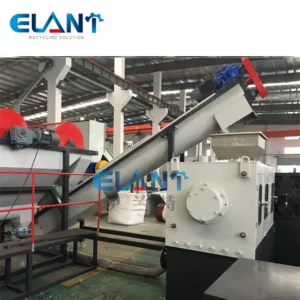
Agricultural film (mulch film, silage wrap, greenhouse film) is one of the toughest polyolefin streams to recycle—not because PE/PP is hard to melt, but because the film comes home wearing the field.
If you’re feeding sand-laden film into a standard wash line, you’ll see the same pattern:
- wear on cutters, friction washer rotors, pump housings, and screw conveyors
- sink-float tanks that become “mud tanks”
- hydrocyclones that lose separation because the water loop is overloaded
- extruder screen packs plugging faster than your team can change them
This guide is written for plant operators and process engineers. It focuses on where sand actually leaves the process, how to verify it, and what to change when it doesn’t.
Start with the uncomfortable truth: contamination can be huge
Many teams underestimate how much “non-plastic” is in agricultural film.
From a recycler’s perspective, the biggest issue is often not the polymer—it’s contamination. The European Commission notes that even with best practices, 30–40% contamination by weight for mulch films is to be expected (European Commission’s Conventional and Biodegradable Plastics in Agriculture (2021)). Reviews also report very high surface contamination on recovered mulches, commonly driven by soil and plant debris (Maxapress review on agricultural plastic mulch recycling (2024)).
That matters because your wash line is not just “cleaning plastic.” It’s separating plastic from rocks, sand, clay, silt, organics, and water—at industrial throughput.
Key takeaway: If you treat agricultural film like grocery-bag film, sand will migrate downstream and you’ll pay for it in wear and screen changes.
What “clean enough” looks like before extrusion
You don’t need lab-grade purity, but you do need a feed that won’t destroy the extruder and filtration system.
A practical target is:
- heavy grit removed (no stones/sand collecting in melt filter dumps)
- fine silt reduced (screen pack pressure rise becomes predictable)
- wash water under control (rinse stages aren’t recirculating mud)
Melt filtration is a final safeguard, not a primary separation step. As summarized in the ScienceDirect Topics overview, melt filtration is best at removing remaining impurities in the percent range, not at removing large contaminant fractions (ScienceDirect Topics overview of melt filtration). If the wash line doesn’t remove the sand, your filter will—until it can’t.
How to remove sand from agricultural film recycling (process overview)
A proven wash-line approach is to remove sand in three exits (early bulk separation, sink-float heavy discharge, and fine-solids removal from the water loop), then use extrusion filtration as a final monitor.
Think in two sand problems: bulk grit vs fine silt
If you want stable results, separate the sand problem into two different problems with two different solutions:
- Bulk grit removal: stones, coarse sand, heavy clumps, metal bits.
- Best removed by dry separation and gravity separation early.
- Fine silt removal: fine sand/clay that travels as slurry and re-deposits on film.
- Best removed by friction + controlled water exchange + hydrocyclone/settling.
A line that only has wet washing often turns bulk grit into abrasive slurry. A line that only has dry separation often leaves fines stuck to the film.
The process sequence that works (and why the order matters)
A proven sequence for agricultural film looks like this:
- Receiving + pre-sorting (remove rocks and metal before cutters)
- Size reduction with protection (often wet)
- Early sand removal (dry or hybrid) to drop the bulk grit load
- Friction washing to scrub dirt off film
- Sink-float separation to remove heavy fraction
- Hydrocyclone / fine separation to remove silt from the water loop
- Rinsing with clean-enough water
- Dewatering/drying
- Extrusion with filtration (final insurance)
The core logic is simple:
- remove heavy stuff before high-speed rotors, pumps, and screens
- scrub film after you’ve reduced the bulk grit, so you don’t grind sand into everything
- keep rinse water from turning into mud, or you’ll redeposit fines right back onto clean film
Step 1: receiving and pre-sorting (protect your cutters)
What to do
- Break bales and do a first pass for heavy contamination:
- rocks, stones, wire, metal fragments
- thick mud clods
- big organics (corn stalks, twine)
- Use a magnet + metal detector if you have one.
- If possible, add a simple stone trap / drop zone in the conveyor path.
Done when
- Operators aren’t routinely pulling stones out of the shredder area.
- Shredder torque spikes are occasional, not constant.
Why it matters
One stone can destroy knives. More importantly, stones that survive into wet stages become “wear multipliers.”
Step 2: size reduction without turning sand into paste
What to do
- Use a shredder or cutter designed for film.
- Strongly consider wet shredding / wet granulation for dirty ag film.
Wet cutting does two useful things:
- reduces dust and heat
- starts detaching soil so it can be removed in the next steps
Practical settings to watch
- Keep flake size consistent (big ribbons trap sand; too fine makes sludge handling harder).
- Watch screen plugging: sticky clay will blind screens quickly.
Done when
- Flakes are reasonably uniform and convey/float consistently.
- Screens aren’t plugging every hour.
⚠️ Warning: If your size reduction step is constantly plugging, don’t “push harder.” Fix feed moisture, add pre-dry cleaning, or reduce fines load upstream—otherwise everything downstream becomes a maintenance job.
Step 3: remove bulk sand early (before it hits high-speed washing)
This is where many lines win or lose.
Options that work
Option A: dry cleaning (best when film arrives very sandy)
Use some form of dry sand removal before heavy wet processing. Typical configurations include a trommel-like separation stage plus vibration/air assistance.
Why it works: bulk sand falls out while it’s still “dry enough” to separate by gravity rather than becoming slurry.
Option B: hybrid pre-wash with heavy fraction separation
If you can’t do full dry cleaning, a pre-wash stage that includes heavy fraction discharge can still remove a meaningful portion of sand early.
Done when
- You can physically see a steady heavy fraction discharge (sand/stone) at this stage.
- Your friction washer and pumps stop “eating themselves” compared to baseline.
Common mistake
Using only wet washing and hoping the sand “floats away.” It won’t. It sinks, circulates, and wears.
Step 4: friction washing (make dirt leave the film)
Once bulk grit is reduced, friction washing is the workhorse that removes stubborn soil films and embedded dirt.
What to do
- Run friction washing with enough residence time and water exchange to carry away fines.
- If your line uses multiple friction stages, treat the first as “dirty scrub” and the later as “polish.”
What to measure (simple plant checks)
- Water turbidity trend (even a basic turbidity meter helps): does the discharge stay consistently dirty, or does it spike?
- Visual rub test: take washed flakes, rinse in a clear bucket, agitate by hand—does the water cloud immediately?
Done when
- The rub test water stays relatively clear.
- The next tank (sink-float) doesn’t accumulate sand at an abnormal rate.
Step 5: sink-float separation (get heavy fraction out, continuously)
For PE/PP film, a sink-float tank does two jobs:
- lets clean film float for discharge
- gives sand/stone/metal a place to sink and be removed
What to do
- Ensure you have a reliable heavy discharge (screw conveyor or similar) that can handle grit.
- Don’t let the tank become a settling pond. If sand is sitting in the tank, it’s not leaving the system.
Done when
- Heavy discharge is continuous and not bridging.
- The tank bottom isn’t filling up between cleanouts.
Failure mode to watch
If your tank is full of fibrous organics, they can “trap” sand and keep it from settling. That’s a feedstock problem (sorting) and a turbulence problem (flow pattern).
Step 6: remove fine silt (hydrocyclone + settling discipline)
This step is often skipped, and it’s the reason many lines look good for a week and then gradually collapse.
Fine sand and silt circulate in the water loop, then redeposit on film during rinse and dewatering.
What to do
- Use a separation stage (commonly a hydrocyclone) to continuously remove fine mineral solids from circulating water.
- Support it with settling/filtration so the cyclone isn’t asked to do everything.
What to measure
- solids content in underflow vs overflow (even by simple jar settling tests)
- nozzle and liner wear (cyclones wear fast when abused)
Done when
- Your rinse stages stop acting like “recontamination stages.”
- Sludge build-up in pipes/nozzles slows down.
Step 7: rinsing (clean water, not recycled mud)
Rinsing is where many plants lose the cleanliness they earned.
If you rinse with dirty water, you’re repainting the film with fines.
Elant Machinery has a practical write-up on how water circulation and filtration problems reduce washing performance and cause blockages (washing line water circulation problems and solutions). The key operator takeaway: keep the loop moving, keep solids out of pumps and nozzles, and treat filtration maintenance as part of production—not a side task.
Done when
- Spray nozzles remain stable over a shift.
- Rinse water clarity is stable.
Step 8: dewatering and drying (don’t carry sand and mud into extrusion)
Dewatering is not only about moisture. It’s also a last chance to remove fines.
What to do
- Keep screens clean and inspect for wear.
- If you’re running a squeezer/press, track motor load and output consistency.
Done when
- Moisture is stable and acceptable for your extruder.
- You don’t see dirt streaks in dewatered flake piles.
Step 9: extrusion and filtration (use it as a monitor)
Your melt filter is a sensor.
If you track:
- screen pack life (minutes/tons per change)
- pressure rise rate
- purge quantity
…you get a direct signal of how well your upstream sand removal is working.
Pressure behavior is well understood: as contaminants deposit on screens, differential pressure rises and flow resistance increases (Plastics Technology’s melt-filter pressure fluctuation troubleshooting (2020)). If your pressure rise is unpredictable, the feed isn’t stable—or fines are recirculating.
Done when
- Pressure rise rate becomes predictable.
- Screen changes become planned maintenance instead of emergencies.
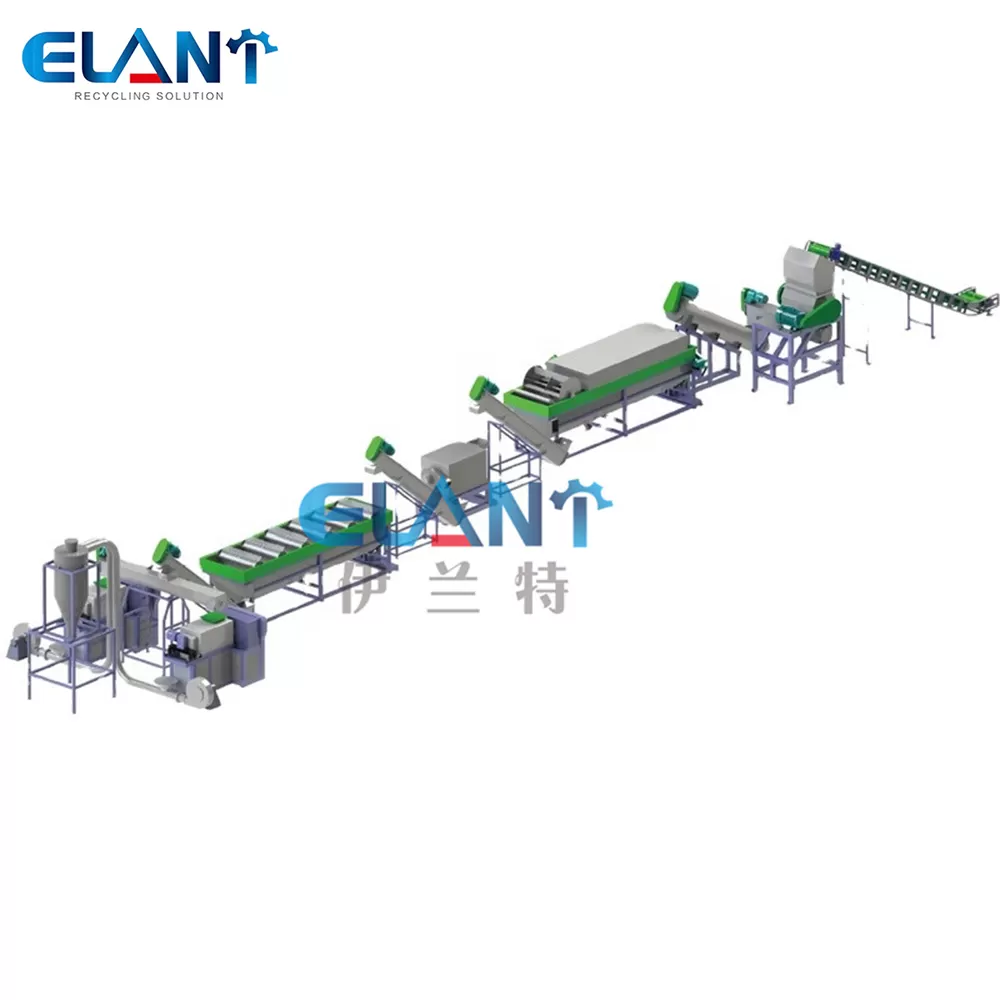
Where sand is actually removed (map it visually)
In a well-run line, sand exits in three main places:
- early dry/hybrid separation (bulk sand/soil drop-out)
- sink-float heavy discharge (stones, heavy grit)
- hydrocyclone/settling underflow (fine sand/silt)
Everything else is either loosening sand from film or transporting it to those exits.
Troubleshooting: symptoms → likely cause → checks → fixes
| Symptom | Likely cause | Quick checks | Practical fixes |
|---|---|---|---|
| Friction washer wear accelerates (paddles/liners) | Bulk sand not removed early | Check heavy fraction discharge rate upstream; inspect sand in pre-wash area | Add/strengthen early sand removal; improve bale breaking and stone trap |
| Sink-float tank turns into a mud pit | Heavy discharge not keeping up; turbulence keeps sand suspended | Check bottom build-up rate; watch flow patterns | Increase heavy discharge capacity; adjust flow; cleanout schedule |
| Hydrocyclone separation “stops working” | Feed water too dirty; pressure unstable; wear in apex/vortex finder | Jar settling test; measure pressure; inspect nozzles | Improve settling/filtration; restore pressure control; replace worn parts |
| Rinsed flakes still feel gritty | Rinse water is recirculating fines | Compare rinse water clarity vs make-up water | Add fresh-water polish stage; improve water-loop solids removal |
| Extruder screens plug fast and unpredictably | Fine silt carryover; inconsistent feed contamination | Track pressure rise rate vs feed lots | Stabilize water loop; improve cyclone/settling; tighten receiving sorting |
A simple verification routine you can run every shift
You don’t need a lab to control sand. You need consistent checks.
- Bucket rub test on washed flakes (before drying).
- Jar settling test on process water from key points:
- friction washer discharge water
- sink-float overflow
- hydrocyclone overflow
- Heavy fraction log: weigh or estimate heavy discharge per shift.
- Screen pack log: pressure rise per hour and time-to-change.
Over time, these four checks tell you exactly where the sand is escaping.
Common design choices that make sand problems worse
- No early heavy separation: sand becomes slurry and eats everything.
- Undersized heavy discharge screw: tank becomes storage, not separation.
- Rinse water reused without solids control: recontamination is guaranteed.
- Over-granulating too early: excessive fines overwhelm the loop.
Internal reference: film washing line equipment context
If you’re mapping or upgrading your process, it helps to align unit ops with actual equipment blocks. The Elant Machinery plastic film recycling machine line overview shows typical washing, float-sink, drying, and pelletizing stages used for film streams, including agricultural film (Elant Machinery plastic film recycling machine line).
(Keep in mind: the exact configuration should match your contamination level and throughput target.)
FAQ
How do I know if my line is removing sand, not just moving it around?
If you don’t have three clear “sand exits” (early separation, sink-float heavy discharge, and fine solids removal from the water loop), you’re probably recirculating it. Your melt filter pressure rise will confirm it.
Can I rely on the extruder screen changer to deal with sand?
No. Filtration is designed to remove remaining impurities in the percent range, not to compensate for poor washing (see the ScienceDirect Topics melt filtration overview referenced above). If sand is reaching the extruder in volume, you’ll see unstable pressure, high purge, and rapid wear.
Is hot washing required for sand removal?
Hot washing helps with oils, pesticides, and some sticky residues. Sand removal is primarily mechanical separation (gravity + friction + fine solids removal). Use heat when residue demands it, not as a substitute for separation.
What’s the single biggest upgrade for very sandy film?
Add (or improve) early heavy separation so bulk sand leaves before it reaches high-speed equipment. Then make sure your water loop has a real fine-solids removal path.
Next steps
If you share (1) your film type (mulch/silage/greenhouse), (2) estimated contamination level, and (3) target output (clean flakes vs pellets), Elant Machinery can suggest a practical wash-line layout and the checkpoints to keep sand from reaching your extrusion and pelletizing stage.