
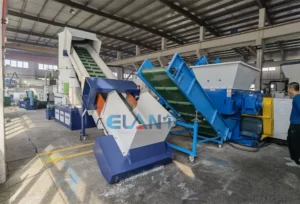
Washed film is supposed to be the “easy” feedstock. PE and PP don’t absorb much water into the polymer like PET does — yet plenty of lines still fight bubbles, steam puffs, surging melt pressure, and pellets that look like they’ve got tiny voids.
That’s because most film moisture problems aren’t about water in the polymer. They’re about water on the film, between layers, and reintroduced after you thought you dried it.
This guide walks through how to reduce film moisture before pelletizing in a way an operator can actually run: measure consistently, find where water is hiding, fix the biggest sources first, and verify the result.
What “too wet” looks like at the pelletizer
Moisture shows up in plastic film pelletizing like a chain reaction: a small amount of water becomes steam in the barrel, steam becomes bubbles/voids, and bubbles become unstable extrusion.
Common shop-floor symptoms:
- Bubbles / foaming at the die (or “spitting” at the vent zone).
- Pellets with pinholes, voids, or a rough/splayed surface.
- Surging melt pressure and throughput swings that don’t match your feeder setting.
- More die drool than usual (because the melt is inconsistent and gassy).
- Higher motor load or sudden current spikes when wet surges hit the screw.
Moisture can also masquerade as other issues (e.g., contamination, excessive fines), so the rest of the article is about confirming it instead of guessing.
Pro tip: Treat moisture as a control loop: measure → locate → fix → verify. If you skip the “verify” step, you’ll end up chasing ghosts.
Step 1 — measure film moisture the same way every time
If moisture numbers are inconsistent, your fixes will be inconsistent.
Decide what you’re measuring: surface water vs total volatiles
In recycling lines, many “moisture” tests are actually measuring weight loss (water + some volatiles). That can still be useful, but it matters when you compare results from different methods.
- Loss-on-drying (LOD): weigh, heat, weigh again. Good for routine checks, but it measures total weight loss, not only water.
- Karl Fischer (KF): chemically measures water specifically; better for very low moisture targets.
- NIR (near‑infrared): fast at-line/inline estimates, but it must be calibrated against a reference method.
If you want a practical overview of how plants choose between KF and NIR, Metrohm’s article on “Moisture Analysis – Karl Fischer Titration, NIRS, or both?” (2020) is a good baseline.
Build a sampling routine that matches film reality
Film flakes aren’t uniform. One wet clump in a sample can swing your reading.
A simple routine that works on most lines:
- Pick 3 sampling points (minimum):
- after mechanical dewatering (centrifugal dryer / squeezer)
- after thermal drying
- right before the extruder feed (after conveying/storage)
- Take multiple small grabs, not one big handful. Combine into one sample.
- Seal the sample immediately. Film picks up surface moisture fast in humid air.
- Record the process state with the sample (throughput, dryer temp, airflow setting, squeezer rpm/pressure, ambient humidity if available).
What target should you aim for?
Targets depend on your equipment, especially whether you have strong venting/vacuum degassing. But you still need a goalpost.
A practical reference point: Elant’s process write-up notes that for film recycling, pelletizing typically requires moisture ≤1%, and higher moisture can show up as bubbling/voids during extrusion (see Elant Machinery’s plastic film recycling machine guide).
Don’t treat that number as a universal standard — treat it as a starting expectation and tune based on your line design, die type, and product requirements.
Step 2 — stop re-wetting before you “buy” more drying capacity
A lot of lines improve drying… and the material still arrives wet at the feeder.
That’s usually re-wetting. If you remove water in step A and add it back in step B, you’ll overwork the dryers and still fight steam.
The four common re-wetting points
- Conveying air that isn’t dry
- If your conveying air is humid, you’re blowing moisture onto hot, freshly dried film.
- Condensation in cold sections
- A warm material stream plus a cool duct/receiver can condense water right where you can’t see it.
- Open bins / open super-sacks
- Dried film sitting exposed in a humid area is basically a moisture sponge (surface moisture, not absorption).
- Compressed air contact
- Wet compressed air (poorly maintained dryers, water in lines) can reintroduce moisture during blow-off, cleaning, or pneumatic transfers.
Quick checks (10 minutes, no lab)
- Feel the discharge ducting and the receiver: cold spots are where condensation happens.
- Look for water streaks or damp dust around the receiver or cyclone.
- Check compressed air drains and dryer status; if you’re seeing water at point-of-use, assume you’re re-wetting.
⚠️ Warning: Don’t “fix” re-wetting by just raising thermal dryer temperature. You’ll waste energy and can start softening/warping film if you push too far.
Step 3 — fix mechanical dewatering first (it’s the cheapest water you’ll ever remove)
Thermal drying should be removing the last bit of water — not doing the heavy lifting.
If you feed a thermal dryer material that’s still carrying bulk water, you’ll see:
- unstable moisture at the outlet
- lower throughput
- wetter clumps that never fully dry
- higher power per kg
Mechanical options in film lines
For film, the two most common mechanical approaches are:
- Centrifugal drying / dewatering (spinning off free water)
- Film squeezer / screw-press dewatering (compressing and draining water)
Elant’s own film recycling process description lists “squeeze dryer + hot-air dryer” as the typical pairing before pelletizing.
Where mechanical dewatering fails in real life
If your moisture is high after the dewatering stage, don’t jump straight to “need a bigger dryer.” Check the mechanical stage health:
- screens/plates clog with fines and organics
- the machine is overfed (no residence time)
- rpm/pressure is set for throughput, not drainage
- upstream contamination is turning the dewaterer into a filter
A separate maintenance-style reference from Elant lists early warning signs for film squeezer performance: throughput drop, abnormal noise, overheating, and rising output moisture (see Elant’s film squeezer failure signs checklist). Even if your exact thresholds differ, the logic is solid: mechanical dewatering performance degrades before it “fails.”
A practical “go/no-go” checkpoint
Before you tune thermal drying, confirm this:
- Is the dewatering stage steady?
- stable discharge (no wet surges)
- stable motor load
- no unusual vibration/noise
- no sudden throughput drift
If it’s not steady, thermal drying won’t save you — it just averages the problem.
Step 4 — tune thermal drying (plastic film drying before extrusion)
Thermal drying for film usually works by exposing flakes to hot air while keeping them moving so they don’t clump. The exact design varies (pipeline/transport dryers, cyclone separation, etc.), but the same levers show up again and again:
- airflow
- residence time
- temperature stability
- separation (cyclone/filter) health
What to adjust first
- Airflow / fan performance
- If airflow is low, you don’t carry away moisture.
- If airflow is uneven, you get wet clumps and dry fines.
- Feed rate
- Overfeeding reduces residence time.
- Temperature stability
- A stable outlet condition matters more than a high peak.
The fastest “is it airflow?” check
If you can’t dry below your target:
- reduce feed rate by 10–15% for a short run
- keep temperatures the same
- re-measure moisture
If moisture drops meaningfully, you’re throughput-limited (residence/airflow), not temperature-limited.
Don’t ignore separation and filters
Cyclones, ducts, and filters don’t just handle dust — they’re part of your airflow system. Restriction equals lower drying efficiency.
If your filter bags are damp or loading is high, your airflow can collapse slowly while temperatures look normal.
Step 5 — use venting/vacuum degassing correctly (as insurance, not a crutch)
A vented or vacuum-degassing extruder helps remove trapped air, volatiles, and some moisture during melting. It improves melt stability — but it’s not a license to feed wet film.
Edwards Vacuum explains why vacuum is used in extrusion degassing and how vacuum level influences efficiency in its application note on why vacuum is needed for plastics extruder degassing.
Here’s the operator takeaway:
- If you dry well, degassing makes you more stable.
- If you dry poorly, degassing becomes a dirty job (foam, vent carryover, unstable pressure), and you’ll still fight quality issues.
Three practical checks for the vent zone
- Is the vent area clean and not building up material?
- Is the vacuum system protected from contamination and liquids?
- Does melt pressure become steadier when vacuum is stable?
If you’re seeing material blowing or smearing at the vent, fix upstream moisture first.
Step 6 — moisture map: how to reduce film moisture before pelletizing
This is the mental model that stops endless tuning.
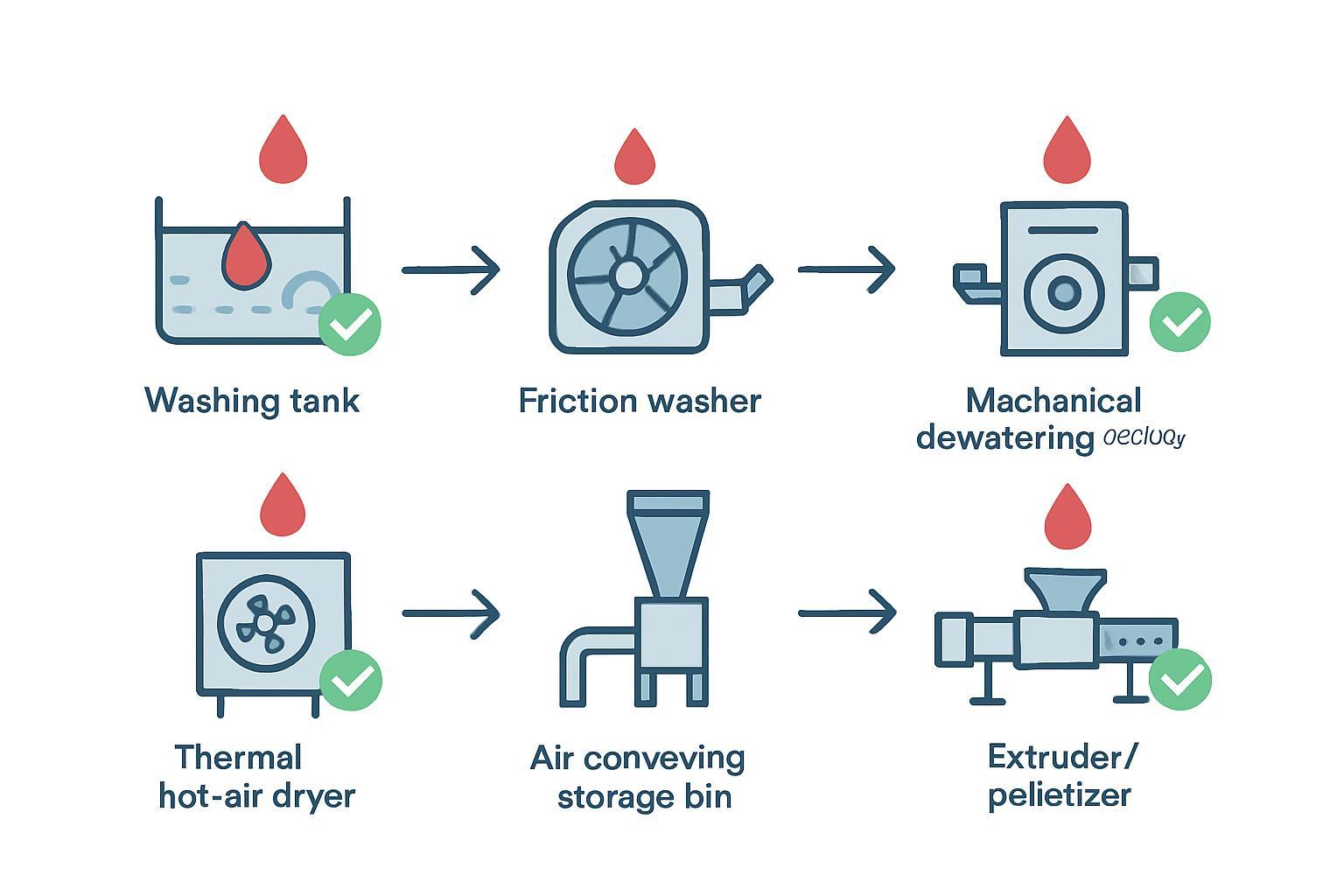
Use the map to force a simple question: where is water still present right now?
- If moisture is high after washing → fix separation/drainage and reduce carryover.
- If moisture is high after dewatering → fix mechanical health and feed stability.
- If moisture is low after thermal drying but high at the feeder → you have re-wetting.
Step 7 — troubleshooting: symptom → likely moisture source → checks → fixes
Most lines waste time because troubleshooting isn’t staged. They change five parameters at once and can’t tell what worked.
Below is a practical troubleshooting table you can run shift-to-shift.
| Symptom at pelletizer | Likely moisture source | Quick checks | Fix that usually works |
|---|---|---|---|
| Bubbles/steam bursts appear in waves | Wet surges from dewatering stage | Trend moisture after dewatering every 30–60 min; look for wet clumps | Stabilize feed, clean/inspect screens, adjust squeezer/centrifuge settings |
| Material tests “dry” after thermal dryer but “wet” at feeder | Re-wetting in conveying/storage | Check receiver/cyclone for condensation; check air dryer; check open bins | Dry conveying air, insulate cold spots, close storage, shorten storage time |
| Moisture won’t come down even with higher dryer temp | Airflow/restriction problem | Check pressure drop/filters; check fan speed and duct restriction | Restore airflow (clean filters/cyclone/ducts), reduce feed rate, then re-tune |
| Melt pressure surges + motor load spikes | Moisture + trapped air + fines | Check fines load; check vent zone behavior; compare to clean feed trial | Improve washing/fines control; verify drying and dewatering stability |
| One side of output looks wetter (edge wet streaks) | Misalignment/wear in squeezer rolls | Look for consistent lateral wet streaks; inspect roll condition | Re-align roll gap, repair/replace worn roll surfaces |
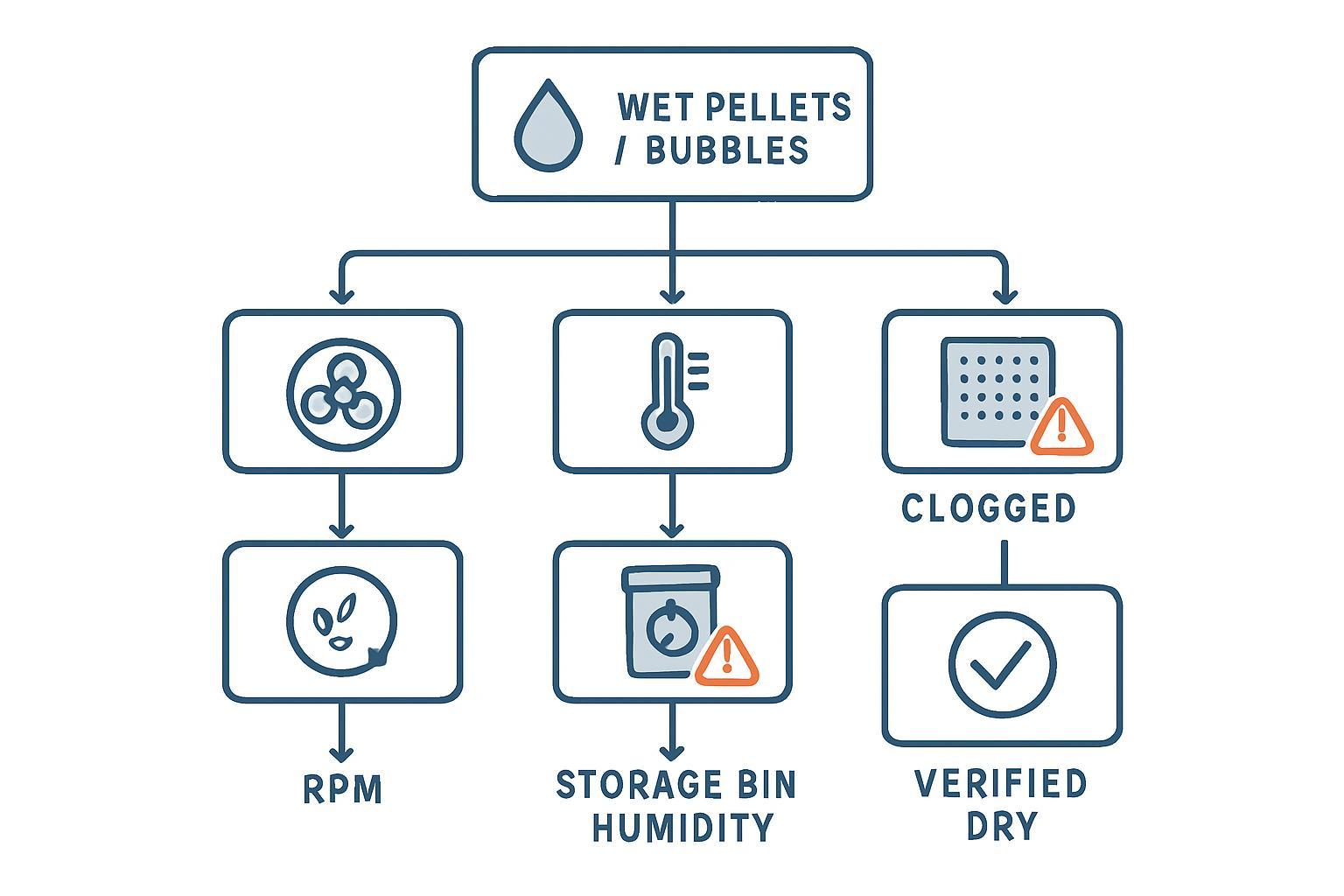
A visual decision-tree reminder
How Elant Machinery fits into this (without turning this into a sales pitch)
If you’re rebuilding a film line, moisture control is easiest when the system is designed as one chain (washing → dewatering → thermal drying → conveying → pelletizing) with matched capacities.
Elant Machinery publishes practical process resources on film recycling and washing/drying stages — for example their plastic film recycling machine solution overview and their explanation of the PP/PE film washing line process.
And if moisture is showing up as “pelletizer instability,” it’s worth also thinking about how wet feed affects melt pressure control and downtime. Elant’s discussion of melt pressure and stability in plastic pelletizing machines is a useful companion read.
FAQ
What moisture level should film flakes be at before pelletizing?
It depends on your line design, but a practical starting point is to target around ≤1% moisture before pelletizing, then verify whether your extrusion is stable and bubble‑free.
If you’re running strong venting/vacuum degassing, you may tolerate slightly higher incoming moisture — but you’ll still get a more stable process (and less vent mess) when upstream drying is doing most of the work.
Do I still need drying if my extruder has vacuum degassing?
Yes. Degassing is best treated as insurance: it removes residual moisture/volatiles and stabilizes the melt. It doesn’t reliably fix bulk moisture surges from upstream.
What’s the fastest way to improve moisture without major capex?
Usually:
- Stop re-wetting (humid conveying air, condensation, open bins).
- Restore mechanical dewatering performance (clean screens, stabilize feed, fix wear).
- Only then tune thermal drying airflow/residence.
Next steps
If you want a second set of eyes on your process chain (where moisture is entering, which stage is limiting, and what measurements to run), talk to Elant Machinery about your feedstock, contamination level, and target throughput. Start with their PP/PE plastic film washing line solutions and build the drying/pelletizing side from there.