
PVC contamination in PET recycling is one of those problems that looks small on a lab report and feels huge on the production floor.
A few bad bottles or the wrong type of label can turn a clean rPET run into yellowed product, black specks, unstable viscosity, corrosion concerns, and hours of cleanup. The painful part is that by the time you see the defect at the extruder, the PVC has already done its damage.
This guide is written for the people who actually have to keep a PET line running: operators, shift leads, process engineers, and QA teams. We’ll cover what PVC does to PET, where it typically gets in, how to detect it early, and how to build a line-level playbook that keeps PVC from reaching your melt.
Why PVC contamination in PET recycling is uniquely destructive
Not every contaminant behaves the same way.
- Some contaminants are mostly cosmetic (a bit of color carryover).
- Some are mechanical (grit or metal causing wear).
- PVC is chemical and mechanical: it degrades at PET processing conditions and creates byproducts that accelerate PET breakdown.
A commonly cited mechanism is that PVC decomposes and forms acids (notably hydrochloric acid) during PET reprocessing, which then catalyze PET degradation—leading to yellowing and brittleness. That’s why PVC is treated as a critical contaminant in PET reclaiming, even at very low concentrations, as described in P2 InfoHouse’s “Contamination Issues” report.
In practical terms, PVC contamination can show up as:
- Yellowing/browning of pellets, sheet, or preforms
- Black specks or gels (localized degradation and inclusions)
- Intrinsic viscosity (IV) loss / weaker melt
- Odor and off-gassing risk (process safety + regulatory headaches)
- Higher corrosion risk on hot metal surfaces
“How low is low?” PVC thresholds you can’t ignore
You’ll see different numbers in different contexts because acceptable contamination depends on end use.
- A frequently cited research benchmark is that PVC as low as 100 ppm can induce PET degradation and discoloration, reported in a 1999 study on PVC contamination at 100 ppm.
- Many industry summaries and operations-focused guides flag serious issues at “tens of ppm,” often calling out 50 ppm as a practical danger zone, such as Energycle’s 2025 overview of PVC contamination in PET recycling.
In other words: the exact number depends on end use and how you measure it—but the process risk starts early.
For the peer-reviewed 100 ppm benchmark, see a 1999 study on PVC contamination at 100 ppm. For an operations-focused discussion of low-ppm sensitivity, see Energycle’s 2025 overview of PVC contamination in PET recycling.
You don’t need to argue about whether the “real” limit is 50 ppm or 100 ppm to run a good plant. The takeaway is simpler:
⚠️ Warning: For PET recycling, PVC is not a “small impurity.” It’s a batch-risk contaminant. Your goal is to catch it upstream, not to “process through it.”
Where PVC typically enters a PET recycling line
If you can’t name your PVC sources, you can’t control them.
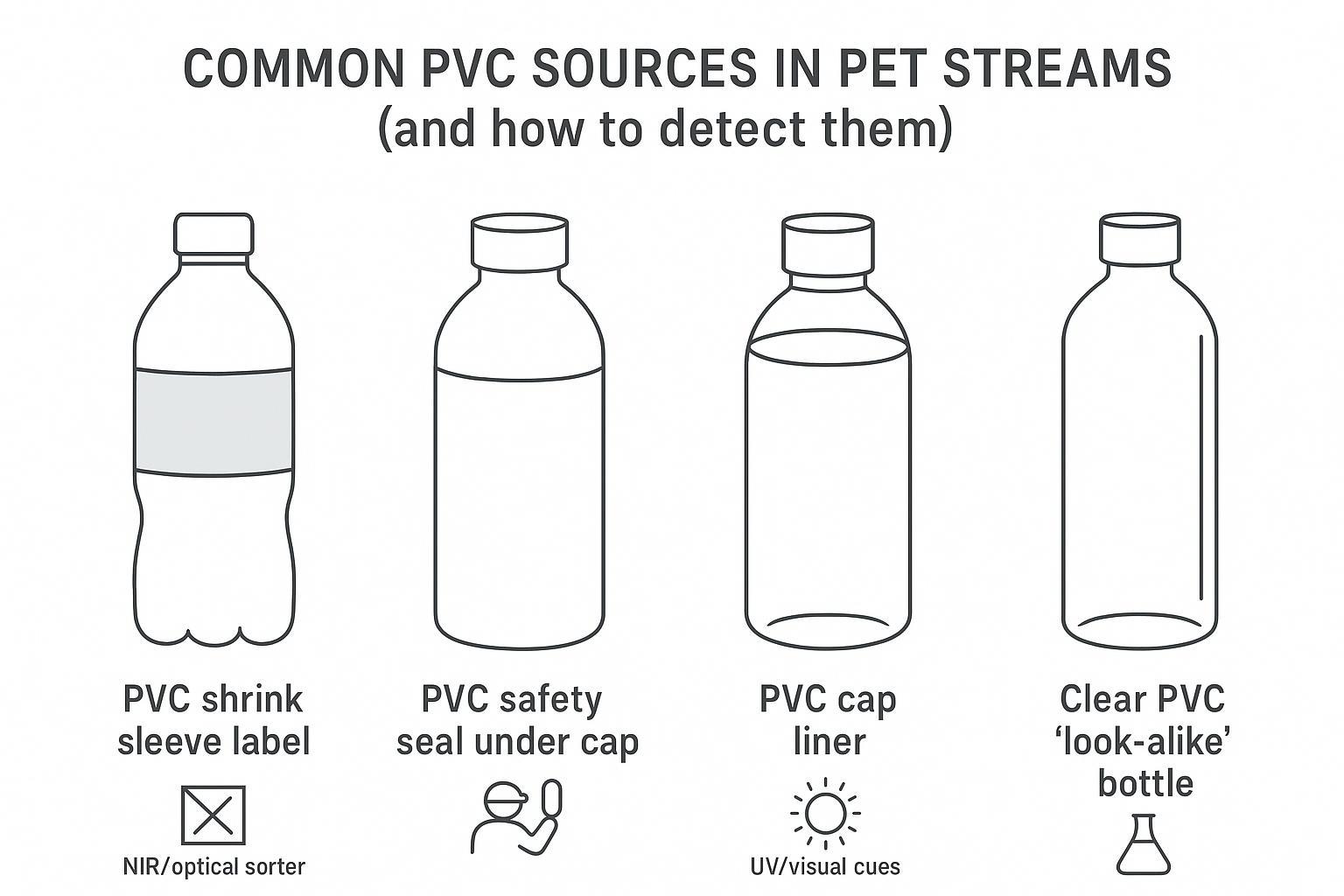
The most common sources of PVC contamination in PET streams are well covered in P2 InfoHouse’s Contamination Issues report. In plant terms, they usually show up in four buckets:
1) PVC “look-alike” bottles
Some clear PVC bottles look close enough to PET that they slip through manual sorting—especially in mixed bales.
Operational reality: if you rely heavily on hand-sorting at the bale opening station, you’re betting your product quality on fatigue-proof attention. That’s not a great bet.
2) PVC shrink sleeves and labels
PVC sleeves are a classic “quiet contaminant.” If they make it past label removal, they get chopped into fragments and become harder to remove downstream.
This is why label removal is a quality control step—not a cosmetic one. If you’re chasing label removal variability, it’s worth reading Elant’s troubleshooting breakdown on why label removal efficiency drops (and how to fix it).
3) PVC safety seals under caps
Some containers use safety seals that can be PVC. If your process leaves them attached through grinding, you’re essentially dosing your flake stream with PVC.
4) PVC liners in caps/closures
- Some caps have liners that can introduce problematic materials if they end up in the PET sink fraction or get ground into fine pieces.
For a practical breakdown of where PVC typically enters (look-alikes, seals, liners, and some labels), see P2 InfoHouse’s “Contamination Issues” report.
The hard truth: washing doesn’t “fix” PVC
A good washing line removes sugars, oils, dirt, glue, paper, and many non-PET components.
But washing is not a magic eraser for PVC—especially once PVC has been shredded into small fragments or has already entered high-temperature stages.
Why sink-float tanks can’t reliably remove PVC
Sink-float works great for low-density polyolefins (PP/PE caps, rings, films) because they float and PET sinks.
PVC is not reliably removed by sink-float alone because:
- It can sink with PET depending on form, additives, and trapped air.
- Once it’s shredded small enough, it behaves like “just another piece of flake.”
That’s why many plants treat sink-float as a necessary step, not a sufficient step, for high-grade rPET.
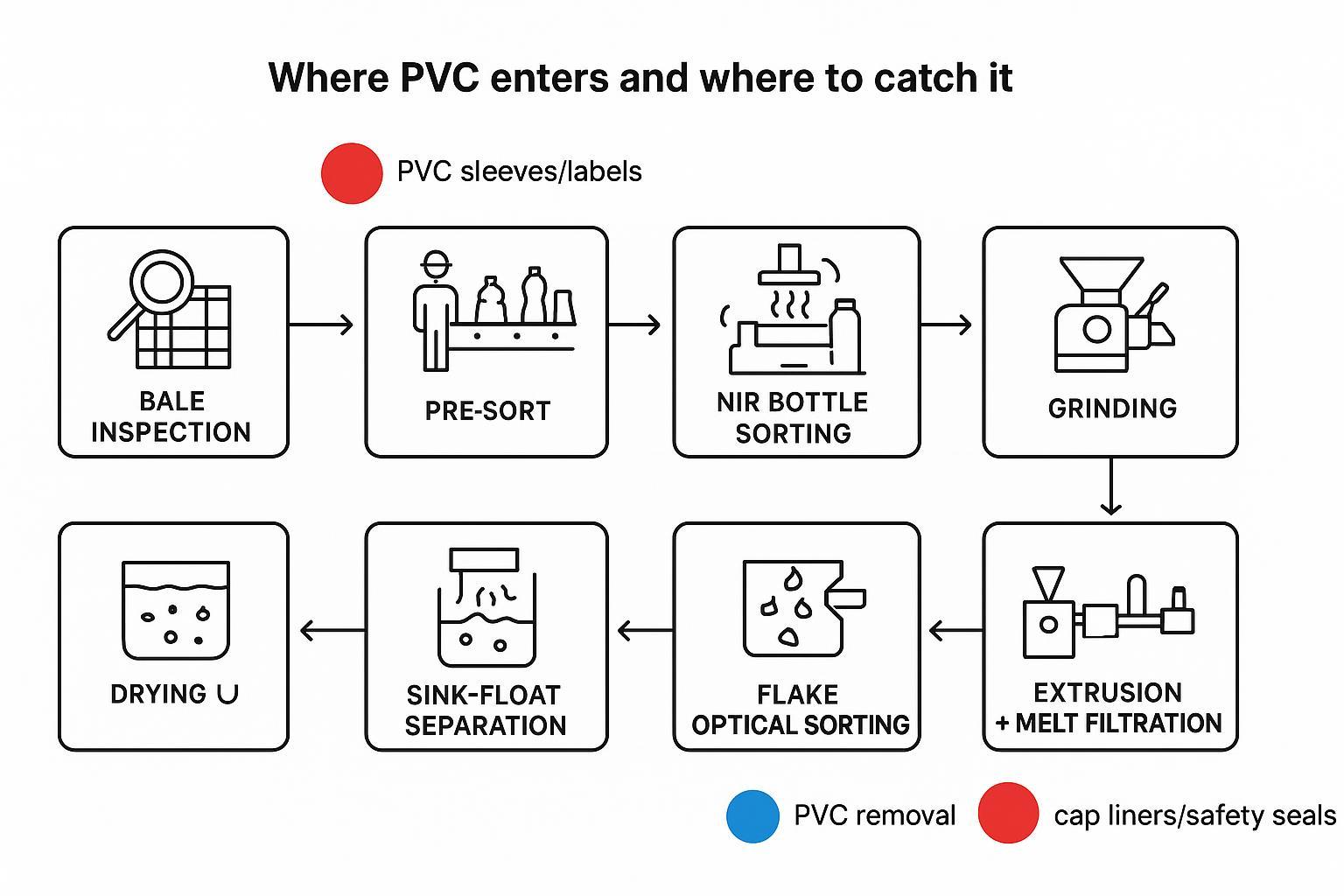
Where to catch PVC: a control-point playbook (from bale to extruder)
If you want consistent rPET, you need multiple chances to stop PVC—not one heroic separator.
Below is a practical “where to catch it” sequence. You can treat this as a diagnostic map: when PVC shows up at the end, work backwards.
Control point 1: incoming bale quality (your cheapest decision)
PVC control starts before the line starts.
What to do:
- Set bale acceptance criteria (supplier grading, contamination notes, rejection thresholds).
- Track supplier lots vs QC outcomes.
- Separate bale categories (clear PET vs mixed color vs heavy label/sleeve content).
What failure looks like:
- You’re “sorting problems” that should have been “buying decisions.”
Control point 2: container sorting (where the big mistakes happen)
If your plant runs optical bottle sorting, this is where you prevent the highest-impact PVC items from ever entering grinding.
Near-infrared (NIR) optical sorting works by reading polymer “spectral fingerprints” and ejecting contaminants with air jets. A clear explanation of this mechanism (and why PVC is dangerous at PET processing temperatures) is given in Meyer Europe’s 2026 explainer on optical sorting PET vs PVC.
What to do:
- Audit sorter performance regularly (test batches with known challenge items).
- Keep optics clean; dust and moisture can ruin identification.
- Ensure good singulation (no clumps, no doublets).
What failure looks like:
- PVC look-alikes slip through and you can’t “wash them out” later.
For more on how NIR sorting separates PET and PVC in practice, see Meyer Europe’s 2026 explainer on optical sorting PET vs PVC.
Control point 3: label and sleeve removal (don’t let PVC get shredded)
Once PVC sleeves get shredded, you’ve made separation harder.
What to do:
- Monitor label remover blade wear and rotor condition.
- Keep feed rate stable (overfeeding and underfeeding both reduce efficiency).
- Fix the causes of sudden label removal drops rather than compensating elsewhere.
If label removal performance is drifting, Elant’s operational checklist on why label removal efficiency drops (and how to fix it) is a useful troubleshooting reference.
What failure looks like:
- More sleeve fragments in wash water, higher sludge load, more non-PET carryover.
Control point 4: grinding and early metal removal (protect downstream equipment)
Grinding isn’t a PVC-removal step—but it’s a point where you can either stabilize the stream or make it chaotic.
What to do:
- Control flake size distribution.
- Use appropriate metal detection/separation to protect friction washers and extruders.
What failure looks like:
- Inconsistent flake size reduces the effectiveness of every separation step after it.
Control point 5: hot wash + friction wash (remove what washing can remove)
Hot wash is great for glue and organic residues. It’s not a PVC fix.
What to do:
- Stabilize hot wash temperature, chemistry concentration, and retention time.
- Control water cleanliness to avoid redeposition.
What failure looks like:
- Glue/label residue looks like “contamination,” gets blamed on “PVC,” and you chase the wrong root cause.
Control point 6: flake optical sorting (your best shot at PVC fragments)
For higher-grade rPET, flake sorting is often the most realistic way to remove PVC fragments that survived earlier stages.
What to do:
- Add optical flake sorting where the business case supports it.
- Keep feed consistent, flakes dry, and optics clean.
What failure looks like:
- You pass a small amount of PVC forward and pay for it later in yellowing and IV loss.
Control point 7: extrusion and melt filtration (containment, not correction)
By extrusion, your goal is to protect the equipment and avoid producing off-spec material—not to “solve PVC.”
What to do:
- Use conservative process controls when contamination risk is suspected.
- Treat unexpected yellowing, gels, or corrosion signs as triggers to investigate upstream.
For overall system context (washing line + pelletizing + downstream SSP), Elant’s overview of Elant’s PET bottle recycling machine solution shows how typical modules fit together.
How to detect PVC contamination before it ruins a run
You need a mix of quick floor checks and QA verification.
Fast operational signals (minutes, not hours)
These are not “PVC tests.” They’re early warnings that something incompatible is getting through.
- Melt discoloration trend compared to baseline material
- Unexpected screen pack loading / pressure rise
- New black specks / gels in strand/pellet
- Irritating odor/off-gassing (treat as a safety signal; don’t ignore it)
If you see these, your next step is not “turn up the hot wash.” It’s to isolate the source.
QC targets and control-point metrics (what “good” often looks like)
Different plants run different specs. But it helps to have clear targets for “line health.”
Elant’s operations-focused QC guide on control points for quality rPET flakes gives example benchmarks plants track, such as overall flake purity targets, moisture targets before extrusion, and low ppm contamination goals (including PVC).
Even if your internal specs differ, the idea is right: measure what matters at multiple points, not just after the extruder.
Confirmatory testing (QA lab)
If you suspect PVC, treat it like a trace contaminant problem:
- Run contamination identification on suspect flakes
- Compare suspect lots vs known-good baseline
- Document supplier lot IDs and line conditions
Exact lab methods vary by facility and standards requirements; the important part is to have a documented escalation path.
Best practices to reduce PVC contamination in PET recycling (and the failure modes to watch)
Below are best practices that hold up across plants because they tie to real failure modes.
Best practice 1: build “two-layer” sorting—containers first, flakes second
Why it matters:
- Bottle sorting catches the biggest PVC offenders.
- Flake sorting catches the fragments that slip through.
How to implement:
- Improve container sorting where possible.
- Add or tune flake sorting if you’re producing higher-grade rPET.
Failure mode:
- You have one sorting step and expect it to achieve “food-grade” outcomes.
Best practice 2: stop PVC before grinding (protect the separation physics)
Why it matters:
- Whole containers are easier to identify than flakes.
How to implement:
- Audit bale opening and pre-sort stations.
- Improve label/sleeve removal upstream.
Failure mode:
- PVC gets shredded, and your plant starts “manufacturing contaminants.”
Best practice 3: treat label removal as a quality gate, not a housekeeping step
Why it matters:
- Sleeves and labels drive downstream contamination load.
How to implement:
- Track label removal efficiency trends.
- Keep spare blades and define replacement intervals.
Failure mode:
- Label remover output slowly drifts and nobody notices until final product defects show up.
Best practice 4: design-for-recycling awareness (upstream prevention)
Why it matters:
- Some contamination problems are created by packaging choices.
How to implement:
- When you work with suppliers or brand owners, reference design-for-recycling standards.
A strong starting point is APR’s PET rigid design guidance, which covers how packaging components can affect recyclability and contamination risk.
For the canonical reference, see APR’s PET rigid design guidance.
Failure mode:
- You keep fighting the same sleeves/labels because upstream packaging never changes.
Best practice 5: define a containment protocol for suspected PVC events
Why it matters:
- The worst outcome isn’t “some scrap.” It’s shipping off-spec material.
How to implement:
- Write a clear protocol: when to hold material, how to label, who signs off, what tests trigger release.
Failure mode:
- The plant “hopes it’s fine” and blends questionable material into good lots.
What to do when you suspect PVC already got through
Here’s the practical sequence that prevents a bad situation from becoming a bigger one:
- Stop making mystery material: quarantine output from the suspected window.
- Work upstream: check bale lots, label removal drift, and sorter rejects.
- Confirm with QA: don’t rely on “looks fine today.”
- Fix the gate, not the symptom: if PVC got through, your control point failed—find which one.
How Elant fits into a PVC-control conversation (without turning this into a sales pitch)
If you’re building or upgrading a PET line, the most useful way to talk about equipment is in terms of control points and verification—not brochure features.
Elant (Zhangjiagang Elant Machinery) publishes several operations-oriented references on PET recycling quality and troubleshooting, including:
- A plain-language overview of Elant’s note on PVC in PET bottle recycling
- A process map of Elant’s PET bottle recycling machine solution
- QC checkpoint guidance via control points for quality rPET flakes
If you want, a practical next step is to review your current line layout against the “where to catch it” map (container sort vs flake sort vs wash vs extrusion) and identify which single upgrade would reduce PVC risk the most for your feedstock.
For reference, here are the two internal pages mentioned above: