
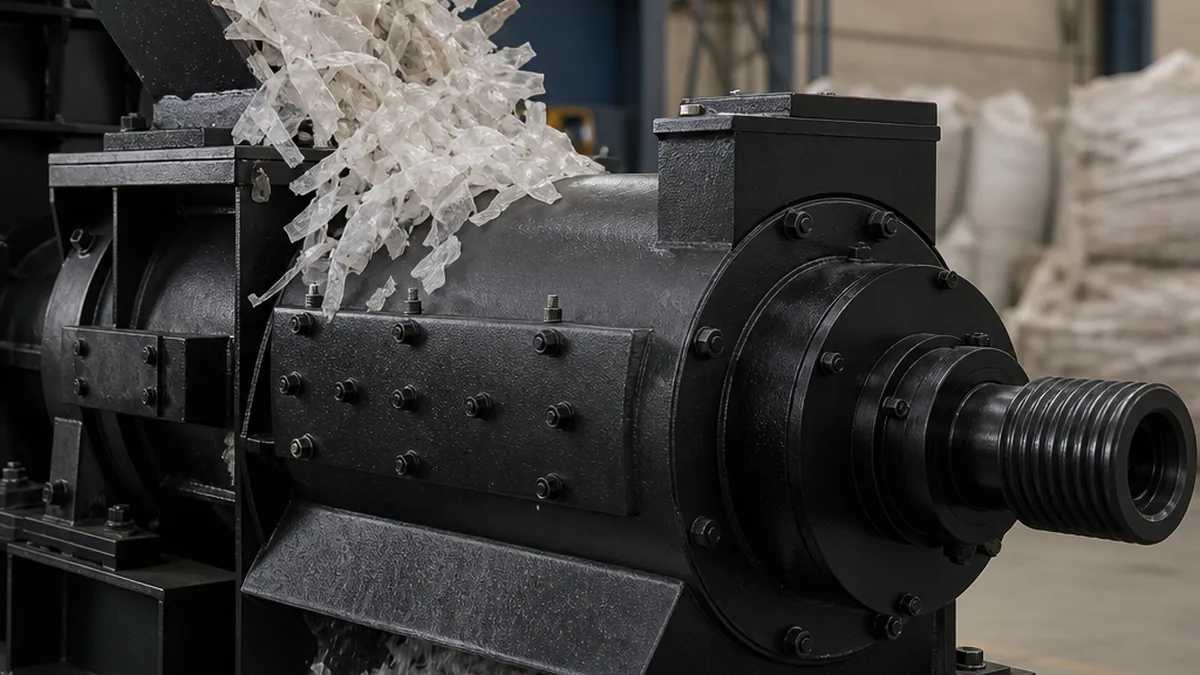
At a glance
- Core function: densify loose plastic films into granules before extrusion
- Primary mechanism: friction heat from rotating blades — no external heater required
- Typical input: LDPE, HDPE, PP plastic films, stretch film, woven bags
- Output bulk density: roughly 4–6× higher than the raw film input
- Integration point: sits between film washing/sorting and the pelletizing extruder
- Configurations: disc-type (most common), drum-type, continuous or batch
- Motor power range: typically 18.5–132 kW depending on throughput target
What a Plastic Agglomerator Actually Does — and Why Film Recyclers Use One
The basic definition: agglomeration vs. simple shredding or granulating
A shredder tears plastic film waste into flat, irregular pieces. A granulator cuts those pieces into smaller chips. Neither machine changes the bulk density of the material — a bag of shredded film is still mostly air.
A film agglomerator machine does something different: it thermally densifies the material without fully melting it. The rotor blades create enough friction heat to bring the plastic films to just below their flow point, the scraps fuse into a sticky clump, and a cold-water quench locks that clump into irregular but compact granules. The result feeds directly into an extruder hopper without bridging or packing problems.
That distinction matters because granulating alone does not solve the volumetric problem. Plastic film chips at roughly 20–50 kg/m³ bulk density bulk density of loose LDPE film scraps plastics recycling industry data choke screw conveyors and cause surge feeding in extruders. A well-configured film agglomerator machine brings output to a significantly higher bulk density — dense enough to meter reliably.
For the full film pelletizing line context, understanding where the agglomerator fits is the first step.
Why low-bulk-density plastic film waste needs densification before reprocessing
LDPE plastic films, HDPE pallet wrap, PP woven bags — all are structurally thin. A cubic meter of loose shredded film weighs almost nothing. Feed that directly into a pelletizing extruder and the screw cannot generate enough friction to melt it consistently; output quality drops and the extruder runs below rated capacity.
Densification solves this at the source. After upstream dewatering with a plastic film squeezer machine, the film agglomerator further densifies the material into granules the extruder can treat like standard regrind.This is why almost every serious film recycling line includes an agglomerator or a compactor stage before the extruder — skipping it means either slower output or wasted energy.
The EPA’s Sustainable Materials Management framework identifies film densification as a key step in diverting post-consumer waste film from landfill.
How a film agglomerator fits into a broader plastic recycling line
In a full film pelletizing line, the agglomerator machine occupies the third stage: after sorting and washing, before extrusion. Wet plastic film waste leaving a washer goes into the agglomerator, which dries and densifies simultaneously. The granules discharge into a buffer hopper and feed the extruder at a controlled, consistent rate, where the downstream plastic pellet production process continues through extrusion and pelletizing.
Some compact single-step recycling machines integrate agglomeration and extrusion in one unit, but standalone film agglomerator machines give operators independent control over throughput at each stage — a meaningful advantage when plastic film waste input rates vary by shift.
How a Plastic Agglomerator Works: Step-by-Step Working Principle for Film Recycling
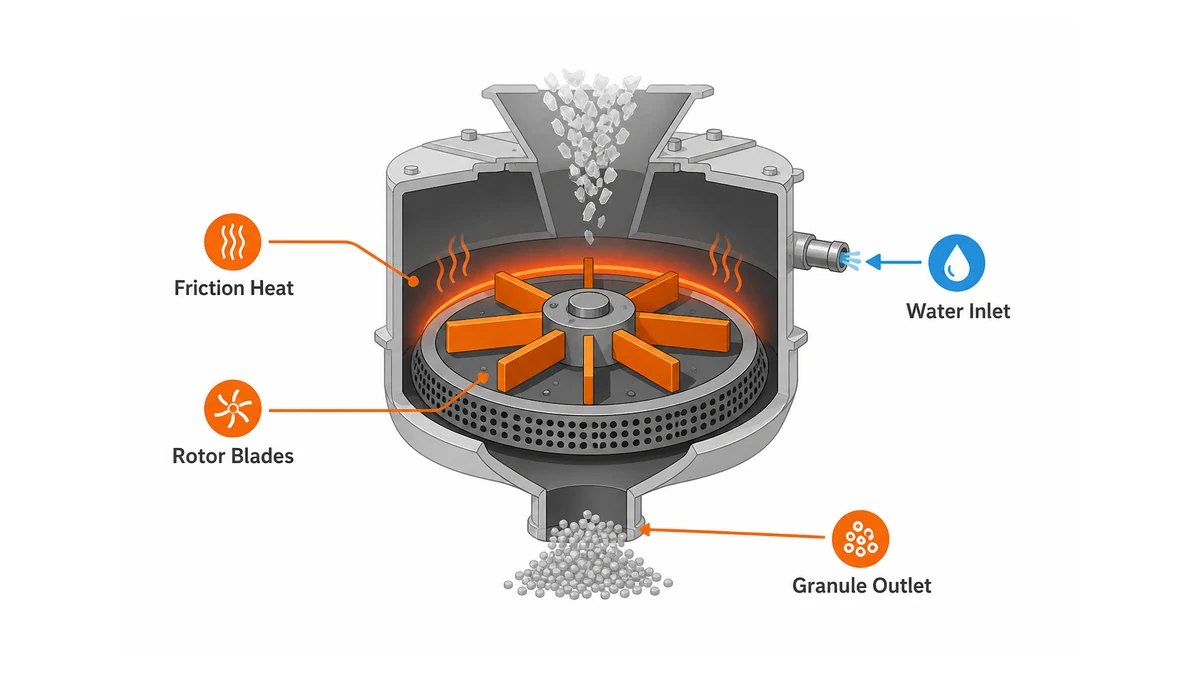
Feeding and cutting: how the rotor blades break down plastic films
Plastic film scraps enter the film agglomerator machine through a top-mounted feed opening. Inside, a set of high-speed rotary blades — typically spinning at 600–1,500 RPM depending on machine size, though exact speeds vary by rotor design and film grade; confirm with your supplier — cut the plastic films into smaller fragments while simultaneously pushing them against the chamber wall. The cutting action is continuous, not intermittent.
The rotor geometry determines cutting efficiency. Disc-type film agglomerators use a flat rotor plate with fixed and moving blades; the clearance between blade tip and chamber wall is typically set in the range of 0.3–0.8 mm, though manufacturers vary this by rotor diameter and target film type — treat this as a starting point, not a universal standard.
Tighter clearance means finer cuts and faster heat buildup, which suits thin LDPE plastic films. Wider clearance handles thicker woven bags or multi-layer plastic films without blade overload.
Frictional heat build-up and the controlled melt-shrink stage
No external heater is used. All the thermal energy comes from friction between the blades, the plastic film waste, and the chamber wall.
As material circulates and cuts repeatedly, surface temperature climbs toward the melting range of the target polymer — LDPE melts between approximately 105–115°C and HDPE between 125–135°C HDPE melting point range polymer properties standard — and the film begins to soften and shrink around itself.
This is the agglomeration moment: the softened plastic film strands stick to each other and form a growing, semi-molten mass. An experienced operator watches the motor amperage — when current draw peaks, the mass has reached optimal density. Timing is critical. Too short, and granules are fragile; too long, and the material approaches full melt, losing the open, porous structure that allows downstream extrusion to work efficiently.
Cold-water quench: locking the semi-molten mass into granules
At the amperage peak, the operator (or an automated control system) introduces a controlled water spray into the chamber. The thermal shock causes the semi-molten mass to contract rapidly and fracture into irregular granules — typically 5–20 mm across. Residual moisture flashes off as steam due to the retained heat.
This cold-water quench stage is what separates a film agglomerator machine from a film compactor that relies on pressure alone. The rapid cooling locks in an open cellular structure, which gives the granules good screw-bite characteristics in the extruder. Granules quenched too slowly tend to fuse into large lumps that jam discharge screens.
Discharge and why output density matters for downstream processing
After quenching, granules discharge through a bottom gate or a side screen. Output bulk density — the number that determines how well the extruder handles the material — depends on three variables: film type, rotor speed, and quench timing.
For LDPE stretch film, well-run agglomerators typically achieve bulk densities in the range of 350–450 kg/m³; HDPE woven bag material, being stiffer, often lands at 400–550 kg/m³ — though both figures vary by machine configuration and film grade, so verify against supplier test data on your specific material.
🔍 Worth checking: Ask any film agglomerator supplier for bulk-density test data on your specific film grade before ordering. A machine optimized for thin LDPE plastic films may underperform on thick PP woven bags — rotor configuration and blade angle differ between them.
That output density figure directly affects pelletizing throughput. Extruders rated for 200 kg/h on standard regrind may only achieve 130–150 kg/h on poorly densified film granules. Getting the agglomeration stage right protects your entire line’s capacity.
Main Types of Agglomerator Machines and the Film Materials Each Handles Best
Disc-type agglomerators: typical specs and target plastic films
The disc-type film agglomerator is the dominant design in plastic film waste recycling operations. A horizontal rotor disc carries 3–6 blades; counterblades are fixed to the chamber wall. The circular flow path keeps plastic films in constant contact with the cutting zone, making heat buildup fast and predictable.
Typical disc-type film agglomerator machine specs:
| Parameter | Typical Range |
|---|---|
| Motor power | 18.5–132 kW |
| Rotor diameter | 300–800 mm |
| Throughput (LDPE plastic films) | 100–800 kg/h |
| Chamber volume | 50–500 L |
| Water consumption | 5–20 L per batch |
Target materials include LDPE grocery bags, LLDPE stretch wrap, HDPE agricultural film, and light PP woven bags. This design handles wet plastic film waste well — the water quench integrates cleanly into the disc chamber geometry.
Continuous vs. batch configurations: throughput trade-offs
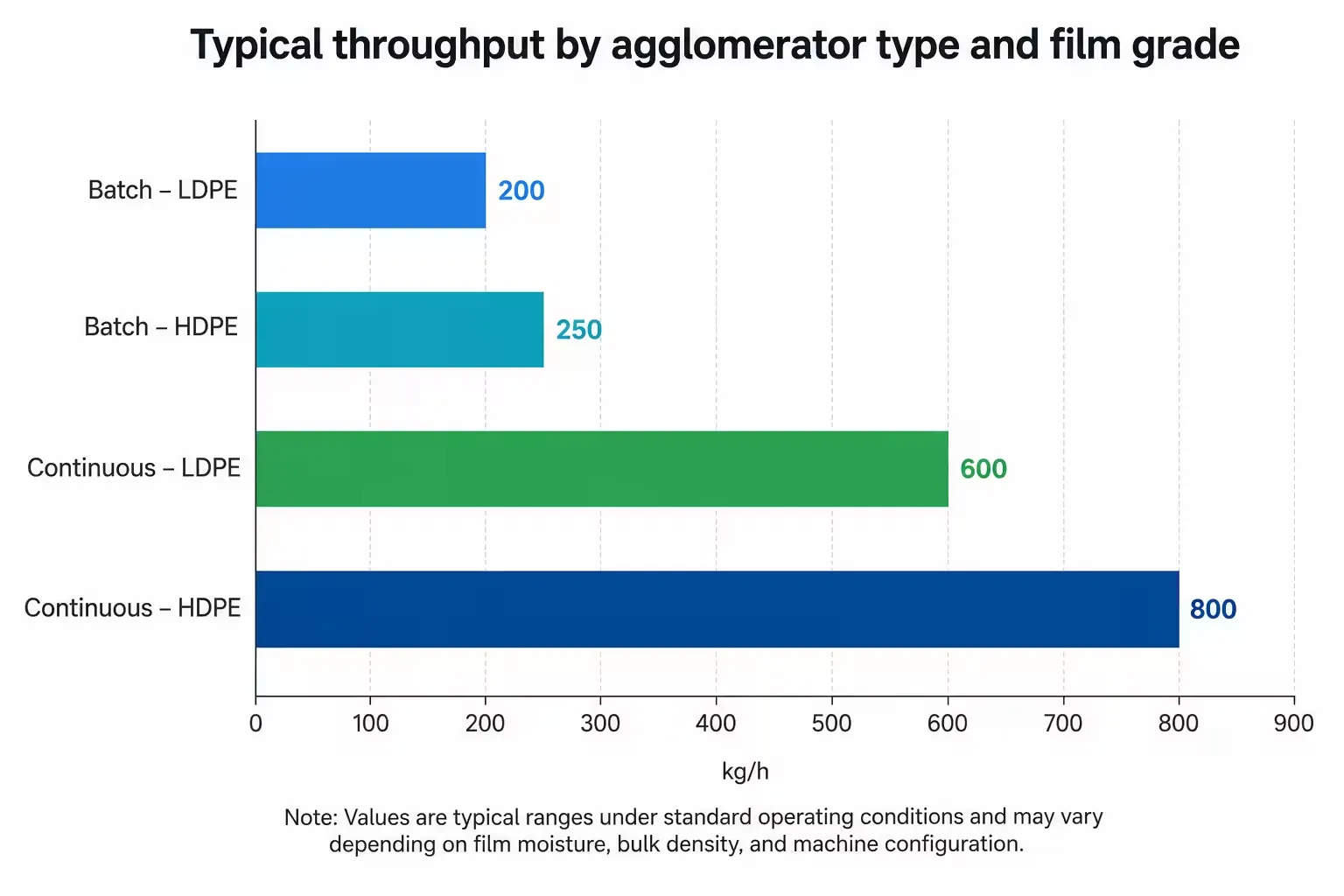
Typical throughput by agglomerator type and film grade
Batch agglomerators process one load at a time: fill, run to peak amperage, quench, discharge, repeat. Cycle time runs 3–8 minutes depending on charge weight and film type. They suit lower-volume operations (under 300 kg/h) or facilities processing mixed plastic film waste grades that need to adjust settings between runs.
Continuous film agglomerator machines feed plastic films and discharge granules simultaneously, using a modified rotor chamber with a metered feed screw and a continuous discharge outlet. Throughput is higher and more consistent, but they require a steadier input stream and more precise process control. For high-volume plastic film waste recycling operations running a single consistent film grade, continuous machines offer better economics per kilogram processed.
Plastic Agglomeration Machines in the U.S. Recycling Industry
The U.S. generates substantial volumes of post-consumer waste film every year, much of it from retail, agriculture, and food distribution. The EPA’s Sustainable Materials Management program tracks plastic film as a distinct category within the broader municipal solid waste stream, noting that film recycling rates remain below those for rigid plastics — primarily because of the logistical challenge of collecting and densifying soft flexible film.
That logistical gap is exactly what the film agglomerator machine addresses. U.S. store drop-off programs for soft plastic films — run through retail chains under guidelines coordinated by organizations such as the Sustainable Packaging Coalition — collect LDPE and LLDPE plastic films that would otherwise enter the waste stream.
That collected soft plastic film waste moves from the drop-off bin to a film recycling facility, where an agglomerator machine is typically the first processing step before extrusion.
The scale of this supply chain matters for equipment sizing. A mid-size regional film recycler processing drop-off material from 200–300 retail locations might receive 5,000–15,000 kg of post-consumer waste film per week — a volume that demands continuous or multi-unit film agglomerator capacity rather than a single batch machine. NEC and UL electrical compliance standards apply to agglomerator machines installed in U.S.
facilities; buyers should confirm compliance in writing before accepting equipment, since non-compliant installations can invalidate facility insurance and create OSHA liability.
Counterintuitively, the film agglomerator is also the point in the recycling line where contamination risk is highest — not the wash stage. Plastic film waste that passes visual inspection during sorting can still carry fine grit or sand embedded in the film surface. That abrasive material reaches the rotor blades at high speed.
Sourcing film agglomerator machines with hardened blade steel and verifying the Rockwell hardness specification from your supplier is a more reliable contamination defense than relying on upstream sorting alone.
Practical Benefits: What a Film Agglomerator Delivers Over a Shredder or Granulator
Agglomerated plastic film granules store in standard bulk bags and flow through pneumatic conveyors without bridging, unlike flat shredded chips that pack into interlocked mats. Warehouse footprint for the same weight of material drops significantly compared to loose shredded plastic films.
Pellet quality from the extruder also improves. A consistent granule size — compared to mixed chip sizes from a granulator — means the extruder screw fills more evenly, reducing surging and degradation from hot spots. Operations that switched from direct granulator-to-extruder feeding to a film agglomerator intermediate stage typically report fewer extruder purges per shift.
The film agglomerator machine also functions as a partial dryer. Wet plastic film waste from a wash line enters at 10–20% surface moisture; friction heat and the steam generated during quenching drive most of that moisture off before the granules reach the extruder. A separate drying stage can often be eliminated or downsized.
Worth knowing: Agglomerators are commonly described as dryers, but drying is a side effect of the quench stage — not a designed primary function. Operators who rely on the agglomerator to handle very wet plastic film waste (above 20% moisture) without a dewatering press upstream typically find granule quality degrades and cycle time extends unpredictably.
The physics are straightforward: too much water in the chamber lowers the peak temperature the friction heat can reach, which means the plastic films never fully reach the semi-molten state needed for proper densification.
One genuine trade-off: film agglomerator machines consume more energy per kilogram processed than a granulator alone. A 75-kW agglomerator processing 400 kg/h uses approximately 0.19 kWh/kg — based on rated motor draw at stated throughput; confirm against your supplier’s actual power data, since real-world draw varies with film type and fill factor.
🚫 Avoid: running a film agglomerator on heavily contaminated plastic film waste without pre-washing. Dirt and grit accelerate blade wear and can introduce abrasive particles into the granule stream, scoring extruder screws downstream.
Common Plastic Film Applications: Which Materials Work Best
The machine’s strength is soft, flexible soft plastic film. LDPE and LLDPE plastic films — pallet stretch wrap, produce bags, dry-cleaning film — are the ideal feed materials. They soften quickly under friction heat and quench into stable granules with minimal blade wear.
HDPE plastic films — heavier-gauge shopping bags, agricultural mulch film, silage wrap — agglomerate well but require higher rotor speeds and longer cycle times due to their higher melting point. PP woven bags are processable in disc-type film agglomerator machines but benefit from a pre-shredder to reduce piece size before feeding.
What resists agglomeration? Plastic films with significant aluminum laminate layers — like metallized snack-food packaging — do not fuse cleanly; the metal disrupts the plastic-to-plastic bonding during the melt-shrink stage. Heavily printed multi-layer barrier plastic films can agglomerate but produce lower-quality granules with ink contamination unless pre-sorted. PVC film should not be run in a film agglomerator machine alongside polyolefins — it degrades at lower temperatures and introduces chlorine contamination.
How to Choose the Right Agglomerator Machine for Your Film Recycling Operation
Matching machine capacity to your daily plastic film waste volume
Start with your daily film waste weight — in kilograms per shift — and work backward to required hourly throughput. A facility generating 2,000 kg/shift over 8 hours needs at least 250 kg/h of agglomerator machine capacity. Add 20–25% headroom for feed variability and downtime.
Motor power is the fastest proxy for capacity. A 37-kW disc-type film agglomerator handles roughly 200–300 kg/h of LDPE plastic films; a 90-kW machine reaches 500–700 kg/h. But motor size alone doesn’t tell the whole story — rotor diameter and blade count determine how quickly heat builds, which affects actual throughput on your specific plastic film waste grade.
Wet vs. dry plastic film input: which configurations handle each
Wet plastic film waste from a wash line needs a machine with sealed bearings, stainless-steel chamber lining, and a drain system to handle the water load. Dry film — shredded scrap from in-house production waste — can run in a simpler configuration. Running wet plastic films in a dry-configured agglomerator accelerates bearing corrosion and oxidizes the chamber surface, causing contamination in the output granules.
A surface moisture of 15% on incoming plastic film waste is manageable for a properly configured film agglomerator; 25%+ typically requires a pre-dryer or a dewatering press upstream. Confirm the machine’s wet-input rating in writing before purchasing.
Questions to ask a supplier before committing to a model
Before placing an order for any film agglomerator machine, get written answers to these:
- What bulk density (kg/m³) does this machine achieve on your specific plastic film grade, tested on their floor?
- What is the blade replacement interval and cost per set for your film type?
- Is the control system manual, semi-automatic, or fully automatic — and does the quench valve operate on a timer or on motor amperage feedback?
- What is the lead time for spare blades and counter-blades from U.S. stock?
- Does the machine comply with applicable NEC and UL electrical standards and safety guarding requirements?
✅ Do this: Request a material trial — send a 50-kg sample of your actual plastic film waste to the supplier’s test facility before finalizing the spec. Output bulk density and cycle time on your specific material are the only numbers that matter for your line.
A supplier’s engineering team should size film agglomerator machines against your actual scrap data, not catalog assumptions. Generic throughput figures based on “standard LDPE film” can be 30–40% optimistic when your actual feed is a mixed plastic film waste stream with variable moisture and contamination levels.
Keeping a Film Agglomerator Running: Maintenance Priorities That Protect Output Quality
Blade condition is the single highest-impact maintenance variable. Dull blades generate heat inefficiently — the plastic films slide rather than cut, extending cycle time and reducing output density. On LDPE plastic film waste, blade sets typically need inspection every 200–400 operating hours; on abrasive HDPE or PP woven bag material, that interval can drop to 100–150 hours.
These intervals are indicative — check your specific machine manual and adjust based on observed blade wear. Keep a spare blade set on the shelf. Waiting on a parts shipment to resume production is an avoidable cost.
The water system deserves equal attention. Scale buildup in the quench nozzles reduces flow rate, which throws off quench timing and causes granule quality to drift. Flush the water circuit weekly and descale nozzles monthly in hard-water areas. Check the inlet water temperature — quench water above 25°C slows solidification and produces larger, less uniform granules.
Bearings on the rotor shaft run under significant radial load. Follow the lubrication interval in the machine manual and monitor bearing temperature during operation. A bearing running 15–20°C above normal ambient is signaling the start of wear, not an emergency — catching it at that stage means a planned replacement rather than an unplanned line stoppage.
The discharge screen (on machines fitted with one) should be checked at the start of every shift for deformation or blocked apertures. A partially blocked screen backs plastic film waste material up into the chamber and forces the motor to overload.
Sizing Your Film Agglomerator: Next Steps
Before contacting a supplier, confirm three numbers: your daily plastic film waste weight, your incoming moisture level, and your target output bulk density for the downstream extruder. Those inputs determine motor size, chamber configuration, and whether you need wet-rated components.
A supplier’s engineering team should size a film agglomerator machine against your actual scrap data — not assumed averages. Submit your film sample data to get a plastic film recycling solution matched to your operation’s actual material characteristics and capacity requirements.
Have a project or a spec sheet in hand? Talk to elantmachine.com — real engineers answer.
FAQ
What is the difference between a plastic agglomerator and a pelletizer?
A plastic agglomerator densifies lightweight film waste using high-speed cutting, frictional heat, and controlled cooling. It produces compact, irregular granules rather than finished pellets. A pelletizer works downstream of an extruder, cutting fully melted and filtered plastic into uniform pellets. In a typical film recycling line, agglomeration prepares the material for more stable extrusion and pelletizing.
What materials can a film agglomerator process?
Film agglomerators are mainly used for lightweight thermoplastic waste such as LDPE film, LLDPE stretch film, HDPE film, PP woven bags, and similar flexible plastic scraps. Performance depends on material thickness, moisture content, contamination level, and bulk density. Mixed or heavily contaminated materials may require washing, sorting, and dewatering before agglomeration.
How do I choose the right capacity for a film agglomerator machine?
Choose capacity based on the actual film type, bulk density, moisture level, hourly input volume, and the capacity of the downstream extruder. Batch machines are generally better suited to lower or variable throughput, while continuous systems are more suitable for stable, higher-volume production. The agglomerator should be sized as part of the complete recycling line rather than selected only by its maximum rated kg/h.
Sources
[1] Store Drop-off: US Only — how2recycle.info
[2] Sustainable Materials Management | US EPA — epa.gov
[3] Low-Density Polyethylene (LDPE): Complete Technical… — lairdplastics.com
[4] Sustainable Materials Management Resources — sbeap.org
[5] SPC Seeks to Expand Label for Film and Flexible… — sustainablepackaging.org
[6] North American Standards – Control Panel Tip — siemens.com
[7] UL 508A: Practical Compliance Guide — payapress.com