
A PET bottle washing line running at 1,000 kg/hr can produce two entirely different flake grades depending on how the process variables are set. The difference between food-contact-grade rPET flakes and downgraded fiber-fill stock often comes down to caustic concentration, rinse-water conductivity, and whether the hot-wash retention time was dialed in or left at the factory default.
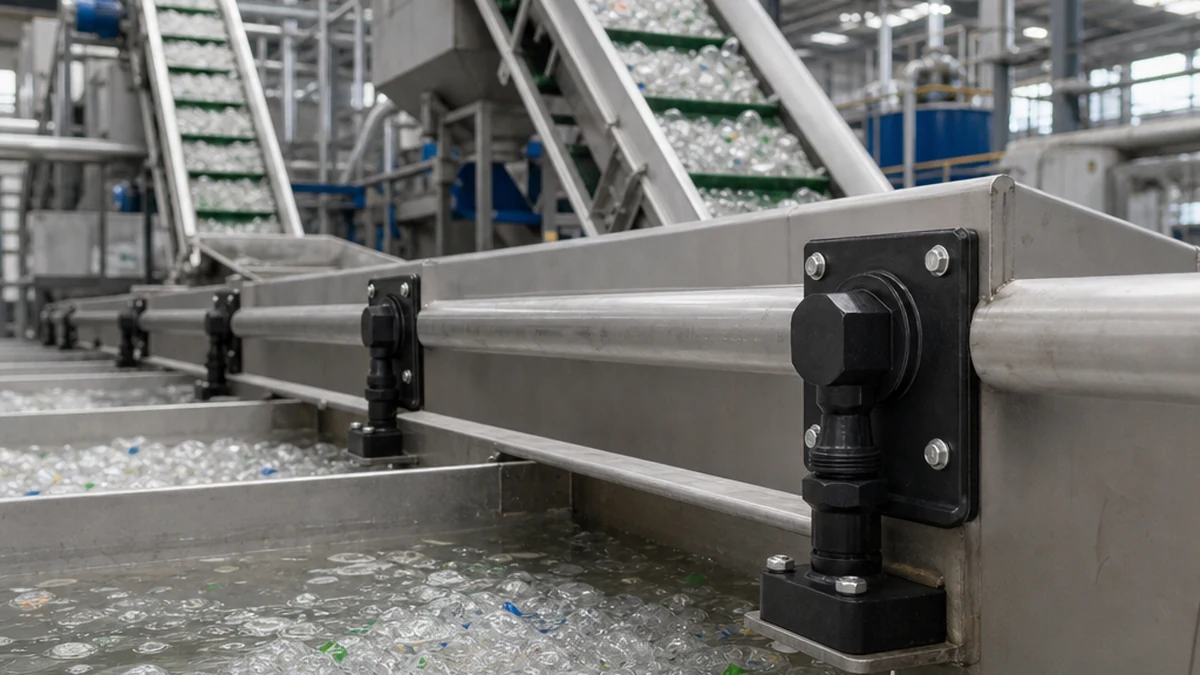
At a glance
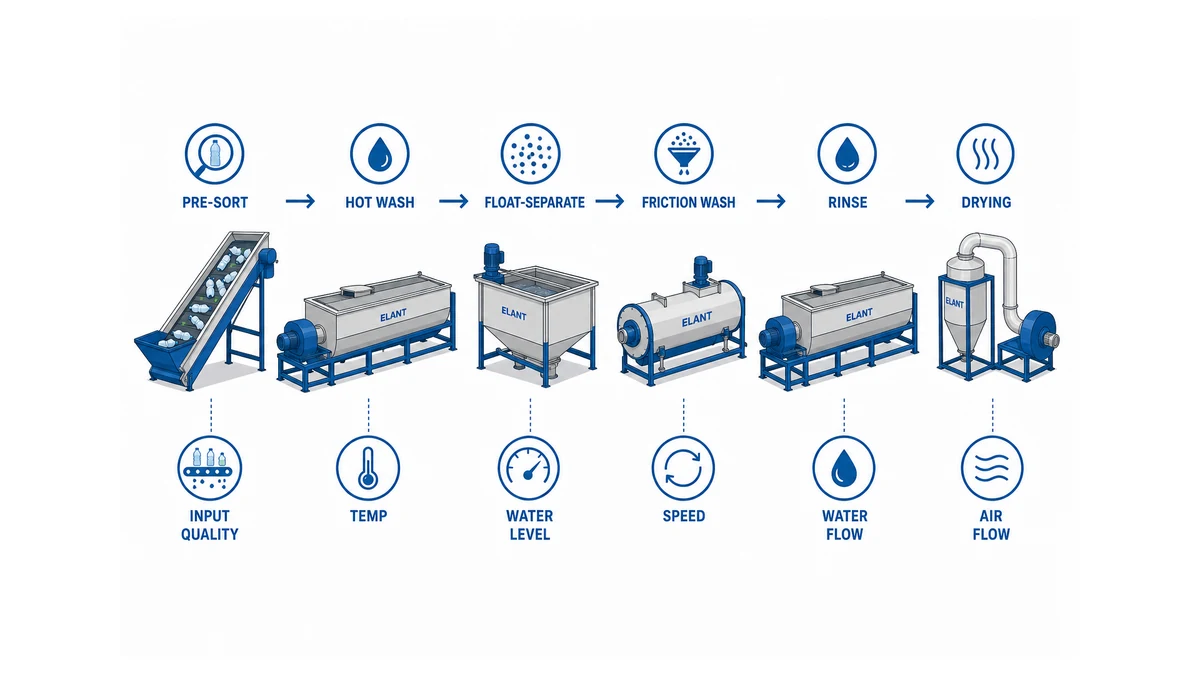
- rPET quality is controlled across six linked washing-line stages: pre-sort → label removal → crush → pre-wash → hot-wash → rinse/dry.
- The single highest-leverage variable for rPET flake purity is hot-wash caustic soda concentration (typically 1–3% by weight at 80–90 °C).
- Rinse-water conductivity below 50 µS/cm at the final rinse stage is the most reliable real-time proxy for residual contamination.
- Moisture content in discharged flakes must reach ≤1% for fiber-grade and ≤0.3% for food-grade or sheet-grade applications.
- rPET is recyclable — bottle-to-bottle PET recycling is commercially proven — but each mechanical recycling cycle causes some intrinsic viscosity (IV) loss, so incoming material quality determines ceiling output grade.
- A structured line audit before adjusting parameters prevents chasing symptoms instead of root causes.
Where rPET Quality Is Won or Lost Across the Washing Line
Before changing operating parameters, identify which stage is creating the quality loss. Adhesive residue, PVC contamination, excess fines, and high final moisture each point to a different part of the washing line. Optimizing the wrong stage can increase chemical, water, or energy consumption without improving the final rPET flake grade.
Feedstock Control Before Washing
Pre-sorting removes non-PET contamination — HDPE caps, aluminum, PVC sleeves, and off-color bottles — before any mechanical processing begins. Every non-PET item that enters the crusher adds contamination that the washing line cannot fully remove downstream.
Label removal at this stage typically uses a friction-based label removal system or a dry de-labeler that strips paper and film sleeves before wet processing. Leaving intact sleeve labels in the crusher dramatically increases the load on the hot-wash stage and, if the labels are PVC, risks contaminating the entire PET flake batch.
✅ Do this: Run a timed inspection of the pre-sort belt every two hours during production. Track rejection rate by contaminant type — a sudden drop in PVC rejection usually signals a worn label-removal rotor, not cleaner incoming material.
Flake Size and Pre-Wash Conditions
The crusher reduces whole PET bottles into flakes, typically 10–16 mm, using wet or dry cutting. Wet crushing — injecting water directly at the cutting chamber — immediately begins removing surface adhesives and reduces heat buildup that can locally melt PET and create fused fines.
Pre-washing in a float-sink tank serves a dual purpose: it separates PP/HDPE caps (density < 1.0 g/cm³, which float) from PET flakes (density ~1.38 g/cm³, which sink), and it dissolves water-soluble adhesives before the hot-wash stage. Skipping or under-sizing this tank passes adhesive load directly to the hot-wash, increasing caustic consumption and shortening solution life.
Hot-Wash and Friction-Wash Performance
This is the highest-leverage stage for improving washed-flake quality.The PET bottle hot washing process uses heated caustic soda solution to saponify adhesives, break down label residues, and strip oils from PET flake surfaces. Friction washers immediately before or after the hot-wash tank add mechanical energy — rotating paddles or screw flights create flake-on-flake abrasion that dislodges particles loosened by the chemistry. The quality result depends on the interaction between temperature, caustic concentration, retention time, and mechanical friction. Increasing one variable cannot always compensate for another that is outside its effective range, which is why these parameters should be measured together rather than adjusted independently.
Final Rinse and Moisture Control
Counter-current rinsing — fresh water entering at the final rinse tank and used water exiting at the first rinse tank — minimizes total water consumption while maximizing contamination removal efficiency. Conductivity meters at the final rinse outlet provide real-time feedback on residual caustic and dissolved solids.
Centrifugal dryers followed by hot-air drying reduce surface moisture. The sequence matters: centrifugal drying first removes bulk water mechanically, which is far more energy-efficient than thermal drying, while the thermal stage brings the flakes down to the required final moisture specification.
How Upstream Problems Affect Washing-Line Performance
Washing-line optimization is sequential. Contamination that escapes an upstream stage increases the chemical, mechanical, or water-treatment load required downstream, so adjusting the stage where a problem becomes visible does not necessarily address its root cause.
How upstream contamination increases washing demand
Adhesive residue not removed during pre-wash coats PET flakes before they enter the hot-wash. This residue increases the cleaning demand placed on the caustic solution, potentially requiring longer retention time or higher caustic concentration to achieve the same result — both of which increase operating cost. If neither is adjusted, the adhesive can carry through to the dried flake.
PVC contamination is especially damaging downstream. Even small amounts can contribute to discoloration and quality loss when PET is later processed at elevated melt temperatures. Unlike surface adhesives and oils, incompatible polymers such as PVC cannot be reliably corrected simply by increasing hot-wash intensity.
🚫 Avoid: Increasing hot-wash temperature or caustic concentration to compensate for poor pre-sort performance. Surface-cleaning parameters cannot replace effective upstream polymer separation.
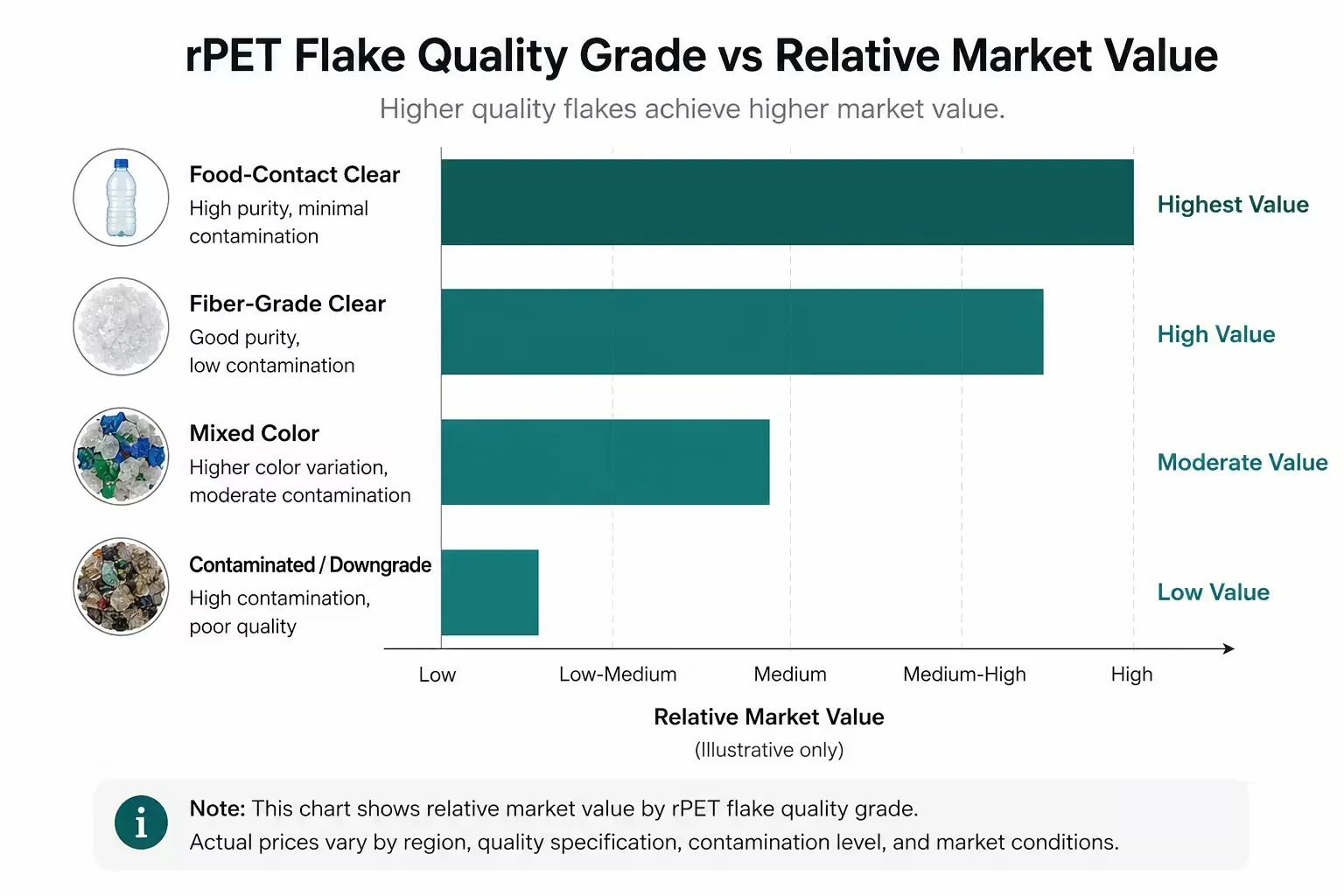
Higher-value rPET grades therefore justify tighter upstream and washing-line control. Food-contact clear flakes generally require more consistent control of contamination, moisture, color, and material properties than fiber-grade or mixed-grade output. The goal of optimization is not simply to make flakes look cleaner, but to keep the process variables within the range required by the intended downstream application.
Key Process Parameters by Washing Line Stage
The table below summarizes the critical control variables, target ranges, and on-site measurement methods for each stage of a PET bottle washing line.
| Washing Line Stage | Key Control Variable | Target / Acceptable Range | On-Site Measurement Method |
|---|---|---|---|
| Pre-sort & label removal | Non-PET rejection rate | ≥95% of non-PET items removed | Timed belt inspection; count by contaminant type |
| Pre-sort & label removal | PVC content in accepted stream | < 100 ppm by weight | NIR sortation unit readout or manual audit |
| Crushing | Flake size distribution | 10–16 mm (majority fraction) | Sieve analysis — 4 mm / 10 mm / 16 mm stack |
| Crushing | Fines (< 4 mm) percentage | < 3% of total output weight | Sieve analysis; weigh fines fraction |
| Pre-wash (float-sink) | Process water conductivity | < 200 µS/cm | Inline conductivity meter |
| Hot-wash | Caustic soda (NaOH) concentration | 1–3% by weight | Titration kit — check start and end of each shift |
| Hot-wash | Tank temperature | 85–90 °C | Independent thermocouple (not tank gauge) |
| Hot-wash | Retention time | 3–5 min (curbside feedstock) | Flow rate vs. tank volume calculation |
| Friction washing | Rotor speed / paddle gap | Per OEM spec for feedstock type | RPM gauge; feeler gauge at scheduled inspection |
| Rinse (counter-current) | Final rinse conductivity | < 50 µS/cm | Inline conductivity meter at final rinse outlet |
| Centrifugal + thermal drying | Moisture content at discharge | ≤ 0.3% (food-grade); ≤ 1.0% (fiber-grade) | Halogen moisture analyzer — 1 sample/hr at startup |
| Finished flake | Intrinsic viscosity (IV) | 0.70–0.85 dL/g (food-contact grade) | Third-party lab (weekly); ASTM D4603 |
| Finished flake | Color (L*a*b*) | L* > 75; |a*| < 3; |b*| < 5 (food-contact clear) | Colorimeter or spectrophotometer |
Use this table as a quick-reference checklist during a line audit. Any parameter outside its target range is a confirmed optimization opportunity before any capital expenditure is considered.
The Critical Variables That Control Output Flake Quality
Hot-wash chemistry: caustic soda ratio and temperature range
Caustic soda (NaOH) concentration in the hot-wash tank typically runs 1–3% by weight. Below 1%, adhesive saponification is incomplete and surface oils persist. Above 3%, caustic cost rises, rinse-water treatment load increases, and there is measurable surface etching of PET flake that degrades IV.
Temperature in the hot-wash tank should target 85–90 °C for effective adhesive removal without PET degradation. The relationship between PET wash temperature and recycling performance is roughly linear up to 90 °C; above that, energy consumption rises steeply with diminishing return.
🔍 Worth checking: Test caustic concentration daily using a simple titration kit, not just by monitoring the dosing pump rate. Organic load from incoming bottles gradually consumes active alkali — a dosing pump set correctly at startup may be maintaining insufficient concentration by mid-shift.
Mechanical friction intensity and dwell time
Friction washer rotor speed and paddle gap determine how much mechanical energy is applied to the flake bed. Higher rotor speed increases throughput of the friction washing stage but reduces individual flake dwell time — the two variables work against each other.
For typical post-consumer PET bottle feedstock, friction-washing intensity and dwell time should be adjusted together according to contamination load and the washer manufacturer’s operating range. Cleaner deposit-return feedstock may require less mechanical washing than heavily contaminated municipal curbside material.
Water recycling quality and rinse-water conductivity
Recycled process water that re-enters the washing line carries dissolved caustic, surfactant residue, and fine PET particles. Conductivity above 200 µS/cm in the pre-wash tank is a practical ceiling — above that, dissolved solids begin redepositing on flake surfaces rather than being flushed away.
At the final rinse stage, target conductivity below 50 µS/cm. This is the most cost-effective on-line quality check available without laboratory equipment, and it correlates reliably with ash content in the finished rPET flakes.
Throughput rate versus wash effectiveness trade-off
Running the washing line at maximum rated capacity does not produce maximum-quality flake. Throughput pushes material through the hot-wash tank faster, reducing effective retention time at temperature. A line rated at 1,500 kg/hr that produces fiber-grade flake at full throughput may produce food-contact-grade flake at 1,100 kg/hr — the same equipment, the same chemistry, different retention time.
Quantify your actual break-even: if the price differential between fiber-grade and food-contact-grade rPET exceeds the revenue lost from the throughput reduction, running at lower capacity is the correct business decision.
Best Practices for Optimizing Each Stage of the Line
Pre-sorting: tightening material acceptance criteria
Define a written material acceptance specification for incoming PET bottle bales — not a verbal guideline. Common U.S. bale specs cap non-PET content at 2–5% and PVC at below 100 ppm by weight. Rejecting bales that don’t meet spec at receiving is cheaper than processing them and downgrading the entire output batch.
Install a near-infrared (NIR) sortation unit after the pre-sort belt if your feedstock is variable-quality municipal curbside material. NIR units reliably separate PVC from PET at line speeds without manual intervention, and the capital cost typically recovers within 18–24 months through grade uplift alone.
Crusher settings that minimize fines generation
Fines — PET particles below 4 mm — cannot be effectively washed, increase moisture retention in the drying section, and reduce bulk density of the final rPET flake. Keep fines below 3% of total output weight to stay within food-contact flake specifications.
Adjust crusher blade gap to keep the majority of output flakes in the 10–16 mm range. Dull blades tear rather than cut, generating significantly more fines. Inspect and rotate blades on a fixed schedule (not reactively when fines rate spikes), and track fines percentage as a lagging indicator of blade condition.
Hot-wash stage: dialing in temperature and chemical dosing
Audit the hot-wash stage first, since it produces the largest quality differential of any single stage adjustment. Verify tank temperature with an independent thermocouple — installed tank gauges drift. Measure caustic concentration at the beginning and end of each production shift.
Log caustic consumption per tonne of PET bottle input. An upward trend over weeks indicates either a change in incoming contamination level or a developing mechanical issue (reduced friction washing intensity pushes more adhesive load into the hot-wash). Both need a different corrective action.
Drying section: moisture targets for food-grade flakes
Food-grade rPET flakes require moisture content ≤0.3% for safe downstream extrusion without IV degradation from hydrolysis. Fiber-grade typically specifies ≤1.0%. These are the targets your drying system must consistently hit, not average targets — a single batch delivered above spec creates a customer claim.
Set drying section parameters (air temperature, residence time, air flow rate) based on measured moisture at discharge, not on the equipment OEM’s nameplate settings. Nameplate settings assume a specific incoming wet-flake moisture content that varies with seasonal conditions and pre-wash water temperature.
How to Measure and Verify rPET Flake Quality On-Site
Visual and sieve tests for fines and size distribution
A sieve analysis takes less than 15 minutes per sample and quantifies fines percentage and size distribution against spec. Use a stacked sieve set with 4 mm, 10 mm, and 16 mm mesh sizes. Weigh each fraction and record as a percentage of total sample weight.
Visual inspection under daylight-equivalent lighting catches color contamination — yellow, green, or blue flakes in a clear-grade lot — that automated systems may miss at low concentration levels. Train operators to flag any visible non-clear flakes for manual removal before final packaging.
Moisture content and IV (intrinsic viscosity) checks
Moisture content can be checked on-site with a halogen moisture analyzer — a $400–$800 instrument that delivers results in under 10 minutes. Check one sample per production hour during startup and one per two hours during steady-state operation.
IV measurement[3] requires laboratory equipment (a viscometer and either solution or melt measurement), so most washing line operators send samples to a third-party lab weekly. IV in the 0.70–0.85 dL/g range is typical for food-contact-grade rPET from post-consumer bottle feedstock. Values below 0.70 dL/g indicate either degraded incoming material or process conditions causing hydrolysis.
🔍 Worth checking: Request IV data from your downstream converter on the first three shipments of any new product line. Their melt processing behavior — die pressure, melt temperature stability — gives you feedback on real-world IV performance that lab measurements alone won’t capture.
Color and contamination benchmarks by end-use grade
Color measurement uses L*a*b* values. Food-contact clear rPET flakes typically require L* > 75, |a*| < 3, and |b*| < 5. Fiber-grade tolerates lower L* (down to ~65) and wider b* range. Mixed-color has no defined standard and is sold on the spot market at prices set by the recycled pet flakes price[4] environment at time of sale.
Contamination benchmarks for food-contact flakes in the U.S. are governed by FDA no-objection letters[5] issued to specific recycling process operators — not to rPET flakes as a category. If food-contact application is your target, verify that your washing line process qualifies under an existing FDA letter or pursue a new submission.
Moisture thresholds for food-contact and sheet-grade rPET flakes are ≤0.3% by weight; fiber-grade applications permit up to ≤1.0%. Apply the appropriate threshold when evaluating lot compliance — reporting a single blended figure without grade distinction will mask out-of-spec food-contact material.
Audit Your Line and Take the Next Optimization Step
Before adjusting any process variable, audit what the line is actually doing — not what the control panel says it’s doing. Measure hot-wash tank temperature with an independent sensor. Pull a conductivity reading at the final rinse outlet. Sieve a 1 kg flake sample and weigh the fines fraction. These three data points, collected in under an hour, will tell you which stage is driving your current quality gap.
Process optimization on a PET bottle washing line is sequential, not simultaneous. Fix the stage that is generating the most contamination first — usually the hot-wash chemistry or the pre-sort rejection rate — before adjusting downstream stages. Adjusting drying parameters to compensate for inadequate hot-wash performance is a common mistake that increases energy cost without raising flake grade.
If your line is producing below-spec flake despite correct parameter settings, the issue is likely mechanical: worn friction washer paddles, a clogged counter-current rinse circuit, or a hot-wash heat exchanger running below design temperature due to scale buildup. Each of these is a maintenance item, not a process tuning problem, and each requires a different corrective action.
A structured line audit — covering feedstock quality, stage-by-stage process measurements, equipment condition, and finished-flake quality data — typically takes one production day and identifies the two or three changes that will produce the largest grade improvement. If your internal team has not run a formal audit in the past 12 months, that is the correct starting point before any capital investment in equipment upgrades.
Have a project or a spec sheet in hand? Talk to elantmachine.com — real engineers answer.
FAQ
What is the best temperature for washing PET flakes?
For hot washing, PET flakes are typically processed at 85–90 °C with a controlled caustic solution. This range supports effective removal of adhesives, oils, and label residues without unnecessarily increasing energy use or exposing PET to excessive heat. Temperature should be monitored with an independent sensor and adjusted together with caustic concentration and retention time rather than treated as a standalone setting.
How can I improve PET flake quality without reducing line capacity?
Start by correcting quality losses that do not require lowering throughput, such as poor pre-sorting, excessive crusher fines, incorrect caustic concentration, weak friction washing, or contaminated rinse water. If these parameters are already optimized, check whether the current throughput is shortening hot-wash retention time. In that case, a moderate capacity reduction may be necessary if the higher rPET grade provides enough additional value to offset the lost throughput.
Which washing-line parameter should I adjust first when rPET quality drops?
Do not adjust a parameter until you identify where the quality loss begins. Check hot-wash temperature, final-rinse conductivity, and flake-size/fines distribution first, then trace abnormal results back to the relevant stage. Adhesive residue may indicate a hot-wash or friction-washing problem, while high moisture points to the drying section and PVC contamination usually requires better upstream separation rather than stronger washing.
Sources
[1] Decisionmaker’s Guide to Recycling Plastics — nepis.epa.gov
[2] 2024 PET Recycling Report — napcor.com
[3] D4603 Standard Test Method for Determining Inherent … — store.astm.org
[4] Design for Recycling Guidelines — recyclass.eu
[5] Guidance on Use of Recycled Plastics in Food Packaging — fda.gov