
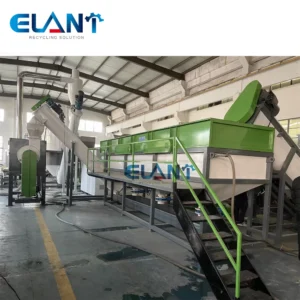
Managing wash water reuse issues in a recycling washing line comes down to five measurable parameters, a calibrated bleed-and-feed ratio, and a written operator response strategy for each of the four predictable failure modes. Unmanaged water recycling introduces contamination build-up, foam, and pH swings that degrade output quality faster than fresh water would — sometimes scrapping an entire batch within a shift. This guide covers the exact operator response strategies our engineering team at Elant applies on every line we commission, where the most common feedstock mix we see is post-consumer film (agricultural and household) running on 8–20 t/hr lines with inlet fresh water supply in the range of 6–15 m³/hr.
Quick takeaways
- Recycled water quality degrades in a predictable pattern: solids → surfactant accumulation → pH drift → biological growth. Each stage has a specific fix.
- Conductivity and turbidity are the two metrics worth monitoring continuously; everything else is downstream of those signals.
- A bleed-and-feed ratio of 10–30% fresh water per cycle is the minimum viable water recycling discipline for most film and rigid plastic lines — but the right number depends on feedstock contamination load.
- Wastewater discharge never disappears: it shrinks. Expect to treat 20–40% of inlet water volume as wastewater even on a well-designed water recycling circuit.
- Operators who document a written response strategy for each failure mode typically halve unplanned downtime within the first quarter of commissioning, in our experience.
Before you start
What you need to know: – Basic understanding of your washing line’s flow path (for example, soaking tank → cold washing for loose dirt removal or hot washing for heavier glue and oil removal → friction wash → rinse stages) – Current fresh water supply capacity (m³/day) and any local regulations on wastewater discharge volumes – Whether your feedstock is post-consumer rigid plastic, film, or mixed — operators should identify plastic type, contamination profile, and input materials before setup because cleaning needs differ significantly
What you need on hand: – Inline conductivity meter (EC meter, range 0–5,000 µS/cm) — under $400 for an industrial unit. If you can only source one instrument first, make it this one: conductivity drift catches roughly 80% of wash water reuse issues before they become visible in output quality. – Turbidity probe or portable Hach turbidimeter – pH strips or inline pH sensor – MSDS sheets for any caustic soda or surfactant additives used in your wash bath, with safety controls in place because high concentrations are corrosive – Bleed valve and fresh water make-up line already plumbed into the circuit
Source the conductivity meter before anything else. The turbidity probe and pH sensor are valuable additions once the circuit is running, but operators who have gone live without the conductivity meter are the ones calling us after a quality failure, not before.
Step 1: Map every contamination source and contamination levels entering the recycled water circuit
Operators who treat recycled water as a single homogeneous problem spend weeks chasing symptoms. The actual contamination sources are discrete and fixable individually — but only once you know which tank they originate in.
A recycling washing line typically introduces contamination at four points, though the required setup depends on contamination level and material type in the incoming waste plastics and the broader plastic waste stream:
- Soaking tank — adhesives, labels, food residue, loose dirt, and other non-plastic impurities dissolve or separate here first; on lines handling pet bottles or post consumer pet bottles, upstream label removal equipment such as a label remover strips labels and adhesive before shredding, but labels and residual contents still often drive the initial load. This is where biological oxygen demand (BOD) spikes.
- Hot caustic wash — surfactant and caustic carryover raises pH and increases foam potential in the water recycling loop, with heated water helping carry chemicals and loosened contaminants into the circuit.
- Friction washer — fine plastic fines (< 200 µm) enter the water here and resist settling.
- Rinse stages — if recycled water is reintroduced here without adequate water treatment, residual surfactant contaminates what should be the cleanest stage, while density separation upstream may already have removed bottle caps before these multiple washing stages.
Draw this as a flow diagram for your specific line. Mark every point where water leaves a tank (overflow, pump discharge) and every point where recycled or fresh water enters. Our engineers call this a water balance map, and we produce one for every washing line we commission — a typical example follows multiple washing stages such as pre washing → soaking tank → hot wash → friction wash → rinse stages, with four discrete contamination entry points, two recirculation return points, and one or two bleed-off nodes feeding the wastewater treatment system. Lines built for plastic films, including agricultural films, need separate mapping because they shed fines and organics differently from bottle lines.
📝 Note: The water balance map is the single most useful visual tool in wash water reuse management. Without it, operators have no reliable basis for setting bleed rates by zone — and zone-level control is what separates a stable water recycling system from one that’s permanently firefighting.
Common mistake: Treating all tanks in the recirculation loop as equivalent and running the same bleed rate across all of them. The soaking tank accumulates contaminants 3–5× faster than the rinse stage on most post-consumer film lines. A single bleed rate undershoots one and wastes water resources on the other.
Step 2: Set baseline water quality parameters before switching to reuse mode
You cannot detect drift without a baseline. Operators who skip this step have no objective trigger for when contamination entering with waste plastics is pushing the circuit out of range, so they default to schedule-based changes that either waste fresh water or run the bath past the point where output quality and clean PET flakes start to suffer when the line is processing bottle feedstock. When reuse drifts out of range, the quality of pet flakes also starts to drop.
Measure and record the following with fresh water fill before the first production run, then relate those readings to the line’s actual throughput in kg/h; for baseline planning, compact layouts often start at 200–300 m²:
| Parameter | Fresh Water Baseline (typical) | Action Threshold (reuse circuit) |
|---|---|---|
| Conductivity (EC) | 200–500 µS/cm | >2,500 µS/cm → increase bleed rate |
| Turbidity | < 5 NTU | >80 NTU → add filtration or bleed |
| pH (hot wash bath) | 10.5–12.0 (caustic) | < 10.0 → replenish caustic; >12.5 → dilute |
| Total suspended solids (TSS) | < 20 mg/L | >400 mg/L → check centrifuge/screen |
| Water temperature | Set point ±2°C | Deviation >5°C → check heat exchanger fouling |
Post this table at the operator station, not in an office binder. The operators who actually stop a line before a quality failure are the ones who can read the threshold without leaving the floor.
💡 Pro tip: Set your conductivity alarm 20% below the action threshold — that gives you a shift’s worth of lead time to adjust the bleed valve before the water quality actually crosses into the danger zone.
Common mistake: Setting action thresholds based on what the equipment supplier wrote in a generic manual rather than your feedstock. Post-consumer film from agricultural sources carries 5–10× more dissolved organic material than post-industrial rigid scrap. Generic thresholds will fail you on contaminated feedstock.
Step 3: Implement a bleed-and-feed protocol that addresses friction washer and wash water reuse issues at the source
This is the core water recycling discipline. Without a defined bleed-and-feed ratio, recycled water accumulates contaminants geometrically — each cycle concentrates what the last cycle left behind, and these baseline values are what allow a washing line to consistently produce high purity flakes.
The standard formula for a minimum bleed rate is:
Bleed fraction = Concentration factor target / (Concentration factor target − 1)
For most plastic film washing lines running post-consumer feedstock, a concentration factor of 3–5× is sustainable before water quality degradation affects output. That translates to bleeding 20–33% of the circulating water volume per production cycle and replacing it with fresh make-up water.
Practically, this means installing a calibrated bleed valve on the return line from your clean-water tank and setting it to discharge at the calculated rate continuously during production — not manually, not on a timer, with thresholds scaled to the line’s rated throughput in kg/h. Route the bleed stream to your wastewater treatment system to support environmental compliance. Do not send it to a municipal drain without checking local discharge regulations, as dissolved surfactants and plasticizers are regulated under industrial effluent standards[[1]](LINK 2) in most jurisdictions. These compounds affect surface water resources if discharged untreated and are specifically flagged under EU industrial emissions guidance[[2]](LINK 4) for plastics processing.
The treated wastewater from the bleed stream can itself be reclaimed through a secondary water treatment loop — sand filter plus UV — improving energy efficiency and reducing net fresh water consumption to 8–12% of total circuit volume, while a well-controlled recycling line can support high quality PET flakes in bottle applications and convert washed bottle output into raw materials for later manufacturing. PET bottle washing lines can achieve up to 99% impurity removal when these baseline limits are maintained. We’ve seen customers on high-contamination agricultural film lines achieve this after installing a compact dissolved air flotation unit on the bleed stream. That unit handles the suspended solids and emulsified fats that a sand filter alone cannot capture, which also helps lower operating costs and carbon emissions.
⚠️ Warning: Never reduce the bleed rate below 10% in an attempt to lower operating cost. The downstream cost of one scrapped production batch — reprocessing, energy, lost output time — consistently exceeds three weeks of increased fresh water spend in every cost analysis we’ve run.
Stopping the bleed valve during slow production periods (“we’re only running at half rate, we’ll save water”). Contamination accumulation is proportional to feedstock throughput, not to the clock. If throughput drops 50%, so does your contamination load — bleed proportionally, not to zero.
Step 4: Install filtration matched to your plastic washing line size and feedstock type
Filtration is where response cost examples diverge most sharply between well-designed and poorly-designed lines. A $3,000 drum screen installed in the wrong position saves nothing; the same screen in the right position can extend hot wash bath life by 40%, reducing caustic consumption and wastewater generation simultaneously, but only if filter cleaning is performed regularly to maintain efficiency.
Filtration sequence for a recycled water circuit on a plastic washing line:
- Coarse screen (1–3 mm mesh) — at the overflow from the soaking and friction wash tanks. Catches plastic fines and label fragments before they enter the pump system; friction washers use high speed rotating blades to scrub plastic surfaces before fines enter the water circuit, and on lines handling hard plastics, this stage also helps screen out particles below 10 mm before they circulate further.
- Centrifugal separator or hydrocyclone — after the coarse screen. Removes particles in the 50–500 µm range that pass the screen, including heavy contaminants that would otherwise wear pumps and reduce recycling efficiency. Especially important on film lines where PE and PP fines are abundant.
- Sand filter or multimedia filter — on the recirculated water supply line before it re-enters the hot wash or rinse tanks. Reduces turbidity to < 20 NTU, extending bath life; upstream size reduction affects filtration load because smaller particles are harder to remove once generated. This is a water treatment step, not just a pre-filter — it materially changes the chemistry of what goes back into the wash bath and protects downstream equipment.
- UV or ozone disinfection — optional but strongly recommended on lines running >16 hours/day. Biological growth in recirculated warm water (30–50°C) can foul heat exchangers and contaminate output within 72 hours. UV systems also reduce biological oxygen demand in the recycled water, which matters for downstream discharge compliance.
These four stages are among the core components of a closed-loop water system, while pumps, tanks, and controls form the core equipment that keeps the circuit stable. Reclaiming treated wastewater through a secondary loop also improves energy efficiency and lowers operating costs by reducing both freshwater intake and reheating demand. On well-optimized systems, water recycling can reduce freshwater use by up to 90% while supporting environmental compliance. Optimizing washing lines in this way can increase recycling rates by 30%.
Not every line needs all four stages. Use this decision matrix to avoid over-specifying:
| Line type | Required stages | |
|---|---|---|
| Single-shift (≤8 hr/day), post-industrial rigid scrap | Stages 1–2 only | Low biofilm risk; clean feedstock; stages 3–4 add cost without proportionate benefit |
| Multi-shift (>16 hr/day), post-consumer film or mixed | Stages 1–4 all required | Continuous warm water creates biofilm risk within 72 hours; stage 4 is not optional here |
📝 Note: Filtration alone does not replace bleed-and-feed. It reduces the rate of contamination build-up; it does not eliminate it. Both systems must run in parallel.
Installing filtration only on the wastewater discharge stream (to meet environmental regulations) and neglecting the recirculation supply line. Discharge water treatment satisfies regulators; supply-side filtration protects output quality, and efficient recycled lines also help divert waste from landfills and incinerators while lowering the carbon footprint. These are separate engineering problems requiring separate solutions.
Step 5: Write operator response strategies for each wash water reuse failure mode
A response strategy is only effective if it exists before the emergency, not during it. In our experience commissioning washing lines across Southeast Asia and Europe, the lines that maintain water recycling consistency have one thing in common: a one-page response card for each of the four main failure modes, posted at the control panel.
The four failure modes and their structured responses:
Failure Mode 1: Sudden turbidity spike (>80 NTU in < 30 minutes) – Cause: Screen blockage or bypass, or a feedstock contamination surge – Fix: Check drum screen for blockage → clear manually → verify hydrocyclone pressure drop → if both normal, increase bleed rate 50% for 2 hours → resample
Failure Mode 2: pH drop below 10.0 in hot wash bath – Cause: Organic acid carryover from feedstock overwhelming caustic buffer, or dilution from excessive fresh water make-up – Fix: Test caustic concentration directly (titration, 10 minutes) → add calculated volume of NaOH solution → recheck in 20 minutes → if pH drops again within 1 hour, the bath needs full replacement
Failure Mode 3: Persistent foam in recirculation tanks – Cause: Surfactant accumulation past the critical micelle concentration, typically after 48–72 hours of continuous water reuse without adequate bleed. – Fix: Add defoamer at 50–100 ppm (food-grade silicone defoamer for food-contact recyclate) → increase bleed rate to 40% for 4 hours → resample for surfactant carryover on output flake. If foam returns within 8 hours of treatment, the wash bath needs a full drain — partial measures at that stage extend the problem without solving it.
Failure Mode 4: Biological odor or slime in tanks – Cause: Biofilm growth in warm recirculated water — common after a weekend shutdown with water left standing. This is the most expensive failure mode to recover from: it requires a full production stop, not just a parameter adjustment. – Fix: Full drain → hot caustic shock clean (1–2% NaOH at 70°C, 30 minutes) → refill and verify water quality before restarting production. High concentrations of caustic soda are corrosive to equipment, so stay within that shock-clean range.
The table below summarizes all four in the format we recommend for the operator response card:

Contamination parameter response time by failure mode
| Item | Value |
|---|---|
| Turbidity Spike | 2.0 |
| pH Drop | 1.0 |
| Foam | 4.0 |
| Biofilm | 24.0 |
| Failure Mode | Trigger | Action | Success Criterion |
|---|---|---|---|
| Turbidity spike | >80 NTU | Clear screen → increase bleed | < 40 NTU within 2 hours |
| pH drop | < 10.0 | Titrate → add NaOH | pH 10.5–12.0 stable for 1 hour |
| Foam | Visible foam >5 cm | Defoamer + bleed 40% | No foam within 4 hours |
| Biofilm | Odor or slime | Full drain + caustic shock | Clean visual + < 5 NTU after refill |
These wash water reuse issues and their responses follow a simple logic: each card specifies a trigger (the observable condition), an action sequence, and a success criterion. Without all three elements, operators improvise under pressure — and improvised decisions during a production failure are expensive. Printing and laminating four A4 cards costs less than thirty minutes of downtime.
Answering the conservation questions operators actually ask
The three practical water conservation moves that work on a washing line map to reduce, reuse, and recycle:
Reduce means cutting fresh water consumption by optimizing spray nozzle pressure. Many lines run nozzles at 4–6 bar when 2.5 bar achieves equivalent rinsing. The EPA WaterSense program[[4]](LINK 2) reports that nozzle optimization alone cuts water usage by 15–30% in industrial wash applications. That reduction comes at near-zero capital cost.
Reuse means recirculating rinse water — the cleanest stream in the system — back to the pre-rinse stage. Rinse water quality is typically high enough for reuse without treatment, saving fresh water at the point of highest volume consumption and reducing pressure on water resources at the municipal supply level.
Recycle means treating the bleed stream through a compact wastewater treatment unit (DAF + sand filter + UV) and returning the treated water to the soaking tank, where water quality requirements are lowest. This creates a tiered cascade: freshest water at the rinse stage, recycled water at the soak stage. The WHO guidelines on water reuse articulate the same hierarchy for agricultural applications — match water quality to the sensitivity of the end use. That principle applies directly here, especially when converting wash output into recycled materials and reusable raw materials for later manufacturing.
Plastics recovered from bottles can also be recycled into durable products such as clothesline cords.
A fourth lever — recover — applies to heat: heat exchangers on the hot wash discharge water recover thermal energy to pre-heat incoming fresh water, cutting energy consumption by 20–35% on lines running at 70°C+ wash temperatures.
Preventive maintenance supports these response strategies: blade sharpening is routine, lubrication of moving parts protects performance, sludge removal prevents blockages, and electrical inspections help maintain safe operation.
On a 10 m³/hour washing line, a three-stage reuse cascade (rinse water → pre-rinse, treated bleed → soak) combined with heat recovery typically reduces fresh water supply demand from 10 m³/hour to 3–4 m³/hour — without capital investment beyond the filtration and heat exchanger hardware already described above.
Troubleshooting: three wash water reuse problems operators escalate most often
Problem 1: Output flake is still dirty after upgrading to recirculated water – Cause: Contaminated recycled water is being used in the final rinse, depositing dissolved solids back onto clean pet flakes and other flake output. – Fix: Audit your water routing. Final rinse must use only fresh or UV-treated reclaimed water. Recycled water belongs in the soak and pre-wash stages, while dry, clean flake with low excess moisture is what you want before further processing. Clean recycled PET flakes are cheaper than virgin PET materials, so contamination control protects both quality and economics. Converting wash output into recycled materials also helps reduce plastic pollution.
Problem 2: The bleed rate is set correctly but conductivity keeps climbing – Cause: Fresh make-up water has high mineral content (hard water), and the bleed is not removing minerals as fast as they concentrate. This is common in regions where fresh water supply comes from limestone aquifers (EC >500 µS/cm at source). – Fix: Treat make-up water through a water softener or reverse osmosis unit before it enters the circuit. Alternatively, recalibrate your concentration factor target based on your actual fresh water baseline EC — our washing line water system specification guide covers this calculation. Using recycled output also conserves natural resources like petroleum.
Problem 3: Foam is uncontrollable even with defoamer and bleed – Cause: The surfactant in the hot wash bath has been reformulated or dosed incorrectly — a surprisingly common problem when procurement switches supplier without notifying the process team. – Fix: Verify current surfactant MSDS against the formulation the line was originally commissioned with. Even a 10% change in surfactant HLB value can push the recirculated water into foam-prone territory. Ask the chemical supplier for surfactant critical micelle concentration data[[6]](LINK 3) at your operating temperature. This matters because unstable washing conditions can leave small flakes unready for downstream extrusion. Plastic recycling also reduces CO₂ emissions by 250 million tons annually.
Key facts and output quality at a glance
| Item | Detail |
|---|---|
| Recommended bleed-and-feed ratio | 10–33% of circuit volume per production cycle |
| Conductivity action threshold (reuse circuit) | >2,500 µS/cm |
| Turbidity action threshold | >80 NTU |
| Typical fresh water reduction achievable | 60–70% with three-stage reuse cascade |
| Sink-float separation behavior | PET sinks, while lighter materials such as PP and PE float for easier contamination removal |
| Biofilm risk temperature range | 25–55°C standing water |
| Wastewater volume (well-designed system) | 20–40% of inlet fresh water volume |
| Caustic shock concentration for biofilm | 1–2% NaOH at 70°C for 30 minutes |
| Energy recovery via heat exchanger | 20–35% of thermal input on 70°C+ lines |
| Output quality for bottle-grade pet flakes | High purity, low moisture, and low PVC/glue contamination |
| Priority instrument for water recycling monitoring | Conductivity meter (catches ~80% of failure modes) |
| Drying stage after washing | A centrifugal dryer removes excess water by centrifugal force before packaging or further processing |
What to do next
Once the water recycling loop is stable and your operator response strategies are documented, two follow-on actions deliver the next tier of improvement:
- Audit your filtration sizing against actual throughput. Many buyers commission a washing line at 80% capacity and then ramp to 100% without re-evaluating filter sizing. A centrifuge or hydrocyclone sized for 8 t/hr degrades rapidly at 10 t/hr. Typical output capacity for line selection is about 300 to 1,500+ kg/hr, so choosing the right plastic washing line should start with real feedstock volume rather than nameplate assumptions. Review our recycling washing line capacity upgrade checklist before increasing throughput.
- Establish a quarterly water quality review. Feedstock composition changes seasonally — post-consumer collection rates, contamination profiles, and label adhesive types shift across the year. A quarterly measurement against the Step 2 thresholds catches drift before it becomes a failure mode. This matters if you switch between pet bottle washing lines, rigid plastics, or soft plastics, because each stream changes rinsing load, drying behavior, and residue carryover. For recycling pet bottles, a dedicated stream also changes rinsing load and residue carryover. Use our recycled water quality log template to standardize the records across shifts.
- Check discharge compliance annually. The EU Urban Wastewater Treatment Directive[[7]](LINK 4) was amended in 2022 with stricter limits on micropollutants — surfactants from recycling wash water fall within scope in several member states. Annual compliance review with a local environmental consultant is lower-cost than a retrospective fine. Regulations on treated wastewater affecting public water resources tighten in most jurisdictions every three to five years; build the review into your annual calendar now.
Bottle-derived recycled plastic lines are designed to be sturdy and weather-resistant. Choosing recycled ocean plastic clotheslines reduces reliance on virgin plastics. Natural fiber lines made from jute or cotton are biodegradable alternatives to plastic.
| Specification item | Practical baseline |
|---|---|
| Typical output capacity | 300 to 1,500+ kg/hr |
| Compact layout footprint | 200–300 m² |
| High-capacity line footprint | 500 m² or more |
For a full line specification or to review your current water circuit design, contact our engineering team through the Elant washing line inquiry and specification form — we’ll review your feedstock and water supply data and flag any configuration risks before you commit to hardware.
What are some ways to reduce reuse and recycle water?
In a recycling washing line, the most effective ways to reduce, reuse, and recycle water are installing closed-loop filtration systems, re-checking line sizing when selecting the right plastic washing line for higher throughput, setting a controlled bleed-and-feed ratio to limit contamination buildup, using centrifuges or clarifiers to remove suspended solids before recirculation, and monitoring conductivity and turbidity continuously. Washing lines are commonly categorized into PET, soft, and hard plastic types, with pet bottle washing lines separate from lines for soft plastics and rigid plastics. Soft plastic washing lines often cover film and woven bag configurations, while hard plastic washing lines process materials such as HDPE and PP. These steps cut fresh water consumption significantly while keeping wash water clean enough to protect output quality, while dewatering removes excess water and a well-matched drying system helps prepare flakes for further processing without frequent full-tank replacements.
What are 10 ways to reduce reuse and recycle?
For a recycling washing line specifically, ten practical methods to control water use across the line’s working process are: install inline turbidity sensors, set automated bleed-and-feed controls, use dissolved air flotation to remove fines, add friction washing ahead of density separation so plastic flakes come out cleaner, use a sink float separation tank so density-based sorting improves purity; clean recycled plastics from this step can then be used in injection molding. Use optical sorting during pre-sorting to cut incoming contamination, filter with drum screens before recirculation and pair classification stages with sink float tanks, track conductivity daily, segregate heavily contaminated rinse stages, apply pH correction to stabilize water chemistry, and tune water management so the drying system handles only limited excess water after washing. Plastics from bottles can also be recycled into durable products like clothesline cords. Clean PET flakes are also used to make polyester fibers, and recycled polyester clotheslines provide high durability and resist sagging over time.
[1] Industrial Emissions Directive: EU Wastewater Sector Impact — cambi.com
[2] A practical risk management approach — pmi.org
[3] Dissolved Air Flotation (DAF) System Wastewater Treatment — plasticrecyclingmachine.net
[4] Using Water Efficiently | US EPA — epa.gov
[5] Guidelines for the safe use of wastewater, excreta and … — ho.int
[6] Toward the future of OECD/ISO biodegradability testing-new … — pmc.ncbi.nlm.nih.gov
[7] Urban wastewater – Environment – European Commission — environment.ec.europa.eu