
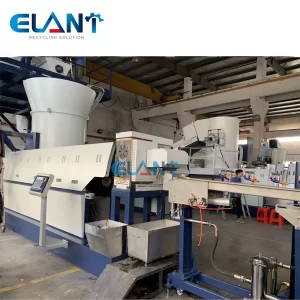
Roughly 40% of all plastic pelletizing failures trace back to a single decision made before the machine ships: choosing the wrong cutting type for the input material. Get that one call right, and every downstream problem — degraded melt, uneven pellet size, blocked dies — shrinks dramatically. This guide walks you through how we configure, commission, and verify a plastic pelletizing machine at Elant, so you can apply the same logic when sourcing your own line.

Quick takeaways
- Cutting method (strand, hot-cut die face, underwater) is the first decision — it locks in material compatibility before anything else
- Twin screw extruder suits PVC pelletizing and compounding; single screw covers straightforward recycling pelletizing of clean films and bottles
- Feeding system design depends on bulk density — low-density flakes need forced feeders, not gravity hoppers
- PVC pelletizing extrusion requires strict temperature zoning; wrong barrel heat degrades the stabilizer package and discolors pellets
- A properly configured line produces uniform pellets in 3–6 mm diameter that pass injection molding and profile extrusion quality checks
Before you start
What you need to know: – Your input material: polymer type (PET, PVC, HDPE, PP, LDPE film), contamination level, moisture content – Your target pellet end-use: fiber-grade, bottle-grade, pipe extrusion, injection molding – Output capacity in kg/h — this determines screw diameter and motor size
What you’ll need on-site: – Stable 3-phase power (confirm voltage and phase balance before machine arrives) – Water supply and chiller for strand cooling or underwater pelletizing – Pre-drying or washing line if input material has >0.3% moisture (PET bottle-grade pelletizing is unforgiving on this point) – A trained pelletizing line operator — not a general laborer
Step 1: Match the Cutting Type to Your Material
Why this matters: The cutting mechanism determines melt pressure, die design, and how cleanly the plastic separates. Choosing strand pelletizing for a high-viscosity material that strings badly means constant strand breaks and operator intervention every 20 minutes.
Elant produces three cutting configurations, and in our experience shipping machines to over 30 countries, buyers most often mismatch cutting type when sourcing from a spec sheet alone rather than discussing their actual material:
- Strand pelletizing line — best for rigid plastics (ABS, PS, PP, clean PET). Melt strands exit the die, cool in a water bath, then feed into a rotary cutter. Simple, low-cost, easy to maintain. Weak point: not suitable for sticky or elastic materials.
- Hot-cut die face pelletizing — cutter rotates directly at the die face; no strand bath needed. Works well for polyolefin films and soft materials. Saves floor space.
- Underwater pelletizing — cutter submerged in circulating water directly at the die face. Handles high-output lines (500 kg/h+), hygroscopic materials, and thermally sensitive resins. Higher capital cost, but pellet sphericity and uniformity are superior for injection molding feed.
⚠️ Warning: Hot-cut cutting for PVC pelletizing is rarely correct — PVC degrades rapidly at the die face if residence time spikes even slightly. Our engineers default to strand pelletizing for rigid PVC extrusion lines unless the customer has proven temperature control systems in place.
Common mistake: Ordering a strand pelletizing line for LDPE film because it costs less. Film materials tangle in the cutter and jam the water bath within hours. Use an agglomerator or a die face cutter for film grades.
Step 2: Select the Right Extruder for the Job
Why this matters: The screw extruder is the core of any plastic pelletizing machine. Wrong screw geometry = unmixed melt = inconsistent pellets that fail quality checks at your customer’s injection molding or profile extrusion line.

The decision tree is shorter than most vendors imply:
- Single screw extruder — one- or two-stage configuration. Suitable for clean, single-polymer streams: PET bottle washing recycling, HDPE bottle recycling, clean PP film. Lower energy draw, easier to operate.
- Parallel twin screw extruder — co-rotating, intermeshing. Required for PVC pelletizing because PVC needs distributive mixing of heat stabilizers and plasticizers. Also the right choice for masterbatch compounding, modification, and filled materials. Our twin screw models run L/D ratios of 36:1 to 52:1 depending on the formulation complexity.
💡 Pro tip: Ask the factory for the screw L/D ratio and the number of temperature zones before wiring a deposit. A PVC pelletizing extrusion line with fewer than 8 barrel zones cannot maintain the fine temperature gradient PVC demands — you will see degradation at the die regardless of what the sales rep says.

| Item | Value |
|---|---|
| Single Screw 1-stage | 150.0 |
| Single Screw 2-stage | 300.0 |
| Twin Screw PVC | 400.0 |
| Twin Screw masterbatch | 500.0 |
| Extruder Type | Best Material | Typical Output | Relative Machine Cost |
|---|---|---|---|
| Single screw (1-stage) | Clean PET, HDPE, PP | 50–200 kg/h | Lowest |
| Single screw (2-stage) | Printed film, wet flake | 100–300 kg/h | Low-mid |
| Twin screw (co-rotating) | PVC, masterbatch, compounds | 100–500 kg/h | Mid-high |
| Underwater + twin screw | Engineering resins, high-fill | 300–800 kg/h | Highest |
Common mistake: Buying a single screw extruder for a PVC pelletizing line because it is cheaper by $8,000–15,000. PVC requires distributive mixing that a single screw cannot deliver — the result is streaked, unstabilized pellets that degrade in the next processing step.
Step 3: Configure the Feeding System for Your Bulk Density
Why this matters: Plastic flake, film scraps, and rigid regrind have bulk densities ranging from 30 kg/m³ (loose LDPE film) to 500 kg/m³ (dense PET bottle flake). A gravity-fed hopper that works fine for PET flake will starve the screw on fluffy film, causing surging output and pellet weight variation.
Elant’s standard feeding system options: – Gravity hopper — adequate for regrind and dense flakes above 200 kg/m³ – Forced feeder (side stuffer) — mandatory for PP woven bag, LDPE film, and any low-density material; the screw compresses material before the extruder intake – Liquid additive dosing pump — required on PVC pelletizing lines that incorporate liquid plasticizers or stabilizers inline
Our customers running PVC pelletizing in Southeast Asia and the Middle East almost always need the liquid dosing option because their stabilizer suppliers deliver liquid DOP rather than powder — a detail that gets missed when buyers compare machines on price alone.
📝 Note: Confirm your raw material bulk density with your scrap supplier before finalizing the feeding system spec. A forced feeder adds roughly 8–12% to machine cost but prevents a surging problem that no downstream adjustment can fix.
The Basic Principles of PVC Pelletizing Extrusion
PVC pelletizing extrusion is distinct enough from general plastic pelletizing to warrant its own discussion. PVC is thermally unstable: it begins releasing HCl gas above 160°C without stabilizer protection, and the processing window between “not yet melted” and “beginning to degrade” is often only 15–20°C wide.
The basic principles of PVC processing[1] demand that the extrusion line maintain separate, tightly controlled temperature zones from the feed throat to the die. A well-designed PVC pelletizing extrusion line runs the feed zone at 130–140°C, transitions through 150–160°C in the compression zone, and holds the metering zone and die at 165–175°C maximum. Exceeding 180°C even briefly produces brown or black pellets and releases corrosive gases that attack barrel and screw surfaces.
The twin screw extruder’s role[2] in PVC pelletizing is to deliver distributive mixing — spreading stabilizer, lubricant, and filler uniformly through the melt — rather than dispersive mixing (which breaks up agglomerates, less critical here). This is why the screw element sequence matters: buyers should ask for the screw element configuration drawing and confirm it matches their formulation, not just accept a “standard PVC screw” without review.
For PVC pellets destined for pipe extrusion[3] or profile extrusion, the die design is equally important: a screen pack with at least 80-mesh filtration removes carbon specks and contamination that would otherwise cause surface defects in the final product.

Key Facts at a Glance
| Parameter | Typical Specification |
|---|---|
| Strand pelletizing line output | 50–500 kg/h |
| Underwater pelletizing pressure | 80–150 bar at die face |
| PVC processing window | 130–175°C (15–20°C margin) |
| Twin screw L/D for PVC | 36:1 minimum, 52:1 preferred |
| Pellet diameter target | 3–5 mm for injection molding; 4–6 mm for extrusion |
| Minimum screw barrier for PVC film | 80-mesh screen pack |
| Pet pelletizing line moisture limit | ≤0.3% pre-drying, ≤50 ppm post-drying |
Troubleshooting
Problem: Pellet weight varies more than ±5% batch to batch Cause: Screw surging from inconsistent feeding — most common with low-density film flake in a gravity hopper. Fix: Install a forced feeder with variable-speed drive; tune feed rate to hold screw amperage steady.
Problem: PVC pellets show brown streaking Cause: Barrel zone overtemperature or insufficient stabilizer dosing. Check zone 3–5 thermocouples first — sensor drift is the most common culprit, not the formulation. Fix: Calibrate all thermocouples against an independent probe; increase stabilizer dosage by 0.2 phr and retest.
Problem: Strand breaks every 10–15 minutes Cause: Water bath temperature too cold (below 40°C for PP, below 55°C for ABS) causing strands to become brittle and snap at the cutter nip. Fix: Raise water bath to the correct range for your polymer; reduce die-to-bath distance to less than 300 mm.
What to Do Next
If you have confirmed your cutting type, extruder selection, and feeding system, the next step is requesting a formal quotation that locks in pellet production line price against your verified throughput and material spec — not a catalog price. We recommend how to compare plastic recycling machine quotations before issuing a purchase order.
For buyers specifically evaluating a PET washing and pelletizing system, see our PET bottle-to-bottle recycling line guide which covers the pre-washing and drying steps upstream of the pelletizing machine.
Finally, if you are comparing recycling pelletizing lines from multiple suppliers, the plastic pelletizing machine buyer checklist gives you the 12 questions to ask any factory before wiring a deposit — including how to verify screw geometry claims and test report formats.
FAQ
What is a pelletizing line?
A pelletizing line is a series of connected machines that converts raw or recycled plastic into uniform, sales-ready pellets. It typically includes a feeder, extruder, die head, cooling section, and pellet cutter. Each stage controls melt temperature, pressure, and cut timing so the finished pellets meet consistent size and density specs that compounders, molders, and resin traders require.
What is the purpose of pelletization?
Pelletization turns irregular plastic material into standardized, free-flowing pellets that are easy to store, transport, and feed into downstream processing equipment. Uniform pellets melt predictably, reduce waste, and command better market prices than flake or regrind. For recyclers and compounders, pelletizing is the step that converts recovered material into a sellable, specification-grade product.
What is the difference between pelleting and pelletizing?
In plastics and industrial processing, the terms are used interchangeably, but a practical distinction exists. Pelleting often refers to compressing dry material through a die under mechanical pressure, common in feed and biomass industries. Pelletizing typically describes the extrusion-and-cut process used in plastics, where material is melted, pushed through a die, and cut into pellets while hot or after water cooling.
Sources
[1] Thermal Behavior and Stability of PVC/TPU Blends … — mdpi.com
[2] Analysis of the Dispersive and Distributive Mixing Effect … — mdpi.com
[3] 23.040.20 – Plastics pipes — iso.org