
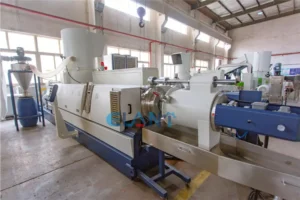
Before You Start
What you need to know first: The bottlenecks described here assume a continuous-run recycling plant processing post-consumer or post-industrial plastic film — LDPE, LLDPE, BOPP, or mixed packaging film. The fixes are different for rigid plastics or PET.
Tools and information to gather before acting:
- Incoming film composition report (resin type, contamination %, moisture %)
- Your current pelletizing machine’s screw L/D ratio and compression ratio
- Die head configuration (strand count, hole diameter)
- Hourly output target vs. actual output over the last 30 operating days
- Downtime log broken down by cause (die head blockage, cutter jam, motor overload, screen changer clog)
📝 Note: Ask your machine supplier for the original process parameters sheet before changing any settings. Running outside the designed melt temperature range by even ±10 °C degrades recycled pellet quality and accelerates screw wear.
Step 1: Diagnose Where the Bottleneck Actually Lives
Why this matters: Most plants we work with assume the pelletizing machine is the problem when the real constraint is upstream — specifically the washing and drying section feeding wet film into the extruder. Treating the wrong node wastes money.
Walk the line and record the input rate at five points: bale breaker → shredder → washer → centrifuge dryer → pelletizing machine feed throat. Where the rate drops relative to the previous station is your bottleneck.
Film recycling plants in particular suffer from what operators call “accordion effect”: the washer surges material, the dryer partially buffers it, and then a slug of 3–5% residual moisture film hits the extruder feed throat at once. That moisture flash-vaporizes in the barrel, creates back pressure, and forces the die head to work against an unstable melt — producing degraded recycled pellets and, eventually, a blocked die.
Common mistake: Attributing poor pellet quality to a worn screw when the actual cause is moisture. Run a Karl Fischer titration on film samples taken immediately before the feed throat. If moisture exceeds 0.5% by weight, fix the drying section before touching the pelletizing machine.
Step 2: Understand What a Plastic Film Pelletizing System Actually Does
Why this matters: Operators who treat the pelletizing machine as a black box cannot isolate which sub-component is causing the failure.
A plastic film pelletizing system is a multi-stage process line, not a single machine. The core sequence is: cutter-compactor or compactor (to pre-treat low-bulk-density film by heating and compacting it into smaller pieces) → single- or double-screw extruder as the line’s extrusion system (where the extrusion process melts and conveys the compacted material for pellet formation) → melt filtration / screen changer → die head → pellet cutter → cooling and separation → pellet dryer.
Each stage can become the rate-limiting step. The agglomerator controls how consistently film enters the extruder, and cutter compactor feeding helps maximize output and prevent bridging with film feedstock. The screen changer determines how long the line can run before a filter change stops output, while the filtration system removes impurities from molten plastic and continuous screen changers can swap clogged filter screens without halting production. The die head geometry determines whether plastic pellets come out uniform or tailed. The cooling system — strand bath, underwater pelletizer, water ring, or air-cooled ring — controls pellet shape and surface quality; water ring pelletizers use a ring of water to cool the plastic melt, and underwater pelletizers cool plastic melt in water for better pellet quality. A stable heating and cooling system also helps maintain the correct processing window.
💡 Pro tip: When reviewing a supplier’s capacity claim (e.g., “500 kg/h”), ask whether that figure is for clean, dry, single-resin LDPE film or for a realistic mixed-film feedstock at 2% contamination. The difference is typically 15–25% in actual throughput. We ask this question on every inquiry we receive before quoting.
Step 3: Apply the Six Selection Criteria and Customization Options Before Buying or Upgrading
Why this matters: Selecting the wrong pelletizing machine for your film type is the single most preventable source of long-term bottlenecks. The six criteria below are the evaluation framework our engineering team uses when specifying machines for recycling plant projects.

Bottleneck frequency by pelletizing machine sub-component in plastic film recycling plants
| Item | Value |
|---|---|
| Screen Changer | 32.0 |
| Die Head | 24.0 |
| Agglomerator | 18.0 |
| Cooling System | 12.0 |
| Cutter | 9.0 |
| Control System | 5.0 |
| Sub-component | % of Reported Downtime Events |
| ————————– | ——————————- |
| Screen changer | 32% |
| Die head | 24% |
| Agglomerator / compactor | 18% |
| Cooling system | 12% |
| Cutter | 9% |
| Control system | 5% |
1. Screw design. Single-screw extruders handle clean, pre-sorted film well, and the transmission system works with the motor to drive the screw during operation. Double-screw (twin-screw) machines tolerate contamination and mixed plastics better but cost 30–50% more. High-quality extruder screws are essential for durability and long service life. For post-consumer packaging film with variable resin content, a twin-screw pelletizing machine pays back that premium in reduced rejects within 12–18 months.
2. Die head configuration. Strand die heads are lower-cost and easier to maintain, but a single broken strand stops output from that hole until cleared. Underwater pelletizing die heads keep all holes running but require precise temperature control in the die plate. For high-output plastic film recycling lines above 800 kg/h, underwater pelletizing is the standard.
3. Cooling method. Water-ring pelletizing is a standard, versatile choice for film pelletization, while underwater and strand cooling fit different output and pellet requirements. Air-cooled pelletizing works for LDPE and PP film. Water-strand cooling produces harder pellets with tighter dimensional tolerance — preferred when recycled pellets go back into blown film extrusion.
4. Degassing. Plastic film traps volatiles (printing inks, adhesives, moisture). A vented barrel or a dedicated degassing zone prevents bubble formation in recycled plastic pellets. No degassing on a packaging film line is a design error, not a cost saving.
5. Cutter type. Rotary cutters running at fixed speed mis-cut when melt viscosity varies. Machines with torque-feedback cutter control maintain consistent pellet length across varying film compositions.
6. Control system. A pelletizing machine without real-time melt pressure and temperature logging gives operators no data to act on. Demand OPC-UA compatible controls so your plant’s SCADA system can log every production event. When evaluating upgrades, a compact design can also save space in production areas, and lower energy consumption is a practical advantage.
⚠️ Warning: Spare parts availability is a hidden bottleneck. A screen changer filter that takes six weeks to ship from overseas converts a two-hour maintenance event into a six-week production halt. Before ordering any pelletizing machine, confirm that wear parts (screens, die head inserts, cutter blades) are stocked regionally or can be manufactured locally, and that fast after-service minimizes downtime during maintenance.
Step 4: Evaluate Universal Pelletizing Systems for Mixed-Film Reality
Why this matters: Recycling plants rarely receive perfectly sorted plastic film. Universal recycling pelletizing systems are designed to process mixed plastics — LDPE, LLDPE, HDPE, pe pp mixed-film input, and light contamination — in a single pass, removing the pre-sorting bottleneck entirely.
The latest generation of universal pelletizing machines combines a high-torque compactor (which agglomerates, pre-dries, and feeds simultaneously) with a degassing extruder and a continuous self-cleaning screen changer. As a plastic pelletizing machine within broader recycling systems and other plastic recycling machines, this setup is built for mixed-film recovery. Running mixed packaging film through a correctly configured universal system, our customers have reported a 20–35% reduction in pre-processing labor cost compared to sorted-feed single-resin lines.
The trade-off: recycled pellets from mixed-input runs carry higher resin variability, which limits their end-market to lower-specification applications, though they can still serve as raw material for some lower-spec plastic products. If your buyer requires pellets meeting ASTM D4976 for PE film resin[[1]](LINK 2), a universal system needs a downstream blending and testing step.
Plastic Waste Context: Why These Bottlenecks Matter at Scale
Globally, plastic production reached approximately 400 million metric tons per year as of 2023, according to UNEP’s Global Plastics Outlook[[2]](LINK 2). The top five plastic waste producers[[3]](LINK 4) are China, the United States, Germany, Brazil, and Japan — together accounting for roughly 40% of all plastic waste generated worldwide. China alone generates an estimated 60 million…[[4]](LINK 6).
Despite that scale, actual plastic film recycling rates remain below 20% in most economies. The EU’s packaging and packaging waste regulation[[5]](LINK 8) sets mandatory recycled content targets that will force recycling plants in the UK, across Europe, and in emerging markets including recycling plants in India, the Philippines, Pakistan, and Ghana to increase plastic film pelletizing capacity significantly before 2030. At scale, pelletization supports reducing waste and lowering environmental impact, while pellets can be reused as raw material in manufacturing plants for new plastic products, helping cut raw material costs and overall system costs.
That pressure means bottlenecks that were tolerable in 2022 are operationally disqualifying by 2026. Recycling machines that cannot maintain consistent throughput on mixed packaging film will not meet contracted supply volumes.
How Recycling Machines and Plastic Pelletizing Machines Transform Plastic Waste into Pellets
The transformation from baled plastic scrap to uniform recycled plastic pellets involves six mechanical steps within a wider recycling line that also includes sorting, crushing, cleaning, and granulation before final pellet formation: crushing → washing → drying → melt extrusion → filtration → pelletizing and cooling. Each step changes the material’s form — from film to flake, flake to melt, melt to filtered melt, filtered melt to pellet. The pelletizing machine is the final-form step in plastic pelletizing: it sets the pellet’s diameter, length, and density, which determines how a downstream blown film or injection molding machine can process it, helping convert waste plastic and scrap plastic into reusable pellets for downstream processing such as film blowing.
Poor pellet geometry (tails, fines, agglomerated clusters) is a leading reason why processors reject recycled plastic pellets from film recycling plants. The cause is almost always die head wear or incorrect melt temperature — both diagnosable with the data logging described in Step 3.
Why Companies Struggle to Incorporate Recycled Materials Into Production
Recycled plastic from film recycling carries inconsistent melt flow index (MFI) — a direct result of mixed-resin inputs and variable processing conditions in the pelletizing machine. Converters running blown film lines designed for virgin LDPE cannot tolerate MFI swings of ±3 g/10 min without manual line adjustments every few hours, even though recycled pellets are often meant for new plastic products and variable feedstock makes them harder to use consistently. That operational overhead is why many packaging manufacturers still prefer virgin plastic even when recycled pellets are cheaper on the commodity market.
The fix is upstream: tighter feedstock sorting, consistent pelletizing machine temperature control, and inline MFI measurement before pellets leave the recycling plant. Inline NIR melt analyzers[[6]](LINK 2) installed after the die head now cost under $15,000 and can hold MFI variance to ±0.5 g/10 min on a well-configured pelletizing line, producing a quality pellet needed for stable downstream production.
Troubleshooting: Three Failure Modes with Concrete Fixes
| Problem | Cause | Fix |
|---|---|---|
| Die head pressure spike + extruder surge | Wet film entering barrel; moisture flash | Check centrifuge dryer output moisture; target <0.3% before feed throat |
| Irregular pellet length / tailing | Die hole wear or melt temperature too low | Measure die hole diameter (replace at +0.15 mm wear); raise barrel zone 3 temp by 5 °C and re-test |
| Screen changer clogging every <4 hours | High contamination in incoming plastic film; wrong mesh rating | Step down from 80-mesh to 60-mesh as initial filter; add pre-wash grit removal stage upstream |
Key Facts at a Glance
| Item | Detail |
|---|---|
| Top bottleneck sub-component | Screen changer (32% of downtime) |
| Acceptable moisture at feed throat | ≤ 0.5% by weight (Karl Fischer) |
| Die hole replacement threshold | +0.15 mm over nominal diameter |
| MFI variance acceptable for blown film reuse | ±0.5 g/10 min |
| Universal system labor saving (mixed film) | 20–35% vs. sorted-feed lines |
| Global plastic waste produced annually | ~400 million metric tonnes (2023) |
What to Do Next
If your downtime log shows screen changer events as the top cause, start with feedstock contamination analysis before spending on a new plastic film pelletizing machine. If your reject rate on recycled pellets is the issue, run the die head wear check and MFI logging procedure in Steps 3 and 4.
For plants evaluating new capacity or a machine upgrade, plastic film pelletizing machine buyer’s guide walks through supplier qualification and factory acceptance testing. For plants dealing specifically with BOPP or multi-layer packaging film, multi-layer film recycling line configuration covers the additional degassing and compatibilizer dosing steps those materials require. The recommended machine plastic configuration should match different types of plastic materials and any customization options offered by suppliers.
Our team at Elant has worked through these diagnostics on recycling plants across Asia, Europe, and the Middle East. If your bottleneck does not resolve with the steps above, contact Elant engineering for a pelletizing line audit — we ask for the downtime log and a feedstock sample before recommending any hardware change. That is the minimum information needed to give you a useful answer rather than a sales pitch.
plastic recycling plant equipment overview
FAQ
How do recycling machines and pelletizers transform plastic waste into reusable pellets?
Plastic film, along with bags such as stretch film and shrink film, can be fed into a pelletizing machine, and a pp woven bag line follows a similar flow: the material is shredded or compacted into small pieces, melted in a heated extruder barrel, forced through a die, and cut into uniform pellets as it exits. One common input for this type of line is non printed PE. Each stage — feeding, melting, filtering, cutting — must stay synchronized, and the pellets are later dried and bagged for reuse as raw material. When any stage runs slower or faster than the others, a production bottleneck forms and overall throughput drops.
Why do so many companies struggle with processing and incorporating recycled materials into their production processes?
Recycled plastic film comes in different types of material streams, with varying contamination, moisture content, and melt-flow index, so the line must be suitable for each one rather than tuned like virgin resin. Pelletizing machines set for uniform feedstock stall or degrade output quality when batch properties shift, which makes converting scrap plastic into stable raw material harder from one run to the next. Plants also face knowledge gaps around screen-changer intervals, screw wear, and degassing settings. Without real-time monitoring and operator training, these variables compound into chronic bottlenecks that erode margins and push buyers back toward virgin material; this is why manufacturing plants evaluating plastic granulator equipment need machine settings and support to convert plastic waste reliably.
Sources
[1] D4976 Standard Specification for Polyethylene Plastics … — store.astm.org
[2] Plastic Pollution — unep.org
[3] Global Plastics Outlook — oecd.org
[4] Plastic Pollution — ourworldindata.org
[5] Packaging waste – Environment – European Commission — environment.ec.europa.eu
[6] (PDF) In-Line Monitoring of Polymer Extrusion Processes … — researchgate.net