
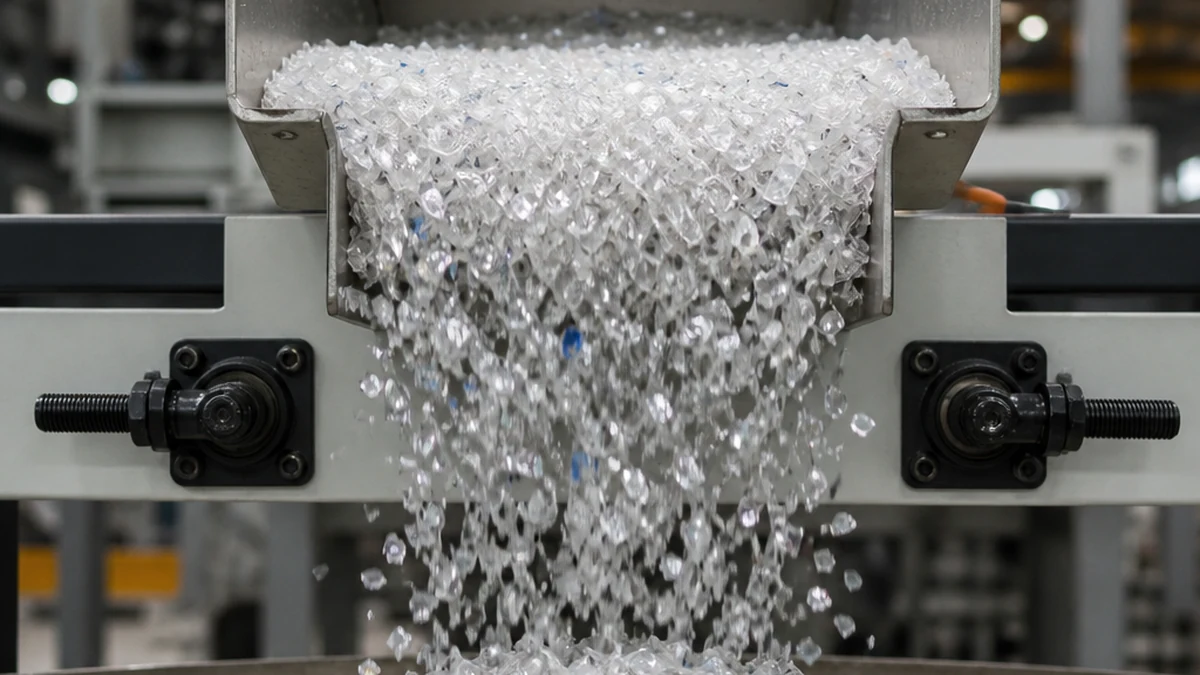
PET flakes are the small, irregular chips of polyethylene terephthalate produced when post-consumer plastic bottles are cleaned, sorted, and mechanically shredded. Flake size typically runs 8–14 mm. Quality is defined by four measurable parameters — intrinsic viscosity, moisture content, fines percentage, and contamination level — and controlling these PET recycling line quality factors determines which end market the flakes can serve.
For buyers evaluating recycled PET flakes, understanding how the rPET recycling process affects fiber-grade output quality is more valuable than relying on a supplier’s marketing sheet alone.
At a glance
- Material: Polyethylene terephthalate (PET), resin ID code #1 [1], resin ID code #1) ASTM resin identification code system
- Typical flake size: 8–14 mm after granulation
- Intrinsic viscosity target (food-grade): ≥ 0.70 dL/g FDA guidance on recycled PET food-contact materials
- Moisture limit (standard processing): ≤ 0.5% by weight before further processing
- Color grades: Clear, light blue, green, mixed/colored
- Key certifications: GRS (Global Recycled Standard), FDA Letter of Non-Objection (LNO) for food-contact rPET [2] for food-contact rPET)
- Primary end markets: Bottle-to-bottle rPET, polyester fiber, strapping band, packaging sheet
How Recycled PET Flakes Are Made from Collected Plastic Bottles
PET is unusually sensitive to hydrolytic degradation — moisture present during melt processing cleaves polymer chains, potentially dropping intrinsic viscosity significantly per processing pass if pre-drying is inadequate. That means the identity of PET flakes is fixed during processing, not afterward. A buyer evaluating a COA is really reading a record of what happened inside the recycling plant.
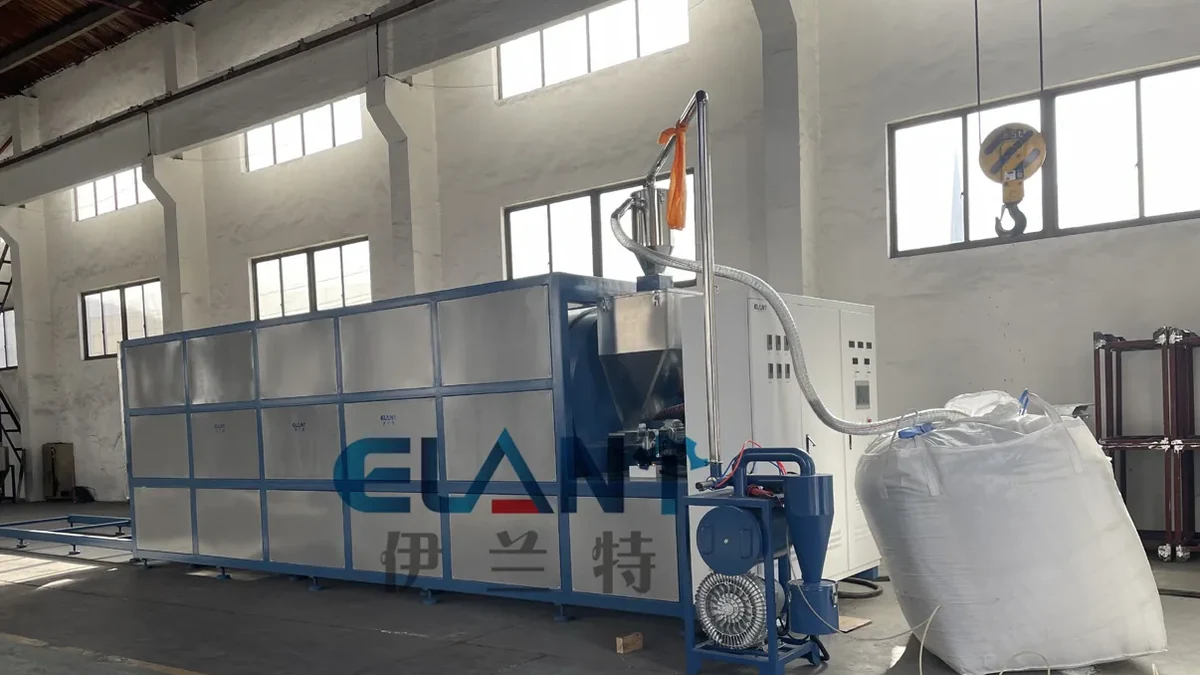
Collected plastic bottles arrive at a material recovery facility compressed into bales. Pre-sorting removes non-PET containers, caps, and gross contamination. Sorted bottles pass through label removal, then shredding and density separation, while the PET bottle hot washing process uses alkaline cleaning and friction to remove adhesives and other residues that affect final flake purity.
Centrifugal drying brings moisture to ≤ 0.5% before bagging.
The washing temperature is the single biggest quality lever. A recycling plant running a 60°C wash to save energy will leave adhesive traces that inflate contamination readings. A plant running two hot-wash passes consistently reaches sub-100 ppm polyolefin contamination. Buyers who skip the plant audit are trusting that the sensor calibration log exists and is current.
Color segregation happens at the optical sorter stage. Near-infrared sensors identify PET resin; color cameras reject green, amber, and opaque bottles from the clear stream. How many rejection passes a plant runs determines whether the clear flake stream stays below 5% light blue and near-zero green.
PET Flake Quality Grades, Specifications and Applications: The Full Breakdown
A supplier’s data sheet lists dozens of figures. Four of them actually predict downstream performance. Ask for a third-party COA covering all four before placing an order.
Intrinsic Viscosity: The Specification That Predicts End-Use Performance
Intrinsic viscosity (IV) measures average molecular chain length in dL/g. Higher IV = longer chains = stronger melt. Virgin bottle-grade PET typically runs 0.78–0.82 dL/g. Post-consumer PET flakes commonly fall in the 0.72–0.80 dL/g range, though actual values vary by feedstock and processing conditions.
Fiber producers using flake for carpet or apparel yarn generally accept IV as low as 0.62 dL/g. Bottle-to-bottle and food packaging applications typically require ≥ 0.70 dL/g; some sheet applications demand ≥ 0.75 dL/g.
If a supplier cannot provide an IV result measured per a recognized standard such as ASTM D4603 or an equivalent method — verify which standard applies to your application — walk away.
For context on PET flake processing lines and how machinery configuration affects IV consistency, the line design matters as much as the feedstock.
Moisture, Fines, and Contamination Limits by Grade
The contamination thresholds below reflect commonly specified buyer targets and typical industry ranges — actual acceptance limits vary by processor, customer specification, and application. Confirm precise limits with your supplier’s COA and your own application requirements.
⚠️ Important: Meeting the polyolefin contamination target of ≤ 50 ppm shown below indicates a high level of cleanliness, but it does not by itself confer food-grade status. Even flake meeting this specification cannot be used in direct food contact without a separately validated decontamination process and the appropriate regulatory clearance (such as an FDA Letter of Non-Objection). The quality COA and the regulatory authorization are distinct requirements — both are necessary for food-contact applications.
PET Flake Quality Specifications by Grade
| Parameter | Food-Grade Target | Fiber-Grade Typical | Test Method |
|---|---|---|---|
| Moisture | ≤ 0.5% | ≤ 1.0% | Gravimetric drying |
| Fines (< 2 mm) | ≤ 1% by weight | ≤ 3% | Sieve analysis |
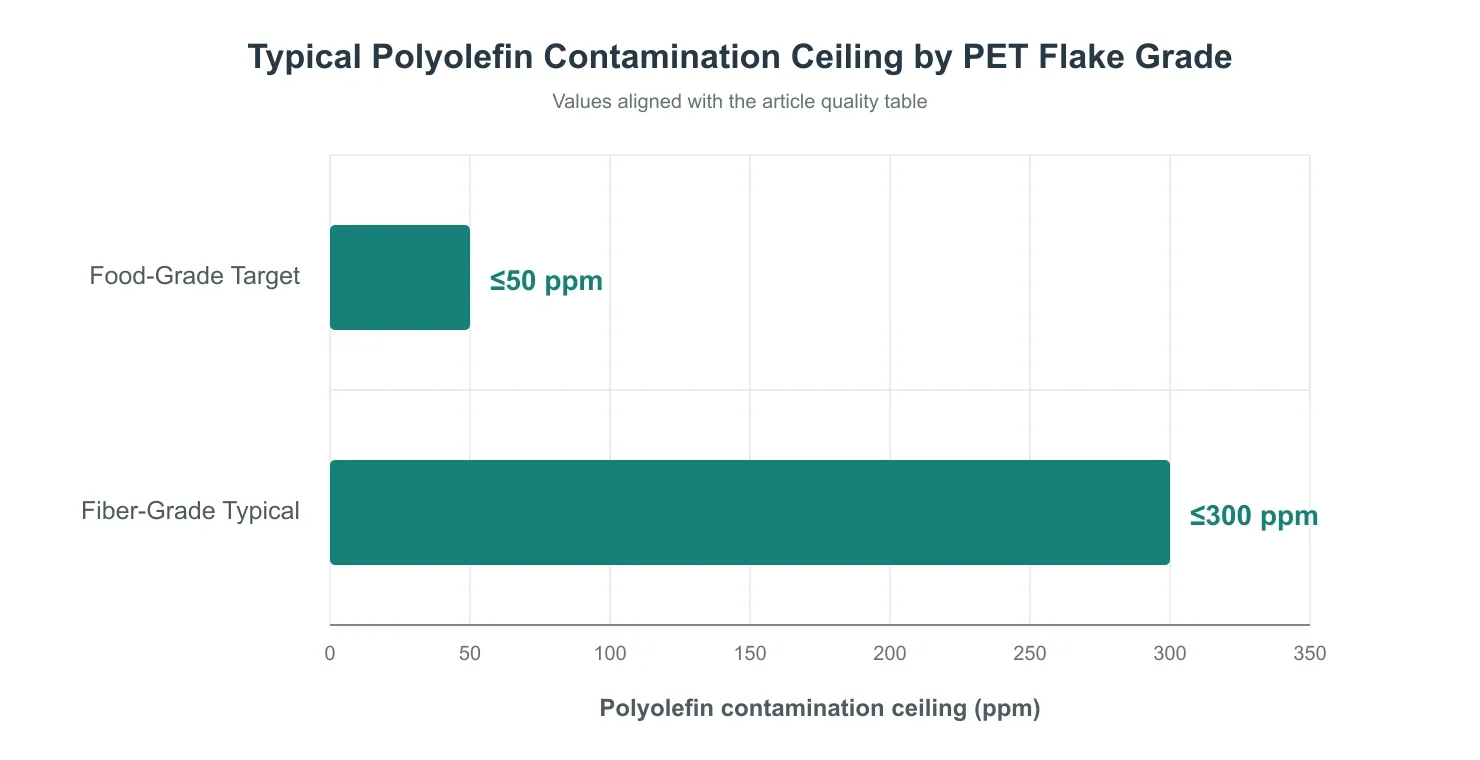
| Polyolefin contamination | ≤ 50 ppm (typical buyer target) | ≤ 300 ppm | Float-sink / FTIR |
| PVC contamination | ≤ 5 ppm (typical buyer target) | ≤ 50 ppm | HCl evolution test |
| Metals | ≤ 10 ppm (typical buyer target) | ≤ 50 ppm | X-ray / magnet |
 🔍 Worth checking: Request that contamination figures are reported in ppm, not vague qualitative ratings. A COA that says “low PVC” instead of “< 5 ppm PVC” is unverifiable and should be rejected.
Fines — particles under 2 mm — are invisible in a bulk sample but cause filter screen clogging and uneven melt flow in extrusion. They are a consistent problem with lower-cost flake and rarely flagged by suppliers voluntarily.
Color Classification: Clear, Light Blue, Green, and Mixed
Color grade is not cosmetic — it is a processing constraint. Bottle-to-bottle recycling runs on clear flake because any colored fraction shows up in the final preform wall. Fiber production tolerates a light-blue fraction because color can be overdyed.
Counterintuitively: A batch of 80% light-blue flake dyes more predictably than a batch of 50% clear and 50% mixed-color — the inconsistency in the mixed lot creates dye-uptake variation across production runs, which costs more to correct than simply sourcing a uniform light-blue stream.
| Color Grade | Typical Composition | Primary End Market |
|---|---|---|
| Clear (water-white) | < 5% light blue, ≈ 0% green | Bottle-to-bottle, food packaging |
| Light blue | 5–30% blue bottles included | Fiber, strapping |
| Green | Mixed green stream | Colored fiber, strapping |
| Mixed / colored | All colors blended | Low-grade fiber, geotextiles |
PET Flake Color Grades and Primary End Markets
How to Identify Food-Grade and Non-Food-Grade rPET Flakes
This is where most sourcing errors happen. A buyer who assumes that “clean” plastic flake equals “food-safe” flake has skipped an entire regulatory layer — and meeting a cleanliness specification such as ≤ 50 ppm polyolefin contamination does not change this: even flake at that purity level is not food-grade without the additional validated decontamination step described below.
In the United States, buyers should be aware that regulatory requirements for rPET used in food packaging generally involve validated decontamination processes and appropriate regulatory authorization. The specific requirements of the FDA’s recycled plastics framework may evolve over time; buyers are strongly encouraged to confirm the exact current rules directly with FDA or qualified regulatory counsel before sourcing or using rPET for food-contact applications.
The decontamination step is the differentiator. Standard hot-wash flake, even at < 50 ppm polyolefin, has not been through a validated decontamination cycle. It cannot be used in direct food contact without that additional step.
To identify food-grade PET flakes in practice, ask for: the FDA LNO number, the specific process it covers, and cross-check it against the FDA’s recycled plastics submissions database. Suppliers are generally expected to hold appropriate regulatory authorization for their specific validated process, but buyers should verify the current requirements with FDA or qualified counsel, as documentation expectations may change.
If a supplier claims food-grade status without verifiable regulatory authorization, the designation is marketing, not regulatory fact. For EFSA-regulated markets in Europe, an equivalent Opinion is required; the documentation requirements differ from FDA’s but the underlying logic — a validated decontamination cycle, not just washing — is the same.
Non-food-grade flake has no such documentation trail. The practical identification is the absence of an LNO: good-quality recycling-stream plastic waste flake for fiber or strapping will have a COA for IV and contaminants, but no decontamination validation. That is the correct specification for those applications — not a deficiency.
✅ Do this: Ask every supplier claiming “food-grade” PET flakes for their FDA LNO number and the specific process it covers. Cross-check it against the FDA’s database before committing to an order.
Key Applications of PET Flake Quality Grades Across Industries
Each quality grade maps to one or two end markets: clear flake with IV ≥ 0.70 dL/g and a validated decontamination step goes bottle-to-bottle or food packaging; light-blue and mixed-color flake at IV ≥ 0.62 dL/g serves fiber; strapping accepts the widest spec range.
Bottle-to-bottle recycling — producing new PET preforms from recycled plastic — demands the strictest inputs and is the highest-value outlet for post-consumer PET. Demand for certified food-grade rPET in the United States is growing as beverage companies pursue recycled-content commitments.
Industry reports suggest that recycled polyester (largely rPET-derived) may account for a significant and growing share of global polyester production, but figures shift from year to year. Readers should consult the most current edition of Textile Exchange’s Preferred Fiber & Materials report and other relevant industry sources — and confirm the latest data directly with those sources — as published shares vary by year and methodology.
Polyester staple fiber for pillow fill, carpet, and nonwovens accepts light-blue and mixed-color flake at IV ≥ 0.62 dL/g. Apparel-grade filament yarn is more demanding: consistent color (clear or light blue only), IV ≥ 0.68 dL/g, and fines < 2%.
Strapping band is generally understood to tolerate a broader spec range than food-grade or apparel-fiber applications — including lower IV, mixed color, and higher pre-drying moisture — though buyers should confirm the precise acceptance thresholds with their specific processor or customer requirements.
Engineering compound applications — adding PET flakes as a base resin for glass-fiber-reinforced compounds — are a smaller but growing outlet for off-spec flake that does not meet fiber or packaging thresholds.
Sourcing PET Flakes: Key Producing Regions and Trade Flows
Where a buyer sources PET flakes has direct implications for consistency, lead time, regulatory compliance, and landed cost — and the global recycling supply map is less uniform than most buyers assume.
Domestic U.S. supply is shaped by collection infrastructure. NAPCOR’s annual report data shows U.S. PET bottle recycling rates have varied in recent years: approximately 29% in 2022, rising to approximately 33% in 2023, and approximately 30.2% in 2024 — indicating that while rates have generally exceeded earlier estimates, the majority of post-consumer plastic bottles still exit the recycling stream entirely.
Domestic flake supply is therefore structurally tight relative to demand from bottle-to-bottle and fiber converters, which is why import flows matter.
Southeast Asia — particularly India, Indonesia, and Vietnam — exports significant volumes of PET flakes to the U.S. and European markets. India’s post-consumer PET collection rate is among the highest globally for an emerging market, driven by an informal waste-collection network that aggregates plastic waste efficiently at low labor cost.
Flake from these origins varies widely in quality: some Indian processors operate modern two-stage hot-wash lines producing consistent IV and low contamination; others do not. Lot-by-lot COA verification is non-negotiable for import material.
Latin America, particularly Mexico and Brazil, exports PET flakes to U.S. buyers; whether preferential trade terms apply depends on the specific origin, product classification, and current trade agreement status — buyers should confirm applicable terms with a customs broker or trade counsel before building a landed-cost model. Middle Eastern and Turkish processors are growing suppliers to European converters.
Tariff considerations matter for import sourcing. PET flakes are subject to tariff classification rules that may vary by origin and applicable trade agreements — buyers should confirm the correct HS code and current duty rates with a licensed customs broker or by consulting U.S. International Trade Commission tariff schedules before building a landed-cost model.
Anti-dumping or countervailing duties on plastic waste streams have shifted in recent years and can materially affect economics.
A practical sourcing approach: use domestic supply for food-grade and certified applications where LNO traceability and short supply chains reduce regulatory risk; consider import sources for fiber-grade volume where COA verification and price are the primary decision variables.
Saheb Fibre: Manufacturer and Supplier of rPET Flakes
This section is a placeholder pending verified brand context from Saheb Fibre. The content below reflects publicly available information only — no capability figures, tonnage, or certification claims have been added that are not verifiable from public sources.
Saheb Fibre operates as a manufacturer and supplier of recycled PET flakes within the Indian rPET processing sector. India’s position as a major exporter of post-consumer PET flake is tied to the country’s high collection rates for PET plastic waste and its established base of washing-line processors. Buyers sourcing from Indian suppliers benefit from competitive pricing on fiber-grade flake and, where applicable, shorter lead times to Asian fiber converters.
Buyers evaluating Saheb Fibre or any Indian rPET supplier should apply the same COA and certification framework described throughout this guide: third-party IV testing per a recognized standard such as ASTM D4603 or equivalent (confirm which method applies to your application), ppm-level contamination reporting, and GRS transaction certificates if recycled-content claims are required downstream.
For food-grade applications, confirm whether the supplier holds a validated decontamination process and the associated regulatory clearance for the target market (FDA LNO for U.S.; EFSA Opinion for EU).
Specification Checklist Before Buying PET Flakes
Certificates and Testing Documentation to Request
Before wiring a deposit, collect and verify every item on this list:
- Third-party COA (not supplier’s own lab): IV per a recognized standard such as ASTM D4603 or equivalent, moisture, fines %, PVC ppm, polyolefin ppm, metals ppm
- FDA Letter of Non-Objection (food-grade only): confirm the LNO covers the specific process and output form
- GRS certificate (if sustainability claims are part of the purchase rationale): check certificate scope and transaction certificate
- Lot traceability record: which collection regions and plastic waste streams fed this lot
- Color report: percentage breakdown by clear / light blue / green / mixed on this specific lot — not a historical average
🔍 Worth checking: Request that testing was performed by a suitably accredited third-party laboratory — buyers should confirm what accreditation standards are recognized for their application and target market, as requirements may vary. In-house results have a persistent bias toward passing specs.
GRS Certification: What It Covers and What It Doesn’t
The Global Recycled Standard certifies chain of custody for recycled content — it confirms that the PET flakes originate from post-consumer or pre-consumer waste and that the percentage claimed is audited.
GRS does not certify quality.
A GRS-certified lot can still carry IV of 0.60 dL/g and 200 ppm PVC — and that lot can still fail every spec your application requires. GRS matters when your downstream customer requires a sustainability claim or when you’re selling into brands with public recycled-content commitments. Treat it as a separate document serving a separate purpose from the COA, and request both independently.
Conflating them is one of the most common and costly sourcing mistakes in the rPET market.
Food-grade PET flakes for a beverage application need an LNO, a quality COA, and — if recycled-content claims are made — a GRS certificate. That is three documents, not one. Accepting fewer means assuming a risk your supplier has not agreed to share.
Have a project or a spec sheet in hand? Talk to elantmachine.com — real engineers answer.
FAQ
What is grade 4 plastic?
Grade 4 plastic is the resin identification code for LDPE (low-density polyethylene), used in squeeze bottles, plastic bags, and flexible packaging. It is unrelated to PET, which carries resin code 1. When buyers discuss PET flake quality grades, they are referring to internal industry tiers — food-grade, fiber-grade, and sheet-grade — not the resin identification numbering system. Mixing up these two grading frameworks is a common sourcing mistake.
How to check the quality of PET bottles?
Quality checks on incoming PET bottles focus on contamination, color mix, and label coverage before shredding. In the United States, reclaimers typically inspect bales against NAPCOR and APR guidelines, measuring non-PET content, PVC contamination, and moisture. After shredding, flake quality is verified by intrinsic viscosity testing, moisture analysis below 0.5%, and fines measurement. Labs accredited to ASTM standards are the benchmark for reliable results.
Sources
[1] An Introduction to PET (polyethylene terephthalate) – PETRA — petresin.org
[2] U.S. FDA No Objection Letter (NOL) for PCR Plastics in… — en.reach24h.com
[3] D4603 Standard Test Method for Determining Inherent… — store.astm.org
[4] Guidance on Use of Recycled Plastics in Food Packaging — fda.gov
[5] Submissions on Post-Consumer Recycled (PCR) Plastics… — hfpappexternal.fda.gov
[6] Experts question US FDA’s safety assessment of recycled… — foodpackagingforum.org
[7] Ellen MacArthur Foundation: Leading the Transition to a… — ellenmacarthurfoundation.org
[8] Global Recycled Standard (GRS) — textileexchange.org