
A recycler in Ohio just received three quotes for a 1,500 kg/h PET bottle washing line: $280,000, $410,000, and $620,000 — for what looked like the same system on paper. The difference wasn’t the nameplate capacity. It was hot wash vs. cold wash configuration, automation level, and whether a closed-loop water treatment system was included. Getting that wrong at the purchase stage costs more than the price gap.
This guide breaks down what a PET washing line actually costs, what drives those costs, and how to build a specification tight enough to get comparable quotes from suppliers.
At a glance
- Entry-level lines (500–1,000 kg/h, cold wash): typically $80,000–$180,000 USD ex-works
- Mid-range lines (1,500–3,000 kg/h, hot wash): typically $250,000–$550,000 USD ex-works (fully equipped hot wash lines at 2,000 kg/h typically start at $320,000; the $250,000 lower bound applies to simpler 1,500 kg/h configurations)
- High-capacity lines(5,000+ kg/h, complete hot wash): typically $900,000–$1,500,000+ USD ex-works
- Shipping + installation to a U.S. site: add $30,000–$90,000 depending on origin and line size
- Energy draw: cold wash lines typically 60–85 kWh per metric ton of output; hot wash lines 100–150 kWh per metric ton; hot wash with thermal dryer and optical sorter 130–180 kWh per metric ton
- Payback window: 18–48 months depending on flake grade, feedstock cost, and labor market
- Key deciding variable: output grade requirement — food-grade rPET demands hot wash; fiber-grade tolerates cold wash
What a PET Bottle Washing Line Does and How the Process Works
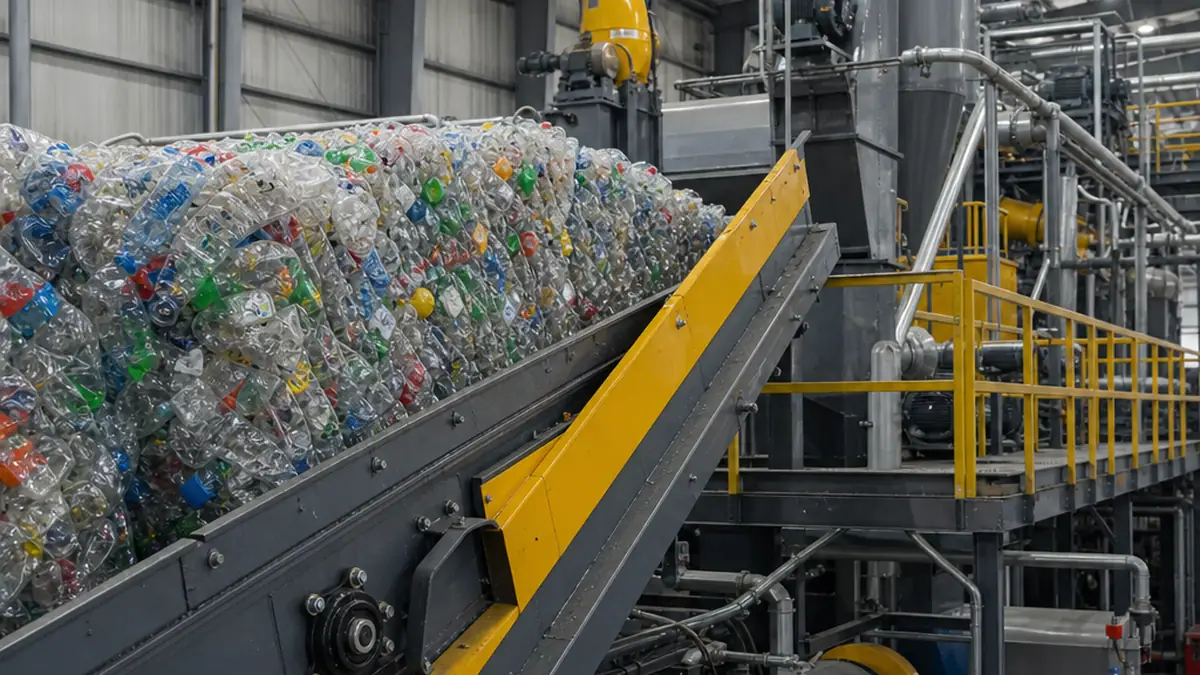
A PET bottle washing line is a sequence of mechanical and thermal processing stages within a complete PET recycling machine system, converting dirty, baled post-consumer PET bottles into clean, dry plastic flake suitable for pelletizing or direct end-use. The system isn’t a single machine — it’s an integrated PET bottle washing and recycling production line where each stage’s output becomes the next stage’s feedstock. Undersizing or misconfiguring any one station creates a bottleneck that limits the whole line.
Video: PET Bottle Recycling Washing Line
Core processing stages from bale to clean flake
A full PET washing line follows a complete PET bottle recycling process, moving material through a series of sorting, washing, separation, and drying stages:
- Debaling — a hydraulic debaler breaks compressed bales into loose bottles
- Pre-sorting conveyor — manual or automated removal of non-PET containers (HDPE, PVC)
- Label removal — a dry friction or wet label remover strips paper and plastic labels before wetting
- Wet pre-wash / trommel — cold-water rinse removes loose dirt, sand, and glass fragments
- Crushing / granulation — a crusher reduces whole bottles to roughly 10–15 mm flake
- Float-sink separation — a water tank separates PET (sinks) from PP/PE caps and labels (float)
- Friction washing — high-speed friction washers scrub surface contamination from flake
- Hot caustic wash (hot wash lines only) — an 85–95 °C caustic solution removes adhesives, oils, and residual organics [4]
- Rinse and dewatering — centrifugal dewatering removes water to below 1% moisture content
- Thermal drying — a thermal dryer reduces moisture content to below 0.5% for downstream processing
- Optical sorting (premium lines) — color sorters remove colored flake from clear PET
For PET washing equipment selection, the stage that buyers most frequently underspec is the friction washing section — a single friction washer rarely delivers the dwell time needed for heavily contaminated post-consumer material.
Hot washing vs cold washing: where each fits in the line
PET bottle hot washing is a specific processing stage, not a description of the whole line. A “hot wash line” contains a caustic wash tank typically operating at 85–95 °C with a 1–3% sodium hydroxide (NaOH) solution. This stage sits after the crusher and float-sink tank, before the final rinse.
Cold wash lines skip this stage entirely. The washing system relies on ambient-temperature friction and mechanical scrubbing. That lowers capital cost and energy consumption but leaves adhesive residue, oils, and ink that food-contact buyers won’t accept.
🔍 Worth checking: Ask any supplier for the caustic wash tank residence time spec — minutes of dwell at temperature, not just the tank volume. A tank that’s too small for the line’s throughput is a common shortcut in under-priced quotes.
What “clean flake” actually means at the output end
“Clean flake” has a precise meaning that varies by end market. For fiber-grade PET flake sold to polyester staple fiber producers, the accepted contamination threshold is typically below 100 ppm. For food-grade rPET flake, FDA’s bottle-to-bottle recycling guidance sets a much tighter bar — requiring a validated decontamination process that demonstrates removal of surrogate contaminants to below detection limits.
Moisture content below 0.5% and bulk density within spec are both part of a marketable flake definition.
How Feedstock Quality and Input Characteristics Shape Your Line Spec
The single biggest variable in washing line sizing and configuration isn’t your target output grade — it’s what you’re putting in. A line built for clean, source-separated deposit-return bottles (DRS material) will not perform at spec when fed mixed curbside bales with 15–25% contamination by weight. Getting the feedstock characterization right before specifying equipment is the foundational step that most buyers skip.
Contamination types that determine pre-wash requirements
Post-consumer PET bales from U.S. curbside collection typically contain:
- Non-PET plastics (HDPE, PVC, PP): require automated near-infrared (NIR) sorting upstream or manual pre-sort
- Paper and wet-strength labels: determine the size and type of label removal stage
- Adhesive residue from sleeve labels: cannot be removed by cold water alone — demands hot caustic wash
- Sand, glass, and grit: accelerate crusher blade wear and require effective trommel pre-wash
- Organic residue (beverages, food): drives caustic concentration and hot wash dwell time requirements
- Metal caps and closures: require magnet and eddy-current metal detection upstream of the crusher
A bale with greater than 5% PVC contamination requires a dedicated PVC detection system — PVC and PET have nearly identical densities, so float-sink won’t separate them. One PVC bottle per 100 kg of PET flake can cause visible yellowing in the final product and render the batch unmarketable to food-grade buyers.
🔍 Worth checking: Before finalizing your line spec, run a bale audit on at least 3–5 representative bales from your actual feedstock source. Weigh and categorize contaminants by type. That data becomes the spec input for pre-wash stage sizing.
Color sorting and label content: impact on configuration
Clear PET commands a significant price premium over mixed-color or green PET flake in the U.S. market. If your feedstock contains more than 10–15% colored bottles (green, blue, amber), you need optical sorting to achieve a marketable clear-flake product.
An optical sorter on a 1,500 kg/h line adds $60,000–$120,000 to capital cost but can increase flake selling price by $80–$150 per metric ton — a gap that typically pays back the color-sorting investment within 12–18 months at full throughput.
Label content also matters for configuration. Sleeve labels (full-body shrink labels common on sports drinks) are significantly harder to remove than paper wraparound labels and require a dedicated steam or friction label remover rated for that label type.
Capacity Tiers and What Each One Costs to Buy and Run
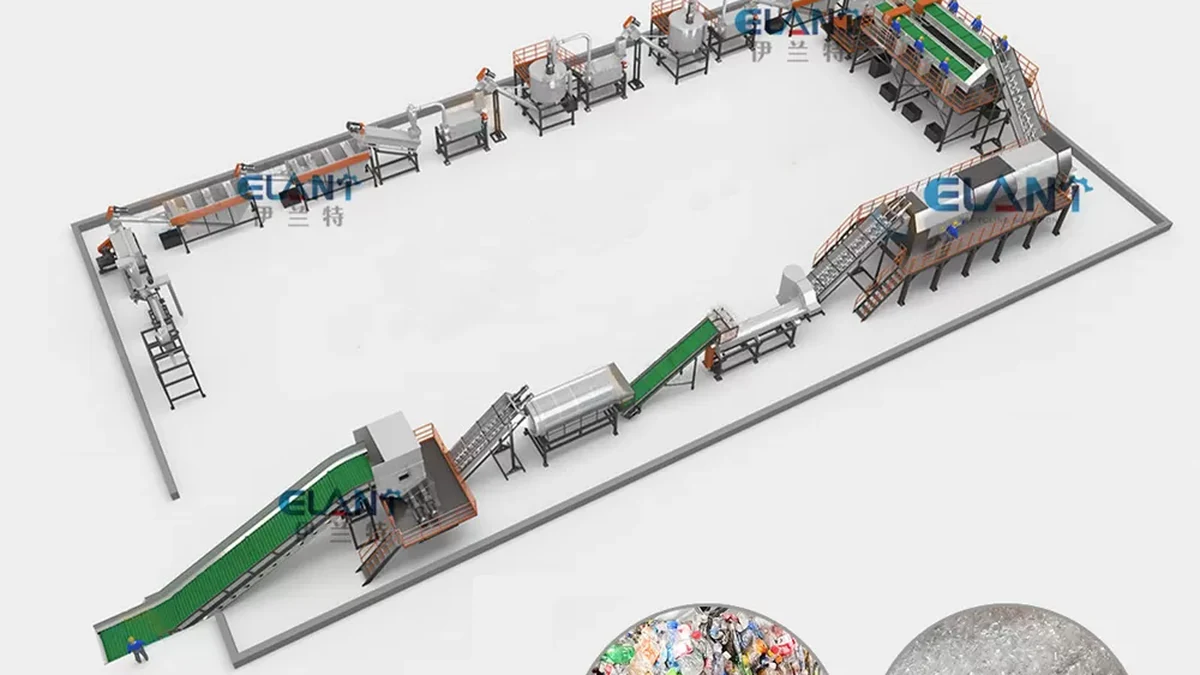
System capacity is rated in kilograms of input material per hour — not output flake. Expect 10–20% mass loss from label removal, moisture, and cap/fines separation, so a 1,000 kg/h line produces roughly 820–880 kg/h of dry flake at the output end.
Entry-level lines (500–1,000 kg/h): capital and trade-offs
Entry-level cold wash lines in this range typically run $80,000–$180,000 USD ex-works. They suit smaller recyclers processing DRS or clean industrial scrap where contamination is controlled. Limitations are significant: most entry lines use single-stage friction washing, which is insufficient for post-consumer curbside material. Labor intensity is high — these lines typically require 3–5 operators per shift.
Running cost at this tier: energy draw of roughly 50–80 kWh per metric ton of output, water consumption of 1.5–3 cubic meters per ton without closed-loop treatment.
Mid-range lines (1,500–3,000 kg/h): the most common buyer tier
This is where most independent U.S. recyclers operate. The mid-range tier spans $250,000–$550,000 USD ex-works, with the lower end of that range applying to simpler 1,500 kg/h hot wash configurations. A fully equipped hot wash line at 2,000 kg/h — including debaler, label remover, crusher, two-stage friction washer, hot caustic tank, rinse section, centrifugal dewatering, and thermal dryer — runs $320,000–$550,000 USD ex-works. Add optical sorting and the range extends to $500,000–$700,000.
Operating cost at this tier is more predictable. Energy consumption for a hot wash configuration typically runs 100–130 kWh per metric ton of PET flake output. With a closed-loop water system, water consumption drops to 0.3–0.8 cubic meters per ton — a meaningful reduction given tightening discharge regulations in many U.S. states.
✅ Do this: For mid-range lines, ask suppliers to provide a guaranteed throughput figure at your specific feedstock contamination level — not just at clean test material. A 10% difference in real-world throughput vs. nameplate capacity changes your payback calculation materially.
High-capacity lines (5,000 kg/h and above): when scale pays off
High-capacity lines at 5,000 kg/h and above are the domain of large-scale material recovery facilities (MRFs) and vertically integrated recyclers who can guarantee feedstock supply at volume. Capital cost for a complete hot wash line at this capacity runs $900,000–$1,500,000+ USD ex-works, before shipping and installation.
The economics only work at scale. Fixed costs — maintenance staff, water treatment, facility footprint — don’t scale linearly with throughput. A high-capacity line processing 40 metric tons per day achieves a cost-per-ton that a 1,000 kg/h line physically cannot match.

Hot Wash vs Cold Wash Configurations: Which One Fits Your Operation
The configuration decision is a downstream-market decision, not a capital-savings decision. Buying a cold wash line to serve a food-grade rPET customer is a procurement error that no amount of negotiation on line price will fix.
Cold wash: cost profile, suitable end markets, and limitations
Cold wash lines use ambient-temperature water and mechanical friction to clean PET flake. Capital cost is 30–50% lower than an equivalent hot wash configuration. Energy draw is significantly reduced.
Suitable end markets include polyester fiber, PET strapping, and non-food thermoform sheet. These applications accept somewhat higher residual contamination and don’t require decontamination validation. The tradeoff: flake selling price is typically $80–$200 per metric ton lower than food-grade clear flake, depending on market conditions.
Hot wash: added capital, energy draw, and flake quality uplift
A hot caustic wash stage adds $60,000–$150,000 to capital cost for a mid-range line, plus 20–35 kWh per metric ton in additional energy consumption. The NaOH chemical cost runs approximately $8–$15 per metric ton of flake processed, depending on caustic price and the concentration required for your feedstock.
The output quality difference is real. Hot washing removes adhesives, organic residue, and inks that cold water cannot. The result is flake with lower color deviation, lower volatile organic compound (VOC) content, and the decontamination performance needed for FDA food-contact compliance. At current U.S.
food-grade rPET spot prices — which have traded between $0.45 and $0.75 per pound depending on color grade and market conditions — the revenue premium over fiber-grade material justifies the added capital in most mid-range operations.
Hybrid configurations and when they make economic sense
Some operators run a hybrid configuration: cold pre-wash for bulk contaminant removal, followed by a targeted hot wash stage sized for the actual throughput that needs food-grade treatment. This approach makes sense when a portion of the feedstock is already clean DRS material that doesn’t need full hot wash treatment.
The capital premium for a hybrid line over a straight cold wash system is typically $40,000–$80,000 — less than a full hot wash line — while still enabling access to food-grade markets for the qualifying fraction of output.
Equipment Components and How Each One Affects Total System Price
Understanding cost contribution by component helps you identify where a supplier cut costs to hit a low headline number — and where those cuts will hurt you operationally.
Debaler, conveyor, and pre-wash sorting stage
The debaler is a hydraulic press running in reverse — often underspecced on lower-cost lines. An underpowered debaler creates bottlenecks when processing dense, heavily compressed bales. Budget $15,000–$35,000 for a correctly-sized unit. Pre-sort conveyor length and manual sorting station count directly affect labor headcount, which compounds over the line’s operating life.
Label remover, crusher, and friction washer
The label remover is a high-wear item. Dry friction label removers use rotating paddles or bars to strip labels before wetting — effective for paper labels, less so for full-body sleeves. A dedicated wet steam label remover adds $20,000–$45,000 but dramatically reduces label fragments in downstream flake.
Crusher blade quality is the single highest-frequency maintenance cost in the entire washing line. Low-cost crushers use softer alloy blades that require replacement every 600–800 operating hours. Premium hardened-steel or tungsten-carbide blades cost more upfront but run 2,000–3,500 hours between replacements — a meaningful difference in parts cost and downtime over a five-year operating period.
Friction washers account for the most variation in line-to-line performance. Two-stage friction washing is the minimum for post-consumer material; a single friction washer is a red flag on a line quoted for curbside feedstock.
Caustic hot-wash tank, rinsing, and drying section
The hot-wash tank is the capital-intensive heart of a hot wash line. Size it for the required residence time at your throughput — not just for volume. An underdimensioned tank runs material through too quickly for the caustic solution to work, producing flake that fails decontamination testing.
The drying section (centrifugal dewatering plus thermal dryer) must achieve moisture content below 0.5% for the flake to be pelletizable without degradation. Undersized dryers are a common source of customer complaints about flake quality in the first months of operation.
Optical sorter and metal detector: quality-assurance add-ons
Optical sorters and metal detectors sit at the end of the washing line as quality-assurance gates, not processing stages. A metal detector is non-negotiable — metal fragments damage downstream pelletizing equipment and represent a product liability issue. Cost: $8,000–$20,000 for an inline belt unit.
Optical sorters for color separation add $60,000–$130,000. For operations targeting food-grade clear flake, a two-stage optical sort (pre-crush and post-crush) provides higher rejection accuracy than a single pass.
Automation Level, Water Systems, and Energy: The Hidden Cost Drivers
The machine price is not the operating cost. Three factors — automation tier, water treatment design, and energy draw — determine the cost per ton of flake over the line’s operating life more than any single equipment choice.
Automation tiers and their effect on headcount and throughput consistency
A basic manual-sort line at 1,500 kg/h requires 6–8 operators per shift to maintain pre-sort quality. A fully automated line with NIR sorting, automated bale wire removal, and SCADA process control runs with 2–3 operators — primarily for monitoring and maintenance. At U.S. labor rates, that difference in headcount costs $300,000–$500,000 per year in additional wages and benefits for a two-shift operation.
The less obvious benefit of automation is throughput consistency. Manual sorting quality degrades over a shift as fatigue sets in. Automated systems maintain consistent contamination rejection rates, which translates directly to more consistent flake output quality and fewer rejected loads from customers.
Closed-loop water treatment: upfront spend vs long-term savings
An open-loop washing system for a 2,000 kg/h line can consume 8–12 cubic meters of fresh water per hour and produce an equivalent wastewater volume requiring treatment before discharge. In states with strict discharge limits — California, New York, New Jersey — this creates both a permit challenge and an ongoing cost.
A closed-loop water treatment system with clarification, filtration, and pH adjustment adds $40,000–$90,000 to capital cost but reduces water consumption by 80–90% and largely eliminates wastewater discharge. Wastewater treatment requirements for recycling facilities vary by jurisdiction and are subject to change — confirm applicable discharge standards with your local permitting authority before finalizing your water system design. A closed-loop system is increasingly a regulatory consideration, and in some jurisdictions a practical necessity, rather than an optional efficiency upgrade.
🚫 Avoid: Specifying an open-loop water system to reduce capital cost, then discovering 12 months into operation that your discharge permit requires a treatment system anyway. The retrofit cost is always higher than building it in from the start.
Energy consumption benchmarks per ton of output
Energy consumption for PET washing varies by configuration:
- Cold wash line: 60–85 kWh per metric ton of flake output
- Hot wash line: 100–150 kWh per metric ton
- Hot wash with thermal dryer and optical sorter: 130–180 kWh per metric ton
At $0.08–$0.12 per kWh (typical U.S. industrial tariff range), energy costs run $8–$22 per metric ton of flake, depending on configuration. Over a line processing 15,000 metric tons per year, the difference between a 90 kWh/ton and a 150 kWh/ton configuration is $72,000–$108,000 per year in electricity alone.
PET Flake Output Grades, Industry Standards, and End-Market Value
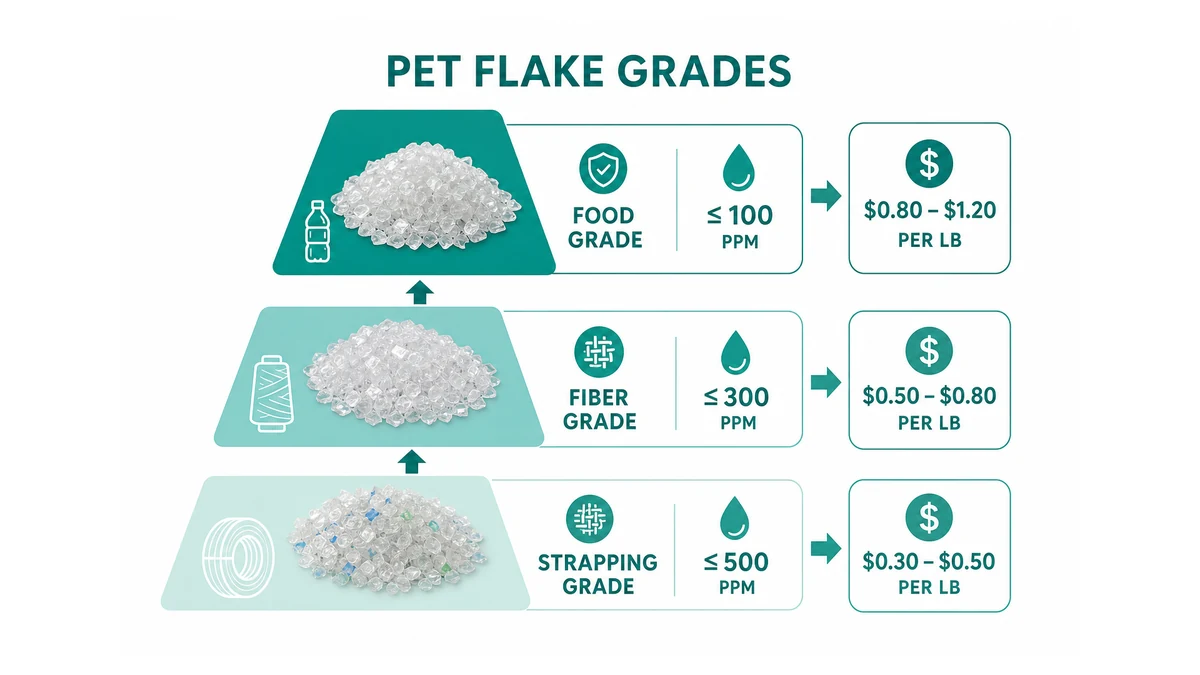
Flake grade is the variable that most directly shapes your ROI case — the spread between feedstock cost and flake selling price is the fundamental economic engine of the washing line.
Food-grade rPET requirements and FDA/EFSA compliance basics
Food-grade rPET must pass a validated decontamination process approved under FDA’s bottle-to-bottle recycling guidance. This requires surrogate contaminant challenge testing demonstrating removal to below 214 ppb for each contaminant surrogate used in the protocol. The FDA issues Letters of No Objection (LNOs) to specific process configurations — meaning the actual line design, not just the concept of hot washing, must be validated.
The practical implication: buying a hot wash line and running it is not sufficient to sell food-grade rPET. The decontamination process must be documented, tested, and submitted for regulatory review. Budget 6–12 months and $50,000–$150,000 for the validation process, depending on the testing laboratory and submission pathway. This is a capital investment buyers routinely omit from their ROI model.
Fiber-grade and strapping-grade flake: specs and typical buyers
Fiber-grade PET flake — the primary feedstock for polyester staple fiber production — requires cleanliness below 100 ppm, intrinsic viscosity (IV) above 0.72 dl/g, and moisture content below 0.5%. U.S. polyester fiber producers and exporters of rPET flake to fiber markets are the primary buyers. Pricing is more volatile than food-grade and more directly tied to virgin PET resin pricing.
Strapping-grade flake has the lowest quality threshold of the three major grades — contamination below 200–300 ppm is typically acceptable, and color consistency requirements are relaxed. It commands the lowest price per pound but requires the least capital investment in the washing line to produce.
Total Cost of Ownership: Installation, Shipping, Maintenance, and ROI
The ex-works machine price is the starting point, not the landed cost. U.S. buyers consistently underestimate what it costs to get a line operational.
Shipping, import duties, and on-site installation cost ranges
Ocean freight for a mid-range washing line (20–40 metric tons of equipment) runs $18,000–$45,000 depending on origin, routing, and market conditions. Import duty rates on recycling equipment vary by HTS classification and are subject to change — confirm the applicable rate for your specific equipment with a licensed customs broker before finalizing landed cost calculations [5].
On-site installation includes mechanical assembly, electrical hookup, piping, commissioning, and operator training. For a mid-range line, budget $35,000–$75,000 for a qualified installation team. Lines requiring concrete foundations, utility infrastructure upgrades, or significant civil work add further cost that must be scoped per site.
Routine maintenance schedules and annual parts budget
A PET washing line requires scheduled preventive maintenance at 500–hour intervals. Key consumable items and their replacement frequency on a mid-range hot wash line:
- Crusher blades: every 800–2,000 hours depending on blade material and feedstock abrasiveness — $4,000–$12,000 per set
- Friction washer paddles/liners: every 2,000–4,000 hours — $3,000–$8,000 per set
- Screen plates and perforated sections: every 6–12 months — $2,000–$5,000 per replacement
- Pump impellers and seals: annual replacement on high-use units — $500–$2,500 per pump
- Drive belts and chain drives: quarterly inspection, replacement as needed
Annual parts budget for a 2,000 kg/h hot wash line running two shifts: typically $25,000–$55,000 per year, depending on feedstock abrasiveness and maintenance program quality. Operations that defer preventive maintenance consistently spend significantly more on emergency repairs and unplanned downtime.
Payback period calculation: inputs, assumptions, and realistic timelines
The payback period formula is straightforward — the challenge is using realistic inputs:
Payback (years) = Total Capital Investment ÷ Annual Net Cash Flow
Where Annual Net Cash Flow = (Flake revenue per ton × annual output tons) − (Feedstock cost + Energy cost + Labor + Water + Maintenance + Debt service)
A worked example for a 2,000 kg/h hot wash line producing food-grade clear flake:
| Line item | Value |
|---|---|
| Total capital (line + shipping + install + FDA validation) | $720,000 |
| Annual output at 80% utilization (two-shift, 300 days) | ~7,200 metric tons |
| Flake revenue | Calculate using the actual contracted selling price and annual saleable output |
| Feedstock cost | Calculate using the actual delivered bale price and annual input tonnage |
| Variable operating costs | Energy, labor, water, chemicals, maintenance, and other site-specific costs |
| Annual net cash flow | Total annual revenue minus feedstock and operating costs |
| Simple payback | Total capital investment ÷ annual net cash flow |
Because PET bale prices, rPET flake selling prices, labor costs, utilization rates, and saleable yield vary significantly by market and over time, buyers should calculate payback using their own contracted prices and operating assumptions rather than relying on a fixed industry-wide payback figure.
Variable operating cost breakdown for a 2,000 kg/h hot wash line at 7,200 metric tons/year:
- Energy: 7,200 mt × ~125 kWh/mt × $0.10/kWh ≈ $90,000
- Labor (2–3 operators, two-shift): ~$220,000–$330,000
- Maintenance/parts: ~$25,000–$55,000
- Water/chemicals: ~$60,000–$120,000
- Subtotal: approximately $395,000–$595,000
Note: if your model includes feedstock cost within a single “operating costs” line, that figure will be substantially higher — keep feedstock cost itemized separately to avoid misreading the operating cost structure.
Adjust feedstock cost, flake selling price, and utilization rate for your specific market — these are the three variables that swing payback from 18 months to 48 months. The ROI formula scales accordingly: higher ROI derives from feedstock cost arbitrage, not from buying the cheapest washing line.
✅ Do this: Build your payback model before you contact suppliers, not after. A supplier who knows you haven’t done the economics will anchor you to their pricing. A buyer who presents a detailed operating model gets treated differently in commercial negotiations.
5 Costly Mistakes Buyers Make — and How to Avoid Them
Mistake 1: Specifying capacity based on peak demand, not average throughput. A 3,000 kg/h line sized for anticipated future volume but running at 40% utilization for the first two years has much worse economics than a 1,500 kg/h line running at 85% utilization. Buy for your 18-month feedstock contract, not your five-year projection.
Mistake 2: Comparing quotes without aligning configuration. Three quotes for “a 2,000 kg/h washing line” can represent three fundamentally different systems — cold wash vs. hot wash, single vs. dual friction washer, open-loop vs. closed-loop water. The lowest quote is often not cheaper once you price the missing components.
Mistake 3: Omitting FDA validation cost from the capital budget. Buyers targeting food-grade rPET markets frequently budget for the washing line and overlook the $50,000–$150,000 cost of the decontamination validation process. A hot wash line that can’t demonstrate FDA-compliant decontamination cannot sell into food-grade markets regardless of flake cleanliness.
Mistake 4: Underestimating crusher blade wear for abrasive feedstock. If your bale stream includes significant glass contamination (common in mixed curbside bales), standard steel crusher blades will wear in 400–600 hours rather than 1,500+. Get blade life guarantees at your specific feedstock abrasiveness specification — not at clean test material.
Mistake 5: Accepting a commissioning test on clean, sorted material. Require factory acceptance testing (FAT) and on-site acceptance testing (SAT) using representative samples of your actual feedstock. A line that meets spec on clean industrial PET may miss throughput or output quality targets by 20–30% on your real curbside bales.
🚫 Avoid: Wiring a deposit before you have the factory
Have a project or a spec sheet in hand? Talk to elantmachine.com — real engineers answer.
FAQ
What a PET Bottle Washing Line Does and How the Process Works?
A PET bottle washing line converts post-consumer bottles into clean, reusable flake that can be sold to fiber, sheet, or food-grade resin producers. Baled bottles enter the system, move through sorting, granulation, washing, rinsing, and drying stages, and exit as dry, contaminant-free flake. Hot wash lines add a caustic bath at roughly 85°C to remove labels, adhesives, and food residue. Output quality directly affects flake price, which is why line configuration matters as much as throughput capacity.
What about Core processing stages from bale to clean flake?
The core stages are bale breaking, pre-sorting, label removal, granulation, float-sink separation, hot or cold washing, friction washing, rinsing, centrifugal drying, and thermal drying. Each stage adds capital cost and affects output purity. A full hot wash sequence typically yields flake meeting FDA food-contact standards, while a cold wash line suits lower-grade fiber applications. Skipping or downsizing any stage to cut upfront cost usually reduces flake value enough to extend payback periods significantly. Energy consumption for PET washing varies by configuration: Cold wash line: 60–85 kWh per metric ton of flake output; Hot wash line: 100–150 kWh per metric ton; Hot wash with thermal dryer and optical sorter: 130–180 kWh per metric ton.
Sources
[1] Guidance on Use of Recycled Plastics in Food Packaging — fda.gov
[2] Organic Chemicals, Plastics and Synthetic Fibers Effluent … — epa.gov
[3] Submissions on Post-Consumer Recycled (PCR) Plastics … — hfpappexternal.fda.gov
[4] A Lot to Digest — U.S. Recycled Plastic Food-Contact … — khlaw.com
[5] Harmonized Tariff Schedule – International Trade Commission — hts.usitc.gov