
Melt filtration problems rarely announce themselves as “the filter is failing.” They show up as things operators actually see: pressure creeping up, pressure swinging around, pellets getting ugly, die holes going quiet, and screen changes suddenly becoming a constant interruption.
If you catch those signals early, you can usually prevent the expensive version of the same problem: a freeze-off at the die, a cutter that’s chewing on bad flow, an unplanned shutdown to clean a plugged die plate, or a shift lost to restarting and re-stabilizing.
This guide is written for hands-on operators and line leads. It focuses on the warning signs that matter, what they typically mean, and the checks you can do right now before the problem turns into downtime.
First, know what “normal” looks like for your plastic pelletizing machine
Melt filtration always adds resistance. A clean screen pack creates backpressure by design. Over time, contaminants build up on the screen, resistance rises, and melt pressure climbs. That is normal.
What’s not normal is when:
- pressure rises faster than your historical “screen life” pattern
- pressure starts pulsing or hunting instead of trending smoothly
- you see quality defects at the die face that match restriction or contamination
- the screen pack looks overloaded long before it should
In other words: your baseline is not “pressure should be flat.” Your baseline is “pressure should rise in a predictable way, then drop after a planned screen change.”
Warning sign 1: plastic pelletizing melt pressure climbs faster than usual (or ΔP across the filter jumps)
A rising melt pressure (or rising differential pressure across the screen pack) usually means the screen is loading with contamination and flow resistance is increasing. PT Online describes how contaminants deposited on screen packs increase differential pressure and flow resistance in melt filters.
What it usually means
- Screen pack is plugging (doing its job, but loading too fast).
- Contamination level upstream just changed.
- You’re running finer mesh than the feedstock can support without frequent changeovers.
Quick checks operators can do
- Compare today’s pressure ramp rate to a “good run” log.
- Check if the pressure drop lines up with screen change events. If it does, you’re likely dealing with normal loading, just faster than usual.
- Look at the removed screen pack. Is the debris type different than normal (paper-like fibers, aluminum flakes, gritty particles, char)?
What happens if you ignore it
Pressure doesn’t just “make the gauge look scary.” It loads the screw, can drive up melt temperature, and eventually forces a stop for screen change or die cleaning.
⚠️ Warning: If pressure is rising fast and pellet quality is also degrading, treat it as a filtration event until proven otherwise.
Warning sign 2: melt pressure fluctuations (pulsing or hunting)
Pressure fluctuations are different from a steady climb. A steady climb points to loading. Fluctuations often mean the restriction is changing moment-to-moment, or the flow into the die is unstable.
In piston-type melt filters, pressure instability can be tied to contamination loading and the mechanics of the filtration system during operation and changeover.Troubleshooting Pressure Fluctuations in Piston-Type Melt Filters (Plastics Technology)
What it usually means
- Partial plugging: contaminants intermittently block flow paths.
- Screen changer cycle or seals are not behaving consistently.
- Flow is surging from upstream feeding, but the filter restriction makes it show up more sharply at the die.
Quick checks operators can do
- Watch whether the pulsing is tied to a screen changer event or a pressure control loop.
- Cross-check feeder stability (bridging, surging, inconsistent densification in a cutter-compactor), since a cutter-compactor style pelletizing system combines cutting, compacting, and pelletizing before the melt reaches filtration.
- Check for heater zone cycling or obvious temperature drift.
What happens if you ignore it
Pulsing melt flow becomes pellet inconsistency. Depending on your setup, it can also cause hole-level freeze-off at the die, then a cascade of blocked holes.
Warning sign 3: some die holes go “slow” or stop producing
When filtration is overloaded or contaminants break through, die holes can block. In die-face pelletizing, cutters act at the die surface, so blocked holes at the die head quickly show up as output loss. Plastics Technology notes that impurities not properly filtered can lead to holes being blocked in underwater pelletizing.Mitigating and Troubleshooting Underwater Pelletizing Issues (Plastics Technology)
What it usually means
- Contaminants are making it to the die.
- The screen pack isn’t fine enough (or it’s bypassing).
- The screen pack is torn or improperly seated.
- Die temperature uniformity is off and you’re freezing certain holes, with contamination making it worse.
Quick checks operators can do
- Confirm die heaters are actually holding setpoint (not just “set” on the controller).
- Inspect the die face for uneven flow patterns (a ring of dead holes, clusters, or one sector affected).
- If your process allows it, watch whether a screen change improves open-hole behavior.
What happens if you ignore it
Blocked holes don’t stay isolated. The remaining holes carry more load, flow patterns distort, and pellet cut quality goes downhill.
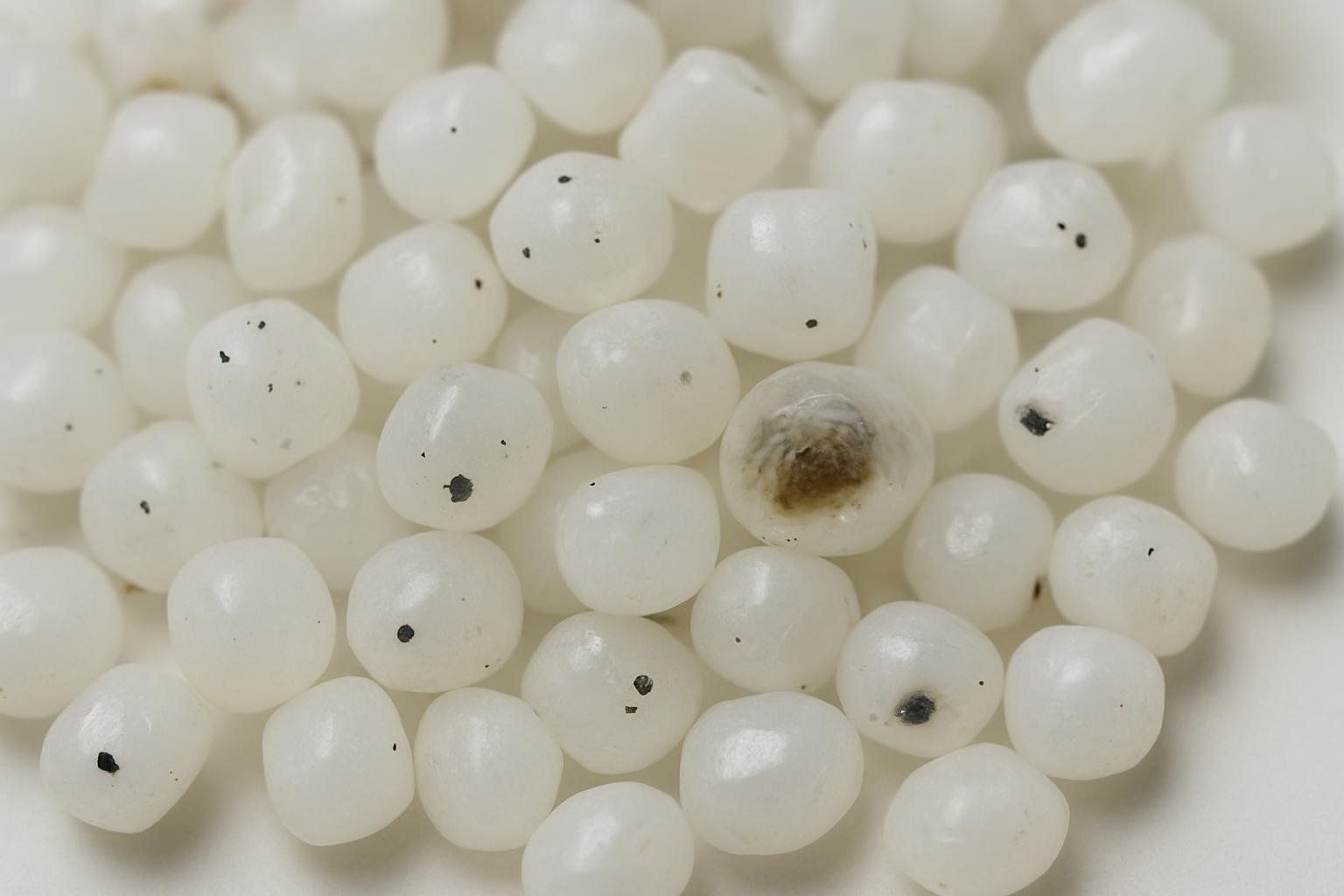
Warning sign 4: black specks, gels, or “trash” suddenly show up in pellets
If you’re seeing black specks, visible inclusions, gels, or unmelted bits, treat it as contamination until proven otherwise.
These defects often come with other filtration signals (short screen life, rising pressure, die-hole plugging). Even when the root cause starts upstream (dirty feedstock, degraded polymer), filtration is where you see the problem first. High-quality plastic pellets depend on filtering impurities from molten plastic.
What it usually means
- Contamination load increased (labels, paper, aluminum, sand-like grit).
- Degraded polymer or char is shedding from somewhere hot (barrel, adapter, die).
- Filtration is too coarse for what the customers will accept.
- With dirty feedstock and degraded polymer, problems show up first at filtration; clean flakes free of residues melt more consistently and reduce filtration load and die buildup.
Quick checks operators can do
- Check whether screen packs look dirtier than normal.
- Verify your melt temperature is not creeping up due to backpressure and shear.
- If you have multiple material sources, confirm nothing changed in feedstock lot, wash quality, or drying.
What happens if you ignore it
You will produce off-spec pellets. Worse, hard contaminants can damage downstream equipment, and char can continue to shed until cleaned.
Warning sign 5: pellet shape defects that correlate with restriction
Many pellet defects have multiple causes, but when they show up together with pressure and die symptoms, they often point back to filtration or die restriction. Many plastic pellets, including cylindrical pellets, are standardized to about 3-5 mm, which helps maintain predictable melting times, material properties, and more consistent pellet shape evaluation.
Plastics Technology describes how irregular pellets in underwater pelletizing can be caused by obstructions blocking die holes or material solidifying/freezing in the die.
Here are a few operator-relevant patterns:
If you run underwater pelletizing
- Longs, doubles, or “zippers” can show up when flow is uneven across holes, including from partial blockages. In an underwater pelletizer, the plastic melt is cooled in water, and that cooling generally supports more consistent pellet quality when flow and hole condition are stable.
- Irregular pellets and open/closed hole variation can happen when contaminants obstruct holes.
If you run strand pelletizing
A strand pelletizer forms molten polymer into strands first and then cuts the cooled strands into pellets, which is why unstable die flow can increase breakage and fines.
- Strand breakage can increase if flow is unstable.
- Fines can increase when pelletizing/cutting has to fight inconsistent strand output.
The key point: don’t chase cutter settings first if the die flow itself is unstable.
Warning sign 6: screen pack plugging (screen changes get more frequent)

If screen life collapses (you’re changing screens far more often than your normal interval), something upstream changed.
What it usually means
- Feedstock contamination increased.
- Mesh selection is too fine for the current stream.
- A process upset is creating more degraded material (gels/char) that loads the screen.
Quick checks operators can do
- Compare screen life by material type and supplier lot.
- Check upstream wash/dry performance if you’re running recycling feed.
- Confirm no abnormal start/stop pattern is causing extra degradation.
What happens if you ignore it
You’ll lose throughput to changeovers and your process will run in a constant state of “almost plugged.”
Warning sign 7: motor load and melt temperature creep up along with pressure
This is the “secondary confirmation.” When pressure rises, the extruder works harder. That can show up as higher motor load and sometimes melt temperature increase.
PlasticsToday notes that the screen pack and breaker plate combination creates backpressure that affects mixing and melt uniformity in extrusion, reinforcing that pressure behavior is part of the process, not just a gauge number.Technology Notebook: Optimizing the extrusion process and melt stream (PlasticsToday)
What it usually means
- You’re spending more energy to push melt through a restricted path (screen pack, adapter, die).
- If melt temperature rises enough, you may create more degradation, which then plugs screens faster. It becomes a loop.
Quick checks operators can do
- Confirm venting and degassing are stable (if applicable).
- Verify heater zones aren’t compensating for a restriction by cycling more aggressively.
A 10-minute operator checklist: diagnose before you touch settings
Use this when you see the first real warning signs.
- Look at pressure trend: steady ramp vs pulsing vs sudden spike.
- Check the screen-change log: did the problem start right after a changeover or right before the next one?
- Compare to baseline: how long should screens usually last on this material?
- Check die condition: any dead holes, uneven flow, visible buildup.
- Confirm die temperature holds: controllers are not proof; verify actual stability.
- Check feed stability: bridging, surging, inconsistent densification.
- Look at pellets: specks/gels, irregular shape, fines, chains/longs.
- Escalate early if needed: if pressure is rising fast and die holes are dropping out, don’t wait for the line to fail.
When to escalate (don’t “power through” these)
Escalate to maintenance/engineering if you see any of the following:
- pressure is approaching your equipment limit (or you’re within one screen change of it)
- blocked die holes are spreading
- pressure fluctuations are severe enough to affect pellet cut stability
- contamination is hard (grit/metal-like) or you suspect screen damage
The operator goal is not to diagnose every root cause. The goal is to stop the line from eating itself.
How to evaluate solutions for the pelletizing process (what to change so it doesn’t keep happening)
Once you’ve confirmed you’re dealing with filtration-driven instability, the “fix” typically falls into one (or more) of these buckets. In practice, a plastic pelletizing line is not a single machine but a complete pelletizing system with feeding, filtration, die, and cutting stages.
1) Screen pack selection and change discipline
- Mesh has to match the contamination load and the quality spec.
- If you keep tightening mesh to fix specks but screen life collapses, you’re forcing filtration to do the job of upstream cleaning.
2) Screen changer type and stability
If your process can’t tolerate interruptions or pressure swings, continuous or more stable screen changing is often the right direction. Across common pelletizing methods, pelletizing systems include hopper and side feeding types, so screen-changing stability needs to match the feed form and throughput.
A water ring pelletizer is one option for more continuous operation, and its cooling system uses a water ring to cool pellets.
A good screen changing setup should keep flow stable during normal operation and behave predictably during changeovers. In plastic pelletizing, that fit between plastic pelletizers and pelletizing technology also affects melt handling, and small-scale lines are typically $50,000–$150,000, full systems can run $50,000–$350,000, and water ring pelletizers are commonly $20,000–$120,000.
3) Upstream contamination control
If you’re recycling and the process can’t tolerate interruptions or pressure swings, choosing the right plastic pelletizers and pelletizing technology matters:
- better sorting and label removal upstream can buy more screen life across different polymers
- better washing reduces fines, paper, and grit load, since contamination and moisture levels directly affect pellet quality
- more consistent drying and feed preparation reduces surging that can mask itself as “filtration issues,” but different materials need different control, with PET especially sensitive to moisture above 50ppm during processing and to its melting points
- feed systems should also match the scrap form, whether that means handling plastic film cleanly, densifying woven bags, hopper-feeding rigid regrind, or accounting for wear from glass fiber in reinforced scrap
Common materials suitable for pelletizing include PET, HDPE, LDPE, and PP, and extrusion must deliver a clean, homogeneous melt for stable pellet quality. In general, strand and die-face or water-ring methods are chosen based on polymer behavior and operator preference.
4) Die and downstream hygiene
Even with good filtration, die buildup and thermal inconsistency can create symptoms that look like filtration. Treat die-face inspection and cleaning as part of the system; cleaner input also reduces filtration load and die buildup. Stable pellet quality supports consistent production because pellets are standardized raw materials, and uniform pellets run more reliably in manufacturing equipment, including injection molding. Plastic film and woven bags need consistent wash quality, while rigid regrind may feed differently. Pelletized plastics can also be blended with additives to alter properties, so contamination or inconsistency at the die can carry downstream into extrusion, packaging, and plastic packaging. Materials containing glass fiber can accelerate wear in the screw and barrel, which affects long-run stability.
For a more complete look at line components buyers usually compare, along with third-party services and other products around the line, see Elant’s overview of what buyers compare before investing in pelletizing equipment.
Next steps
If you want to reduce unplanned downtime, you need two things: a stable pressure trend and a filtration setup matched to your plastic waste.
A practical place to start is Elant Machine’s guide on how melt pressure controls downtime on a plastic pelletizing machine, then compare that to your own pressure logs and screen-change intervals.
Plastic pelletizing is typically the final stage of plastic recycling and plays a crucial role in the circular economy.
It also helps reduce reliance on virgin resin by converting recycled material into recycled pellets and recycled plastic pellets that are easier to store and transport, since bulk density improves from about 0.1-0.2 g/cm³ to 0.4-0.7 g/cm³.
If you’re evaluating upgrades or a new line, this walkthrough on how to choose and run a pelletizing line can help you translate these warning signs into equipment requirements.
Considering equipment changes? Start with the full system view: feed preparation, degassing, melt filtration, die, and pelletizing have to work together when processing waste plastic, and this step helps cut plastic pollution and landfill waste. You can review Elant Machine’s plastic pelletizing machines to see common configurations, then match filtration options to your material and contamination load. For plastics manufacturers, recycled pellets can lower raw material costs and may sell for $100-$400 more per ton than loose regrind.