
A plastic recycling washing machine is not a single piece of equipment — it is a sequence of interdependent stages, and buying the wrong one (or skipping a stage to cut costs) can strand your cleaned flake well below the purity threshold that U.S. buyers will pay a premium for.
This guide walks procurement managers and facility operators through every major machine type, real throughput and price ranges, and the specification mistakes that quietly kill resale value.
Key Facts at a Glance
| Item | Detail |
|---|---|
| Primary machine types | Friction washer, float-sink tank, hot-wash unit, centrifugal dryer, label remover |
| Typical throughput range | 500–6,000 lbs/hr depending on configuration |
| U.S. price range (single unit) | $18,000–$350,000+ depending on type and capacity |
| FDA food-contact standard for rPET | FDA recycled plastic guidance |
| Key U.S. regulatory reference | EPA national recycling goals; California SB 343 |
| Contamination threshold for Grade-A flake | Typically <100 ppm organics (verify with offtake buyer) |
What Is a Plastic Recycling Washing Machine and Why Does It Matter?
A plastic recycling washing machine removes surface contamination — labels, adhesives, food residue, dirt, and oils — from shredded or granulated plastic before it is melted and reprocessed. Without adequate washing, even high-quality post-consumer HDPE or PET cannot meet the purity specifications that compounders and bottle-grade rPET buyers require.
The Association of Plastic Recyclers notes that flake purity directly determines market tier: Grade A commands 20–40% higher resale pricing than Grade B. That spread is the economic argument for investing in a complete washing line rather than a single-stage unit.
In the U.S., the stakes are rising. The EPA’s 2021 national recycling strategy set a target of 50% recycling rate by 2030, and state-level extended producer responsibility laws — California SB 343 being the most stringent — are tightening the definition of what counts as “recyclable.” Facilities that cannot produce consistently clean flake will find fewer offtake partners as those standards take hold.
Video: Waste Plastic Recycling Machine | How to recycle PP, PE into plastic pellets and granules?
Machine Types in a Plastic Recycling Washing Line
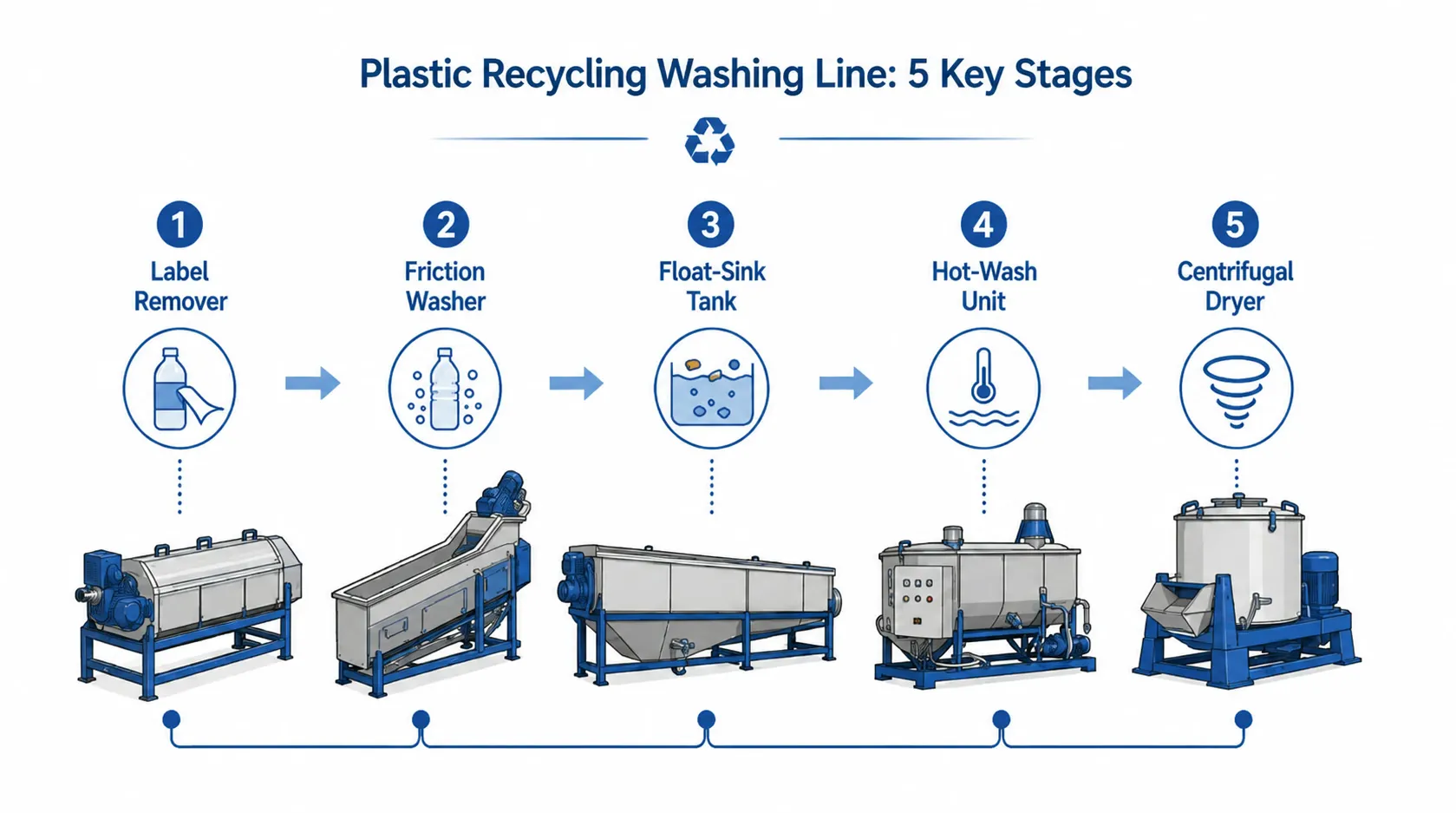
A full plastic recycling machine washing line typically runs in this sequence:
Label remover / pre-wash drum — a rotating drum that loosens paper labels and large debris before water contact. Throughput: 1,000–4,000 lbs/hr.
Friction washer — high-speed paddles agitate plastic flake against water and, optionally, a caustic solution to strip adhesives and organics. This is where most of the real contamination removal happens. Throughput: 500–3,000 lbs/hr per unit; facilities often run two in series for high-contamination HDPE loads.
Float-sink separation tank — exploits density differences to separate polyolefins (PP, HDPE, floats) from PET and PVC (sinks). Essential for any mixed-density feedstock. Without it, density-mixed streams produce off-spec flake regardless of how well the friction washer runs.
Hot-wash unit — circulates water at 140–185°F (60–85°C), often with caustic soda in PET bottle washing processes, to break down food-grade adhesives and oils that cold washing cannot remove. This is the stage most directly tied to FDA food-contact compliance for rPET.
Centrifugal dryer / spin dryer — mechanical drying before the thermal dryer stage, reducing moisture to 1–3% and cutting energy consumption in the downstream thermal drying step.
Throughput and Price Comparison by Machine Type
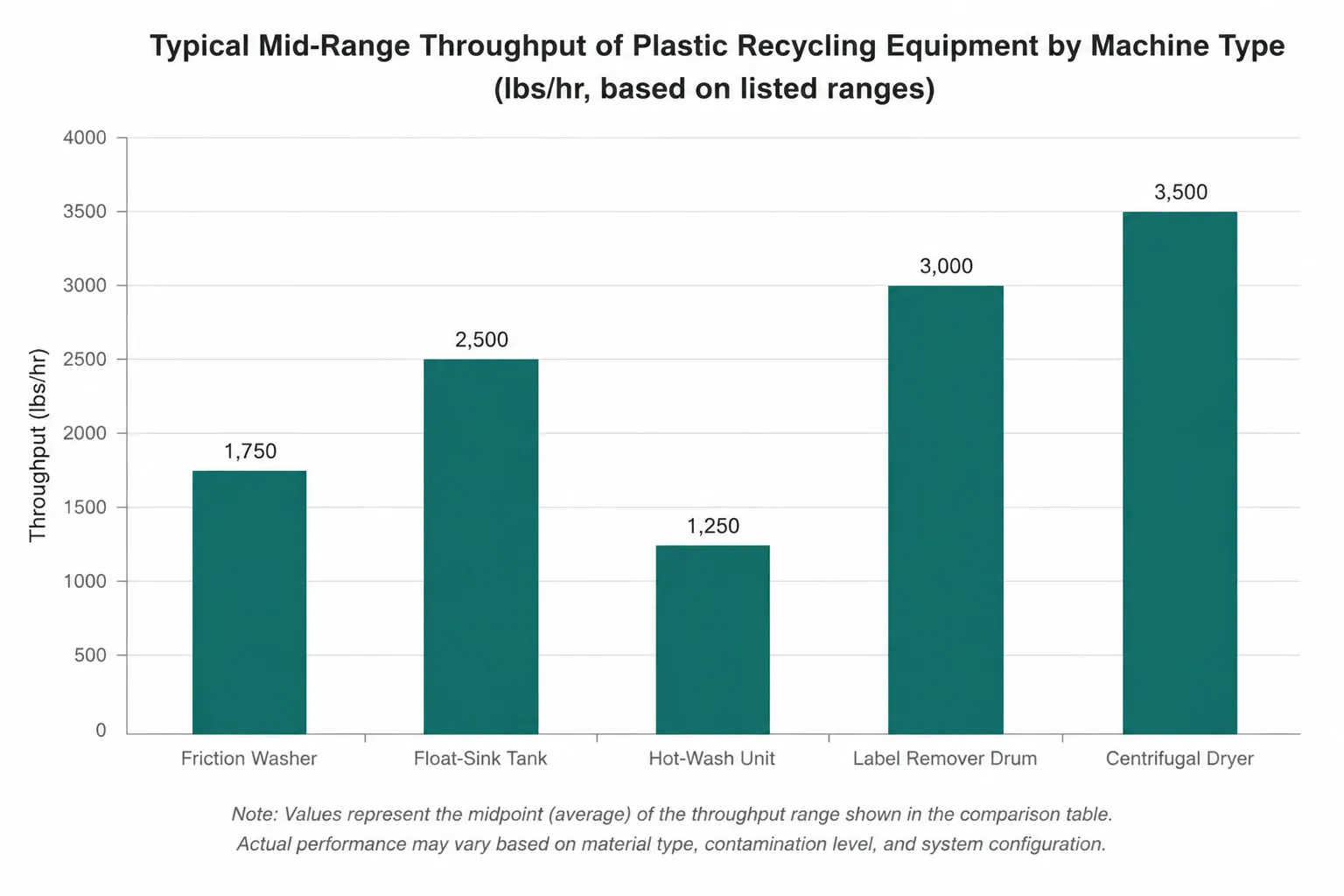
| Machine Type | Best Plastic Type | Throughput Range (lbs/hr) | Typical U.S. Price Range | Key Limitation |
|---|---|---|---|---|
| Friction washer | HDPE, PP film, PET flake | 500–3,000 | $25,000–$90,000 | Ineffective on oil-saturated loads without hot-wash follow-up |
| Float-sink tank | Mixed-density streams | 1,000–4,000 | $18,000–$55,000 | Requires adequate upstream shredding for consistent separation |
| Hot-wash unit | PET (food-grade), dairy HDPE | 500–2,000 | $60,000–$180,000 | High water and energy consumption; chemical handling requirements |
| Label remover drum | All types with paper labels | 1,000–5,000 | $15,000–$45,000 | Limited effectiveness on pressure-sensitive synthetic labels |
| Centrifugal dryer | All washed flake types | 1,000–6,000 | $20,000–$80,000 | Does not replace thermal drying for moisture-sensitive applications |
All price ranges are indicative U.S. market figures as of 2025; verify current pricing with at least two equipment suppliers before budgeting.
Common Mistakes When Buying a Plastic Recycling Machine
Skipping the hot-wash stage to reduce upfront cost is the single most expensive error a buyer can make. Counterintuitively, the hot-wash unit is the most expensive line item in a full PET washing system — and also the stage buyers most frequently cut to stay under budget.
The consequence is predictable: cold-washed PET flake typically cannot meet the FDA’s food-contact rPET standard, which requires demonstration that the washing process achieves a minimum 99.9% reduction of contaminants. Buyers who skip it report that their flake sells at commodity-grade pricing — roughly 30–40% below food-contact rPET spot values — eliminating the ROI case for the entire line.
Under-sizing the friction washer for label-heavy HDPE loads. Post-consumer HDPE dairy bottles carry aggressive pressure-sensitive labels. A single-pass friction washer rated for clean industrial HDPE will not reach acceptable label-ink residue levels on this feedstock. The correct solution is either a larger friction washer or two units in series — a detail that most general equipment catalogs omit.
Omitting a float-sink tank when processing mixed bale feedstock. If your supply comes from MRF bales rather than a clean source-separated stream, you are almost certainly processing a mix of PP caps, HDPE bottles, and PET containers in the same line. Without density separation, some fraction of heavier PVC and PET will contaminate the HDPE product and vice versa.
ASTM standards for recycled plastic specify contamination tolerances that mixed-density flake without float-sink separation routinely fails.
Specifying on throughput alone, ignoring water consumption. A hot-wash line processing 1,000 lbs/hr of PET can consume 150–300 gallons of water per hour. In states with industrial water restrictions or high municipal rates — California, Arizona, Texas in drought years — this operating cost can swing the entire economics of the operation. Request gallons-per-lb figures from every supplier, not just throughput numbers.
How to Evaluate Cost-Effectiveness Before You Buy
Start with your offtake contract, not the equipment brochure. The flake purity spec your buyer requires — whether that is a compounder accepting 300 ppm or a food-grade converter requiring <100 ppm — determines which stages are non-negotiable. Work backward from that spec to the minimum line configuration.
Then model total cost of ownership, not purchase price. Water, electricity, caustic soda consumption, and labor to manage a multi-stage line can exceed the annualized equipment cost on lines running two shifts. plastic recycling line ROI calculator can help structure that analysis.
Finally, request wash-test results — not just references. Reputable equipment suppliers will run a sample of your actual feedstock through a demonstration unit and provide before/after contamination data. If a supplier cannot or will not do this, treat it as a meaningful signal about post-sale support.
✅ Do this: Ask any equipment vendor for ASTM D5577 particulate test results on their demo output, not just visual assessments. Quantified data protects you in offtake negotiations.
Seek Professional Advice Before Finalizing Your Configuration
A plastic recycling washing machine purchase above $150,000 warrants a process engineer review — either through the equipment OEM or an independent consultant. The variables that determine correct line configuration (feedstock contamination profile, target flake purity, available utilities, water treatment capacity) interact in ways that brochure specs do not capture.
The Association of Plastic Recyclers publishes member resources and can connect buyers with certified technical consultants. EPA’s Sustainable Materials Management program also offers technical assistance grants for qualifying U.S. recycling facilities — worth checking before committing full capital.
Get at least three competitive equipment quotes, specify your feedstock in writing to each vendor, and request performance guarantees — in the contract, not just the sales presentation.
Have a project or a spec sheet in hand? Talk to elantmachine.com — real engineers answer.
FAQ
What are the 5 Primary Machine Types in a Plastic Recycling Washing Line?
The five core machines in a plastic recycling washing line are the friction washer, float-sink tank, hot-wash unit, centrifugal dryer, and label remover. Each handles a distinct step: surface scrubbing, density-based separation, high-temperature contaminant removal, mechanical drying, and label elimination. Skipping any stage typically pushes contamination levels above the 500 ppm threshold that U.S. rPET and rHDPE buyers require for food-grade or compounding applications.
How to Choose the Right Plastic Recycling Machine?
Match the machine to your input stream first — resin type, form factor (bales, film, rigids), and contamination load drive every other decision. Then confirm throughput in pounds per hour aligns with your feedstock supply. U.S. buyers should also verify the equipment meets OSHA guarding standards and that replacement wear parts are stocked domestically. Getting output flake tested to ASTM standards before finalizing a purchase contract prevents costly surprises after installation.
What about Plastic Recycling Machine Cost and ROI?
A complete plastic recycling washing line in the United States typically ranges from $150,000 for a small-capacity system to over $1.5 million for a high-throughput, fully automated line. ROI depends on feedstock cost, cleaned flake sale price, and uptime. Facilities processing 2,000 or more pounds per hour of HDPE or PET commonly reach payback in three to five years when selling into U.S. regrind or pellet markets. Energy and water consumption are the largest operating cost variables to model before purchasing.
Sources
[1] Guidance on Use of Recycled Plastics in Food Packaging — fda.gov
[2] SB 343: Accurate Recycling Labels – CalRecycle Home Page — calrecycle.ca.gov
[3] APR Design Guide Overview — plasticsrecycling.org
[4] National Recycling Strategy | US EPA — epa.gov
[5] Submissions on Post-Consumer Recycled (PCR) Plastics… — hfpappexternal.fda.gov
[6] Resin Identification Codes (RICs), as Specified by ASTM… — blog.ansi.org
[7] Plastics Standards – Standards Products — store.astm.org
[8] Meet Our Membership — plasticsrecycling.org