
A recycling plant’s washing drum runs at full capacity—shredded PET bottles tumbling through hot water, friction tearing surface contamination loose. What leaves with that wastewater isn’t just dirt and label adhesive. Billions of microplastic fragments, fibers, and particles ride out with every drain cycle, headed straight for municipal wastewater treatment systems that were never designed to catch them.
Understanding how plastic washing lines produce microplastics—and why water treatment is the critical control point—matters for every recycler, equipment buyer, and sustainability auditor working with plastic recovery today.
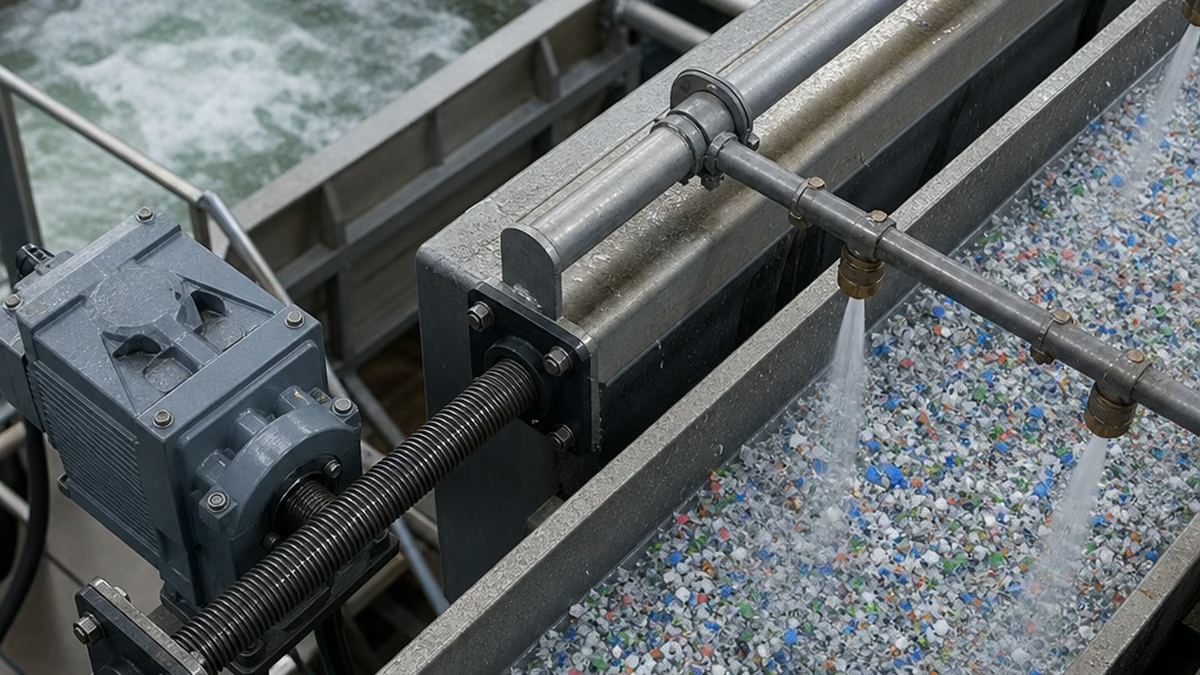
At a glance
- Plastic washing lines can generate microplastics through mechanical abrasion, impact during processing, and changes to plastic surfaces during cleaning.
- Untreated washing wastewater may contribute to aquatic microplastic pollution if released without adequate treatment.
- Processes such as clarification, filtration, and membrane-based treatment can help reduce microplastic levels when properly designed.
- On-site wastewater treatment provides an important barrier before treated water is reused or discharged.
- Plastic washing wastewater can contain microplastic particles, making effective wastewater treatment an important part of responsible recycling operations.
- Microplastic particles vary widely in size, and very small fragments may pass through conventional screening systems without additional filtration.
How Plastic Washing Lines Generate Microplastic Waste
Industrial plastic washing lines process post-consumer plastics, including bottles, films, and rigid containers, through multiple stages such as shredding, friction washing, float-sink separation, and rinsing. During these processes, mechanical stress, friction, and thermal conditions can contribute to the formation of microplastic particles.
Shredding and granulation produce the first wave. Cutting blades fragment plastics into flakes, and the blade edges ablate material from cut surfaces, releasing particles in the 50–500 µm range. Plastic washing wastewater can contain microplastic particles, making effective wastewater treatment an important part of responsible recycling operations.
Friction washers are an important source of microplastic generation in plastic washing lines. These machines use mechanical friction to remove dirt, labels, and adhesive residues from plastic flakes. The same cleaning action that improves flake quality can also release small plastic fragments, especially when processing aged, brittle, or heavily contaminated materials.
Hot-water washing systems may further influence particle release during recycling operations. Elevated temperatures and chemical cleaning agents help remove contaminants from plastic surfaces, but they may also affect surface conditions and increase the possibility of particle release during mechanical processing.
Rinsing stages can also carry fine plastic particles into wastewater streams. Very small particles are more difficult to capture through conventional screening methods, making additional filtration or wastewater treatment important for reducing their release.
In addition to processing equipment, other plant components such as piping and water circulation systems may contribute minor background sources of plastic particles over long-term operation. Regular equipment maintenance and effective wastewater management help control potential microplastic discharge.
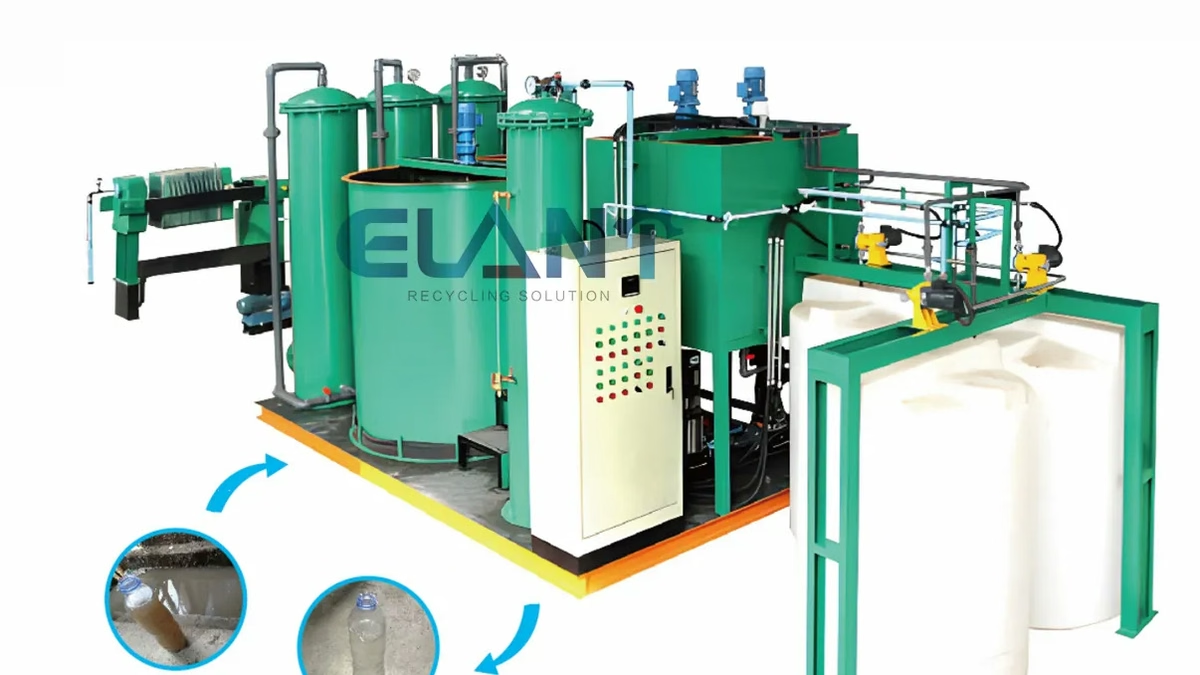
Why Water Treatment Systems Are Important in Plastic Recycling
Water treatment is important in plastic recycling because untreated wash water can carry suspended solids, contaminants, and plastic particles back into the recycling process when water is reused without proper filtration. Plastic recycling plants that rely on open-loop water systems also consume more fresh water and generate larger wastewater volumes, making efficient water management an important part of stable operations.
A complete water treatment system usually combines multiple processes, including clarification, filtration, and other treatment technologies. Clarification removes larger suspended solids by allowing particles to settle, while finer filtration methods help capture smaller particles that cannot be removed through settling alone. Using these treatment stages together helps improve water quality for reuse and reduces the risk of plastic particle discharge.
At the industrial scale, effective wastewater treatment also helps recycling facilities maintain consistent production conditions. Poorly treated process water may affect washing performance, increase contamination risks, and reduce the efficiency of water circulation systems. By treating wastewater on-site before reuse or discharge, plastic recycling plants can better control pollutants and improve overall resource efficiency.
For plastic recycling facilities, water treatment is not only an environmental requirement but also an important part of maintaining cleaner operations, reducing water consumption, and supporting long-term recycling performance.
Key Methods to Control Microplastic Pollution in Plastic Washing
Plastic washing lines generate wastewater containing suspended solids, plastic fines, and other contaminants. A proper water treatment system helps remove these impurities, maintain stable washing performance, and reduce fresh water consumption.
Common treatment methods include:
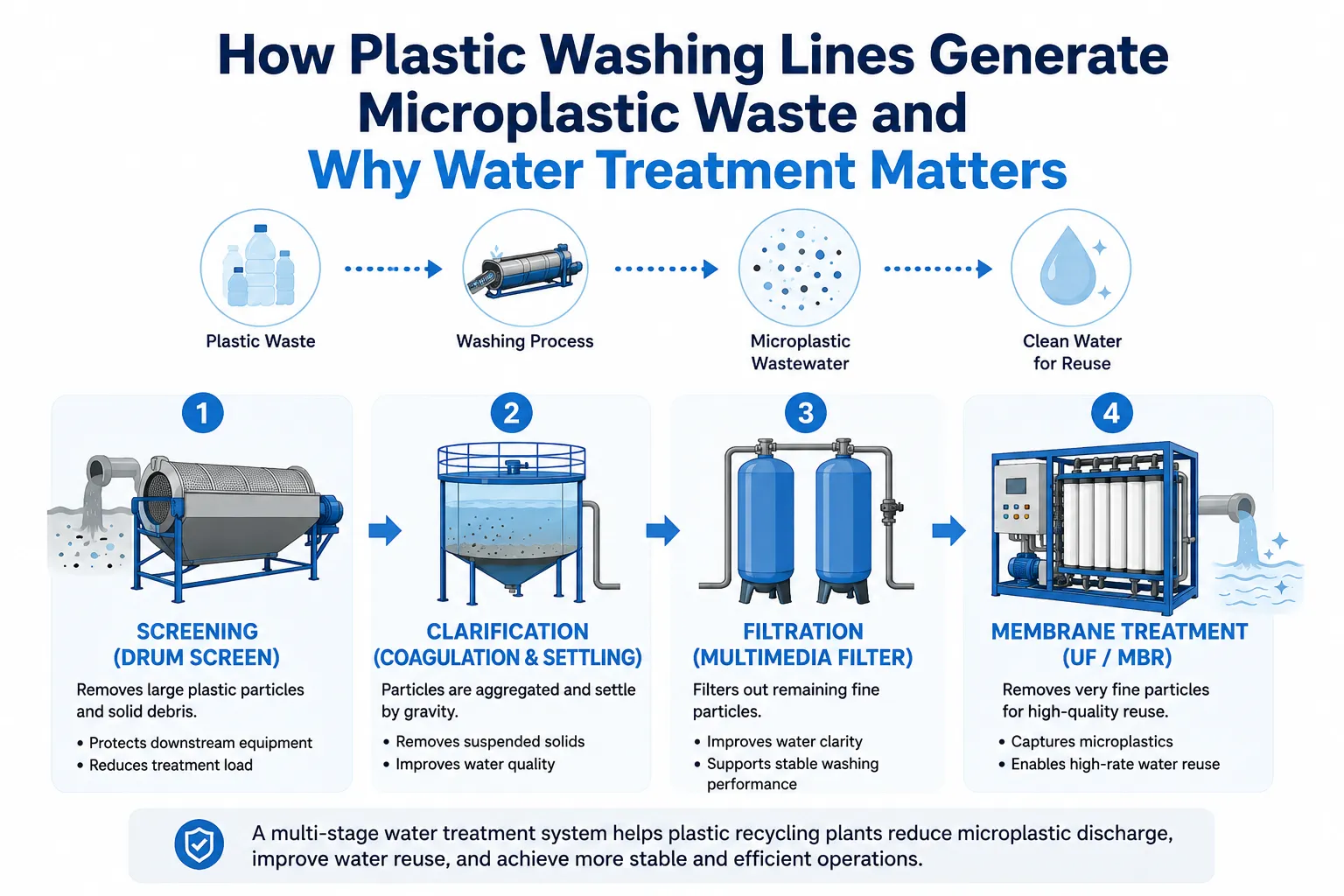
1. Screening: Removing Larger Plastic Particles
Screens are usually the first treatment stage in a plastic washing line. Drum screens or vibrating screens remove larger solid particles and plastic fragments from the wastewater before further treatment.
This step protects downstream equipment and reduces the load on later filtration systems.
2. Clarification: Separating Suspended Solids
Clarification uses gravity settling to separate suspended solids from water. With the help of coagulation or flocculation, smaller particles can combine into larger groups that are easier to remove.
In plastic recycling plants, clarification tanks are commonly used to reduce suspended solids and improve the quality of recycled water.
3. Filtration: Improving Water Quality for Reuse
After clarification, filtration systems remove remaining fine particles from the water.
Sand filters or multimedia filters are often used to improve water quality before the water returns to the washing process. This helps reduce contamination buildup and maintain consistent cleaning performance.
4. Membrane Treatment: Advanced Water Purification
For plants requiring higher water quality or closed-loop water circulation, membrane technologies such as ultrafiltration (UF) can provide additional purification.
These systems can capture smaller particles that traditional treatment methods may not remove, helping recycling plants achieve better water reuse performance.
Worth checking: What drink has the most microplastics? Bottled water in single-use plastic containers consistently shows the highest microplastic concentrations among beverages—one 2018 study[4] found an average of 325 particles per liter. This is a downstream consequence of the same washing and processing conditions discussed here; plastic contact and mechanical stress during production are primary contributors.
How Recycling Plants Improve Water Reuse Efficiency
Water reuse is where environmental benefits and operating efficiency come together. Freshwater consumption increases operating costs, while untreated wastewater can affect both compliance and process stability. A properly designed water treatment system allows recycling plants to clean and reuse process water instead of continuously relying on fresh water.
Closed-loop water systems use multiple treatment stages to remove suspended solids, plastic fines, and other contaminants before returning treated water to the washing process. This helps maintain consistent washing performance and reduces wastewater discharge.
The key factors to monitor are water quality indicators such as turbidity, suspended solids, and particle concentration. Without effective filtration, contaminants can gradually accumulate in recycled water, reducing cleaning efficiency and affecting the quality of recycled plastic flakes.
A well-designed water treatment system combines different technologies based on the requirements of the recycling line. Screening removes larger solids, clarification reduces suspended particles, filtration improves water clarity, and advanced membrane systems provide higher-quality water reuse when required.
For plastic recycling plants, water treatment is not only about reducing water consumption. It also helps maintain stable operation, protect washing equipment, and improve the consistency of final recycled materials.
| Treatment Stage | Main Function | Typical Application |
|---|---|---|
| Drum Screen | Removes larger solids and plastic fragments | Protects downstream equipment |
| Clarification | Separates suspended solids through settling | Reduces solids load |
| Sand / Multimedia Filtration | Removes finer suspended particles | Improves water clarity |
| UF / MBR Membrane Treatment | Provides advanced filtration | High-quality water reuse |
Microplastic Pollution Control in Different Plastic Washing Applications
The microplastic generation profile varies across material types and processing conditions, and treatment systems should be matched accordingly:
- PET bottle washing: High-volume, relatively rigid flakes are processed through shredding, washing, and separation stages. Microplastic particles can be generated mainly through mechanical friction during washing. Common control methods include screening and clarification, while advanced filtration may be considered for higher water reuse requirements.
- Film washing (LDPE/LLDPE): Flexible films can generate more fine plastic particles during shredding, friction washing, and material handling because of their thin and flexible structure. Fine screening and filtration systems help reduce particle accumulation before water is reused in the washing process.
- Mixed rigid plastics (PP/HDPE): These materials usually have more variable contamination levels depending on the waste source. Water treatment systems should be designed with flexibility to handle changes in suspended solids, organic contamination, and plastic particles.
- Electronics and synthetic material recovery: Processing synthetic components and mixed plastic products may generate different particle types, including rigid fragments and fine particles. These applications may require multiple treatment stages depending on contamination levels and water reuse requirements.
Do toothbrushes have microplastics? They can contribute plastic particles during recycling, especially when synthetic materials such as nylon components are mechanically processed. However, the impact depends on the overall material mix and recycling process conditions.
The EPA’s emerging contaminants research and framework shows increasing attention toward contaminants of emerging concern, including the need for better understanding and management of wastewater quality. Recycling plants that improve wastewater treatment capacity can better control discharge quality and support long-term water management.
Integrating mechanical equipment design with appropriate wastewater treatment systems from the beginning can help recycling plants improve water reuse efficiency and maintain more stable washing operations.
Have a project or a spec sheet in hand? Talk to elantmachine.com — real engineers answer.
FAQ
Do plastic pipes contribute to microplastics?
Yes, plastic pipes contribute microplastics to water systems through abrasion, UV degradation, and pressure fluctuations that shed particles from pipe walls. In industrial recycling facilities, PVC and polyethylene supply lines carrying wash water can release fragments directly into the process stream. Studies submitted to the EPA have detected microplastic concentrations downstream of facilities using aging plastic plumbing, making pipe material selection and regular inspection a genuine concern for plants managing wastewater discharge compliance.
How can plastic washing lines reduce microplastic discharge?
Plastic washing lines can reduce microplastic discharge by combining mechanical control and wastewater treatment methods. Screening systems remove larger plastic particles, while clarification, filtration, and membrane treatment help remove finer suspended particles from process water. A well-designed water treatment system also allows treated water to be reused, reducing contaminant buildup and wastewater discharge.
Sources
[1] Evaluating the generation of microplastics from an unlikely … — sciencedirect.com
[2] Guidance on Use of Recycled Plastics in Food Packaging — fda.gov
[3] Microplastic removal by coagulation/flocculation: A review … — sciencedirect.com
[4] Synthetic Polymer Contamination in Bottled Water – PMC — pmc.ncbi.nlm.nih.gov
[5] framework-understanding-contaminants-emerging-concern … — epa.gov
[6] The potential for a plastic recycling facility to release … — pureportal.strath.ac.uk
[7] Industrial Effluent Guidelines — epa.gov
[8] Microplastic removal and management strategies for … — pubmed.ncbi.nlm.nih.gov