
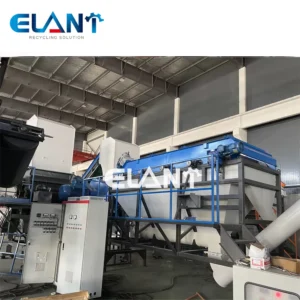
If you’re running a PET wash line, “labels in flakes” isn’t a cosmetic issue. It’s a quality problem (contamination), a maintenance problem (screens, filters, water loops), and often a throughput problem (because you end up slowing the line down to compensate).
This guide is written for decision-stage operators: people who need a repeatable way to remove labels, keep adhesive from smearing through the line, and choose equipment/process changes with less guesswork.
Why label removal matters more than most teams admit
Labels bring three things your rPET doesn’t want:
- Non-PET polymers (common label films and cap materials are often PP/PE; shrink sleeves may include PVC in some streams).
- Inks and coatings that can discolor wash water or flakes.
- Adhesive residue that attracts fines, forms “glue balls,” and makes separation steps less stable.
When label removal is unstable, you usually see it downstream:
- float/sink tanks that “never look clean”
- more fines and sludge load
- sticky buildup on friction washer screens
- more frequent hot-wash water changes
- filtration plugging during extrusion/pelletizing
What plastic labels you’re dealing with (because the label type changes the whole approach)
Before you touch settings, classify the incoming stream for a week:
- Pressure-sensitive labels (PSL): typically peelable, but adhesive behavior varies.
- Glue-applied paper labels: can fragment and add fiber/fines.
- Wrap-around plastic labels (BOPP/PP film): tend to separate by density/air classification.
- Full-body shrink sleeves: the biggest operational swing factor. They can behave like “contamination blankets” if they survive upstream steps.
⚠️ Warning: If your inbound bales include a noticeable amount of full-body sleeves, treat it as a process change—not a minor nuisance. Sleeves that reach the granulator tend to become small fragments that are harder to capture later.
A useful external reference for what “good” looks like is the recyclability expectation that the label detaches cleanly and adhesive stays with the label, not on the PET. RecyClass formalizes this in its testing protocol for PET bottle label adhesives (see the RecyClass “Recyclability Evaluation Protocol for adhesives for labels on PET bottles” and their design-for-recycling guidelines).
Where label removal happens in a PET bottle washing line
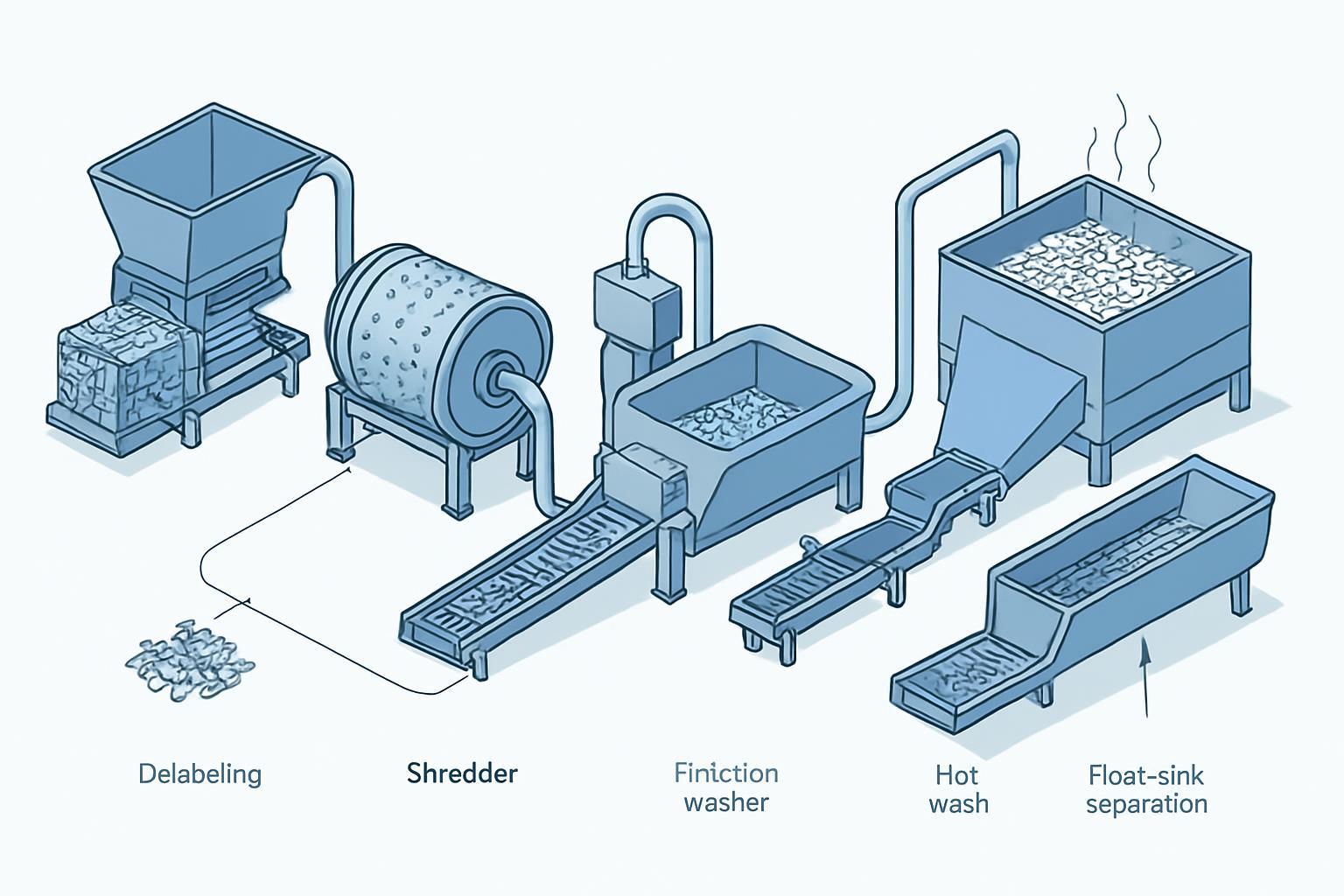
A PET bottle washing line doesn’t have one “label removal step.” Most recycling facilities can handle labels on plastics, but separation works best when the line removes them in stages. It’s a chain of steps, each removing a different failure mode in plastic recycling, and modern systems for recycling plastic separate different plastics and adhesives during processing rather than relying on a single step:
- Delabeling (whole bottle): remove as much label mass as possible before grinding.
- Crushing/granulation: should happen after delabeling, or you create fragments.
- Friction washing: scrubs off remaining label fragments and loosened adhesive.
- Hot wash: does the heavy lifting on glue/oils that won’t release cold.
- Float-sink separation: separates PET (sinks) from many label films and caps (float).
- Air separation / aspiration (where used): captures remaining light label fragments.
If you’re troubleshooting, map the symptom to the stage:
- Big intact labels downstream → delabeler or feed issue.
- Tiny label confetti everywhere → labels are hitting the granulator.
- Sticky smear / glue carryover → hot wash stability + friction washing effectiveness.
- Floating layer “never clears” → float/sink flow control, sludge load, skimming discipline.
Step-by-step: how to remove labels from PET bottles in the recycling process
This is a practical sequence you can implement whether you run a mostly-dry delabeling front end or a wet prewash.
Step 1: stabilize the inbound stream (so your settings actually mean something)
Input: bales and inbound QC notes.
Actions:
- Create a simple inbound scorecard: sleeve % (rough), paper label % (rough), fines level, non-PET contamination.
- Do a quick manual removal check for obvious residual labels or sleeves before bottles move deeper into the line.
- Separate “high sleeve” bales when possible so you can run a controlled trial.
Done when: you can compare label removal performance against a known inbound profile, not “whatever arrived today.”
Step 2: maximize whole-bottle delabeling before grinding
Input: bottles before granulation.
Actions:
- Confirm bottles are sufficiently loosened/debaled so the delabeler can contact the bottle surface.
- Tune for consistent feeding. Both overfeeding and underfeeding reduce effective label removal.
- Inspect wear items (blades/knives, screen openings, rotor condition) on a schedule.
Done when: most labels are removed as whole pieces (or at least detached) before the granulator.
Pro Tip: If your line swings day-to-day, start with feed stability before changing chemistry. A steady feed rate often fixes “random” label removal dips.
Step 3: control granulation so you don’t create label confetti
Input: delabeled bottles.
Actions:
- Verify the granulator isn’t being used as a “delabeler by force.”
- Watch the output: if you see lots of small label pieces immediately after grinding, you’re grinding labels.
Done when: flake output looks like PET flake with minimal label fragments, not a mixed confetti stream.
Step 4: use friction washing for mechanical scrubbing (not just rinsing)
Input: mixed flakes.
Actions:
- Check that the friction washer is actually scrubbing: rotor speed, paddle condition, loading level, drainage.
- Avoid turning the friction washer into a “high-flow rinse” that reduces contact effectiveness.
Done when: label fragments visibly reduce after friction washing and screens aren’t loading up with sticky buildup.
Step 5: keep hot wash stable if adhesive residue is your problem
Input: flakes entering hot wash.
Actions:
- Treat hot wash as a controlled process: temperature stability, chemistry consistency, retention time, and water cleanliness.
- If adhesive residue shows up as tacky flakes or smear in downstream tanks, hot wash drift is a prime suspect.
Done when: flakes exiting hot wash feel clean (not tacky), and downstream separation stays stable.
Step 6: run float-sink separation like a separation unit, not a “tank of water”
Input: washed flakes.
Actions:
- Maintain stable flow and remove float continuously.
- Control turbulence: too much churn can push light fraction down and carry PET fines up.
- Watch sludge load; separation gets worse as water quality degrades.
Done when: the float layer clears consistently, and PET losses don’t spike.
Step 7: add a final light-fraction cleanup if your spec demands it
If you’re pushing toward higher-purity flakes (or food-grade targets), a final separation step (e.g., aspiration/air separation, additional rinsing/QA sorting) may be warranted.
Done when: your QC rejects for labels drop to a stable, repeatable level—not a daily fight.
Verification: how to tell if label removal is “good enough”
Decision-stage operators need measurable checkpoints. Use a mix of fast checks and trend metrics.
Fast checks (per shift)
- Visual check on dried flake: look for label film, paper fibers, and ink specks.
- Touch test: tacky flakes usually mean adhesive carryover.
- Float fraction observation: is the float layer clearing, or building up and recirculating?
Trend metrics (weekly)
- screen cleaning frequency (friction washer, dewatering screens)
- hot wash water change frequency
- float/sink reject rate and PET loss
- extrusion filtration plugging frequency (if you pelletize)
- scheduled maintenance adherence for wear-part inspection or replacement, since unstable label removal often follows missed intervals
Key Takeaway: “Good enough” is not “labels look mostly gone.” It’s stable separation + stable downstream cleanliness week over week.
For a practical checklist of control points, you can also cross-reference control points for quality rPET flakes as a process-audit starting point.
Troubleshooting: when labels keep showing up in flakes
Use this as a fast diagnostic map.
Symptom: intact labels after delabeling
Likely causes:
- compressed bottles / poor bale opening
- worn delabeler blades or blocked screens
- inconsistent feed rate
Fix path:
- stabilize feed and inspect wear items before changing anything else.
Symptom: lots of tiny label fragments everywhere
Likely cause:
- labels are entering the granulator
Fix path:
- push delabeling upstream; avoid using grinding as the removal method.
Symptom: sticky flakes, glue smears, sludge buildup
Likely causes:
- hot wash instability
- friction washer not providing enough scrubbing
Fix path:
- bring hot wash under control (stability first), then tune friction washer effectiveness.
Symptom: float/sink doesn’t separate cleanly
Likely causes:
- turbulence/flow instability
- high sludge load
- poor float removal discipline
Fix path:
- stabilize water conditions and continuously remove float.
A more detailed fault-tree style checklist is in Elant Machine’s in-depth article on why label removal efficiency drops in a PET bottle recycling line and how to fix it.
Choosing equipment and configuring the line (BOFU decision criteria)
Here’s the decision framework I’d use if I were buying or reconfiguring a PET bottle washing line for label-heavy feedstock.
1) Decide where you want to remove the label mass
- If your biggest issue is label fragments, prioritize stronger whole-bottle delabeling.
- If your biggest issue is adhesive smear, prioritize hot wash stability + friction washing.
2) Match the method to your inbound reality
- Cleaner, well-sorted stream → dry delabeling can carry more weight.
- Mixed, high-contamination stream → wet prewash + robust washing/separation becomes more important.
3) Evaluate equipment the way operations will live with it
Ask vendors (and your own team) for answers to:
- What are the wear parts and inspection cadence?
- How does the machine behave when the bale profile shifts?
- What’s the cleaning burden (screens, water loops, sludge handling)?
- Where are the control points you can actually adjust without stopping the line?
- What on-site support is available during startup, troubleshooting, or maintenance visits at your site?
Companies buying equipment should compare support responsiveness alongside wear parts and cleaning burden.
4) Don’t ignore “material risk” label materials
If you suspect PVC sleeves or other incompatible label materials are entering your feed, treat it as a quality risk, not just a yield problem. This is a good time to review PVC contamination in PET bottle recycling and decide whether you need tighter inbound specs or stronger sorting.
5) Use internal references to map equipment to your process
If you’re evaluating line configurations, start by mapping your capacity and cleaning requirements against a system view (see PET bottle washing line equipment).
(Brand note: If you’re comparing suppliers, Elant Machine is one option in the market—just make sure you evaluate it with the same operational criteria you apply to everyone else.)
Next steps
If you want to turn this into an equipment decision quickly, gather three inputs:
- a quick bale profile (sleeves %, paper %, PSL %, heavy contamination yes/no)
- your target output (flake spec, downstream extrusion/pelletizing requirements)
- the top 2 pain points you’re trying to fix (labels in flakes, adhesive smear, float/sink instability, downtime)
For readers handling individual items instead of a wash line, removing labels from bottles for plastic recycling is usually best done by soaking, using gentle heat, or applying mild solvents to loosen adhesive so the material is cleaner to recycle. To remove a glued label, soak the container in warm water or warm soapy water; this works well on many plastic containers because it softens paper and adhesive for easier peeling. Applying heat directly with a hairdryer can loosen glue, but too much heat can warp thin bottles. Cold temperatures can also make some adhesives brittle and easier to peel. For leftover glue, try rubbing alcohol or oil first, then use Goo Gone or WD-40 if needed. A paste made from equal parts baking soda and cooking oil can help dissolve sticky residue. If print remains, 100% acetone can remove print from containers with minimal effort. Always check local recycling guidelines, because practices vary by city, county, or state: most people are putting accepted items in a curbside bin, labels usually are not recyclable there even when other things on the item are tolerated, and #1 and #2 bottles are almost always accepted as recyclables; that said, keep nonaccepted trash, garbage, and bags out, and note that many programs handle labels on glass differently.
Then use those to pressure-test your delabeling + wash + separation configuration and identify the one or two changes most likely to stabilize label removal.