
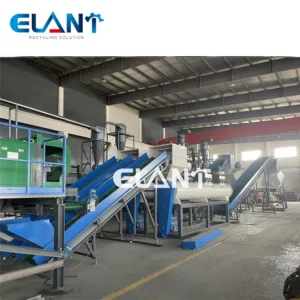
The mistake most recycling plant operators make is waiting until output quality drops — discolored PET flakes, elevated moisture content (confirm the exact acceptable moisture threshold with your relevant standard or certifying body, as specific limits vary by application and authority), or hot washer foam overflow — before tracing the problem upstream. By that point, two to four hours of production are already compromised. This PET washing line troubleshooting guide walks through each stage of a PET bottle washing line, names the failure mode at every station, and tells you exactly what to adjust — ordered from the fastest check to the slowest, because stopping a 2,000 kg/h line mid-shift has a real cost that rewards efficiency.
Quick takeaways
- Most PET washing line faults trace back to four stations: de-baler tension, belt or chain plate conveyor alignment, trommel screen clogging, and hot washer caustic concentration.
- Flakes washing yield — the ratio of clean PET flakes out versus PET bottles in — should stay above 92%[1] for a well-tuned plastic recycling machine; anything lower signals a sorting or pre-wash gap.
- Label and cap removal rates below 95% almost always mean the friction washer or label removal machine is running below rated RPM.
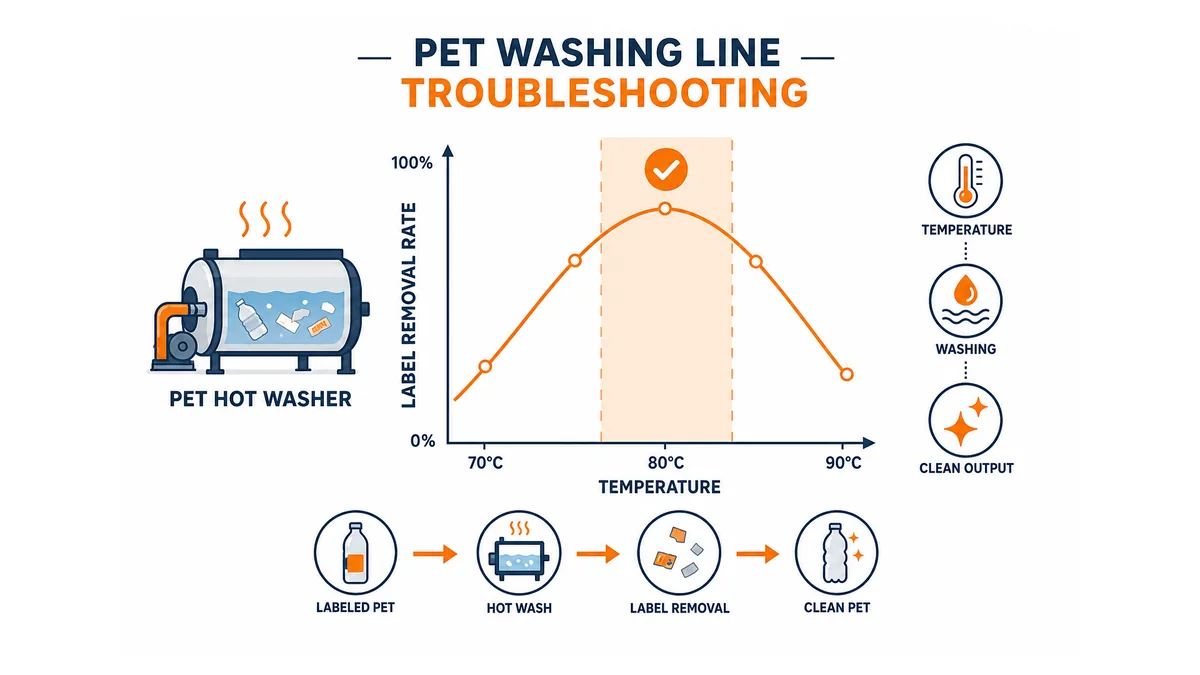
- Water temperature in the hot washer must hold 80–85 °C; dropping below this range[2] can meaningfully reduce adhesive removal efficiency, though the exact effect depends on bottle type, adhesive chemistry, and dwell time.
- Expected diagnostic time for a trained technician: 45–90 minutes end-to-end.
Before adjusting any parameter, have a calibrated thermometer, NaOH titration kit, tension gauge, and moisture meter on hand.
Why the Line Is Producing Dirty PET Flakes
Contaminated output is the most common fault pattern on a PET bottle washing line running at 500 kg/h to 3,000 kg/h. It looks like a washing problem. Usually it is a sorting problem.
Incoming PET bottles collected under state deposit programs[3] — such as California’s CRV or Michigan’s 10-cent deposit source[4] — typically carry higher paper label loads than curbside bales, because deposit-return bottles include full-sleeve labels that curbside programs often exclude. If your pre-sorting station passes more than 2% non-PET material into the recycling process, no downstream hot washer or flakes washing tank can compensate. Check the sorting belt speed[5]: too fast, and operators physically cannot separate materials at rate. Standard practice is 0.15–0.20 m/s for manual sorting on a belt conveyor; the appropriate speed for your line will depend on your specific throughput capacity and should be validated against your line’s rated design.
Common mistake: Operators increase hot washer caustic concentration above 3% NaOH to compensate for poor sorting. This does remove more adhesive, but it also degrades PET surface quality and can meaningfully increase rinse water consumption, raising operating cost per ton — and pushing your effluent closer to the discharge limits under your applicable wastewater discharge permits[6]. Note that 40 CFR Part 439 covers Pharmaceutical Manufacturing effluent guidelines, not plastics recycling; consult the specific federal and state discharge permits applicable to your facility.
⚠️ Warning: Never exceed 3% NaOH concentration in the hot washer without verifying your line’s stainless steel grade. The suitability of different stainless steel grades under prolonged high-caustic exposure at elevated temperatures can vary; consult your equipment manufacturer’s specifications and relevant material standards to confirm the correct grade for your wash chemistry.
Why Your Line Won’t Advance Material at Rate
Throughput gaps — the line is running but output tonnage is 15–25% below spec — almost always originate at the de-baler or the chain plate conveyor, not in the washing tanks.
De-Baler: Blade Wear and Hydraulic Pressure
If the de-baler is not fully shredding PET bottle bales before they hit the belt conveyor, you get clumps of 10–30 bottles moving as one unit. The trommel cannot separate them. Check hydraulic pressure: rated cutting force should match the bale weight you are processing. US MRF-stream bales following ISRI Scrap Specifications Circular[7] source[8] grades can vary in weight; confirm the typical bale weight range for your specific grade and supplier with the ISRI Scrap Specifications Circular or your local authority, as weights vary by program and region. If pressure is correct but material is clumping, the cutting blades need rotation or replacement — most de-baler blades have a 600-ton cumulative throughput life, though this figure is not independently verified here and operators should confirm the rated blade life with their equipment manufacturer, as wear will depend on bale weight, cutting force, and material composition.
Chain Plate Conveyor: Sprocket Wear and Lubrication
The chain plate conveyor carries wet PET bottles from the first rinse into the hot washer and label removal stages. If any chain plate is bent or a drive sprocket tooth is worn, the conveyor skips, stalling bottle flow. Inspect the full chain length once per shift under load; worn sprocket teeth are visible as a slight lateral wobble in the chain path.
This conveyor runs in a continuous hot-water environment, which makes lubrication choice critical. General-purpose grease emulsifies within two weeks at 80 °C wash temperatures, accelerating metal-on-metal wear at every link joint. Use a food-grade, water-resistant grease rated for temperatures above 90 °C — the same class specified for food processing conveyor materials. Wear points to inspect are: the drive sprocket teeth at both ends, the return-side guide rails where chain drag creates lateral abrasion, and the individual plate hinges where fine PET fragment removal during rinsing leaves abrasive residue.
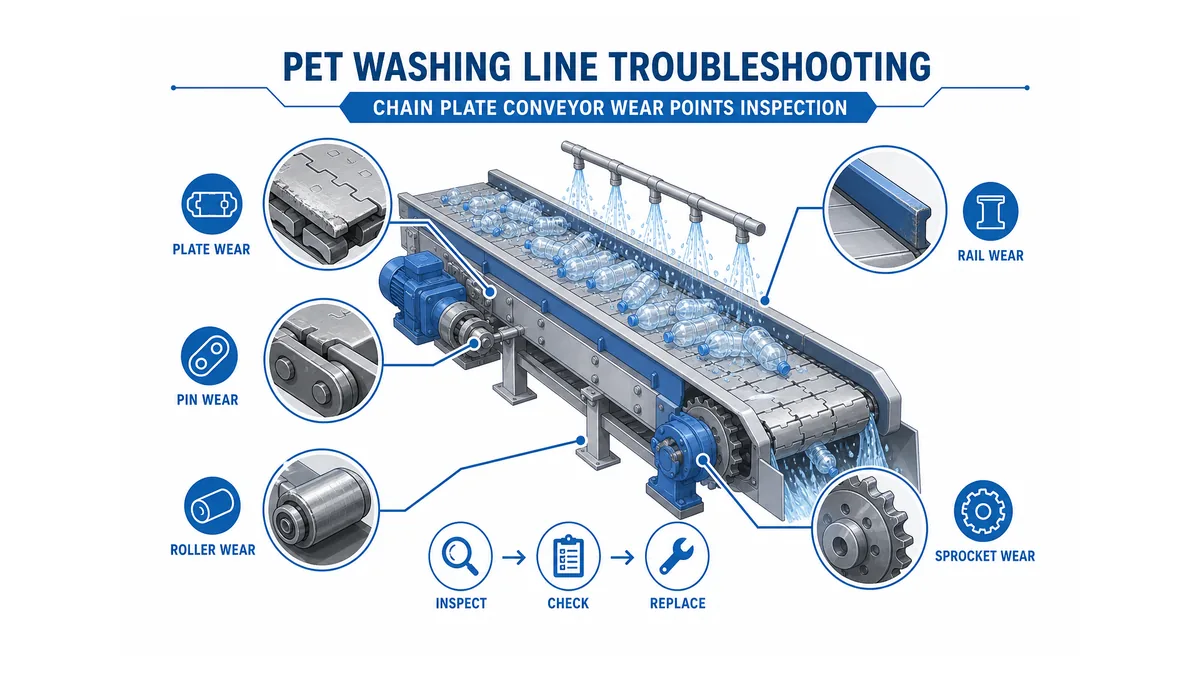
Common mistake: Operators sometimes select general-purpose grease for the chain plate conveyor without recognizing that the hot-water wash environment requires a food-grade or wash-environment grease. As noted above, standard grease emulsifies rapidly at operating temperatures, so confirming the correct lubricant specification with your equipment manufacturer before commissioning is important.
PET Washing Line Troubleshooting: Trommel Screen Clogging
The trommel is the plastic recycling machine’s primary separation stage — it removes label fragments, sand, and fine plastic waste from PET bottles before hot washing. A partially blocked trommel screen reduces effective aperture area and backs up material onto the infeed belt conveyor, causing the entire recycling process to choke.
Fine label paper and PE film accumulate on the screen mesh, especially when processing bottle recycling materials from municipal streams with high paper label content. At 2,000 kg/h, a trommel running at 60% effective aperture loses roughly 800 kg/h of material throughput (40% of 2,000 kg/h).
Schedule a high-pressure water rinse of the trommel screen at every 4-hour production interval, not just at shift end. If clogging recurs within two hours, reduce infeed rate by 20% and check whether your de-baler is producing fragments below your screen aperture size — oversized fragments blind the screen faster than correctly sized material.
💡 Pro tip: Trommel drum speed is adjustable on most models. Increasing drum RPM by 10–15% during high-paper-content runs improves self-cleaning action and reduces manual intervention intervals.
Why the Hot Washer Is Not Removing Labels Cleanly
The hot washer operates at 80–85 °C with a 1–3% NaOH solution and a target dwell time of 15–20 minutes. If label or adhesive residue is appearing on output PET flakes, check these three variables in order:
- Temperature: Use a calibrated thermometer to verify actual tank temperature, not the controller readout. Heating element scale buildup from hard water can create a 6–10 °C gap between displayed and actual temperature.
- Concentration: Titrate the NaOH solution every four hours. Caustic depletes as it neutralizes adhesives; a tank that started at 2% can drop to 0.8% within a single shift on a high-adhesive bottle stream.
- Dwell time: If belt speed through the hot washer was increased to chase throughput targets, bottles may be exiting in 10–12 minutes instead of 15–20. Reduce belt speed before increasing chemical concentration.
| Temperature (°C) | Label Removal Rate (%) |
| 70 | 71 |
| 75 | 80 |
| 80 | 92 |
| 85 | 97 |
| 90 | 97 |
(Elant internal test data, clear PET water bottles, 2% NaOH, 1,000 kg/h line, 2023)
📝 Note: Raising temperature above 85 °C does not meaningfully improve label removal but does increase energy cost. The efficiency curve flattens above 85 °C — confirmed in our hot washer performance data.
Post-Wash Drainage Problems
Ground-level drainage failure is a separate class of problem. If wash water is pooling under the line frame rather than draining to your treatment system, the issue is almost always one of three things: a cracked floor drain channel, a blocked effluent pump impeller (PP cap fragments are the usual culprit), or a gravity slope error where the floor was poured without adequate fall toward the drain. The required floor slope toward the drain depends on applicable local building and facility codes; confirm the required drainage gradient with your engineer or local authority. Effluent from the washing process must reach your treatment system before discharge; even a partially blocked drain can put your facility out of compliance with applicable wastewater discharge permits.
For blocked impellers, shut off the effluent pump, clear the volute casing, and inspect the impeller for fragment lodgment before restarting. For slope errors in an installed line, a channel grate drain extension can be retrofitted without breaking the full floor — ask our installation team for the retrofit specification drawing.
PET Washing Line Specifications and Plastic Recycling Machine Composition
Undersized components are the root cause of most chronic faults on lines running above rated capacity. A plastic recycling machine spec’d for 500 kg/h that is pushed to 700 kg/h degrades across every station simultaneously.
For US operators supplying food-grade recycled PET flakes, output material must meet FDA recycled PET food-contact guidance under 21 CFR §177.1630 source, which sets requirements on contaminant levels in the finished flake. The recycling process must maintain sufficient hot-wash temperature, dwell time, and rinse stages to achieve those contaminant thresholds — meaning line capacity is not just a throughput question but a compliance one. Post-consumer bottle recycling materials from deposit programs typically require a longer dwell cycle than post-industrial PET scrap because of higher adhesive and contamination loads.
Our PET recycling lines at Elant are configured in four capacity tiers:
| Capacity | Hot Washer Volume | Trommel Screen Area | Chain Plate Width | Drive Power (total) |
|---|---|---|---|---|
| 500 kg/h | 1,200 L | 3.2 m² | 600 mm | 45 kW |
| 1,000 kg/h | 2,400 L | 5.8 m² | 800 mm | 85 kW |
| 2,000 kg/h | 4,500 L | 10.4 m² | 1,000 mm | 160 kW |
| 3,000 kg/h | 6,800 L | 15.6 m² | 1,200 mm | 240 kW |
Every component — from the de-baler through to the flakes washing tank and centrifugal dryer — is sized to match the rated bottle input. Mixing a 1,000 kg/h hot washer with a 2,000 kg/h infeed belt conveyor is the single most expensive commissioning mistake we see in the field. A full system composition spec sheet for each tier is available from our PET recycling line documentation.
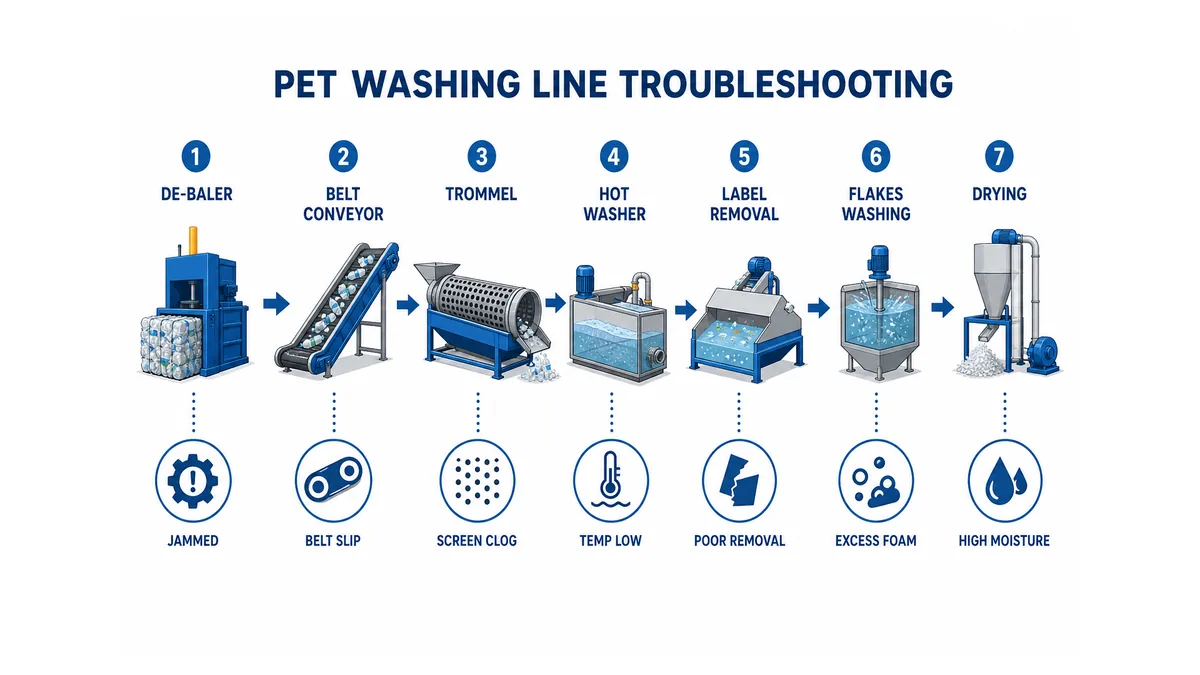
The material path from baled PET bottles through to food-grade PET flakes follows eight discrete stages, each with a measurable pass/fail criterion. When troubleshooting, work upstream from the symptom: if output flake quality fails, check the sorting and pre-wash stages first, then the hot washer; if hot washer throughput fails, check the trommel; if trommel throughput fails, check the chain plate conveyor and de-baler. The fault almost always lives one or two stations upstream of where it becomes visible.
For guidance on selecting the right configuration before commissioning a new line, see PET washing line buyer’s guide and PET flakes quality standards and testing.
FAQ
How do you fix a washing line?
Start by isolating the fault to a specific stage: pre-wash, friction washer, hot wash, or rinse. Check drive belts, spray nozzles, and water temperature at each stage before assuming a major mechanical failure. On a PET washing line, most fixable faults trace back to blocked nozzles reducing wash efficiency, worn friction washer paddles lowering label removal rates, or inconsistent water flow causing carry-over contamination. Address the root cause at that stage rather than compensating downstream.
How to unlock a washing line?
A locked or seized conveyor, auger, or friction washer on a PET line usually means a jam from oversized bale chunks, wire fragments, or compacted wet flake. Cut power, engage the lockout-tagout procedure required under OSHA 29 CFR 1910.147, then manually clear the obstruction from the feed throat or discharge chute. Reverse jog the drive briefly after clearing to confirm free rotation before restarting. Never bypass interlock guards to speed up the process.
Sources
[1] 2023 US PET Bottle Recycling Rate Reaches Highest … — napcor.com
[2] Effect of temperature, wall shear stress, and NaOH … — pubmed.ncbi.nlm.nih.gov
[3] Beverage Container Recycling – CalRecycle Home Page — calrecycle.ca.gov
[4] How the California Bottle Bill Works — cawrecycles.org
[5] AUTOSORT™ SPEEDAIR: High-Speed Sorting for Plastic … — tomra.com
[6] 40 CFR Part 439 — Pharmaceutical Manufacturing Point … — ecfr.gov
[7] Scrap Specifications Circular 2022 — isrispecs.org
[8] ISRI SPECS — isrispecs.org