
A twin-screw extruder is often assumed to produce superior rPET pellets compared to a single-screw unit. In commercial plastic recycling production across the United States, that assumption falls apart when processing clean, uniform bottle flake. A properly configured single-screw line matches target pellet specs at roughly 30% lower machinery acquisition costs. The better architecture depends strictly on flake bulk density, contamination variance, and your downstream resin specification.
When sourcing a PET Pelletizing Machine: Single-Screw vs Twin-Screw for Recycled PET Flakes, choosing the wrong screw geometry causes serious plant bottlenecks. It locks your facility into unnecessary mechanical maintenance or chronic feed instability. Evaluating flake bulk density and contamination before selecting extruder geometry helps prevent costly downstream retrofits.
Suppliers processing recycled PET flakes must balance capital cost against strict melt specifications.
Evaluating an extrusion line requires looking past nominal nameplate output. Processors must assess how screw flight design handles the narrow processing window of recycled polyethylene terephthalate.
At a glance
- Single-screw extruders: Best for uniform, clean PET bottle flake requiring low shear, straightforward melt conversion, and stable operating costs.
- Twin-screw extruders: Necessary for post-industrial scrap, broad bulk-density variance, inline masterbatch dosing, or direct liquid additive incorporation.
- Initial investment gap: Single-screw systems typically require 25% to 40% lower capital expenditure than co-rotating twin-screw systems of comparable output.
- Maintenance overhead: Twin-screw machines feature segmented barrels and modular screw elements that increase long-term spare-parts budgets.
- Operating footprint: Co-rotating intermeshing screws offer shorter residence times, reducing polymer thermal degradation under tight process parameters.
What Is the Difference Between Single-Screw and Twin-Screw Extruders?
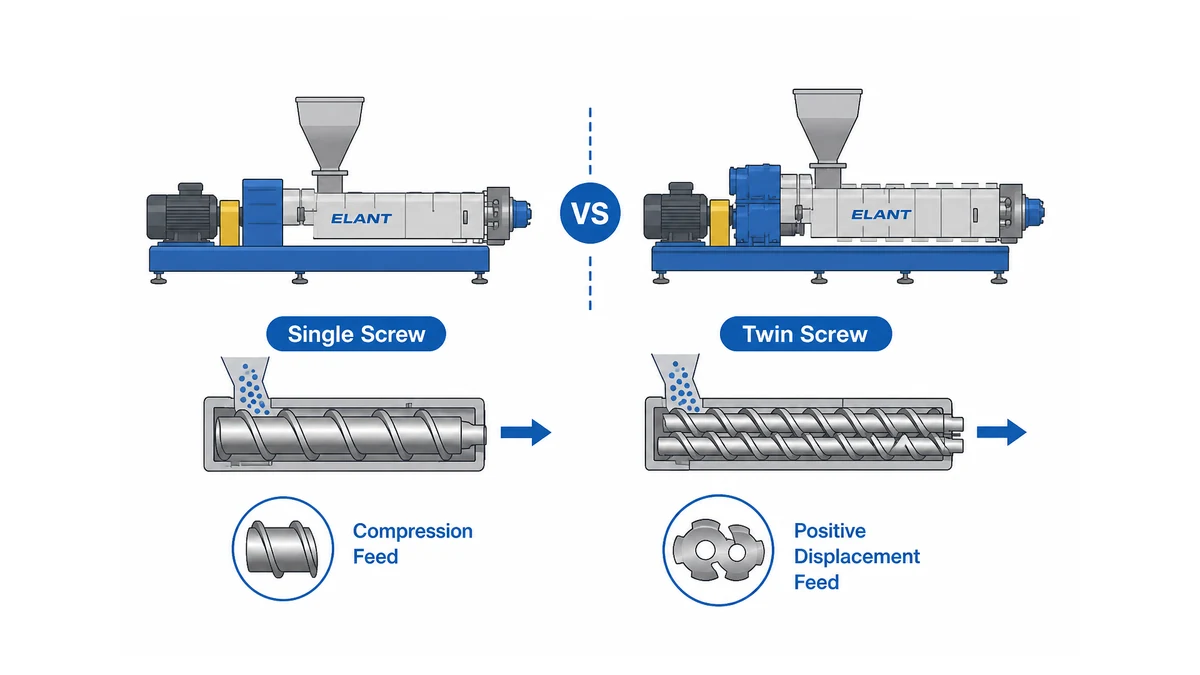
The fundamental distinction lies in mechanical transport mechanics, shear generation, and melt homogenization. Single-screw extruders rely entirely on frictional drag along the barrel wall to convey solid plastic flake forward. Because melting occurs primarily via conductive heat transfer from external ceramic heater bands, the single-screw architecture generates low, uniform shear rates. This mechanical simplicity makes single-screw extruders highly dependable for consistent polymers that require minimal molecular rearrangement.
Twin-screw extruders—specifically co-rotating, intermeshing designs—rely on positive displacement rather than friction to convey material. Two parallel screws rotate in the same direction, with the flight of one screw cleaning the channel of the other. This self-wiping action forces polymer through narrow clearances between screw elements, generating intensive dispersive and distributive mixing fields.
While single-screw flights carry a fixed geometry along a solid shaft, twin-screw shafts accommodate interchangeable kneading blocks, reverse elements, and degassing zones tailored to specific polymer blending requirements.
Which Extruder Works Best for Different Plastic Recycling Materials?
Feedstock origin dictates whether simple drag flow or positive mechanical displacement is required to maintain steady extrusion.
Clean, Dried PET Bottle Flakes vs. Variable Recycled PET Feed
Standard post-consumer PET bottle recycling generates flakes with predictable bulk densities, typically between 0.25 and 0.40 g/cm³ according to the Association of Plastic Recyclers design guidelines[1]. For processors converting washed, uniform recycled pet flakes from a dedicated PET bottle wash plant, single-screw extruders deliver reliable pumping stability without generating excess frictional heat.
Variable feeds present a completely different mechanical challenge. Processing mixed thermoform regrind, post-industrial strapping, or mixed curbside plastic recycling creates continuous bulk-density swings. Twin-screw systems, particularly co-rotating intermeshing screws[2], use positive displacement feeding zones that prevent bridging and starving at the throat.
🔍 Worth checking: Measure your flake bulk density over three separate production shifts before submitting equipment RFQs. Variations greater than ±15% demand twin-screw feeding geometry or an upstream crammer feeder.
When Additives or Chain Extenders Change the Extruder Requirement
Basic PET bottle flakes pelletizing simply converts regrind into uniform granules. However, when target applications require compounding, screw geometry must do more than melt plastic.
Twin-screw extruders excel at dispersing liquid chain extenders, functional stabilizers, and color masterbatches. Their kneading blocks create distributive and dispersive mixing fields that single-screw flights cannot match without generating localized overheating. Single-screw systems can introduce standard colorants, but intensive reactive blending requires co-rotating modular elements.
How Do Performance and Product Quality Compare?
Thermal history, devolatilization efficiency, and intrinsic viscosity (IV) retention determine the commercial value of output rPET pellets.
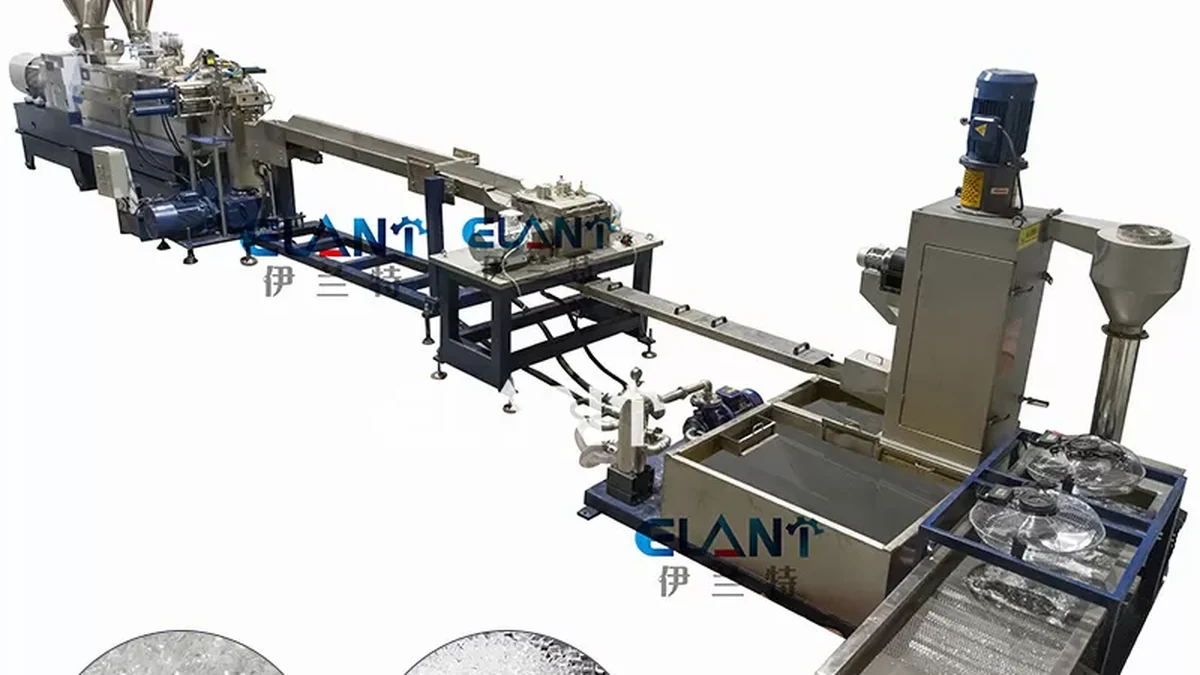
Residence Time, Shear, and IV Preservation
PET degrades rapidly under excessive heat and moisture, which breaks polymer chains and drops intrinsic viscosity as measured by ASTM D4603 standard test methods[3]. In single-screw extruders, melting relies on barrel contact conduction combined with steady compression across a 30:1 to 36:1 L/D ratio. This provides a gentle melt with predictable temperature gradients, but average residence time often spans 90 to 180 seconds.
Single-Screw:  [Feed Zone] --------> [Compression / Melting] --------> [Metering]  (90–180s)
Twin-Screw:    [Feed] -> [Kneading Block] -> [Melt] -> [Devolatilization] -> [Die] (30–60s)
Co-rotating twin-screw extruders operate with intermeshing flights that generate high, localized shear within short kneading sections. Total residence time drops to 30 to 60 seconds, according to extrusion machinery design parameters[4]. This narrow thermal history limits prolonged exposure, though excessive screw speeds run the risk of instantaneous thermal degradation if shear rates spike.
Counterintuitively, throwing more horsepower and higher screw RPMs at clean bottle flake often destroys pellet quality faster than an underpowered line by shearing intrinsic viscosity below processable thresholds.
🚫 Avoid: Running a twin-screw machine above 450 RPM on standard clear flake without verifying melt temperature at the adapter flange; excess shear degrades polymer chains instantly.
Degassing and Vacuum Venting Performance
Entrapped air, surface moisture residues, and printing ink volatiles must escape the extruder barrel before reaching the pelletizer die face.
Single-screw extruders rely on decompression zones along the screw root to release volatiles through a single vacuum port. Because the melt pool sits thick within deep single-screw flights, volatile gases diffuse slowly. This design works reliably for dry PET bottle flakes carrying minimal surface ink.
Twin-screw extruders spread polymer into thin melt films across intermeshing zones. These thin films continuously renew surface area under dual or triple vacuum ports. Operating under deep vacuum levels in alignment with general EPA plastic recycling process documentation[5] (always confirm specific operational and volatile-handling requirements with your local authority), moisture and printing solvent volatiles escape rapidly. This aggressive devolatilization prevents melt foaming at the die face without requiring extensive pre-drying drying silos.
What Are the Cost Differences and ROI Considerations?
A complete extrusion line requires balancing capital expenditure against five-year maintenance and operational budgets.
Initial Investment vs. Operational Simplicity
An entry-level single-screw pelletizing line represents a significantly lower initial investment, often costing 25% to 40% less than a twin-screw compounding system of equivalent hourly capacity. For small to mid-sized recyclers processing consistent PET bottle scrap, this lower capital barrier accelerates payback periods.
Twin-screw extruders demand a higher initial investment due to precision gearboxes, complex drive motors, and modular barrel heating-cooling zones. However, twin-screw lines lower pre-drying utility costs by removing moisture inline through high-vacuum venting. Recyclers must calculate whether energy savings from bypassing desiccant dryers offset the higher initial machine purchase price.
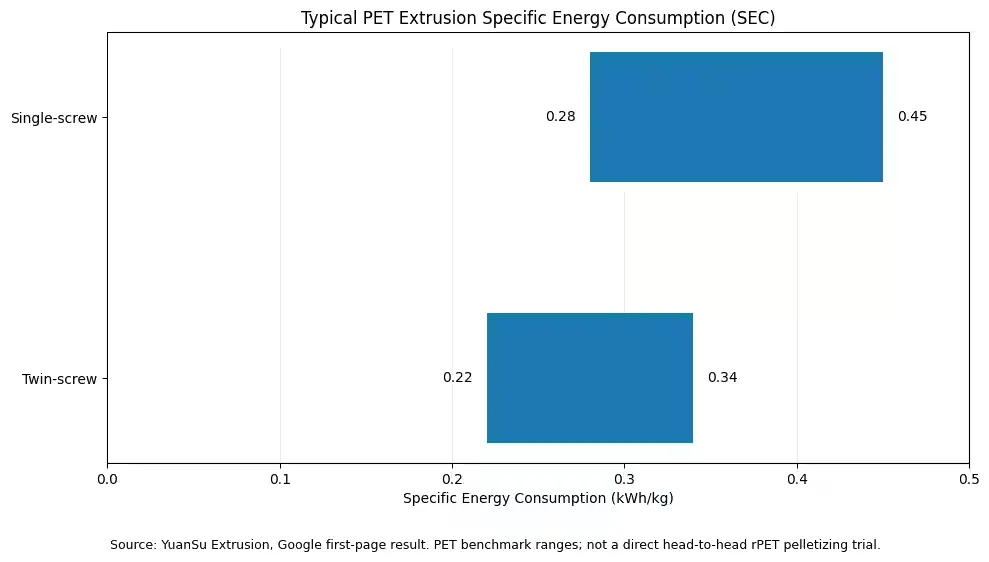
Figure: Typical PET extrusion specific energy consumption ranges for single-screw and twin-screw systems. Actual SEC varies with throughput, screw configuration, drying, vacuum load, and auxiliary equipment.
Wear Parts, Maintenance Access, and Downtime
Operating expenditure over a 5-year lifecycle often exceeds the purchase price differences between machine architectures.
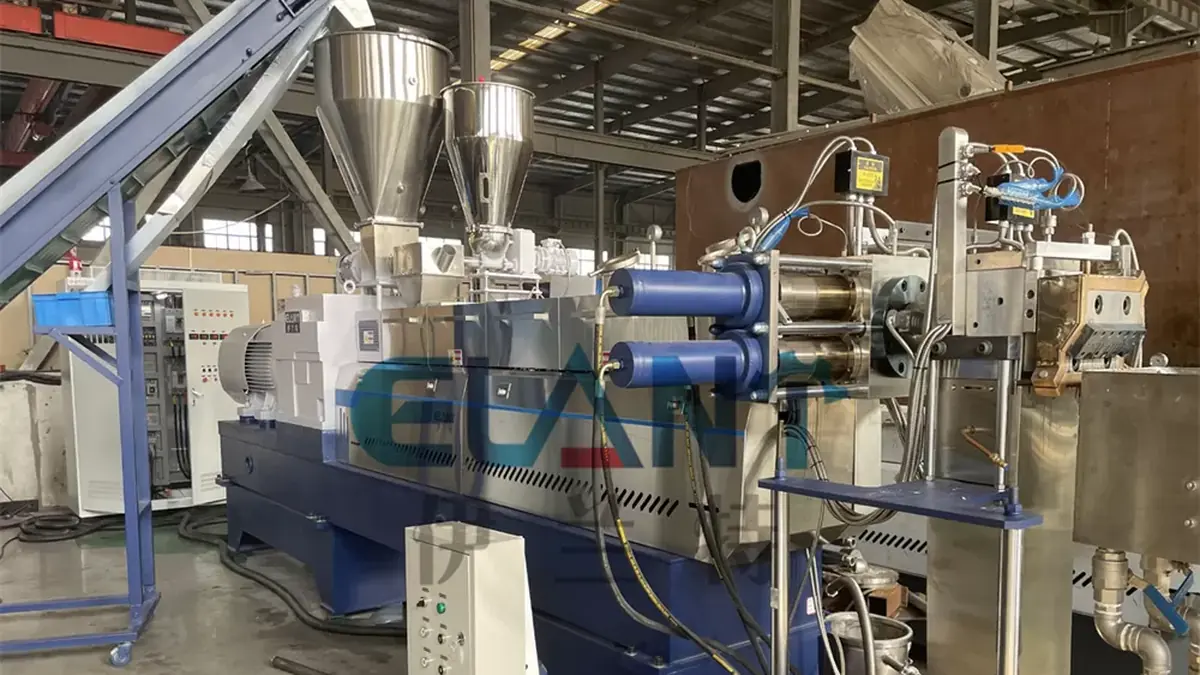
Single-screw extruders represent straightforward industrial machinery. They feature one nitrided or bimetallic barrel, one continuous screw shaft, and a standard reduction gearbox. Maintenance technicians can service, pull, and clean a single-screw barrel using standard shop tools. Replacing a worn screw requires purchasing and rigging an entire 10- to 13-foot (3- to 4-meter) screw forging.
| Feature | Single-Screw Extruder | Twin-Screw Extruder |
|---|---|---|
| Initial Investment | Baseline ($) | +30% to +60% ($$$) |
| Melt Pumping Stability | Highly dependent on bulk density | Positive displacement; highly stable |
| Shear Stress Generation | Low to moderate | Moderate to aggressive |
| Screw Element Design | Monolithic single shaft | Modular elements on splined shafts |
| Gearbox Complexity | Single output shaft; simple lubrication | Dual output shafts; high-torque distribution |
| Operator Skill Barrier | Standard industrial technician | Advanced process engineering required |
Twin-screw extruders use modular screw segments mounted onto splined shafts. Operators replace individual high-wear kneading blocks without scrapping the entire shaft. However, twin-screw gearboxes require specialized high-torque distribution maintenance, and thermal barrel alignment is critical to avoid screw galling. For recyclers selling general pellets at market rates in cents per pound (¢/lb) or per short ton (2,000 lbs), minimizing unplanned mechanical downtime is critical to protecting gross margins.
Industry Trend: Why Hybrid and Customized Solutions Are Gaining Attention
Modern plastic recycling facilities face increasingly degraded incoming waste streams, prompting machinery manufacturers to engineer hybrid processing architectures. The most prominent trend combines an upstream single-screw or continuous cutter-compactor with a downstream twin-screw degassing system, or vice versa. These two-stage tandem extrusion configurations decouple the primary melting phase from the high-pressure pelletizing stage.
In a tandem arrangement, a large-diameter, low-shear single-screw extruder gently melts pre-conditioned flake without excessive thermal degradation. The molten PET transfers directly into a co-rotating twin-screw section dedicated purely to fine filtration, reactive chain extension, and deep vacuum devolatilization. Alternatively, co-rotating twin-screw units feed directly into a single-screw discharge booster, isolating the sensitive twin-screw mixing zone from the intense backpressure generated by fine melt-blown filtration screens.
These customized configurations provide maximum flexibility for operations handling contaminated post-consumer scrap.
Have a project or a spec sheet in hand? Talk to elantmachine.com — real engineers answer.
Conclusion: Choosing the Right Extrusion Solution for Your Recycling Line
Selecting between extruder architectures requires grounding your capital procurement in empirical feedstock realities. If your facility processes washed, uniform PET bottle flakes with predictable bulk density and sells standard rPET resin to sheet or fiber manufacturers, a single-screw pelletizing machine provides the lowest operational risk and fastest capital recovery.
If your operational roadmap involves compounding, liquid additive injection, or handling variable post-industrial thermoforms, a twin-screw compounding system is the necessary choice. Before finalizing your equipment contract, insist on sustained pilot trials with your actual scrap materials. Verify that melt pressure fluctuations remain within ±150 psi (10 bar) and confirm that intrinsic viscosity retention meets your downstream buyer’s technical specification sheets.
Choosing the correct PET Pelletizing Machine: Single-Screw vs Twin-Screw for Recycled PET Flakes ensures your plant secures long-term processing profitability.
Sources
[1] APR Design Guide Overview — plasticsrecycling.org
[2] Compounding – Plastics – Leistritz Extrusion Technology — extruders.leistritz.com
[3] D4603 Standard Test Method for Determining Inherent … — store.astm.org
[4] Plastic Processing Tutorials (Extrusion and Injection Molding) — 4spe.org
[5] Advanced Recycling of Plastics — epa.gov
[6] SPE Library — 4spe.org