
Specifying a plastic pelletizing machine by resin name alone frequently leads to incorrect configuration — because the same polymer can arrive as thin film, rigid regrind, wet flakes, or compounded pellets, and each form demands a different screw, feeding system, venting setup, and cutting method. The sections below map each variable to the material that drives it.
At a glance
- PET pelletizing machine: requires crystallizing dryer or deep-vacuum venting; viscosity loss from residual moisture is irreversible — confirm the precise moisture threshold with your equipment supplier or the relevant industry standard.
- LDPE/LLDPE film: low bulk density forces a compaction feeder or agglomeration stage before the extruder — confirm actual bulk density by measurement before specifying feeding equipment
- HDPE regrind: higher melt viscosity than PE film; typically needs a single-stage vent and fine-mesh screen pack (40–80 mesh) for bottle-grade regrind
- PP regrind: melt flow variation across feedstock batches is the primary driver of screw L/D selection (typically 30:1 to 36:1 for recycled PP)
- PVC: processing temperature window is narrow — rigid PVC degrades at elevated temperatures that should be confirmed with your material supplier or a recognized industry standard ; conical twin-screw is the standard equipment choice
- Cutting method: strand, water-ring, hot-die-face, and underwater cutting each suit a different melt viscosity and cooling rate — resin name alone does not determine the right one
Why Feedstock Material Changes the Pelletizing Machine Configuration
Every pelletizing line is, at its core, a melt-handling system. The screw geometry, barrel temperature profile, venting positions, filtration mesh, and cutting environment all exist to manage one thing: the condition of the polymer melt at the die face. Change the feedstock, and almost every parameter shifts.
Match the machine to feedstock form, not only the resin name
A buyer who specifies “HDPE pelletizer” without describing feedstock form will receive a proposal that may be completely wrong for the actual material. HDPE arriving as clean pipe regrind (bulk density ~350 kg/m³) feeds smoothly through a standard hopper. HDPE arriving as shredded film (bulk density ~80 kg/m³) starves that same hopper and produces surging output.
Feedstock form determines the feeding system first, and the extruder second. The four forms that matter in plastic recycling — flakes, film/fiber, regrind, and pre-pelletized raw material — each require a different intake geometry, compaction method, or agglomeration step before the melt stage begins.
For a broader look at how a plastic film recycling machine is configured around different film feedstocks, the same configuration logic applies upstream as well.
How melt behavior and thermal sensitivity affect line configuration
Once material enters the extruder, melt viscosity and thermal sensitivity govern every downstream decision. A high-viscosity melt (typical of HDPE pipe regrind) generates higher shear heat and requires more precise barrel cooling. A thermally sensitive melt (PVC, PET) punishes any residence time beyond the process window.
Two plastics can share a resin family and still require different line configurations because of additive content, contamination level, or prior processing history. Recycled PP from automotive bumpers carries pigment loads and glass fiber fractions that a food-packaging PP regrind line never sees. The machine configuration follows the actual feedstock, not the resin abbreviation on the material data sheet.
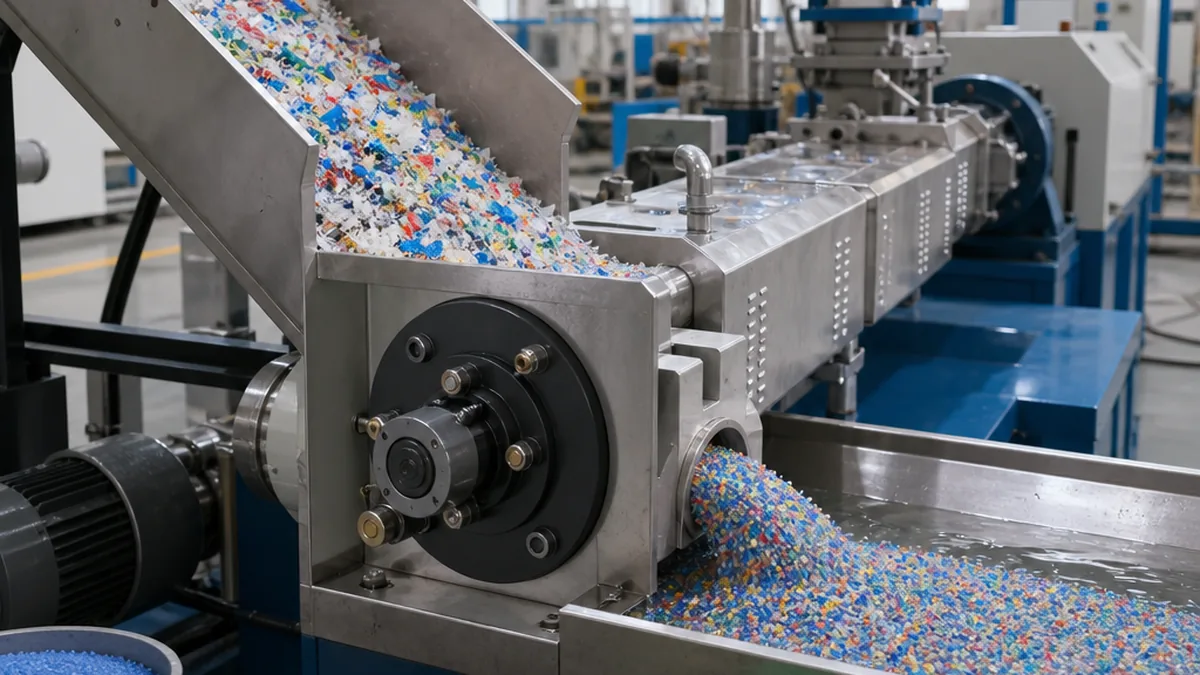
Match the Pellet Cutting System to Material Behavior
The cutting system is not interchangeable across materials. Each method imposes specific melt temperature, viscosity, and cooling requirements at the die face — and mismatching any of those variables produces out-of-spec pellets or unplanned downtime.
When strand cutting fits the process
Strand pelletizing suits materials with stable melt viscosity and good strand integrity — clean HDPE regrind, PP regrind, and rigid PVC compounds fall here under the right conditions. The strand exits the die, cools in a water bath, and is cut by a rotating blade unit. If the melt sags, strings, or breaks before reaching the cutter, strand cutting will not hold output consistency.
For recycled PE film after agglomeration, strand cutting works when throughput is moderate (under ~300 kg/hr on a single line) and melt index is controlled. At higher throughputs or with variable-viscosity recycled material, strand breaks become frequent enough to reduce effective production time.
Note that this threshold is specific to PE film after agglomeration; comparable throughput limits for other materials such as PET should be evaluated separately based on their own melt behavior and line configuration.
When water-ring, hot-die-face, or underwater cutting is considered
Water-ring pelletizing places the cutter blades immediately at the die face with a rotating water curtain — suitable for PE and PP with moderate melt viscosity. It handles lower bulk-density materials better than strand cutting because there is no strand transport distance.
Hot-die-face (or die-face) cutting with air cooling is used for materials sensitive to rapid quenching, certain flexible PVC compounds, and EVA-based plastics where a water contact at the die would cause sticking or thermal shock.
Underwater pelletizing is the configuration for high-throughput lines, engineered plastics, and materials where a perfectly spherical, consistently sized pellet is required. It is also the standard configuration for PET recycling lines where pellet quality feeds directly back into fiber or bottle production. The system cost is higher, and it demands tighter process control — but for PET and high-output PE/PP lines, it is the equipment of record.
Why cutting method cannot be selected by resin name alone
PVC illustrates this precisely. Rigid PVC compounds cut well on a strand pelletizer with a dry cutter (no water contact at the die).
Flexible PVC — plasticized with a substantial plasticizer loading, typically DEHP or a non-phthalate alternative; confirm the specific loading range for your formulation with your material supplier — exits the die as a soft, tacky strand that sticks to strand guides and to itself in a conventional water bath. The same resin family, different cutting system required.
🔍 Worth checking: Before accepting a supplier’s standard cutting system recommendation, ask specifically: “What melt index range and feedstock form is this cutting configuration rated for?” A concrete range (e.g., MFI 0.3–2.0 g/10 min for HDPE regrind on strand cut) tells you whether the equipment matches your actual material.
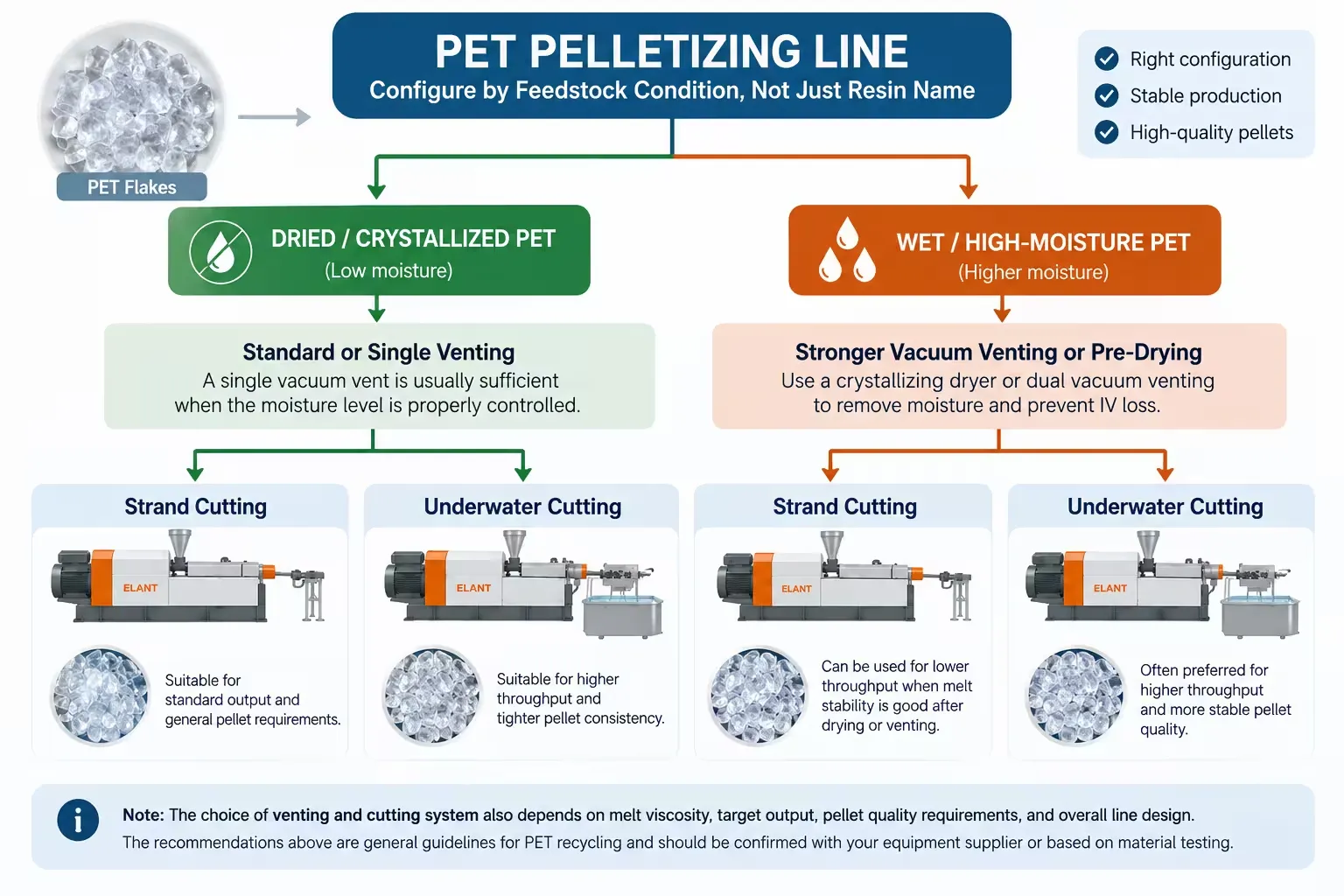
Selecting a PET Pelletizing Machine: Moisture and Viscosity Control
PET is unforgiving. Residual moisture at the screw inlet can cause hydrolytic degradation that permanently reduces intrinsic viscosity (IV) — confirm the precise moisture threshold for your grade and application with your resin supplier or the applicable industry standard. For a plastic recycling operation processing post-consumer PET bottle flakes, IV loss in the extruder means the output pellets cannot re-enter fiber or bottle-grade applications without solid-state polycondensation.
Determine whether PET enters the line dried and crystallized
The configuration fork for a PET pelletizing line is upstream of the extruder: dried and crystallized flakes, or wet/uncrystallized input? Lines running pre-dried, crystallized PET flakes can use a standard single-screw or twin-screw extruder with one atmospheric vent zone, provided the dryer reliably and consistently achieves the required moisture specification — treat dryer performance as a process risk that should be validated, not assumed.
Lines running undried flakes require a deep-vacuum venting system (typically two-stage; confirm the required vacuum level with your equipment supplier or the relevant industry standard) or an upstream crystallizing dryer — and the extruder configuration changes accordingly.
Most recycled PET bottle flake operations in the U.S. that target food-contact or fiber-grade output specify a vacuum-vented twin-screw or a dedicated SSP (solid-state polycondensation) stage after pelletizing to restore IV. That is a capital line item that a machine proposal should address explicitly before any deposit is wired.
Specify venting and melt handling for PET
The number of vent zones and vacuum level are non-negotiable PET line specifications. A single atmospheric vent is insufficient for wet flakes. Specify the vent vacuum level (mbar), vent location along the barrel (typically 60–75% of L/D), and the melt pump configuration if IV stability is required at the die face.
PET melt temperature typically runs 265–285 °C. Extended residence time at elevated melt temperatures can accelerate acetaldehyde formation — confirm the specific temperature and time thresholds that apply to your grade and application with your resin or equipment supplier, as this may disqualify output from bottle or food-packaging applications.
Match throughput to required PET pellet quality
A 500 kg/hr PET recycling line producing fiber-grade pellets has fundamentally different equipment requirements than a 150 kg/hr compounding line producing PET-based engineering blends. Higher throughput on a fiber-grade line justifies underwater pelletizing for pellet geometry consistency. Lower-throughput compounding lines often use strand cutting with a water bath, accepting the manual strand threading in exchange for lower equipment cost.
🚫 Avoid: Configuring a PET line without specifying target IV range and final pellet application. A machine proposal that does not address IV management for your target use case is an incomplete proposal — request IV test data from the supplier’s reference lines.
Selecting a Pelletizing Machine for PE Film and HDPE Regrind
PE and HDPE are not a single configuration problem. Within the polyethylene family itself, the difference between LDPE film and HDPE pipe regrind is large enough that the two materials require separate line architectures.
LDPE and LLDPE film: feeding and compaction requirements
Thin PE film — LDPE and LLDPE from agricultural film, stretch wrap, or packaging — arrives at bulk densities that make standard hopper feeding impractical. The low bulk density of film in this form causes it to flutter, bridge, and starve the extruder screw; confirm actual bulk density by measurement before specifying feeding equipment.
Two feeding solutions are in common use:
- Integrated compactor-feeder: melts and compacts film directly into the extruder inlet; eliminates the need for pre-agglomeration
- Agglomeration stage + standard hopper: thermal agglomerator densifies film to a significantly higher bulk density before it enters the pelletizer; confirm the target densified bulk density with your agglomerator supplier, as achieved values vary by equipment and feedstock; suitable when feedstock supply is intermittent or mixed
The screw design for PE film lines typically uses a barrier screw or grooved-barrel configuration to manage the compacted melt intake and maintain consistent output at variable input densities.
HDPE bottle and pipe regrind: extrusion configuration
HDPE regrind from bottles and pipe arrives at bulk densities of 300–500 kg/m³ and processes more predictably through a standard single-screw extruder. The configuration priority shifts from feeding to melt filtration and output consistency.
Pipe-grade HDPE regrind typically contains less contamination than post-consumer bottle regrind but may carry color pigment, processing aids, or carbon black that affect the output pellet’s end-use compatibility. Bottle-grade HDPE regrind from mixed-color streams requires a screen changer with at minimum 80-mesh filtration to control gel count in the output pellets.
When feedstock contamination changes filtration requirements
Contaminated PE or HDPE feedstock — soil, label adhesive, cross-linked material, or non-PE polymer fragments — increases screen pack pressure and reduces effective production time between screen changes. A continuous screen changer (hydraulic or rotary) is warranted when contamination is consistent and screen change frequency exceeds once per shift on a standard single-position filter.
For heavily contaminated HDPE recycling streams, laser or optical sorting upstream reduces the contamination burden on the pelletizing line’s filtration system and extends screen pack life significantly.
Selecting a PP Pelletizing Machine for Regrind and Recycled PP
Recycled PP presents a melt flow variability problem. Post-consumer PP regrind — from caps, containers, automotive parts, and nonwoven fabric — carries a wide MFI range, often 2–30 g/10 min within a single feedstock batch. A pelletizing line configured for a narrow MFI window will produce inconsistent pellet size and output when the feedstock melt index shifts.
Match screw configuration to PP feedstock
PP regrind responds well to a single-screw extruder with L/D of 30:1 to 36:1, which provides enough mixing length to homogenize melt temperature across variable-viscosity input. For recycled PP containing glass fiber fractions or mineral fillers (common in automotive PP regrind), a twin-screw configuration handles the compounding task while pelletizing, at higher capital cost.
✅ Do this: Request the MFI distribution data for your PP feedstock stream before specifying the screw L/D. A supplier who configures a PP pelletizer without asking for MFI range is either assuming clean virgin-grade input or not accounting for recycled material variability.
Decide whether additive incorporation is required
PP oxidizes during reprocessing — each thermal cycle reduces molecular weight and increases brittleness. Recycled PP lines targeting durable goods applications typically incorporate antioxidants (e.g., Irganox/Irgafos blends) and UV stabilizers during the pelletizing pass. If additive incorporation is required, the extruder needs a liquid injection port or a downstream side feeder for masterbatch or solid additive input.
This is a capital and process specification decision that should appear on the machine purchase order, not as a field modification after delivery.
Select filtration and cutting for the target pellet quality
Clean PP regrind from industrial trim or purge material processes well through a standard 40-mesh screen pack and strand pelletizer. Mixed post-consumer PP regrind with higher contamination warrants a 60–80 mesh screen changer and, for high-throughput recycling lines, water-ring pelletizing to maintain consistent pellet geometry under variable melt conditions.
Selecting a PVC Pelletizing Machine: Thermal Control and Equipment Configuration
PVC is the material with the narrowest processing window among the five covered here. Rigid PVC degrades thermally at elevated temperatures — confirm the specific degradation threshold for your formulation with your material supplier or a recognized industry standard — releasing HCl, which then attacks metal surfaces in the barrel and die. Every configuration decision for a PVC pelletizing line traces back to managing this constraint.
Control processing temperature and residence time
Residence time in the barrel is as critical as temperature for PVC. Long L/D screws that serve PP well are inappropriate for PVC because they increase residence time, raising the probability of thermal degradation. PVC pelletizing lines use shorter effective processing lengths and larger-diameter barrels to achieve throughput without extending residence time.
Consult your equipment supplier for the specific L/D range appropriate for your PVC formulation, as no single figure applies universally.
Temperature control zones on a PVC extruder must be tightly calibrated — confirm the required tolerance with your equipment supplier, as the specification varies by formulation and line design — and the barrel must be equipped for rapid heat removal (water cooling, not air cooling) in the feed zone where PVC compounding begins.
Specify screw, barrel, and die requirements
The standard equipment configuration for PVC pelletizing is a conical counter-rotating twin-screw extruder with corrosion-resistant barrel lining (bimetallic or hardened alloy) and die tooling in hardened tool steel or chrome-plated surfaces. The conical screw geometry provides high-pressure output at low screw speed, reducing shear heat — exactly what PVC requires.
Die configuration for PVC uses multi-hole strand dies with short land length to minimize pressure buildup and residence at the die face.
Adjust configuration for rigid and flexible PVC
The difference between rigid and flexible PVC equipment needs is significant:
| Parameter | Rigid PVC | Flexible PVC |
|---|---|---|
| Plasticizer content | None to trace | 30–60 phr typically |
| Screw type | Conical twin-screw | Twin-screw or single-screw |
| Cutting method | Strand (dry) or hot-die-face | Hot-die-face or air-quench |
| Die temperature control | Critical — narrow window | Moderate — wider window |
| Barrel material | Bimetallic, HCl resistant | Standard with coating |
Flexible PVC compounds exit the die as a soft, sticky strand. Water contact at the die face causes surface defects. Hot-die-face or air-quench cutting is standard for flexible PVC pelletizing.
How the Same Pelletizing Machine Specifications Change by Material
The same 200 kg/hr pelletizing line, built for five different materials, would have five different specifications. This is the sourcing risk that generic “plastic pelletizer” proposals create.
Compare feed form and feeding requirements first
| Material | Typical Feedstock Form | Bulk Density | Feeding System |
|---|---|---|---|
| PET | Flakes (post-consumer bottle) | 200–350 kg/m³ | Standard hopper or vibratory feeder |
| LDPE film | Shredded/baled film | 20–80 kg/m³ | Compactor-feeder or agglomerator |
| HDPE regrind | Granules or flakes | 300–500 kg/m³ | Standard hopper |
| PP regrind | Granules, flakes, or mixed | 200–450 kg/m³ | Standard or force feeder |
| PVC compound | Dry blend or granules | 400–600 kg/m³ | Force feeder (conical twin-screw) |
Match screw, venting, and filtration to the polymer
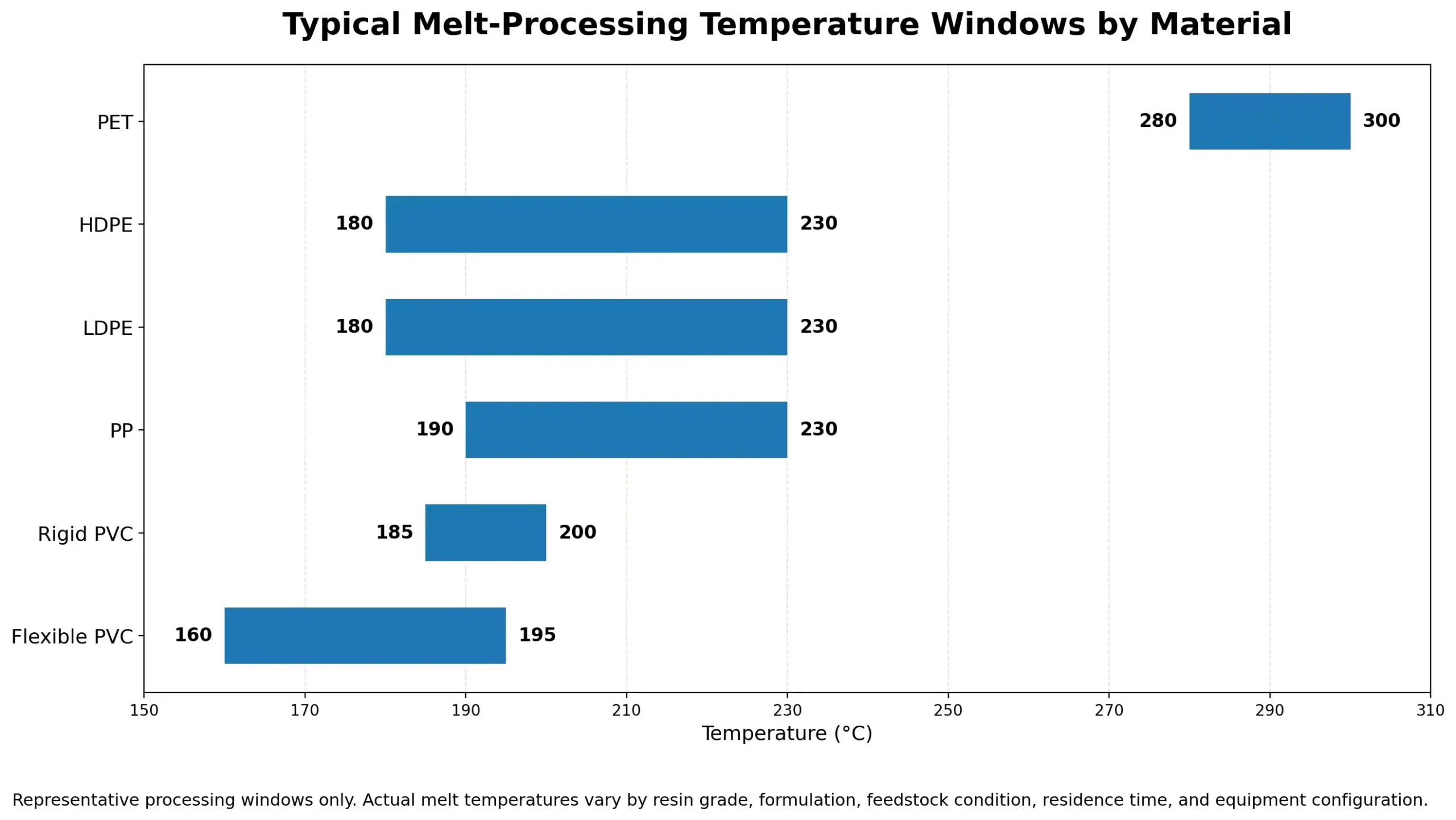
PET requires the deepest vacuum venting and the most precise temperature ceiling of any material in this group. PP and HDPE tolerate a wider temperature window but demand filtration matched to contamination level. PVC requires corrosion-resistant metallurgy throughout the extruder, not merely at the die.
Screw L/D selection tracks melt mixing requirements: PET and PP regrind benefit from 30:1–36:1; rigid PVC stays shorter to minimize residence time (consult your equipment supplier for a PVC-specific range); HDPE pipe regrind processes well at 28:1–33:1 with a barrier screw.
Match pellet cutting and cooling to melt behavior
The melt viscosity at the die face determines whether strand, water-ring, hot-die-face, or underwater cutting is viable. High-IV PET and clean HDPE handle strand cutting well at moderate throughput. Low-viscosity PE film melt and flexible PVC require cutting at or near the die face — for flexible PVC, this means hot-die-face or air-quench cutting, as water contact at the die face causes surface defects.
High-throughput PET and PP recycling lines favor underwater pelletizing for output consistency and pellet geometry control.
PET vs PE vs PP vs HDPE vs PVC: Material-to-Machine Selection Matrix
This table is the configuration summary. Use it as the starting brief for any pelletizing line proposal — if a supplier’s response does not address each column for your material, the proposal is incomplete.
| Material | Critical Processing Issue | Feeding Requirement | Drying / Venting | Filtration Need | Preferred Cutting System |
|---|---|---|---|---|---|
| PET (post-consumer flake) | IV loss from moisture; acetaldehyde formation | Standard hopper (flakes) | Crystallizing dryer OR deep vacuum (dual-stage; confirm vacuum level with supplier or industry standard) | 60–100 mesh; continuous screen changer at high output | Underwater (fiber/bottle grade); strand (lower throughput) |
| LDPE / LLDPE film | Low bulk density; compaction before extrusion | Compactor-feeder or agglomerator mandatory | Atmospheric vent (1 zone typical) | 40–60 mesh standard; higher mesh for packaging-grade output | Water-ring or strand (post-agglomeration) |
| HDPE regrind | Contamination and melt consistency | Standard hopper; force feeder for low-density streams | Atmospheric vent | 40–80 mesh; continuous screen changer for contaminated streams | Strand (clean regrind); water-ring (variable input) |
| PP regrind | MFI variability; oxidative degradation | Standard or force feeder | Atmospheric vent; additive injection port if stabilizer needed | 40–80 mesh | Strand or water-ring; underwater for high throughput |
| Rigid PVC | Narrow thermal window; HCl corrosion | Force feeder (conical twin-screw) | None required; short residence time design | 40 mesh (compound is typically clean) | Strand (dry) or hot-die-face |
| Flexible PVC | Tacky melt; surface sticking in water | Force feeder | None required | 40 mesh | Hot-die-face or air-quench |
HDPE and PVC are not the same polymer — their processing temperatures, screw configurations, and cutting methods differ at every point. The question of whether HDPE is “the same as PVC” has a clear engineering answer: no. HDPE is a semi-crystalline polyolefin; PVC is an amorphous vinyl chloride polymer with thermal stability additives. Their melt behavior, chemical resistance, and equipment metallurgy requirements are distinct.
What Feedstock Information to Send Before Configuring a Pelletizing Line
A machine supplier cannot configure a pelletizing line accurately from a resin name and a throughput number. The information below is what separates a correctly specified line from one that requires modification after installation.
Material type and feedstock form
Send the polymer type, grade designation if known, and physical form: flakes, film bales, granules, regrind, or mixed stream. If the feedstock is post-consumer plastic waste, describe the collection source (bottle stream, agricultural film, automotive regrind) because contamination profile and prior thermal history vary significantly between sources.
Specify whether the material has been previously pelletized — raw material from a virgin resin producer behaves differently from twice-recycled plastic pellets.
Moisture, contamination, and bulk density
These three variables change the feeding system, venting configuration, and filtration specification more than any other input data. Provide:
- Moisture content (% by weight, or confirm if dried to spec)
- Bulk density (kg/m³ or lb/ft³) — measured, not estimated
- Contamination type and level: paper labels, adhesives, metal fragments, cross-linked polymer, incompatible plastic fractions
- Color or additive content if known
A bulk density measurement takes five minutes with a graduated container and a scale. Skipping it and letting the supplier assume costs more in the long run.
Required throughput and final pellet application
Throughput sets the extruder size, motor power, and screen changer cycle rate. But the final pellet application determines quality thresholds that can change the cutting system, filtration mesh, and post-processing steps entirely.
A 300 kg/hr PP recycling line producing pellets for injection-molded household goods has different gel count, moisture, and pellet size tolerances than a 300 kg/hr line producing pellets for blow-molded containers. State the end application. If the output pellets re-enter food-contact production, say so — that triggers FDA-related compliance requirements for the recycling process itself.
✅ Do this: Build a one-page feedstock data sheet covering material type, form, bulk density, moisture, contamination level, required throughput, and final pellet application before contacting any plastic pelletizer manufacturer. Suppliers who respond to this level of detail with a complete line configuration are more credible than those who respond with a standard brochure.
The configuration decisions documented here are the technical brief every serious buyer should own before opening a commercial conversation. Send the feedstock data sheet, ask the supplier to respond column by column against the material-to-machine matrix above, and the gap between a correct configuration and an undersized or mismatched line becomes visible before any capital is committed.
Have a project or a spec sheet in hand? Talk to elantmachine.com — real engineers answer.
FAQ
Can PP and PE be pelletized on the same pelletizing line?
Yes, in some cases. PP and PE have relatively similar processing characteristics compared with PET or PVC, so one pelletizing line may handle both materials if the feeding system, screw design, temperature profile, filtration, and cutting system can be adjusted for the actual feedstock.
However, the same setup may not work equally well for every PP and PE stream. Low-density PE film may require compaction or force feeding, while rigid PP or HDPE regrind can often use a more conventional feeding system. Check the feedstock form, melt flow range, contamination level, and required output before assuming one configuration can process both materials.
Can a plastic pelletizing machine handle mixed plastics?
Only when the mixed stream is compatible with the machine configuration and the intended pellet quality. A pelletizing machine can physically process some mixed recycled streams, but different polymers may have different melt temperatures, viscosities, thermal stability, and cooling behavior.
If the mixture contains incompatible plastics, simply melting them together can reduce pellet consistency and downstream usability. The material composition should therefore be identified first, and the feeding, venting, filtration, screw, and cutting configuration should be selected around the actual mixture rather than treating it as generic plastic feedstock.
When does switching from PP/PE to PET or PVC require a different line configuration?
A configuration change is usually necessary when the new polymer has substantially different moisture sensitivity, thermal stability, melt behavior, or feeding requirements.
Switching from PP or PE to PET may require additional drying or stronger vacuum venting because PET is much more sensitive to residual moisture. Switching to PVC can require different screw geometry, tighter temperature control, shorter residence time, and components suited to PVC processing.
For this reason, changing from one polyolefin stream to another may only require parameter and feeding adjustments, while moving from PP/PE to PET or PVC can require more significant equipment changes.
Sources
[1] Runs of homozygosity: windows into population history and… — pubmed.ncbi.nlm.nih.gov
[2] Guidance on Use of Recycled Plastics in Food Packaging — fda.gov
[3] Occurrence, toxicity and remediation of polyethylene… – PMC — pmc.ncbi.nlm.nih.gov
[4] Thermal degradation of poly(vinyl chloride) — sciencedirect.com
[5] cookbooks — molly yeh — mynameisyeh.com
[6] Recycled Plastics in Food Packaging — fda.gov