
PET crystallizer sticking happens when amorphous pellets fuse together inside a continuous PET crystallizer, forming clumps that jam discharge chutes, overload downstream dryers, and cause unplanned shutdowns. The root cause is nearly always a mismatch between heat input and the pellet’s crystallinity state — but that single statement covers at least five distinct failure modes, each requiring a different fix. Understanding why PET needs crystallization before pelletizing also helps explain why incomplete crystallinity makes sticking more likely.
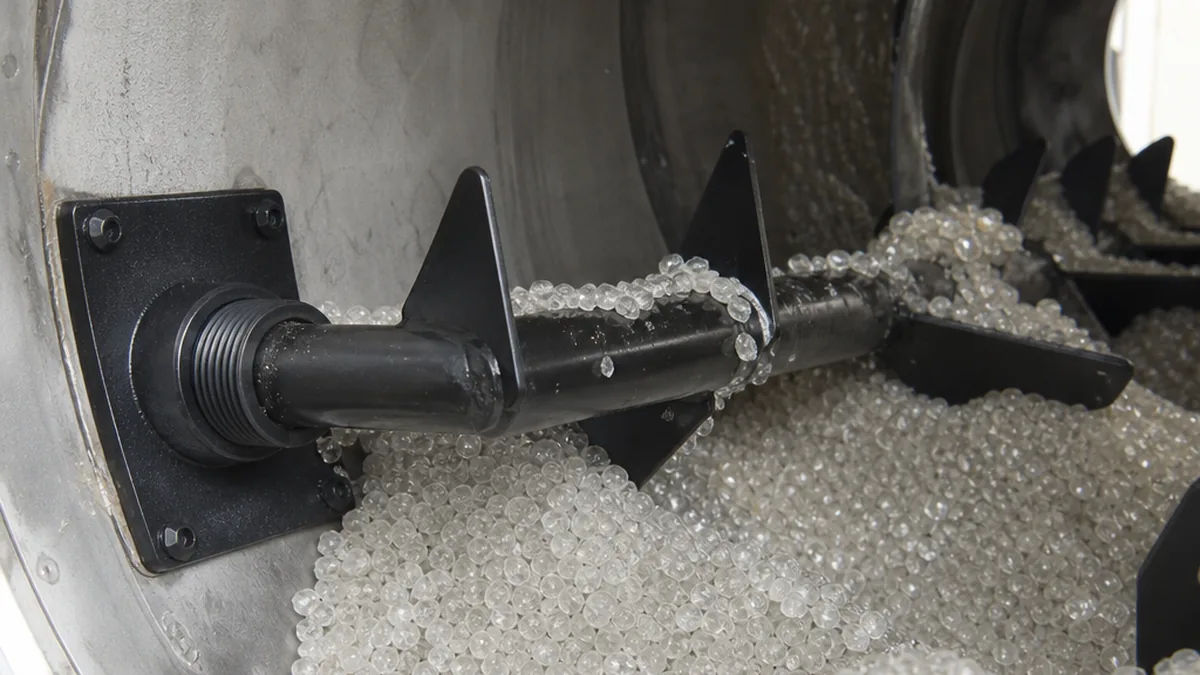
At a glance
- Sticking window: amorphous PET has a glass-transition temperature that varies by grade and moisture content; surface fusion risk is highest in the early heating phase before sufficient crystallinity builds — consult your resin supplier for grade-specific values
- Target crystallinity at crystallizer exit: the acceptable exit crystallinity range varies by application and resin grade; confirm the appropriate target with your resin supplier or equipment manufacturer
- Inlet air temperature range: commonly 140–170 °C depending on pellet throughput and residence time design
- Moisture content of amorphous feed: moisture control before crystallization is critical; the acceptable upper limit varies by resin grade — confirm with your supplier, as elevated moisture acts as a plasticizer that lowers Tg
- Residence time: residence time requirements vary by resin grade and crystallizer design; consult your equipment manufacturer and resin supplier for appropriate targets specific to your process and resin type
- Agitator check interval: inspect blade wear regularly according to your equipment manufacturer’s recommendations; do not extend inspection intervals beyond those specified in the original equipment documentation
Five Root Causes and Key Operating Parameters at a Glance
The table below summarises the five primary sticking failure modes covered in this guide, along with the key symptom, the main diagnostic check, and the first corrective action for each.
| # | Root Cause | Primary Symptom | Key Diagnostic Check | First Corrective Action |
|---|---|---|---|---|
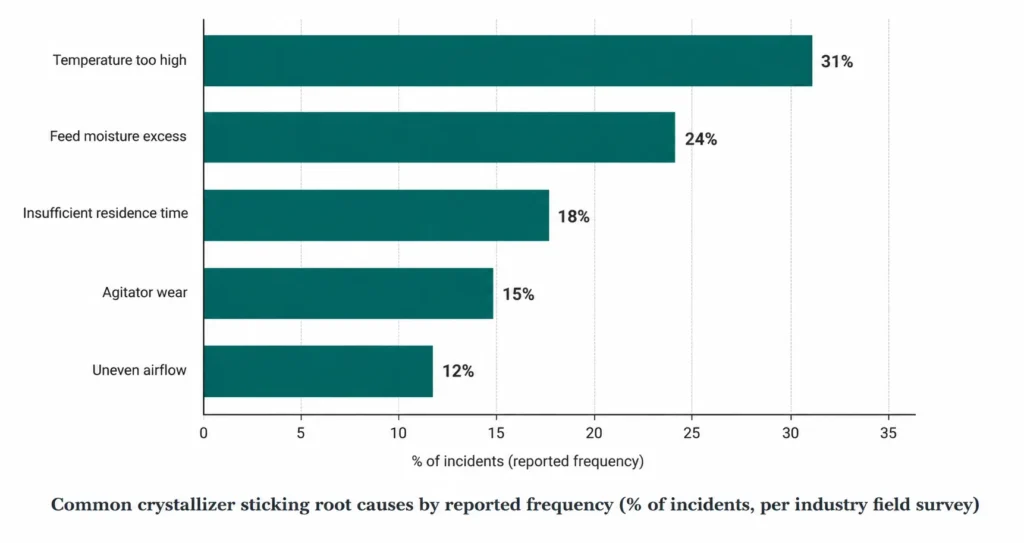
| 1 | Inlet air temperature too high | Surface fusion; pellets tacky at exit | Discharge crystallinity + surface appearance | Reduce inlet temp in 5 °C increments; recheck crystallinity |
| 2 | Inlet air temperature too low | Soft amorphous cores; poor whiteness | Discharge crystallinity below supplier minimum | Increase inlet temp incrementally; monitor each step |
| 3 | Excess moisture in amorphous feed | Sticking concentrated in inlet zone | Karl Fischer or moisture analyzer reading | Add pre-drying step; confirm target moisture with supplier |
| 4 | Agitator blade wear / undersized blades | Sticking despite correct temps and moisture | Blade height vs.[4] original drawing (>15% wear) | Replace blades; match OEM specification |
| 5 | Uneven air distribution | Hot or cool spots; asymmetric sticking location | Multi-point outlet temperature map (>10 °C spread) | Clear air distribution plate; inspect damper |
How PET Pellets Stick Together Inside a Crystallizer
What “sticking” actually looks like during crystallization
Sticking presents as pellets that arrive at the crystallizer discharge port fused in clusters of two to fifty or more. At the mild end, you see pairs or triplets that break apart under light mechanical pressure. Severe sticking produces a rigid cake that has to be broken out by hand.
The PET crystallization process depends on pellets tumbling freely so every surface receives uniform heat. When pellets contact each other while their surface is still in the amorphous, tacky state, that contact point bonds. The bond strength grows with contact time and surface temperature — which is why sticking becomes catastrophic when flow is disrupted even briefly.
How sticking differs from normal agglomeration
Normal agglomeration — pellets temporarily clinging then separating — resolves on its own as crystallinity increases and surface tackiness drops. True sticking persists past the crystallization endpoint and survives the mechanical forces inside the drum or fluid bed.
The practical test: pull a sample at the crystallizer exit. If clusters crumble between two fingers, you have mild agglomeration. If they require a tool, you have a sticking problem that will only worsen with throughput increases.
Temperature Imbalances That Trigger PET Pellet Sticking
Too-high inlet air temperature: surface melting before crystallinity sets
Raising inlet air temperature above the design range causes the pellet surface to soften faster than the crystallization front can advance inward. The outer layer goes tacky before it becomes crystalline enough to resist fusion. The upper safe limit varies by resin grade and process design; consult your resin supplier and equipment manufacturer for the appropriate ceiling for your specific application.
This is the single most common operator error after a production restart. A “hotter is faster” assumption is risky for PET crystallization. Excessive temperature can cause surface softening to outpace crystallization, narrowing or eliminating the safe processing window rather than widening it. Any temperature adjustment should be made in small increments with crystallinity monitoring at each step.
Too-low temperature: incomplete crystallinity leaving tacky amorphous zones
At the opposite extreme, insufficient inlet air temperature leaves PET pellets with large amorphous zones at the core. Crystal size stays small and crystal content stays low, and those pellets remain tacky long enough to bond under the weight of the pellet bed above them.
PET dryer temperature setup is where incomplete crystallinity hits hardest: an incompletely crystallized pellet will also absorb moisture unevenly in the subsequent drying stage, compounding the downstream problem.
Moisture, Residence Time, and Feed Rate Issues Behind the Problem
Excess moisture in amorphous PET feed
Amorphous PET is hygroscopic. Moisture absorbed during pellet transport or storage acts as a plasticizer, meaningfully depressing the effective glass-transition temperature in wet conditions. That depression means pellets can enter their tacky state at a lower temperature than the crystallizer was designed for.
Elevated feed moisture is a reliable predictor of sticking events in the inlet zone of the crystallizer — the region where pellets are hottest and least crystalline simultaneously. The specific moisture threshold that triggers action depends on resin grade; work from your supplier’s data sheet rather than a generic industry figure.
Overloaded feed rate limiting pellet movement
A feed rate above the crystallizer’s volumetric design capacity reduces the average space between pellets. Pellets that cannot move freely cannot tumble, and static contact at elevated temperature is exactly the sticking condition.
Operators often increase feed rate to recover throughput after a line stop, inadvertently recreating the sticking event they just cleared.
Insufficient residence time preventing full crystallinity
Shortening residence time — whether by increasing feed rate, reducing drum speed, or cutting crystallizer length in a retrofit — leaves pellets with incomplete crystallinity at discharge. A pellet exiting with a significant tacky amorphous fraction bonds readily under dryer loading pressure.

Equipment-Side Causes: Agitation Failure and Airflow Deficiencies
Worn or undersized agitator blades reducing pellet separation
Agitator blades that are worn down by more than 15–20% of their original profile no longer generate enough turbulence to keep pellets separated. The crystallizer may be running at correct temperature and feed rate, yet sticking persists because the mechanical mixing is insufficient.
Undersized blades — a common outcome of aftermarket part substitution — produce the same result even when new. Always match replacement blades to the original equipment specification, not just overall dimensions.
Uneven air distribution creating hot or cool spots
A partially blocked air distribution plate or a failed inlet duct damper creates zones where local air temperature and velocity deviate sharply from the bulk average. Pellets passing through a hot spot experience surface fusion; those in a cool spot exit under-crystallized. Both conditions produce sticking, but in different locations in the crystallizer — which is diagnostically useful.
Mapping air temperature at the crystallizer outlet with a multi-point thermocouple probe takes under an hour and immediately identifies distribution asymmetry.
Step-by-Step Corrective Actions to Stop PET Sticking
Adjusting temperature profile and airflow settings
Start with the inlet air temperature. If surface melting is suspected, reduce temperature in small increments and recheck discharge crystallinity after each adjustment. If pellets are exiting under-crystallized with insufficient bulk crystallinity, a modest temperature increase in small increments may help — but monitor discharge crystallinity carefully at each step, as the benefit of higher temperature depends strongly on where the process currently sits relative to the resin’s processing window.
Log crystallinity at discharge after each increment — visual whiteness alone is not a reliable crystallinity proxy.
Verify airflow velocity simultaneously. Insufficient velocity means even correct-temperature air fails to fluidize the bed adequately.
Pre-drying protocol for high-moisture amorphous PET
When feed moisture exceeds your resin supplier’s recommended pre-crystallization limit, a pre-drying step before crystallization is warranted. A dehumidifying hopper dryer operated at a moderate temperature below the crystallization onset can reduce moisture to an acceptable level without initiating significant crystallization; confirm the appropriate temperature, duration, and target moisture level with your resin supplier for your specific grade.
✅ Do this: Check feed moisture with a Karl Fischer titrator or a dedicated moisture analyzer at the start of every production shift, not only after a sticking event.
Agitator inspection and replacement criteria
Remove and inspect agitator blades whenever sticking persists after correcting temperature and moisture. Measure blade height against the original drawing. Replace if worn beyond 15% of nominal height, if any blade shows cracks at the root, or if blade pitch has deformed visibly.
🔍 Worth checking: After any blade replacement, run the crystallizer empty for 15 minutes and verify that air temperature distribution is symmetric before reintroducing pellets.
Preventive Operating Practices That Keep PET Flowing Freely
Prevention is simpler than correction. Crystallization problems are almost always signaled before they become shutdowns — if operators are measuring the right parameters.
Log inlet air temperature, discharge crystallinity, and feed moisture at minimum once per shift. Plot trends rather than spot-checking against a limit — a slow drift in discharge crystallinity over three shifts is actionable before sticking starts.
At every startup after a planned or unplanned stop, ramp feed rate gradually. A common practice is 50% of design rate for the first 15 minutes, then full rate — this prevents a cold pellet slug from entering a fully heated crystallizer simultaneously.
Establish a clean-out schedule. Fines and dust accumulate on air distribution plates and reduce airflow uniformity over time; periodic compressed-air blow-down of the distribution system can help prevent flow channeling — follow a frequency recommended by your equipment manufacturer rather than assuming any single interval is universally sufficient.
Finally, keep a spare set of agitator blades on-site. Blade wear is predictable; an unplanned stop to wait for parts is not.
Use This Checklist to Diagnose Your Crystallizer Sticking Issue
Work through these checks in order. Stop at the first “yes” — that is your primary fix.
- Is discharge crystallinity below your resin supplier’s minimum target? → Increase residence time or make small incremental adjustments to inlet air temperature; recheck after one hour and confirm with crystallinity measurement.
- Is feed moisture above your resin supplier’s recommended pre-crystallization limit? → Add a pre-drying step at a moderate temperature below crystallization onset before the crystallizer inlet; confirm parameters with your supplier.
- Is inlet air temperature above your equipment manufacturer’s recommended maximum for your resin grade? → Reduce by 5 °C increments until surface fusion stops.
- Is feed rate above the crystallizer’s rated capacity? → Cut feed rate by 20% and monitor for 30 minutes. Confirm acceptable moisture limits with your resin supplier.
- Is agitator blade height worn more than 15% from nominal? → Replace blades before restarting at full rate.
- Is air temperature distribution asymmetric by more than 10 °C across the outlet cross-section? → Inspect and clear the air distribution plate; check damper operation.
- Has the problem recurred within 30 days of a previous fix? → The root cause is almost certainly a combination of two of the above — run the full checklist, not just the item that resolved it last time.
If all six parameters are within spec and sticking persists, consider requesting a pellet sample analysis — tests such as inherent viscosity (measured per ASTM D4603, a standard method for PET) or crystal size distribution may help identify an out-of-spec resin lot; inherent viscosity is an indicator of polymer molecular weight and can flag degradation or lot variability. Confirm which analyses are most relevant with your resin supplier or a qualified laboratory.
Have a project or a spec sheet in hand? Talk to elantmachine.com — real engineers answer.
FAQ
Why Do PET Pellets Stick Together in a Crystallizer?
PET pellets stick when their surfaces become tacky before sufficient crystallinity develops. Common causes include excessive inlet air temperature, high feed moisture, insufficient residence time, overloaded feed rate, worn agitator blades, and uneven airflow. The correct fix depends on which process variable is pushing the pellets into the sticky transition zone.
How Do I Stop PET Pellets From Sticking in the Crystallizer?
Start by checking discharge crystallinity, feed moisture, inlet air temperature, feed rate, agitator condition, and airflow distribution. Adjust temperature gradually rather than making large changes, pre-dry wet amorphous PET when necessary, and replace worn agitator blades if mechanical separation is inadequate.
Can Excess Moisture Cause PET Crystallizer Sticking?
Yes. Moisture acts as a plasticizer in amorphous PET and lowers its effective glass-transition temperature, so pellets can become tacky at a lower temperature than expected. High feed moisture commonly causes sticking near the crystallizer inlet, where pellets are hot but have not yet developed sufficient crystallinity.
How Can I Tell Whether PET Sticking Is Caused by Temperature or Agitation?
Temperature-related sticking usually appears with surface softening, low discharge crystallinity, or hot and cool zones inside the crystallizer. If temperature, moisture, and feed rate are within specification but pellets still stick, inspect the agitator blades for wear, deformation, or insufficient blade size. Uneven air distribution should also be checked with multi-point temperature measurements.
Sources
[1] Crystallization of Poly(ethylene terephthalate): A Review – PMC — pmc.ncbi.nlm.nih.gov
[2] Effect of moisture on the crystallization behavior of PET … — ui.adsabs.harvard.edu
[3] PET Standard Laboratory Processing Practices — plasticsrecycling.org
[4] Crystallization From Solutions and Melts — sciencedirect.com
[5] Crystallization Behavior Of Pet Materials — exhibits.wilson.edu
[6] What’s the role of a crystallizer? – Conair — conairgroup.com