
Solid-state polymerization (SSP) is the thermal process that rebuilds broken polymer chains in recycled PET flake below the material’s melting point, measurably raising intrinsic viscosity (IV) and restoring the molecular weight lost during mechanical recycling.
Without SSP, many post-consumer rPET flakes produced through a PET bottle washing line cannot reach the higher IV typically required for bottle-grade applications, while lower-IV material may remain suitable for certain fiber or film end-uses.
At a glance
- What SSP does: re-links chain-scission fragments in solid-state PET without remelting the material
- IV range of typical post-consumer flake before SSP: approximately 0.55–0.65 dL/g
- Bottle-grade IV target: ≥ 0.72–0.80 dL/g (minimum floor; typical commercial production targets may run higher)
- Fiber-grade IV target: typically 0.60–0.68 dL/g
- Key process levers: reactor temperature, residence time, inert-gas (nitrogen) or vacuum atmosphere
- Primary test method: solution viscometry per ASTM D4603 or ISO 1628-5
- Reactor types: continuous rotary or moving-bed; batch tumble-dryer configurations
What Intrinsic Viscosity Means for Recycled PET Flake Quality
Intrinsic viscosity is a single-number proxy for the average molecular weight of a polymer sample. For polyethylene terephthalate, it is measured by dissolving the PET material in a solvent — typically a phenol/1,1,2,2-tetrachloroethane mixture — and timing how slowly that solution flows through a calibrated capillary viscometer relative to the pure solvent.
A longer average chain resists flow more, so a higher IV value in dL/g signals higher molecular weight and longer chain architecture.
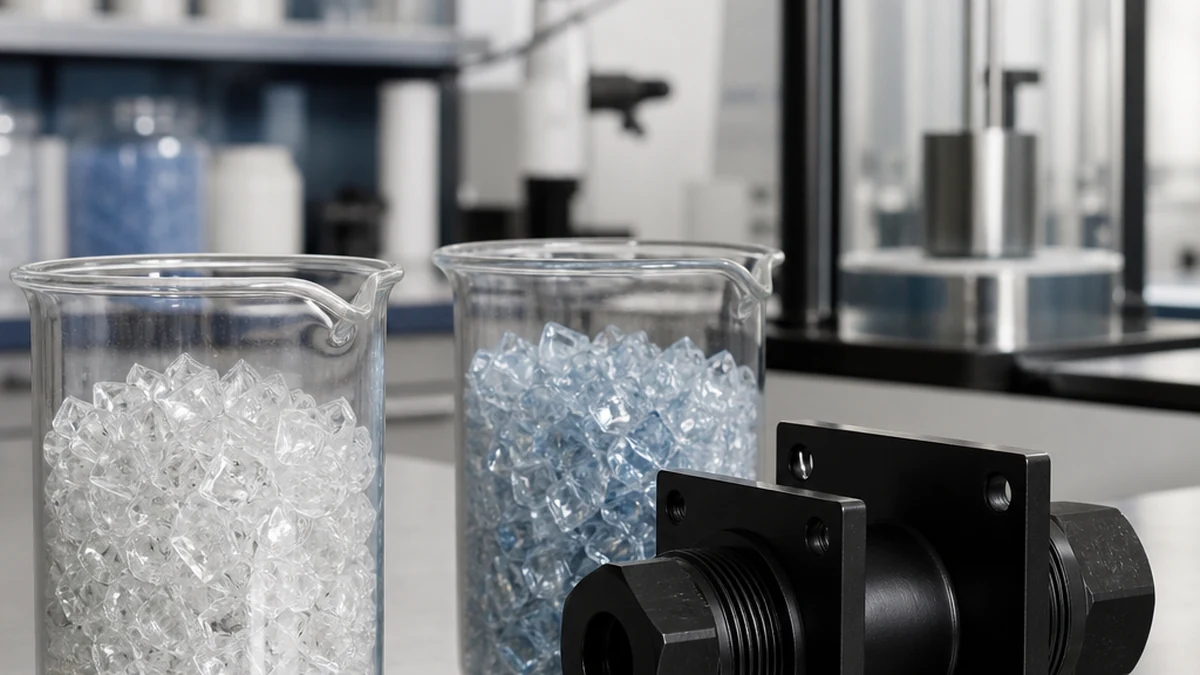
For recycled PET flake buyers and processors, IV is not an abstract lab curiosity. It directly predicts whether the material will survive the mechanical stresses of downstream processing — stretch blow-molding, melt-spinning into polyester fiber, or extrusion into film.
A flake lot that tests at 0.58 dL/g will behave differently on a blow-molding line than a lot at 0.78 dL/g — the former sits within the typical pre-SSP range while the latter represents a post-SSP result, illustrating the kind of IV gap the SSP process is designed to close — regardless of color or contamination grade.
Intrinsic viscosity vs. inherent viscosity: the practical difference
Both terms appear on supplier data sheets, and confusing them is an easy specification error. Inherent viscosity is measured at a single fixed concentration (usually 0.5 g/dL); intrinsic viscosity is the value extrapolated to zero concentration, eliminating chain-to-chain interaction effects. For PET production quality control, intrinsic viscosity is the technically rigorous standard because it is concentration-independent and therefore directly comparable across labs and suppliers.
Inherent viscosity measured at a fixed concentration is not numerically identical to intrinsic viscosity, which is defined as the limiting viscosity value as polymer concentration approaches zero. The difference depends on the polymer-solvent system, concentration, temperature, and calculation method, so supplier values should only be compared when the same test method and reporting convention are used.
Ask any supplier quoting IV values which method they used and at what concentration. The difference between inherent and intrinsic viscosity reporting is the kind of detail that silently shifts a material from in-spec to out-of-spec once it reaches your process line.
Why IV is the preferred quality metric over Melt Flow Index for PET
Melt Flow Index (MFI) is fine for polyolefins, but it is a poor primary metric for PET material quality control. MFI requires melting the sample, which accelerates hydrolytic degradation if the material is not perfectly dry — making the test result more sensitive to sample preparation than to the material itself. Intrinsic viscosity testing uses a solution at room temperature, avoiding thermal degradation entirely.
The ASTM D4603 standard is widely cited as a reference method for PET solution viscometry and has seen broad industry use; however, confirm with the relevant authority or your downstream customer that it remains the applicable method for your specific application and jurisdiction before building a QC protocol around it.
Why Low IV Is the Core Problem in Recycled PET Flake
Mechanical recycling of post-consumer PET bottles — collection, sorting, washing, drying, size reduction — inflicts cumulative chain damage on the polymer every time energy is applied. The result is measurably shorter chains and a lower IV in the output flake compared to the original bottle-grade resin. This is not a processing defect; it is a thermodynamic inevitability.
The practical consequence: a bottle manufactured from virgin PET typically starts at an IV of approximately 0.78–0.84 dL/g. Post-consumer flake from that same bottle, after one mechanical recycling cycle, typically tests in the 0.55–0.65 dL/g range. That gap is precisely what the SSP process is designed to close.
Chain scission during washing, drying, and reprocessing steps
Every thermal or hydrolytic stress event cuts ester linkages in the polyethylene terephthalate backbone — a reaction called chain scission. Washing at elevated temperature introduces water that attacks the ester bond; the subsequent drying step, if residence time or temperature is poorly controlled, continues the damage. Remelting and extruding the flake into pellets adds another round of thermal and shear stress.
Each step is individually small. Cumulative across a full recycling pass, the IV loss during typical post-consumer processing can be significant — enough to disqualify the output from most bottle-grade specifications. Processors should characterize IV loss empirically for their specific feed streams rather than relying on generalized figures.
What target IV ranges recycled flake must hit for bottle, fiber, and film end-uses
Different end-use markets set different IV floors, and knowing them is essential before specifying an SSP system:
| End-use | Minimum IV (dL/g) | Notes |
|---|---|---|
| Bottle-grade (food contact) | 0.72–0.80 | FDA food-contact recycled PET guidance applies |
| Textile / polyester fiber | 0.60–0.68 | Lower IV acceptable for staple fiber |
| Strapping / sheet | 0.65–0.72 | Depends on orientation ratio |
| Film (biaxially oriented) | 0.62–0.68 | Orientation compensates partially for lower IV |
Recycled plastic flakes destined for fiber can tolerate lower IV than bottle applications. Polyester fiber is often cited as a significant outlet for post-consumer rPET in the United States, though the relative volumes of fiber-grade versus bottle-grade end-uses shift with market conditions — confirm current figures with industry sources or trade associations before making capacity decisions.
This directly affects how much IV uplift an SSP system needs to deliver, which drives reactor sizing and residence time.
How the SSP Process Rebuilds Molecular Chains to Raise IV
The chemistry of SSP is solid-state polycondensation: the same esterification reaction that builds chains during primary PET production, but run below the crystalline melting point. PET’s crystalline melting point falls in a well-documented range; consult resin supplier data sheets or published polymer reference tables for the specific value applicable to your material, as it can vary with copolymer composition.
By keeping the material solid, the process avoids the color degradation and thermal randomization that remelting would cause.
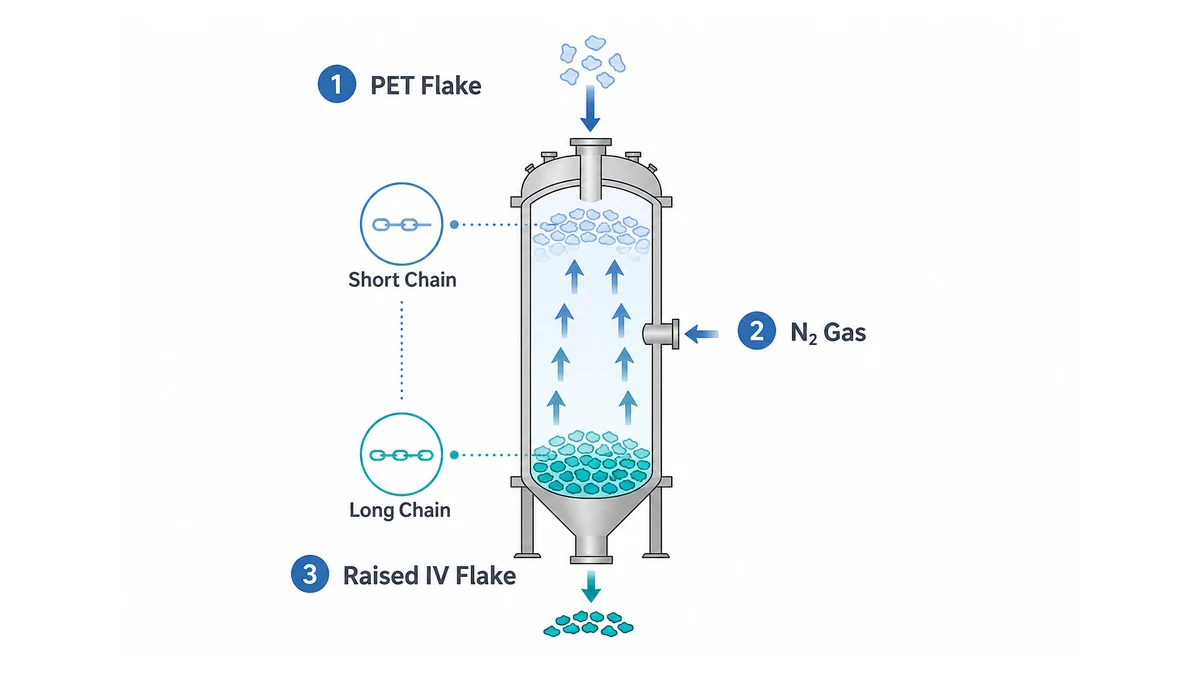
Chain-end groups — primarily hydroxyl (–OH) and carboxyl (–COOH) groups — react with each other to form new ester linkages, releasing ethylene glycol and water as byproducts. Removing those byproducts continuously is essential; if they accumulate in the reaction zone, the equilibrium shifts back and the polymerization process stalls.
This is why inert-gas flow or vacuum is not optional — it is the mechanism by which the reaction is driven forward.
Temperature, residence time, and inert-gas flow as the three control levers
Temperature is the most powerful control variable. Higher temperatures accelerate the polycondensation SSP reaction rate, but operating too close to the crystalline melting point risks particle fusion (agglomeration), which blocks the reactor and ruins a batch. Practical SSP reactor temperatures for PET flake sit in the range of approximately 200–230 °C.
Residence time determines total IV uplift at a given temperature. Longer time in the reactor means more chain-building reactions, up to the point where reactive chain ends are exhausted. A typical SSP process for recycled PET flake targeting bottle-grade output runs 8–20 hours of reactor residence depending on starting IV and target IV.
Nitrogen flow rate sets how efficiently byproduct vapors are swept out of the solid-state bed. Insufficient flow leaves ethylene glycol vapor in the reactor, slowing the reaction. Over-specification wastes energy and nitrogen cost.

Typical IV buildup vs. SSP residence time at 215 °C for recycled PET flake
How SSP raises IV without remelting — preserving color and reducing degradation
This is the key practical advantage over melt-phase re-polymerization. Because the PET material never reaches its melt temperature during SSP, acetaldehyde generation — the primary source of off-flavor contamination in food-contact rPET — is dramatically lower. Color values (b* yellowness in particular) remain stable or improve, rather than shifting yellow as they would in an extended melt-phase process.
For recycled PET flakes targeting food and beverage packaging, the combination of raised IV and preserved color in a single thermal step is what makes SSP the standard approach rather than an alternative.
SSP System Design for Flake: Key Equipment Stages and Parameters
A complete SSP system for recycled PET flake is not a single reactor — it is a staged process line where each upstream stage conditions the material for the stage that follows. Skipping or under-sizing any stage compromises IV results.
Pre-crystallization and drying before the SSP reactor
Amorphous or semi-crystalline flake cannot go directly into the SSP reactor at process temperature. Below approximately 110 °C, amorphous PET will soften and fuse; pre-crystallization raises crystallinity substantially so the flake remains free-flowing at SSP temperatures — consult equipment supplier data and published literature for the crystallinity range appropriate to your specific flake morphology and processing conditions.
This step typically runs at 130–160 °C with mechanical agitation (to prevent sticking) for 30–90 minutes depending on flake morphology.
Drying follows — or is integrated with — pre-crystallization to reduce moisture below 50 ppm. Moisture in the SSP reactor causes hydrolytic chain scission, directly working against the IV-building objective. Pre-drying is one of the most common under-investments on recycled PET flake SSP lines, and its consequences show up as IV results that plateau well below target.
🚫 Avoid: Feeding partially dried flake into the SSP reactor. The moisture threshold for the reactor inlet is set at below 50 ppm as noted above; exceeding that threshold — at any level above 50 ppm — risks significant reduction in achievable IV gain relative to theoretical values for a given residence time.
Continuous vs. batch reactor configurations for flake throughput
The two architectures suit different production scales:
| Configuration | Typical capacity range | Best fit |
|---|---|---|
| Continuous moving-bed / rotary | 500 kg/h – 10+ t/h | High-volume, consistent-grade flake operations |
| Batch tumble-dryer / paddle | 50 kg – 2 t per batch | Smaller operations, multi-grade flexibility |
Continuous systems offer tighter IV uniformity because residence time distribution is controlled by mechanical design. Batch systems offer grade-change flexibility — useful when a processor handles multiple recycled PET flakes grades with different starting IV values and different target specifications.
Nitrogen or vacuum loop: gas management and energy recovery
The two atmosphere options — flowing nitrogen and closed-loop vacuum — each have engineering trade-offs. Nitrogen systems are mechanically simpler and more forgiving of small air leaks, but nitrogen consumption is an ongoing operating cost. Vacuum systems eliminate carrier gas cost but require robust rotary seals and vacuum pumps, and are more sensitive to particle fines that can block vacuum lines.
Modern nitrogen-loop SSP systems recover and recirculate process nitrogen after removing byproduct vapors through a molecular-sieve dryer or condenser. Properly sized nitrogen recovery reduces consumption to make-up quantities only — the precise figure varies by system design and operating conditions; request a verified consumption figure from equipment suppliers for your specific throughput and IV uplift target rather than relying on generalized benchmarks.
✅ Do this: Request the supplier’s nitrogen consumption figure in Nm³/t at your target IV uplift — not just peak-load consumption. This single number drives a significant portion of operating cost for any nitrogen-loop SSP line.
Measuring and Controlling IV Throughout the SSP Line
A well-designed SSP process line for recycled PET flake builds IV measurement into the process — not just the quality lab at the end of the shift. The reason is straightforward: a batch of flake that exits the reactor below target IV cannot be economically corrected by returning it through the full cycle.
Standard solution-viscometry test methods used for rPET flake
ASTM D4603 or ISO 1628-5 — ASTM D4603 is widely used for PET solution viscometry in the United States. It specifies the solvent system (60/40 phenol/1,1,2,2-tetrachloroethane by weight), the dissolution protocol, and the capillary viscometer size. ISO 1628-5 covers the same measurement with slight differences in solvent ratios and temperature; for food-contact applications, confirm which standard your downstream customer requires before building your QC protocol around one or the other.
A single IV measurement on properly prepared flake takes approximately 30–60 minutes in a manual lab setup. This is the core limitation that automated monitoring is designed to address.
Automated in-process IV monitoring: reducing lab lag and batch rejects
The differentiation between operations that run SSP profitably and those that fight batch rejects comes down to measurement frequency. Offline solution viscometry at shift-end catches problems after they have already been produced. Automated in-process IV monitoring — using near-infrared (NIR) spectroscopy or in-line melt rheometry at a discharge sampling point — can provide IV estimates every few minutes with appropriate calibration against reference solution-viscometry values.
NIR-based IV estimation for PET material has shown promise in production environments and may correlate well with solution-viscometry results when the calibration model is appropriately built and maintained; however, performance varies with material composition and instrument configuration — confirm suitability and accuracy for your specific application with the instrument supplier and verify against your chosen reference method before relying on it for production decisions. [4] The investment in automated IV monitoring pays for itself rapidly by catching reactor upsets — a temperature control fault, a nitrogen-flow anomaly — before they turn into a full reactor hold.
Typical IV Uplift Results and What They Enable Downstream
A properly operated SSP process running post-consumer recycled PET flake at approximately 215 °C with adequate residence time and pre-drying will typically raise intrinsic viscosity meaningfully from starting values in the 0.55–0.65 dL/g range. That uplift is enough to move material from below fiber-grade into bottle-grade specification in a single processing pass.
The downstream implications are direct and commercial. Flake that exits SSP at 0.76–0.80 dL/g qualifies for food-contact bottle applications where recycled PET price premiums over commodity-grade material are measurable.
Bottle-grade recycled PET in the United States has generally been understood to command a premium over fiber-grade recycled PET flake, though the exact spread varies with virgin resin markets and prevailing supply-demand conditions — verify current pricing with market data providers or industry contacts before making investment decisions, as the relationship can shift. The IV threshold remains the gate that determines which price a processor captures.
For operations recycling PET flakes to polyester fiber, SSP provides a quality floor that reduces breakage during melt-spinning. Fiber-grade material consistently above 0.63 dL/g runs with fewer filament breaks than material that tests irregularly between 0.55 and 0.63 — even if the average is nominally adequate. IV consistency, not just IV level, is what spinning mills actually want.
The SSP process also reduces residual acetaldehyde and volatile byproducts in the PET material — a food-safety benefit that runs alongside the mechanical property improvement.
For processors pursuing FDA food-contact recycled content approvals, SSP is widely regarded as an important process step; however, the specific requirements applicable to your operation depend on the approval pathway and regulatory guidance in effect at the time — confirm the current requirements directly with the FDA or qualified regulatory counsel rather than treating any general statement as definitive.
Choosing the Right SSP System Configuration for Your Flake Operation
Specifying an SSP system before fully characterizing the feed material and output specification is the most expensive mistake a recycled PET flake processor can make. Equipment is sized around throughput, starting IV, and target IV — change any of those inputs after the fact and the reactor either cannot hit target or runs chronically over-capacity.
Throughput and feed-quality criteria that shape system sizing
Start with a realistic IV distribution of your feed flake — not a single average number. A flake operation processing mixed post-consumer bales will see IV variation of ±0.05–0.10 dL/g lot-to-lot. The SSP system must be sized to bring the low end of that distribution up to target, which means designing for the worst-case starting material, not the average.
Key parameters to characterize before approaching a supplier:
- Feed flake IV range: minimum, maximum, and typical (test at least 10 representative lots per ASTM D4603)
- Target output IV and permitted tolerance: ±0.02 dL/g is a common specification; tighter tolerances require longer average residence times and better process control
- Annual throughput in metric tons: size the continuous line or batch cycle count accordingly
- Moisture content of feed flake: determines pre-dryer specification
- Flake particle size and fines content: affects bed behavior in the reactor and nitrogen bypass
Questions to ask a supplier before specifying an SSP line
A supplier who cannot answer the questions below with documented data — not verbal assurance — is not ready to accept the order.
- What is the guaranteed IV uplift (dL/g) for a defined starting IV, residence time, and temperature? Get this in writing with a performance bond in the contract.
- What is the nitrogen consumption in Nm³ per metric ton at the guaranteed operating point? This is a direct operating cost line.
- What is the pre-crystallizer temperature profile and minimum residence time for your flake particle size? Under-crystallization is a common root cause of reactor agglomeration in the field.
- What IV monitoring instrumentation is included, and what is its correlation to ASTM D4603 on rPET specifically?
- Can you provide reference installations processing similar post-consumer flake grades, with contact information for those plants?
The recycled PET flakes market in the United States is competitive enough that equipment suppliers will have reference installations. If they cannot name one processing material comparable to yours, treat that as a significant risk signal before committing capital.
Have a project or a spec sheet in hand? Talk to elantmachine.com — real engineers answer.
FAQ
How much can SSP increase the IV of recycled PET flake?
The achievable IV increase depends on starting IV, reactor temperature, residence time, moisture level, and nitrogen or vacuum conditions. Post-consumer PET flake commonly enters SSP around 0.55–0.65 dL/g, while properly controlled SSP can raise it into the bottle-grade range of approximately 0.72–0.80 dL/g.
What temperature and residence time are typically used for PET SSP?
PET flake SSP commonly operates at approximately 200–230 °C. Residence time may range from about 8 to 20 hours depending on the starting IV and required final IV. Higher temperature accelerates polycondensation, but excessive temperature can increase the risk of flake agglomeration.
Does PET flake need to be dried before SSP?
Yes. PET flake should be pre-crystallized and thoroughly dried before entering the SSP reactor. The article recommends reducing moisture below 50 ppm because excess moisture promotes hydrolytic chain scission and can limit the achievable IV increase.
How is PET viscosity measured?
ASTM D4603 is widely used in the United States to determine the inherent viscosity of PET at a specified concentration using glass-capillary solution viscometry. Intrinsic viscosity is a limiting value obtained by extrapolation to zero polymer concentration, so the two terms should not be treated as strictly interchangeable.
Sources
[1] D4603 Standard Test Method for Determining Inherent… — store.astm.org
[2] Guidance on Use of Recycled Plastics in Food Packaging — fda.gov
[3] Polyethylene Terephthalate (PET) Bottle-to-… — mdpi.com
[4] Intrinsic viscosity (IV) determination of recycled PET by NIR… — icpms.labrulez.com
[5] Effect of solid-state polymerization on fiber structure … — nature.com
[6] Applications Guidance Protocol for Recycled PET — plasticsrecycling.org