
The mistake that costs recycling plant operators the most isn’t buying the wrong extruder or the wrong pelletizer — it’s skipping proper drying validation on PET flakes and discovering the defect three steps later in melt quality or pellet clarity. If you’re specifying or purchasing a PET flakes dryer, this guide maps every decision from moisture targets to supplier red flags.
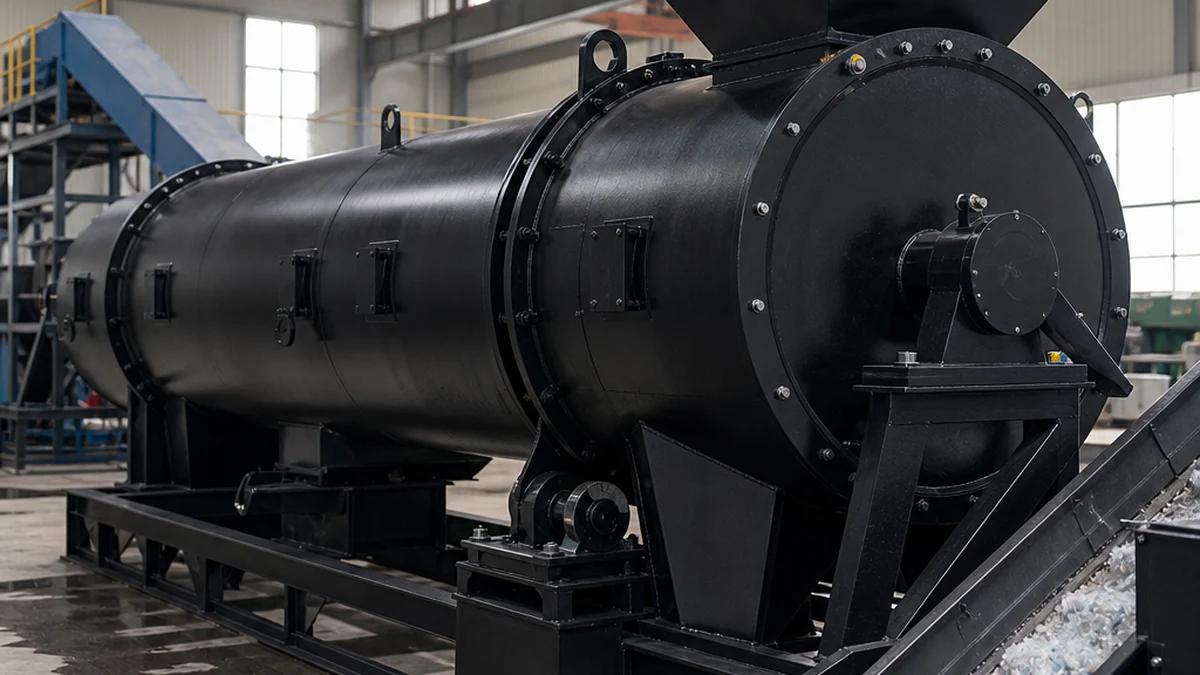
At a glance
- Target moisture-out: ≤0.3% for extrusion; ≤0.2% (200 ppm) for fiber-grade spinning; ≤0.05% (500 ppm wt) for bottle-to-bottle pelletizing
- Typical moisture-in from washing: 15–35% by weight (surface + trapped water)
- Two-stage process: centrifugal dewatering (mechanical) + thermal hot-air drying
- Capacity tiers: 300 kg/h (small batch) to 3,000+ kg/h (continuous high-volume)
- Heat sources: electric resistance, steam, or natural gas — each with different operating cost profiles
- Key control point: rotor speed on the centrifuge stage and air temperature on the thermal stage
Why Residual Moisture in PET Flakes Destroys Downstream Quality
PET is hygroscopic, so controlling PET flake drying temperature and moisture is critical because PET absorbs moisture into the polymer, not just on the surface. When you feed wet PET flakes into an extruder, the heat causes hydrolytic degradation: water molecules break ester bonds in the polymer backbone, dropping intrinsic viscosity (IV) and producing a brittle, discolored melt.
The downstream damage is expensive and hard to reverse. Pellets produced from under-dried PET flakes exhibit reduced IV, visible bubbles, and inconsistent color — all of which can lower the resulting recycled PET flakes quality grade or prevent the material from meeting food-contact or fiber-grade requirements.
What moisture levels are acceptable before extrusion or pelletizing?
The ASTM D7459 standard and industry processing guides put the ceiling at 180–300 ppm (0.018–0.03% by weight) for most extrusion applications. Fiber-grade spinning drops that requirement to around 100–150 ppm. Bottle-to-bottle food-contact resin requires even tighter control — often below 50 ppm at the extruder throat.
A plastic flakes dryer machine that delivers 0.5% residual moisture looks acceptable in a supplier data sheet but puts you 5–10× over the acceptable threshold at the extruder. Verify moisture-out with a Karl Fischer titration, not an infrared surface reading.
How washing lines leave PET flakes wetter than they look
A PET bottle washing line typically runs flakes through hot caustic washing, rinse tanks, and mechanical dewatering before they enter the final drying stage. By the time flakes exit the friction washer, surface moisture sits at 15–35% by weight — the material looks damp but not saturated.
The trap: a visual or even a simple weight-loss oven test measures bulk surface water, not the moisture absorbed into flake walls during prolonged hot washing. That absorbed fraction persists through centrifugal dewatering and only releases under sustained thermal exposure above 140°C.
🔍 Worth checking: Ask any washing-line supplier for the IV loss curve between unwashed and washed PET flakes at your run temperature — if they don’t have the data, that’s a gap in their process engineering.
How a PET Flakes Dryer Removes Moisture at a Mechanical Level
A pet flakes dryer machine doesn’t work as a single monolithic device. Every production-grade system separates the moisture-removal task into two physically distinct stages, because no single mechanism removes both bulk water and absorbed moisture efficiently.
Centrifugal spin-drying stage: separating bulk surface water
The first stage is a dewatering machine — a high-speed centrifugal spinner. PET flakes feed into a rotating drum or rotor surrounded by a perforated screen. At rotor speeds between 800–1,500 RPM (depending on machine size and flake geometry), centrifugal force throws surface water through the screen and into a collection sump. This stage alone can drop moisture content from 30% down to 3–8% within seconds of contact time.
The mechanical dewatering step does most of the heavy lifting and sets the thermal stage up for efficiency. Skipping it and relying on hot air alone to evaporate 30% moisture is wasteful — you’d need either much higher temperatures (risking PET degradation above 160°C) or extremely long dwell times that kill throughput.
Thermal or hot-air drying stage: driving out residual moisture
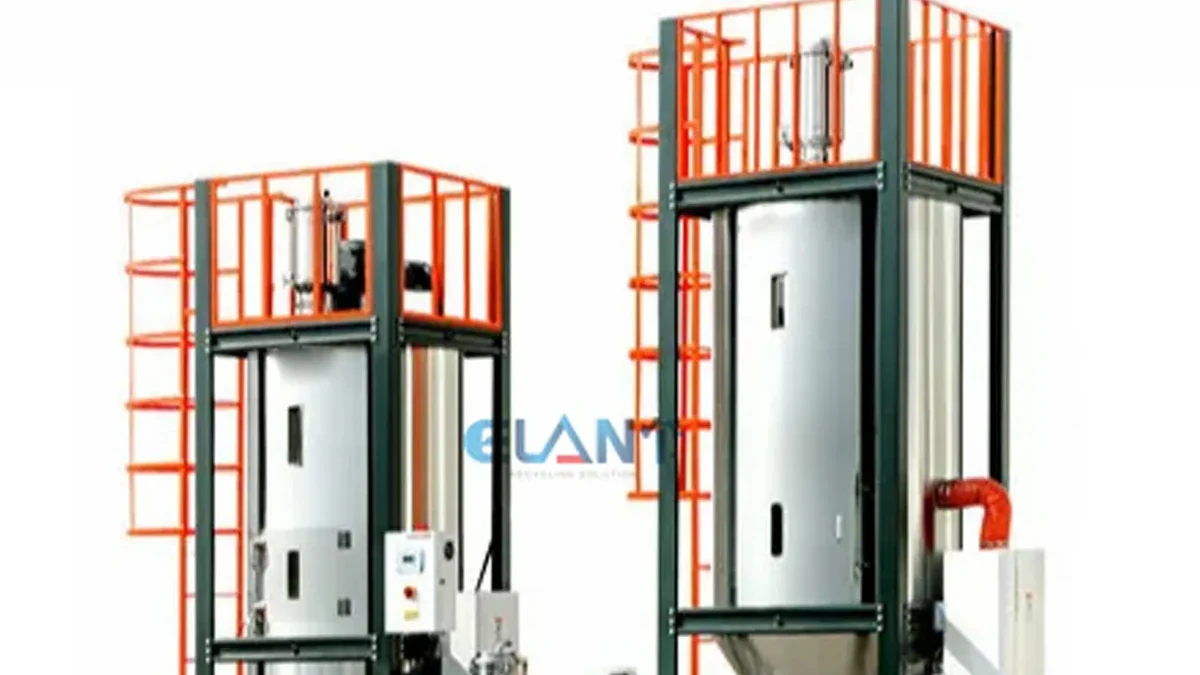
After centrifugal dewatering, flakes enter the thermal dryer — typically a drum dryer flaker configuration or a fluid-bed hot-air system. Heated air at 100–160°C circulates through the flake bed, driving absorbed moisture out of the polymer matrix by diffusion. Dwell time in this stage is the critical variable: too short leaves absorbed moisture intact; too long at high temperature degrades the polymer.
Most continuous systems target 20–45 minutes of thermal exposure at 120–140°C for standard bottle-grade PET flakes. The exit moisture content from this stage is what actually determines whether your downstream process runs clean.
How the two stages work together in a single system
The two stages are engineered as a matched pair, not independent machines bolted together. The centrifuge controls the moisture load entering the thermal stage — if centrifuge performance drops (worn screen, imbalanced rotor), the thermal stage is suddenly asked to evaporate 3× more water, which either slows throughput or delivers under-dried product.
Integrated control systems link both stages so that if centrifuge RPM drops below a set threshold, the line slows or alarms rather than passing wet flakes forward.
Core Features That Determine Real-World Drying Performance
Spec sheets for plastic flakes dryer machines all report similar headline numbers. The features that separate a reliable machine from an expensive maintenance problem are in the sub-specifications.
Rotor speed, screen mesh size, and housing material
Rotor speed determines the G-force applied to flakes — higher G-force extracts more surface water but also increases flake breakage on brittle or small flakes. For standard 12–18 mm PET flakes, 900–1,200 RPM is the typical range. Screen mesh size determines the water-extraction efficiency versus the risk of small flake fragments passing through — 1.5–2.0 mm perforations are standard for bottle-grade PET recycling.
Housing and rotor material matters for longevity. Stainless-steel (304 or 316) wetted surfaces resist the acidic wash water carryover that corrodes mild-steel rotors within 12–18 months of continuous operation. Ask for the material certificate, not just a verbal assurance.
Temperature control range and heat source options
The thermal dryer’s temperature control system should deliver ±5°C stability across the drying chamber — wider swings produce inconsistent moisture-out values batch to batch. PID controllers with multiple zone sensors are the baseline; single-point thermostats on cheaper machines allow temperature stratification that leaves the center of the flake bed under-dried.
Heat source affects operating cost more than capital cost:
- Electric resistance: highest capital efficiency, lowest installation complexity, highest energy cost per kWh in most U.S. markets
- Natural gas burner: 30–50% lower operating cost per unit of heat in most U.S. regions; requires gas infrastructure and combustion safety controls
- Steam: suitable where a central boiler already exists; adds dependency on boiler uptime
🚫 Avoid: Any thermal dryer without an independent over-temperature cutoff at the discharge end. A controller failure at 180°C+ begins degrading PET within minutes.
Throughput consistency across flake sizes and contamination levels
A dryer machine rated at 1,000 kg/h in a spec sheet is typically rated on clean, uniform 15 mm flakes. Real recycling lines produce size distributions from 5 mm fines to 25 mm oversized pieces, plus residual label fragments and cap material. Demand test data on mixed-size PET flake feed, not just on clean material.
Fines clog screens, reduce centrifuge efficiency, and cause channeling in hot-air beds — all of which degrade drying performance and inflate energy consumption.
Input Capacity and Output Parameters: Matching the Machine to Your Line
The right capacity tier isn’t the largest machine you can afford — it’s the machine that matches your upstream washing output with a 10–15% buffer for throughput variation.
Capacity tiers: small-batch vs. continuous high-volume systems
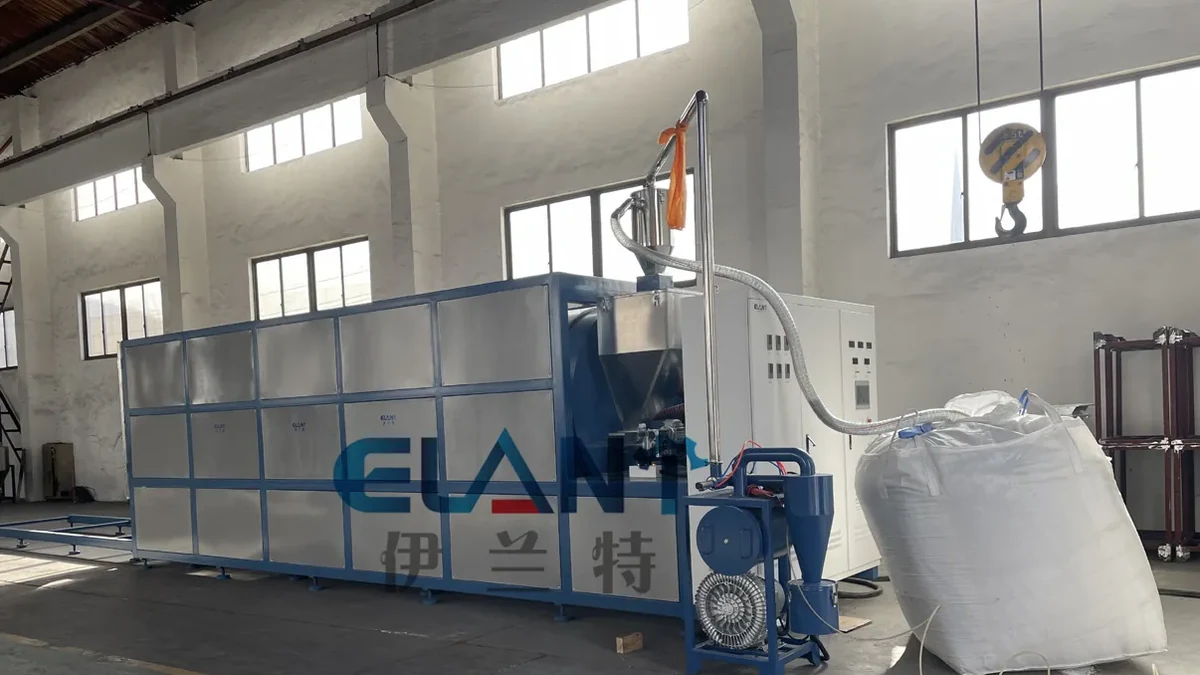
Small-batch systems in the 300–600 kg/h range serve single-stream or secondary PET recycling operations where feed stock varies in volume and composition week to week. Continuous systems from 1,000–3,000+ kg/h are sized for dedicated bottle-to-bottle or fiber-grade lines running two or three shifts.
A mismatch in either direction creates problems: undersized dryers create wet-flake backpressure; oversized systems running at 40% capacity produce inconsistent drying because air flow and thermal profiles are calibrated for full-load operation.
Parameters table: feed rate, moisture-in, moisture-out, power draw
| Parameter | Small-Batch (300–600 kg/h) | Mid-Scale (800–1,500 kg/h) | High-Volume (2,000–3,000+ kg/h) |
|---|---|---|---|
| Typical moisture-in | 15–35% | 15–35% | 15–35% |
| Target moisture-out | ≤0.3% | ≤0.3% | ≤0.2% |
| Centrifuge motor power | 15–30 kW | 30–55 kW | 55–110 kW |
| Thermal dryer power | 20–45 kW | 45–90 kW | 90–200 kW |
| Dwell time (thermal) | 25–40 min | 20–35 min | 20–30 min |
✅ Do this: Before finalizing capacity, measure your actual wash-line output over 5 operating days — not the nameplate capacity. Real throughput is typically 75–85% of nameplate on mixed-quality bale stock.

What Dried PET Flakes Are Used For — and Why Dryness Specs Vary
Dried PET flakes feed into three distinct end markets, each with its own moisture ceiling and intrinsic viscosity requirement.
Fiber production is the largest outlet for recycled PET flakes in the U.S. — polyester staple fiber and filament yarn for textiles and fill materials. Fiber spinning tolerates moisture up to ~150 ppm and accepts moderate IV reduction, which is why fiber-grade dryer specs are slightly less demanding than bottle-grade.
Sheet and strapping extrusion is the mid-tier application. Thermoformed sheet for food packaging (clamshells, trays) requires FDA-compliant recycled PET at ≤200 ppm moisture, but the IV floor is lower than bottle-to-bottle since wall thickness compensates for some IV loss.
Bottle-to-bottle applications carry the tightest requirements — moisture below 50 ppm and IV above 0.72–0.78 dL/g — because the final container must pass FDA GRAS or letter-of-no-objection thresholds. This is why a machine adequate for fiber-grade drying is often insufficient for bottle-to-bottle without an additional vacuum crystallizer or IV-enhancement step.
The price differential reflects the spec gap: hot washed PET flakes meeting bottle-grade moisture specs command a premium over fiber-grade material in the U.S. secondary market. A dryer that can reliably hold ≤0.05% moisture-out opens the higher-value end of the market.
How to Evaluate a PET Flakes Dryer Before You Commit to a Purchase
A supplier’s factory acceptance test on clean virgin-equivalent PET tells you almost nothing about how the machine will perform on the bale stock your line actually runs. Build your evaluation around your material, not theirs.
Questions to ask a supplier during a machine demonstration
- Can you run our flake sample? Ship 200 kg of your actual feedstock — post-wash, pre-dried — and request a documented moisture-in / moisture-out test using Karl Fischer, not infrared.
- What is the rotor replacement interval at full load, and what does a rotor cost? Screen and rotor wear is the primary operating cost on the centrifuge stage; a $180,000 machine with a $15,000 annual rotor cost is a different TCO calculation than the capital figure alone.
- What spare parts are stocked in the U.S.? Lead times on overseas-sourced wear parts (screens, bearings, heating elements) can run 8–16 weeks. A U.S.-based spare-parts depot is not optional for a machine running two or three shifts.
- What PLC or control platform does the machine use? Allen-Bradley and Siemens platforms have deep U.S. service networks. Proprietary controllers create technician dependency on the OEM.
Red flags in dryer specs that signal hidden operating costs
Watch for these specific warning signs before signing a purchase order:
- Moisture-out spec given without a test method — “≤0.3% moisture” means nothing without specifying Karl Fischer, oven loss on ignition, or microwave moisture analysis. These methods give different readings on the same sample.
- Single-point temperature sensor in a drum dryer longer than 3 meters — temperature stratification is guaranteed; you’re buying inconsistent drying by design.
- No variable-frequency drive (VFD) on the centrifuge motor — fixed-speed centrifuges can’t adapt to load variations from different flake densities, wasting energy and causing throughput surges.
- “Capacity” rated on dry flakes, not wet feed — a dryer rated at 1,000 kg/h output on dry flakes handles roughly 1,150–1,400 kg/h of wet feed input. Misquoted basis inflates perceived capacity by 15–40%.
🔍 Worth checking: Request the energy consumption log (kWh/ton of dried output) from a comparable installation running similar feedstock. A reputable supplier will have at least two reference sites in the U.S. you can contact directly.
Have a project or a spec sheet in hand? Talk to elantmachine.com — real engineers answer.
FAQ
What moisture level should a PET flakes dryer achieve?
The required final moisture level depends on the downstream application. Fiber-grade PET can generally tolerate more residual moisture than sheet, strapping, or bottle-to-bottle applications. When selecting a dryer, specify the required outlet moisture rather than relying only on the supplier’s stated drying capacity.
What size PET flakes dryer do I need?
Match dryer capacity to the actual throughput of your washing line rather than its theoretical maximum. The dryer should handle peak flake flow without becoming a bottleneck while maintaining the required outlet moisture level.
Is a centrifugal dryer enough for PET flakes?
A centrifugal dryer can remove most surface water after washing, but it may not achieve sufficiently low moisture for demanding downstream processes. Many PET recycling lines therefore combine mechanical dewatering with thermal drying when lower residual moisture is required.
What should I check before buying a PET flakes dryer?
Check rated and tested throughput, inlet and outlet moisture, motor power, thermal energy consumption, temperature control, screen design, material-contact construction, maintenance access, spare-parts availability, and whether the supplier can perform a factory acceptance test using PET flakes similar to your feedstock.
Sources
[1] How To Measure Moisture Content In Plastic Pellets? — mt.com
[2] Guidance on Use of Recycled Plastics in Food Packaging — fda.gov
[3] PET Cold vs. Hot Washing Line: Cost, Quality & — boxinpm.com
[4] FDA Legal Requirements for Recycled Plastics in Food… — consumerbrandsassociation.org
[5] Submissions on Post-Consumer Recycled (PCR) Plastics… — hfpappexternal.fda.gov