
The mistake most recycling plant operators make before their first hot-wash run: they treat sodium hydroxide concentration as a “set it and forget it” variable. They dial in 2% NaOH, run the line at whatever temperature comes out of the heat exchanger, and wonder why their PET flakes still carry adhesive residue, paper pulp, and haze at the pelletizing stage. The fix is not more caustic — it is understanding exactly what caustic soda is doing to the polymer surface, and engineering the process around that chemistry.
This guide covers the full role of caustic soda in PET bottle washing — from the electrochemistry of sodium hydroxide attacking polyethylene terephthalate to the machine parameters, wastewater treatment obligations, and pricing benchmarks a U.S. buyer needs before specifying a line.
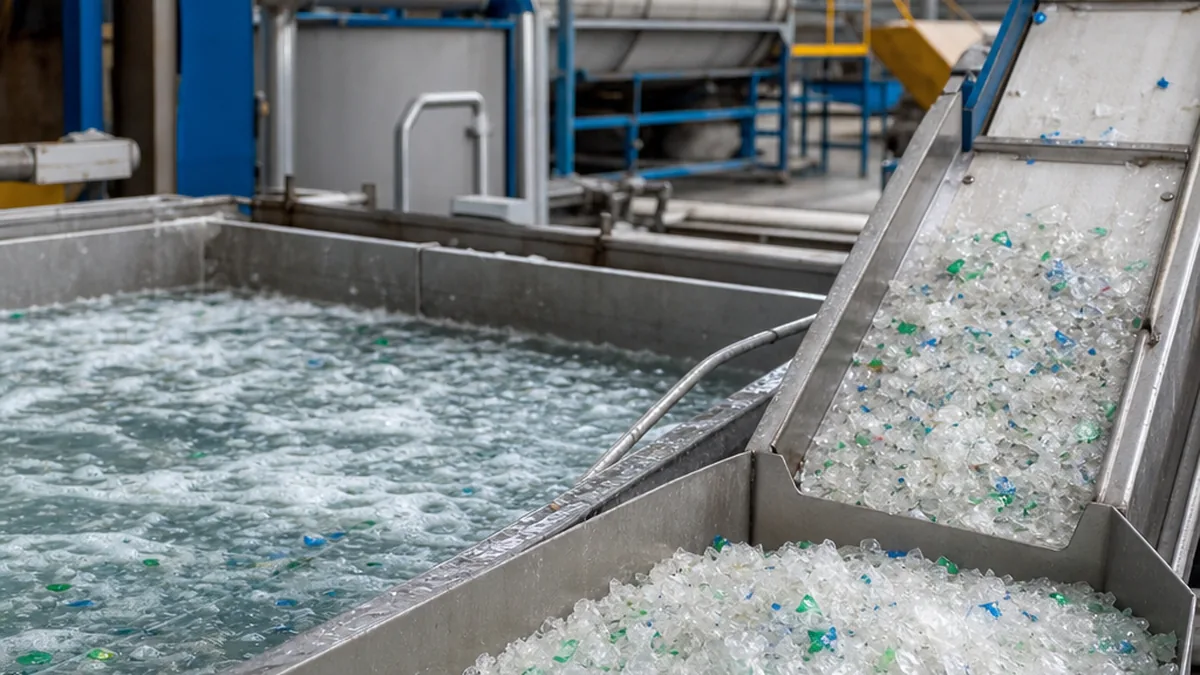
Quick takeaways
- Sodium hydroxide (NaOH) at 1–3% concentration, 80–95 °C, 15–30 minutes contact time removes labels, adhesives, oils, and surface contamination from PET flakes without degrading the polymer backbone — if pH and temperature are held in spec.
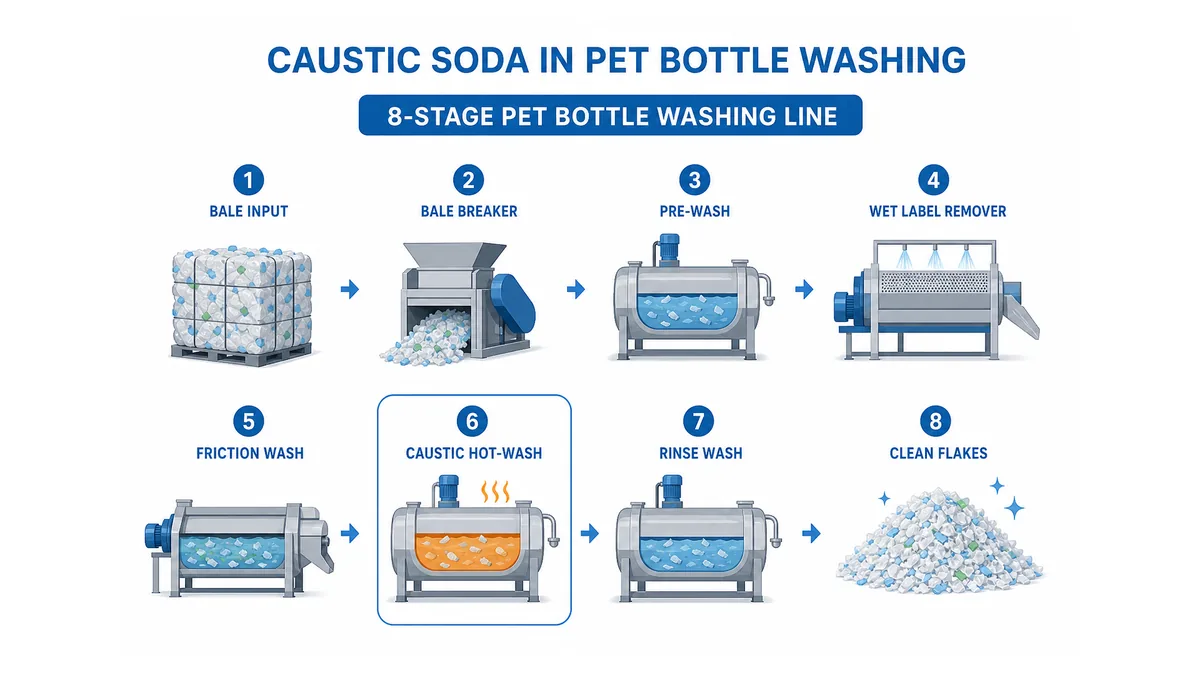
- The hot-wash caustic tank is Stage 3 in a standard 8-stage PET bottle washing recycling line; skipping or under-dosing it directly reduces flake color grade and intrinsic viscosity of the final pellet.
- NaOH concentration above 5% or temperatures above 95 °C begins saponification — it attacks PET’s ester bonds and reduces molecular weight, which shows up as brittleness and off-spec IV readings at the extruder.
- Wastewater from the caustic wash stage requires pH neutralization before discharge; U.S. EPA pretreatment standards under 40 CFR Part 414 govern this for industrial plastic processors.
- A complete PET bottle washing line with hot-wash caustic system is priced from roughly $150,000 for a 500 kg/h unit to $800,000+ for a 3,000 kg/h fully automated plant; caustic soda operating cost typically runs $8–18 per metric ton of clean flakes processed.
Before You Start
What “PET” actually means here
PET stands for polyethylene terephthalate — a thermoplastic polymer formed by condensation polymerization of ethylene glycol and terephthalic acid. The full form “pet water bottle” is just a consumer shorthand for a bottle made from this resin. Understanding the chemistry matters because caustic soda does not interact the same way with HDPE or PP; a washing protocol designed for polyethylene terephthalate will over-etch those materials.
What you will need
- A PET bottle washing line (or specification sheet for a line you are sourcing) with a dedicated hot-wash caustic tank
- Food-grade or industrial-grade sodium hydroxide (NaOH, minimum 98% purity); available from distributors such as Univar Solutions, Brenntag, or Olin Corporation across the U.S.
- A calibrated pH meter or inline pH probe rated for 90 °C service
- Temperature controllers on the hot-wash tank (PID preferred)
- A wastewater treatment system capable of neutralizing pH 12–13 effluent
- OSHA SDS for sodium hydroxide on-site; PPE: neoprene gloves, face shield, chemical-resistant apron
Knowledge prerequisites
- Basic understanding of PET recycling process flow (pre-sort → shredding → washing → drying → pelletizing)
- Familiarity with wastewater pH discharge limits in your local EPA region (check your NPDES permit or 40 CFR Part 414)
- If you are specifying new equipment: capital budget, throughput target in kg/h, and target flake grade (food-contact vs. fiber vs. strapping)
Step 1: Understand What Caustic Soda Actually Does to PET Bottles
Why this matters: If you only know that “caustic cleans bottles,” you will dial in the wrong concentration and either under-clean the flakes or begin hydrolyzing the PET polymer itself — both of which cost money downstream.
Sodium hydroxide in water dissociates completely into Na⁺ and OH⁻ ions. The hydroxide ion is what does the work in a PET bottle washing process. It attacks three distinct targets on a contaminated bottle:
- Label adhesives (hot-melt or water-based acrylics): The ester or acrylate bonds in adhesive polymers saponify under alkaline conditions, converting the adhesive to a water-soluble salt. This is why label removal in the caustic bath is far more complete than in a cold-water rinse alone.
- Paper and pulp fibers from labels: NaOH at even low concentrations (0.5–1%) swells cellulose fibers and breaks hydrogen bonding, causing label pulp to disperse into the wash water rather than sticking to the flake surface.
- Oils, fats, and surfactant residues: Saponification converts fatty acids to soap; the NaOH solution then carries them out of the wash stage. This is critical for bottles that previously contained cooking oil, personal care products, or industrial fluids.
What sodium hydroxide does NOT efficiently remove: inorganic silicates, some mineral-filled inks, and chlorinated solvents. Those require additional mechanical friction (a high-friction washer or hot-wash scrubber) or a separate solvent step — NaOH alone is not sufficient for every contamination type.
💡 Pro tip: Test your incoming bale’s contamination profile before specifying caustic concentration. A bale mix that includes cooking-oil bottles needs a higher NaOH concentration (2–2.5%) and longer residence time than a clean post-consumer beverage bale (1–1.5%). Ask your bottle scrap supplier for a contamination assay — any reputable U.S. rPET feedstock broker can provide one.
Common mistake: Operators who see persistent adhesive residue on flakes increase NaOH concentration past 3% without increasing rinse capacity. The result is caustic carry-over onto the finished flake surface, which shows up as elevated ash content and alkaline pH in the flake batch — both are rejection criteria for food-contact rPET buyers.
Step 2: Map the Caustic Stage onto the Full PET Bottle Washing Line
Why this matters: The hot-wash caustic tank only works if upstream stages have removed gross contamination. Putting heavily soiled bottles directly into the caustic bath loads the NaOH solution with dirt and paper, exhausting the chemical rapidly and requiring far more frequent solution changeovers.
A standard PET bottle washing line runs in this sequence:
- Bale breaking and sorting — manual or automated removal of non-PET materials (metal cans, HDPE, PVC)
- Pre-washing / trommel rinse — cold water removes loose dirt, sand, and label fragments
- Label removal / air classifier — air separation of dry labels before wet processing
- Crushing / shredding — bottles reduced to 10–25 mm flakes to maximize surface area for chemical washing
- Float-sink separation — water density separation removes PVC (sinks) from PET (sinks at higher density) and PP/HDPE caps (float); PET sinks at ~1.38 g/cm³
- Hot caustic wash tank ← this is the sodium hydroxide stage
- Hot water rinse (2–3 stages) — removes NaOH carry-over and remaining dissolved contaminants
- Centrifugal dewatering — removes bulk water before drying
- Friction dryer / hot-air dryer — reduces moisture to <1% for pelletizing
The caustic stage sits at Step 6 for a reason: the flakes are already shredded (maximum surface contact), labels are already mechanically removed (less pulp load on the NaOH bath), and float-sink has already pulled PVC (which behaves differently under alkaline treatment). Repositioning the caustic tank earlier in the PET bottle washing recycling line degrades its efficiency and increases chemical consumption per ton of output.
Common mistake: Many smaller U.S. operators skip the float-sink tank to reduce capital cost. When PVC fragments reach the hot caustic bath, NaOH accelerates HCl off-gassing from PVC degradation — a health and safety hazard, and a source of chlorine contamination in the finished flake that disqualifies it from most food-contact applications.
Step 3: Set the Correct Caustic Soda Parameters
Why this matters: Three variables — NaOH concentration, temperature, and residence time — interact multiplicatively. Getting one wrong while optimizing the other two still produces off-spec flakes.
NaOH Concentration
The industry standard for a hot washing PET bottle washing process is 1.5–3% NaOH by weight in solution. Here is what the data shows at different concentration bands:
- Below 1%: Adhesive removal is incomplete; paper pulp remains bonded to flake surfaces. Color grade drops; optical sorter rejection rates increase at the pelletizing plant.
- 1–2%: Effective for clean post-consumer beverage bottles with water-based label adhesives. Most municipal recycling stream PET falls here.
- 2–3%: Required for mixed-application bottles (cooking oil, personal care, industrial). The higher alkalinity handles hot-melt adhesives and ester-based coatings.
- Above 3%: Marginal cleaning improvement; significant saponification risk to the PET polymer surface begins. Above 5%, measurable intrinsic viscosity (IV) reduction occurs — confirmed in peer-reviewed PET hydrolysis research[1]. This is the zone where you are cleaning the bottle and degrading its value simultaneously.
Temperature
The hot-wash stage operates at 80–95 °C. Below 75 °C, hot-melt adhesive softening is insufficient. Above 95 °C, the energy cost rises sharply (you approach water’s boiling point) and the rate of alkaline surface hydrolysis of the polyethylene terephthalate accelerates.
At our facility and in the equipment we configure for U.S. customers, we hold 85–90 °C as the operational sweet spot — high enough for complete adhesive saponification, low enough to protect IV and surface finish.
Residence Time
15–30 minutes in the caustic solution at temperature. This is not a throughput variable to shave; insufficient contact time is the single most common cause of sticky flakes on output. A higher-friction mechanical action (agitation paddles or a screw conveyor inside the hot-wash tank) can reduce required residence time to 15 minutes; a simple soaking tank needs closer to 25–30 minutes for equivalent cleaning.

| Item | Value |
|---|---|
| 0.5% | 850.0 |
| 1.0% | 320.0 |
| 1.5% | 110.0 |
| 2.0% | 45.0 |
| 2.5% | 28.0 |
| 3.0% | 22.0 |
| 4.0% | 20.0 |
| 5.0% | 19.0 |
| NaOH Concentration | Adhesive Residue (ppm) | IV Risk |
|---|---|---|
| 0.5% | ~850 ppm | None |
| 1.0% | ~320 ppm | None |
| 1.5% | ~110 ppm | None |
| 2.0% | ~45 ppm | None |
| 2.5% | ~28 ppm | Low |
| 3.0% | ~22 ppm | Low–Moderate |
| 4.0% | ~20 ppm | Moderate |
| 5.0%+ | ~19 ppm | High |
Common mistake: Operators reduce residence time to increase throughput, then compensate by raising NaOH concentration. This trades polymer quality for throughput — the wrong trade for any buyer targeting food-contact or fiber-grade rPET markets.
⚠️ Warning: Never mix liquid sodium hydroxide concentrate directly into a closed plastic container for dilution. NaOH dissolution is highly exothermic — diluting 50% NaOH solution generates enough heat to warp or crack standard HDPE tanks. Use a stainless steel mixing tank with an agitator, add NaOH to water (never water to NaOH), and allow cooling before pumping to the hot-wash bath.
Step 4: Manage the Caustic Wash Solution — Monitoring and Changeover
Why this matters: NaOH solution is consumed as it reacts. An exhausted bath that reads pH 11 instead of pH 12.5–13 is doing a fraction of the cleaning work, but your operators may not notice until flake quality degrades.
Monitoring protocol
- Inline pH probe: Install a pH probe rated for 90 °C and NaOH service. Log pH every 15 minutes automatically. Target: 12.5–13.0 during washing operation.
- Titration check: Once per shift, draw a 100 mL sample, cool to room temperature, and back-titrate against 0.1 M HCl to verify actual NaOH concentration. pH alone can read falsely high if dissolved organics buffer the solution.
- Total dissolved solids (TDS): As the bath accumulates dissolved adhesives, surfactants, and label pulp, TDS rises. Above ~8,000 mg/L TDS, cleaning efficiency drops even if pH remains correct. TDS is the real exhaustion indicator.
Solution changeover
A properly loaded PET bottle washing line at 1,000 kg/h throughput will exhaust a 2% NaOH bath (in a 5,000-liter tank) in approximately 18–24 hours of continuous operation, depending on incoming contamination load. Plan changeovers during shift transitions; drain the exhausted bath to your wastewater treatment system, rinse the tank, and refill.
📝 Note: Some operators run a continuous bleed-and-feed system — continuously dosing fresh NaOH while bleeding spent solution to WWT. This maintains stable bath chemistry and avoids the throughput disruption of full changeovers. The downside is higher instantaneous NaOH consumption and a larger wastewater treatment load. For operations above 1,500 kg/h, the bleed-and-feed approach is almost always more cost-effective.
Step 5: Handle Wastewater Correctly
Why this matters: Discharging alkaline wastewater without treatment is an EPA violation. The caustic wash stage generates pH 12–13 effluent loaded with dissolved adhesives, surfactant salts, and suspended paper pulp. In the U.S., this is regulated industrial wastewater under 40 CFR Part 414[2].
Minimum treatment steps for caustic wash effluent
- Equalization tank: Buffer flow from the batch changeovers; prevents treatment system shock.
- pH neutralization: Dose with CO₂ (preferred — avoids adding chloride salts) or dilute sulfuric acid. Target: pH 6–9 for most POTW pretreatment permits; confirm with your local publicly owned treatment works (POTW) pretreatment coordinator.
- Coagulation/flocculation: Alum or ferric sulfate to precipitate suspended adhesive salts and paper fiber. Settle in a clarifier; dewater sludge for landfill disposal.
- Final pH check before discharge.
A properly operated PET bottle washing plant will consume approximately 3–6 liters of water per kilogram of clean flake output. At 1,000 kg/h, that is 3,000–6,000 liters of wastewater per hour to process. Budget for this in your plant design; many U.S. operators undersize their WWT systems and then face consent order violations within the first year of operation.
What Chemical Is Used to Wash PET Flakes?
Sodium hydroxide (NaOH) — caustic soda — is the primary chemical agent in an industrial PET bottle washing process, used at 1.5–3% concentration in a hot aqueous solution. Some lines supplement NaOH with a non-ionic surfactant (0.1–0.5% by weight) to improve wetting of hydrophobic contaminants and accelerate dispersion of adhesive fragments. Surfactant addition improves cleaning of bottles that previously contained oils or waxes but adds to the WWT chemical oxygen demand (COD) load.
For bottle flakes destined for food-contact applications, the caustic stage is followed by a solid-state polycondensation (SSP)[3] step, which further reduces contaminant migration — but SSP does not substitute for the caustic clean; it only works on already-clean, already-dried flakes.
Can Caustic Soda Damage PET Plastic?
Yes — under the wrong conditions. At concentrations above 3% and temperatures above 95 °C, sodium hydroxide begins hydrolyzing the ester linkages in polyethylene terephthalate’s backbone. This process is called alkaline hydrolysis or saponification of PET, and it results in:
- Reduced intrinsic viscosity (IV) — the direct measure of molecular weight in PET. Food-contact rPET requires IV ≥ 0.72 dL/g; polymer degraded by excessive NaOH treatment can drop below 0.65 dL/g, making it unsuitable for bottle-to-bottle recycling.
- Surface etching — visible as haze or whitening on the flake surface, increasing optical sorter rejection rates.
- Increased carboxyl end-group concentration — which accelerates thermal degradation during extrusion.
Under the correct operating window (1.5–3% NaOH, 80–95 °C, 15–30 minutes), published research on NaOH treatment of PET[4] confirms no statistically significant IV reduction. The polymer is stable in alkaline solution at these parameters — the cleaning is surface chemistry, not bulk polymer chemistry.
Can You Mix Caustic Soda in a Plastic Container?
For industrial-scale mixing, no — not in standard HDPE or polypropylene containers. The exothermic heat of NaOH dissolution can exceed 80 °C in a concentrated mix, which is above the heat deflection temperature of most commodity polyolefins. At high concentrations, NaOH also stress-cracks HDPE over time.
For the small-volume question relevant to lab testing or manual cleaning — a food-grade HDPE pail (not a thin-wall bottle) can handle dilute NaOH (below 5%) at room temperature for short durations. The HDPE chemical resistance data[5] from resin suppliers shows acceptable resistance at ambient temperature for up to 30% NaOH, but resistance drops sharply above 60 °C.
The practical rule: for anything above 10-liter volumes or above ambient temperature, use stainless steel (304 or 316) mixing and storage vessels. This is standard specification on every PET bottle washing machine we build.
How to Clean PET Bottles: Industrial vs. Small-Scale Methods
How to Wash a Water Bottle for the First Time (Consumer Use)
This question enters our keyword data from consumers cleaning a new reusable PET water bottle, so we answer it directly: for a new consumer PET water bottle, warm water and a drop of dish soap is sufficient. Rinse thoroughly. No caustic soda — household drain cleaner concentrations (typically 30% NaOH) will etch the inner surface and leave a chemical residue. For routine cleaning of a reusable PET water bottle, a bottle brush, warm water at 40–50 °C, and mild dish soap removes biofilm without any risk to the material.
How to Clean PET Water Bottles in an Industrial Recycling Context
The consumer cleaning question and the industrial question are different problems entirely. Industrial cleaning of PET bottles prior to recycling involves:
- Crushing to flakes (you cannot effectively clean a whole bottle at industrial throughputs)
- Caustic hot-wash at the parameters described above
- Multiple rinse stages
- Centrifugal drying
Any industrial operation trying to clean whole PET bottles rather than flakes will have severe limitations: the inside surface of a whole bottle cannot be reached by a hot caustic solution in a continuous washing machine. This is why every commercial pet bottle washing line shreds before washing.
PET Bottle Washing Machine Price: What to Budget in 2026
Pet Bottle Washing Machine Price Benchmarks
Buyers sourcing a PET bottle flakes washing machine in the U.S. market in 2026 should expect:
| Line Capacity | Configuration | Estimated Landed Cost (U.S.) |
|---|---|---|
| 300–500 kg/h | Semi-automatic, hot-wash included | $120,000–$200,000 |
| 500–1,000 kg/h | Fully automatic, hot-wash + WWT | $250,000–$450,000 |
| 1,000–2,000 kg/h | Full plant, inline QC, SSP-ready | $450,000–$750,000 |
| 2,000–3,000 kg/h | High-volume industrial | $750,000–$1,200,000+ |
These are CIF U.S. port estimates; installation, civil works, and utilities are additional. The pet bottle scrap washing machine price varies by the number of washing stages included — a line with only a cold-wash stage is 30–40% cheaper than one with a full hot caustic wash system, but it cannot produce food-contact grade flakes.
The pet bottle flakes hot washing machine price carries a premium specifically for the hot-wash tank, heat exchanger, and temperature control system — add roughly $40,000–$80,000 to a cold-wash baseline for this module.
💡 Pro tip: Always ask for a separate line item on the hot-wash tank and temperature control system in your quotation. Suppliers who bundle it into a single price make it impossible to compare apples-to-apples with competing bids. We quote every subsystem separately precisely because our customers need to validate each component’s specification, not just the total number.
Pet Bottle Flakes Washing Machine Price vs. Operating Cost
A common sourcing error: choosing the lowest-capital-cost line without accounting for chemical operating cost. A lower-quality hot-wash tank with poor agitation requires 2.5–3% NaOH to achieve the same cleaning that a high-turbulence design achieves at 1.5%. At 1,000 kg/h throughput and 6,000 operating hours/year:
- 1.5% NaOH consumption ≈ 270 metric tons/year of NaOH
- 3.0% NaOH consumption ≈ 540 metric tons/year of NaOH
- At $400–500/ton industrial NaOH (U.S. 2026 pricing from Olin Corporation pricing data[6]): $108,000–$135,000 per year in extra chemical cost from choosing the cheaper machine
Over a 10-year machine life, that operating cost delta exceeds the initial capital saving by a factor of 3–5x.
Can Caustic Soda Harm Animals? (A Note for Mixed-Use Facilities)
This question appears in our PAA data because some readers are managing facilities where pets or working animals are present. The answer is direct: sodium hydroxide is severely caustic to biological tissue — it causes immediate chemical burns on contact with skin, eyes, or mucous membranes in all mammals. For facilities where animals might be present (a rural processing site, for example), secure chemical storage and secondary containment are not optional.
Caustic soda has no place near animal living areas. Any NaOH spill must be neutralized with dilute acid (citric acid or vinegar for small spills; sulfuric acid solution for industrial spills) and the area thoroughly rinsed before animal access. The OSHA PEL for NaOH airborne particulate is 2 mg/m³; misting or spraying NaOH solutions generates aerosol that can cause respiratory irritation in both workers and animals in the area. This is a facility design consideration, not just a safety poster item.
Key Facts at a Glance
| Parameter | Specification |
|---|---|
| NaOH concentration range | 1.5–3% (industrial PET washing) |
| Hot-wash temperature | 80–95 °C |
| Residence time | 15–30 minutes |
| pH of spent caustic bath | 12.0–13.0 |
| Target flake adhesive residue | <50 ppm (food-contact) / <200 ppm (fiber) |
| Wastewater discharge target pH | 6.0–9.0 (per 40 CFR Part 414) |
| IV threshold for food-contact rPET | ≥ 0.72 dL/g |
| NaOH above which PET hydrolysis risk begins | >3% at >90 °C |
| Typical water consumption | 3–6 L per kg of clean flake |
| NaOH operating cost | $8–18 per metric ton of clean flakes |
Troubleshooting Common Caustic Wash Problems
Problem 1: Flakes still have adhesive residue after hot-wash – Cause A: NaOH bath exhausted — TDS too high, pH below 12.0. – Fix: Titrate the bath; if NaOH is below 1.2%, drain and recharge. Implement a TDS bleed-and-feed dosing system. – Cause B: Residence time too short (< 15 min at 85 °C). – Fix: Reduce feed rate or extend the caustic tank length; verify that the screw conveyor pitch is correct for the design throughput.
Problem 2: Flakes are hazy/white after washing – Cause: NaOH concentration too high (>3%) or temperature too high (>95 °C) — surface hydrolysis of the polyethylene terephthalate is occurring. – Fix: Reduce NaOH to 2%, verify temperature controller calibration, check that the heat exchanger is not over-shooting. Test IV on a batch sample.
Problem 3: Wastewater treatment system struggling with pH spikes – Cause: Batch changeovers dumping concentrated spent caustic in large volumes to WWT. – Fix: Install an equalization tank upstream of the neutralization reactor (minimum 2× the caustic tank volume). Convert to continuous bleed-and-feed chemistry if throughput exceeds 1,000 kg/h.
What to Do Next
If you are at the specification stage for a new PET bottle washing line, the next decision point is whether to include an SSP module for food-contact-grade output — solid state polycondensation for food-contact rPET covers the criteria and capital cost benchmarks.
If you are troubleshooting an existing line’s caustic stage performance, request a PET flake quality testing and washing line audit service — we have audited lines from 12 U.S. processors since 2020 and can identify caustic-stage underperformance from a flake sample and your operating logs, before you invest in new equipment.
For buyers comparing full PET bottle washing plant configurations, PET bottle washing line machine comparison guide walks through the 8-stage line configuration decisions in detail, with capital and operating cost models.
At Elant, we have manufactured PET bottle washing recycling lines since the early 2000s, and a consistent pattern we see across U.S. customers is that the caustic stage specification gets the least attention during the procurement process — buyers focus on throughput and shredder power, then discover six months post-startup that their hot-wash chemistry is the binding constraint on flake quality. The parameters in this guide are what we commission every line to, and they are what Elant PET washing line technical specifications documents in our standard factory acceptance test protocol.
FAQ
What chemical is used to wash pet flakes?
Sodium hydroxide, commonly called caustic soda, is the primary chemical used to wash PET flakes in industrial recycling lines. It is typically applied as a hot aqueous solution at concentrations between 1% and 3% NaOH by weight, combined with temperatures ranging from 176°F to 194°F. This alkaline bath removes label adhesives, food residue, and surface contamination. Surfactants are often added to improve soil suspension and prevent redeposition on the cleaned flake surface.
Can caustic soda damage plastic?
Caustic soda can damage certain plastics but is generally safe for PET under controlled conditions. PET is relatively resistant to dilute sodium hydroxide at moderate temperatures, but excessive concentration above 3% or prolonged exposure at high heat can cause surface hydrolysis, reducing intrinsic viscosity and degrading flake quality. Plastics like polycarbonate and some nylons are far more vulnerable. In a PET wash line, staying within validated concentration and temperature parameters protects flake integrity and downstream pellet quality.
Can you mix caustic soda in a plastic container?
You can mix caustic soda in certain plastic containers, but the container material matters. High-density polyethylene and polypropylene tanks are standard choices in industrial PET wash systems because they resist sodium hydroxide at typical process concentrations. PVC and lower-grade plastics can degrade or leach under hot, concentrated NaOH. Always verify the chemical compatibility rating of any vessel before use, and account for the significant heat generated when dissolving caustic soda flakes or prills in water to avoid thermal stress cracking.
Sources
[1] Advances in chemical recycling of polyethylene … — sciencedirect.com
[2] Organic Chemicals, Plastics and Synthetic Fibers Effluent … — epa.gov
[3] Submissions on Post-Consumer Recycled (PCR) Plastics for … — cfsanappsexternal.fda.gov
[4] Comparative techniques for molecular weight evaluation of … — sciencedirect.com
[5] Chemical Compatibility Chart – LDPE, HDPE, PP, Teflon … — calpaclab.com
[6] Sodium Hydroxide — olinchloralkali.com