
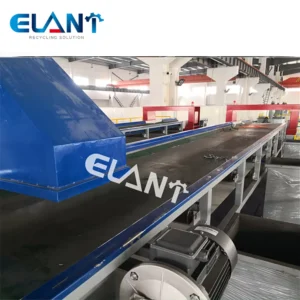
Even a 0.02% residual moisture content in PET flakes — two-hundredths of a single percent — is enough to trigger hydrolytic degradation during melt processing, dropping intrinsic viscosity by 15–20% and making finished fiber or sheet brittle. That single number explains why PET flake drying temperature and moisture control is the one process step recyclers and converters cannot shortcut.
- Target residual moisture content ≤ 0.004% (40 ppm) before PET enters the extruder.
- Drying temperature window: 160–180 °C for crystallized flakes; never exceed 190 °C or you risk thermal yellowing.
- Dew point of the drying air must stay at or below −40 °C for reliable results.
- Drying time in a dehumidifying hopper dryer: typically 4–6 hours at the correct temperature and air flow rate.
- The dryer fits immediately upstream of the extruder throat — it is not optional equipment in any serious PET recycling line.
What you need to know: PET is hygroscopic — it absorbs atmospheric moisture quickly after washing and drying in the mechanical recycling process. A freshly washed flake lot can reabsorb enough moisture in 30 minutes of open-air exposure to fail the 40 ppm threshold. Processors who handle PET like a non-hygroscopic material (e.g., HDPE) consistently generate degraded melt.
Equipment required:
| Item | Specification |
|---|---|
| Dehumidifying hopper dryer | Capacity matched to extruder throughput (kg/hr) |
| Dew-point sensor | Inline, on dryer return air line, range −60 to 0 °C |
| Infrared or Karl Fischer moisture analyzer | For incoming flake QC, target < 200 ppm pre-dryer |
| Thermocouples | Hopper wall + air inlet, ±2 °C accuracy |
| Insulated transfer conveyor | Closed system between dryer and extruder |
In our experience at Elant, customers who skip the inline dew-point sensor are the ones calling us six months later about inconsistent IV loss. The sensor costs less than one rejected production run.
Step 1: Pre-Sort and Inspect Incoming PET Flakes
Contaminated or non-crystallized flakes have different moisture absorption profiles. Clear PET flakes from bottle recycling absorb moisture differently than colored flakes or flakes mixed with PET-G, which has a lower softening point and will cake in the dryer at standard PET drying temperature.
Sort flakes by color and polymer type before loading the dryer. Run a quick sink-float test on mixed lots — PET sinks in water (density 1.33–1.38 g/cm³), while PET-G and many contaminants float or behave differently. Verify that the material is fully crystallized; amorphous PET sheet flakes must pass through a crystallizer at 140–160 °C before hopper drying, or they will agglomerate.
Loading mixed flake types into a single dryer batch. The drying time and temperature optimized for one type will under-dry or over-stress the other. Keep material streams separate through the entire drying process.
Step 2: Set the Correct Drying Temperature and Air Flow
The drying temperature directly controls the rate of moisture diffusion out of the PET matrix. Too low (below 150 °C) and diffusion is slow — you’ll need 8+ hours to hit 40 ppm, which kills throughput. Too high (above 190 °C) and you initiate thermal oxidation before the material even reaches the extruder.
Set the hopper dryer air inlet to 160–180 °C. For fiber-grade PET recycling applications, most processors target 170 °C. For food-contact rPET sheet, stay at the lower end of the range and extend drying time to 5–6 hours to minimize any thermal history.
Air flow rate matters as much as temperature. A rule of thumb: 1.0–1.2 m³/hr of dry air per kilogram of PET per hour of throughput. Under-flowing the dryer means the hot air saturates quickly and stops pulling moisture from the flakes in the lower hopper zone.
Check the return air dew point, not just the supply air. If the return air dew point is rising toward −20 °C, your air flow is too low or your desiccant bed needs regeneration. The delta between supply and return dew point is the real indicator of dryer health.
Trusting the temperature setpoint without verifying actual hopper bed temperature. In a large-volume hopper, the core of the flake bed can run 15–20 °C below the wall thermocouple reading. Use a probe thermometer in the flake mass at startup.
Step 3: Monitor and Maintain Dew Point Below −40 °C
Why this matters: Dew point is the actual control variable for moisture control in PET drying — temperature alone tells you nothing about the water-carrying capacity of the air moving through the flakes. Air at 170 °C but with a dew point of 0 °C carries almost no drying potential. The same air at a dew point of −40 °C has roughly 130× less moisture and pulls aggressively from the flake surface.
Check the inline dew-point sensor at least once per shift. If the reading climbs above −35 °C, the molecular sieve desiccant bed is nearing saturation. Most dehumidifying dryers run two desiccant towers alternately — one drying, one regenerating. If regeneration cycle time has been shortened to save energy without recalibrating, the dew point of the supply air rises and drying time to reach 40 ppm moisture content can jump from 4 hours to 7+ hours.
Step 4: Verify Residual Moisture Before Release to Extruder
The drying process does not have a visible endpoint. Operators who rely on “it’s been 5 hours at 170 °C, it must be dry” are guessing. We’ve seen lots from customers with correctly set dryers that still failed the 40 ppm threshold because a blocked air distribution plate starved the bottom third of the hopper.
Use a Karl Fischer titration analyzer or a fast-response capacitance moisture meter on a pulled sample before opening the discharge gate. Target: ≤ 40 ppm (0.004%). For food-contact rPET sheet applications, some converters require ≤ 20 ppm.
Log each lot: material source, incoming moisture content (pre-dryer), drying temperature, drying time, dew point at start and end, and final measured moisture content. That log is your corrective action baseline when the extruder starts showing IV drop or gels.
Once dried PET flakes exit the hopper, reabsorption begins immediately. Transfer time from dryer discharge to extruder throat should be under 10 minutes in an enclosed, low-humidity environment. Open belt conveyors in humid summer conditions in the southern United States can reintroduce 50–80 ppm of moisture within 20 minutes.
Common mistake: Testing only the top layer of the hopper on a sampled-pull basis. Moisture content varies through the flake bed depth. Pull from the discharge outlet — that’s what the extruder actually sees.
Why Drying PET Flakes Is Non-Negotiable in Any Recycling Line
The intrinsic viscosity (IV) loss caused by undried PET is irreversible inside a single-screw extruder. In polyethylene terephthalate melt processing at 270–290 °C, degradation starts as soon as the pet molecule enters the barrel above 50 ppm moisture: water triggers hydrolysis reactions, and no downstream additive package can fully restore the molecular weight or fully offset thermal degradation in the recycled material. The resulting material produces fiber with lower tenacity, sheet with reduced impact strength, and strapping with poor elongation at break, which also weakens end-use mechanical properties.
In a typical PET recycling line, the dryer sits between the washing/flaking section and the extruder feed throat for PET bottles after the washing and flaking stages in bottle-recycling lines. Its position is not decorative: the ASTM D7209 standard for rPET[[1]](LINK 2) and fiber-grade PET purchasing specifications from major U.S. converters require the moisture level in PET flakes to be reduced below 50 ppm to prevent degradation, with many buyers setting even tighter limits at ≤ 30 ppm for grade rpet and bottle grade applications. Missing that spec means a rejected tanker load, not a re-run.
Producing high quality rpet depends not only on low final moisture but also on keeping contamination low through the upstream cleaning and drying stages.
For the U.S. market specifically, brand owners sourcing recycled PET for food-contact packaging must satisfy FDA guidance on recycled plastic food contact…[[2]](LINK 4), which requires validated decontamination including moisture removal steps. Inadequate drying documentation is one of the most common reasons FDA challenge test submissions fail, especially for food grade applications, whether the output is later used in injection molding, rigid packaging, or flexible films.
Main Types of PET Flakes Dryers, Including Desiccant Dryer, and How They Work
Three dryer types appear in U.S. PET recycling lines, each with a different application fit, though many plants combine multiple drying stages across their drying systems as part of a complete PET setup:
| Dryer Type | Drying Temperature | Typical Drying Time | Best Application |
|---|---|---|---|
| Dehumidifying hopper dryer | 160–180 °C | 4–6 hrs | Fiber spinning, sheet extrusion |
| Vacuum paddle dryer | 120–160 °C | 3–5 hrs | Heat-sensitive grades, low-energy |
| Desiccant rotary drum dryer | 150–175 °C | 4–7 hrs | Large-volume PET recycling |
Hot air drum-style units use heated air, and typically consume about 80–120 kWh per ton of PET flakes.
The dehumidifying hopper dryer is the most common type in U.S. bottle-to-fiber operations. It circulates heated, dehumidified air through a vertical hopper, with flakes moving by gravity from top to bottom. Dew point of the supply air is the critical process parameter.
Vacuum paddle dryers remove moisture without a dry air stream — the reduced pressure lowers water’s boiling point, pulling it out of the PET matrix at lower temperatures. They use less energy per kilogram dried, and can pull moisture below 40 ppm without regeneration filters, but require higher capital cost and more maintenance on the mechanical seals. We see these most often in specialty rPET applications where thermal drying of heat-sensitive recycled material must be minimized.
Infrared conveyor dryers can cut drying time by about 80% versus convection drying, so they are sometimes proposed as a cheaper alternative for pre-drying. In our assessment, they are useful for reducing surface moisture after washing (dropping a 3,000 ppm wet flake to 200–400 ppm), but they cannot achieve the ≤ 40 ppm moisture content required before extrusion. They are one of several drying methods, not final drying equipment — a distinction that vendors sometimes gloss over, especially when they imply crystallization at high temperatures can be replaced outright by faster pre-drying at lower temperatures.
Energy Efficiency: Reducing Drying Costs Without Cutting Corners
Drying is the largest single energy consumer in most PET flake processing lines — typically 60–90 kWh per metric ton of throughput, depending on incoming moisture content and dryer efficiency. In 2025, with U.S. industrial electricity averaging $0.077–$0.095/kWh (EIA 2025 industrial electricity rates[[3]](LINK 2)), that is $4.60–$8.55 per ton just for drying energy. By comparison, hot air drum dryers consume 80–120 kWh per ton of PET flakes, so pre-drying has a direct effect on energy costs.
Three interventions cut that number without compromising the 40 ppm target:
- Reduce incoming moisture before the hopper dryer. Mechanical dewatering on the washing line removes surface water and typically reduces moisture to 2–4% in one pass before the hopper dryer. This mechanical moisture removal is required before thermal drying of PET flakes, not just helpful for cutting load on the system. As a low-energy benchmark, centrifugal dewatering typically uses 30–55 kWh per ton for water removal, using high speed spinning to strip off surface water before flakes enter thermal drying; insufficient centrifugal dewatering leaves excess moisture in the flakes before thermal drying, increasing dryer load. If flakes go in with high moisture content, they are more likely to clump as the process heats up. An infrared pre-dryer can serve as an intermediate stage, and at this pre-drying step infrared dryers can reduce drying time by roughly 80% compared with convection methods while thermal flash drying lowers outlet moisture to 0.3–0.8% in 30–60 seconds. That step reduces moisture further and helps stabilize final moisture before extrusion.
- Insulate the hopper. Uninsulated hoppers in ambient U.S. summer conditions (35 °C, 70% RH in the Southeast) lose 8–12% of input heat to the environment. A 50mm mineral wool wrap on a standard 500 kg hopper pays back in under 90 days on energy savings alone.
- Right-size the dryer to extruder throughput. Oversized hoppers mean long residence time at temperature — more energy input than the moisture removal requires. Match hopper volume to 4–5× the extruder’s hourly consumption rate, not to “maximum possible batch.”

PET drying energy consumption by pre-drying method
| Item | Value |
|---|---|
| No pre-dry | 88.0 |
| Centrifugal spin dryer | 61.0 |
| IR conveyor pre-dryer | 54.0 |
| Spin + IR combined | 47.0 |
| Pre-drying Method | Estimated kWh/metric ton |
|---|---|
| No pre-drying | 88 |
| Centrifugal spin dryer only | 61 |
| IR conveyor pre-dryer only | 54 |
| Spin + IR combined | 47 |
Troubleshooting Common PET Dryer Problems
Problem 1: IV drop persists even after confirmed 4-hour drying time
The dew point of supply air is not actually reaching −40 °C — either the desiccant bed is spent or the regeneration temperature is set too low (should be 250–280 °C for full regeneration of molecular sieves).
Pull a dew-point log for the last 8 hours. If supply air dew point is above −35 °C at any point during the drying cycle, replace or recondition the desiccant. Verify regeneration heater output with an independent thermocouple to rule out under drying.
Problem 2: Flakes caking or bridging in the hopper
Amorphous PET flakes (e.g., from PET sheet or PET-G contamination) softening at 160 °C+ before crystallization is complete.
Add a pre-crystallizer step at 140 °C with mechanical agitation maintained as needed to prevent clumping of softened PET flakes before the hopper dryer. Do not increase drying temperature as a workaround — that accelerates softening.
Problem 3: Moisture content readings vary 30–80 ppm on consecutive samples from the same lot
Non-uniform air distribution in the hopper — typically a blocked or warped air distribution plate at the base.
During next scheduled shutdown, inspect and clean the distribution plate. Redistribute flake bed loading if the hopper is being filled unevenly from a side-feed conveyor.
What to Do Next
Once your drying process is stable and consistently hitting ≤ 40 ppm, the next leverage point is extruder temperature profile and screw design for rPET — the second place where molecular weight loss happens. Our team has written a detailed guide on that step: PET recycling extruder screw design and temperature profile
If you are specifying a new dryer for a U.S. PET recycling line and need to match equipment to throughput and incoming material type, our equipment selection checklist is a faster starting point than a vendor quote: PET flake dryer equipment selection guide.
For processors dealing with variable incoming flake quality — common in post-consumer bottle PET recycling — the upstream washing line affects everything downstream. In most lines, hot washing is the stage that removes labels, sugars, and other organics so final drying can do its job effectively. See our notes on PET bottle washing line configuration for consistent flake quality.
FAQ
What about Quick takeaways?
PET flakes must reach residual moisture below 0.005% before melt processing to avoid hydrolytic degradation. Target drying temperatures between 160°F and 180°F using a desiccant dryer, maintain dew point at or below minus 40°F, and verify moisture with an in-line or handheld Karl Fischer moisture analyzer. Drying time typically runs four to six hours depending on flake thickness and incoming moisture load. Skipping any step risks brittle output and intrinsic viscosity loss.
What about Before You Start?
Before starting PET flake drying, confirm your desiccant dryer is sized correctly for your throughput rate in pounds per hour. Inspect dryer seals, desiccant bed condition, and hopper insulation for air leaks that undercut dew point control. Have a calibrated moisture analyzer on hand to baseline incoming flake moisture, including the initial moisture content, which commonly ranges from 0.2% to 0.5% after washing, and note that hygroscopic PET can attract water molecules from the air during exposure or storage, reaching about 0.4–0.5% moisture. Also verify your process temperature controller is accurate, since even a 10°F deviation can compromise drying efficiency, and depending on the upstream stage, PET flakes are often preheated or crystallized at 135°C to 160°C before final drying control becomes critical.
What about Step 1: Pre-Sort and Inspect Incoming PET Flakes?
Pre-sorting removes contaminants that trap surface moisture or alter drying behavior. In PET bottle recycling lines, a friction washer often follows hot washing to scrub off stubborn glue, dirt, and label residue before flakes move toward drying. Check incoming PET flakes for mixed polymer contamination, excessive fines, clumping from wet storage, and inconsistent flake size. Crystallization converts sticky, amorphous PET into a crystalline structure before hopper drying. It can also reduce moisture to about 0.05–0.10% in 20–40 minutes, which helps you decide which incoming lots need presort handling before final drying. Fines below 2mm dry unevenly and can block dryer screens, causing localized moisture pockets. Use a vibratory screener to separate fines before loading the hopper. Sampling five to ten pounds from each lot for a quick moisture reading gives you a reliable starting point for setting dwell time and temperature.
How Does Hot Air Influence the Drying Process of PET Flakes?
Hot air plays a critical role in the drying process by transferring heat into PET flakes and accelerating moisture diffusion from the polymer structure. However, temperature alone is not enough. Effective drying requires properly controlled hot air combined with low-humidity conditions to achieve consistent moisture removal without damaging the material.
What Problems Can Excess Moisture Cause in Grade rPET Production?
Excess moisture can lead to hydrolytic degradation during extrusion, reducing molecular weight and negatively affecting product performance. In grade rPET production, excessive moisture may result in brittle pellets, reduced tensile strength, discoloration, and inconsistent processing behavior, making moisture control essential for quality assurance.
Which Drying Methods Are Most Common for PET Recycling Applications?
Common drying methods include dehumidifying hopper dryers, desiccant-based drying systems, vacuum drying equipment, and infrared pre-drying technologies. Each method offers different advantages depending on throughput requirements, energy efficiency goals, and target moisture specifications for recycled PET processing.
How Do Different Drying Systems Affect Final Moisture Levels in PET Flakes?
Drying systems vary in their ability to remove moisture from PET flakes. Advanced dehumidifying and desiccant-based systems generally achieve lower final moisture levels than conventional hot-air equipment. Proper system design, airflow management, and temperature control all contribute to consistent moisture reduction before extrusion.
Why Does Flake Size Matter During the PET Drying Process?
Flake size directly influences drying efficiency because smaller flakes have a larger surface-area-to-volume ratio, allowing moisture to escape more quickly. Larger or uneven flake sizes may require longer drying times to achieve uniform moisture distribution and prevent inconsistencies during subsequent processing steps.
What Is the Ideal Final Moisture Target Before Producing Grade rPET Pellets?
The ideal final moisture target depends on the application, but high-quality grade rPET production generally requires very low residual moisture before extrusion. Maintaining low final moisture helps preserve polymer properties, improve pellet quality, and reduce the risk of degradation during melt processing.
How Can Processors Reduce Drying Time Without Sacrificing PET Quality?
Processors can reduce drying time by improving mechanical dewatering, optimizing airflow, using efficient drying systems, and controlling flake size distribution. These measures help remove moisture more effectively before thermal drying, reducing overall energy consumption while maintaining product quality.
What Role Does Moisture Control Play in a Complete PET Recycling Line?
Moisture control is a key component of any complete PET recycling operation. From washing and dewatering to drying and extrusion, every stage influences the final moisture content of the material. Consistent moisture management helps improve process stability, maximize product quality, and increase the value of recycled PET output.
Can Hot Air Drying Systems Handle Different Flake Sizes Efficiently?
Yes, modern hot air drying systems can process a range of flake sizes, but efficiency depends on proper airflow distribution and residence time. Uniform flake size typically produces more predictable drying results, while mixed-size material may require process adjustments to ensure consistent moisture removal throughout the batch.
Why Is Drying Process Optimization Important for High-Quality Grade rPET Manufacturing?
Drying process optimization helps manufacturers achieve stable final moisture levels, reduce energy consumption, improve pellet consistency, and protect polymer properties. For high-quality grade rPET manufacturing, optimized drying conditions often translate directly into better product performance and greater customer acceptance.
Sources
[1] Applications Guidance Protocol for Recycled PET — plasticsrecycling.org
[2] Recycled Plastics in Food Packaging — fda.gov
[3] Electric Power Monthly – U.S. Energy Information … — eia.gov