
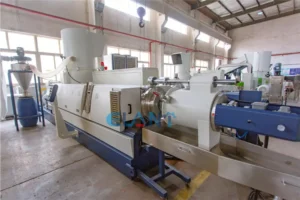
Quick takeaways
- Throughput drop of more than 12% at constant feed rate is the earliest measurable failure signal
- Unusual noise (grinding, rhythmic clicking, or high-pitched squeal) from the squeeze-roll assembly indicates bearing or gear wear
- Moisture in the output pellet or flake stream means the squeezing stage is no longer reaching target compression
- Overheating at the gearbox or roll shaft bearings — above 85°C sustained — precedes most mechanical failures by 2–4 weeks
- A complete diagnostic check takes one operator roughly 45 minutes; catching a failure early typically saves 8–20 hours of unplanned downtime
Before you start
What you need: – Infrared (IR) thermometer or thermal imaging camera (range: 0–200°C) – Vibration meter or smartphone vibration app rated to ±2 g accuracy – Decibel meter (a free phone app works for triage; a calibrated unit is better for records) – Machine logbook with at least 30 days of throughput data – Access to the OEM service manual for your specific squeezer model (roll gap settings, torque specs, bearing temperature limits) – 30-minute observation window during full-production throughput — not idle
Knowledge prerequisites: – Know the normal operating throughput of your line (kg/hr) and your target moisture spec for output material – Know your squeezer’s normal operating temperature range (consult nameplate or OEM manual) – Understand what plastic film types your line is processing — LDPE bags, stretch wrap, agricultural film, and shrink wrap all behave differently under compression
Step 1: Check throughput against baseline
Output rate is the one number that integrates every mechanical problem upstream. A worn squeeze roll, a slipping clutch, or a partially blocked screen all show up as unexplained throughput loss before they cause an outright failure.
Pull your last 30 days of throughput logs. Calculate your 7-day rolling average at constant feed rate. If current throughput has dropped more than 12% below that average without a change in plastic film type, feed rate, or operator shift, treat it as a diagnostic flag — not a maintenance task for “next week.”
Operators frequently attribute throughput loss to “bad film” or “dirty material” from that day’s load. Before accepting that explanation, run 30 minutes of clean, known-good material (e.g., your standard LDPE packaging film) and measure again. If the drop persists, the machine is the variable, not the film.
Common mistake: Comparing today’s output to last week’s single best shift instead of a 30-day rolling average. Peak shifts inflate the baseline and mask a 10–15% decline that’s been building for weeks.
Step 2: Listen and locate abnormal sound
Why this matters: Bearings, gears, and roll surfaces all fail with characteristic acoustics. Catching the right sound at the right location narrows the diagnosis before you open anything.
With the squeezer running at full production load, stand 1 metre from the squeeze-roll housing and listen for:
- Rhythmic clicking or ticking — usually a damaged roller bearing race; frequency tracks shaft RPM
- High-pitched squealing — lubrication failure on a roll bearing or gear mesh; often worsens under load
- Low grinding or rumble — worn gear teeth or a bearing that has already lost its cage
Use a decibel meter. Record baseline dB during normal operation (most film plastic recycling machine squeeze sections run 72–80 dB at 1 m). A sustained increase of 6 dB or more — roughly double the acoustic energy — is a hard trigger for inspection.
A mechanic’s stethoscope (or even a long screwdriver held to your ear and touched to the bearing housing) localizes sound far better than standing in the room. This matters because a noisy granulator nearby will mask squeezer sounds unless you’re making contact with the housing.
Common mistake: Listening only during startup. Many gear and bearing faults are load-dependent and are completely silent at idle — they only appear when the film is actually being compressed. Always diagnose under production load.
Step 3: Measure surface temperature at bearing points
Why this matters: Bearing failure is thermal before it is mechanical. The ISO 281 bearing life standard[1] establishes that every 10°C rise above rated operating temperature halves bearing fatigue life. Catching a 15–20°C excursion early can mean the difference between a scheduled bearing swap and an emergency shaft replacement.
With an IR thermometer, measure and log temperature at four points every shift when a fault is suspected:
- Drive-side roll bearing housing
- Non-drive-side roll bearing housing
- Gearbox output shaft seal area
- Motor frame near the drive coupling
Flag any reading above 85°C (sustained over 10 minutes) or any point that runs more than 20°C hotter than its symmetric opposite (e.g., drive-side 65°C vs. non-drive-side 88°C — asymmetry signals a localized problem, not general overload).
Common mistake: Taking a single spot reading at shift start. Bearings that are failing often heat progressively over 20–40 minutes of operation. Take readings at start, at 20 minutes, and at 40 minutes, and watch the trajectory, not just the peak.
Step 4: Inspect output moisture and pellet quality
Why this matters: The squeezer’s entire job in film plastic recycling is mechanical dewatering before the plastic film enters the extruder, and incoming film should be clean and dry and free of residues before processing. If the output flake or pellet stream shows elevated surface moisture, the rolls are either mis-gapped, worn smooth, or slipping under load — and your extruder will pay for it in degraded recycled plastic[[2]](LINK 2) quality and potential motor overload.
Run your standard moisture test on the squeezer output material (most film recycling specs target ≤1% surface moisture before the extruder). If you’re running above 2%, note whether:
- The moisture is uniformly elevated (compression problem across full roll width)
- The moisture is elevated only at one edge (roll gap alignment issue or crown wear on one side)
- Wet streaks appear at the same lateral position on every batch (localized surface damage on a roll)
Edge-wet patterns are particularly useful — they point directly to roll geometry failure rather than a general throughput problem.
Common mistake: Sending wet material forward and attributing extruder instability to “hard-to-process film.” Wet film going into a hot extruder creates steam pockets, causes surging, and can damage the screw. The squeezer problem becomes an extruder diagnosis, which is three times harder to trace.
What Counts as Plastic Film — and Why It Matters for Machine Calibration
Understanding what is considered plastic film for recycling directly affects how you configure and monitor your squeezer. Plastic film is any thin, flexible plastic that cannot hold its shape, and these lightweight materials are notoriously difficult to recycle because collection and sorting are challenging due to their thin nature — this includes LDPE grocery bags, LLDPE stretch wrap, HDPE produce bags, dry-cleaning bags, newspaper bags, bread bags, and the plastic packaging overwrap on paper towel and toilet paper packs. Many recyclable flexible packaging films accepted in film recycling streams use resin code #2 or #4, and incoming film should be clean and dry; items labeled as degradable should be excluded because they can contaminate the recycling stream. Agricultural film (silage wrap, greenhouse film) falls in the same category but carries much heavier contamination loads.
Each material type has a different compression resistance and moisture content. Agricultural film, for example, may arrive at 15–25% moisture vs. 3–5% for clean post-consumer LDPE bags. A squeezer tuned for clean grocery bags will show apparent failure signs — wet output, elevated motor current — when processing agricultural film, purely because the roll gap and speed settings are wrong for the material. Before concluding you have a mechanical failure, confirm that the plastic film type being processed today matches the baseline conditions when your throughput and moisture benchmarks were recorded.
This calibration mismatch is one of the most common misdiagnoses we see in our service network. A customer calls reporting a “broken squeezer” — but the machine is running exactly as designed; the input plastic film changed, and nobody updated the settings.
Can Plastic Film Be Recycled — and Once Collected, Is It Actually Recycled?
Yes — plastic film is recyclable, but the qualification matters: it cannot go in the curbside recycling bin in most communities. Because it is so light, film can catch the air, become airborne, and tangle sorting machinery, which is why standard materials recovery facilities (MRFs) struggle with it and why equipment damage is common. The 2024 EPA municipal solid waste report[[3]](LINK 2) confirms that plastic film and bags together represent roughly 12.8 million tonnes of plastic waste generated annually in the US, with curbside capture rates under 5%.
The realistic collection route is store drop-off programs — participating retailers in the US, UK, and elsewhere collect clean, dry plastic film, plastic wrap, and plastic bags at dedicated bins, including grocery bags and newspaper bags. More than 20,000 U.S. locations now participate in this kind of recycling program, and the How2Recycle Store Drop-Off label helps consumers identify acceptable film. Local options may also include municipal depots, and many programs specifically collect plastic film through marked plastic recycling bins. Organizations like the Flexible Film Recycling Group[[4]](LINK 4) coordinate collection standards. In New York, some retail stores and enclosed malls are required to provide collection under state rules, so the covered business has to maintain compliant take-back points. In Seattle, a well-publicized city program targets film diversion; in the UK, plastic film recycling has expanded under extended producer responsibility frameworks effective 2025. After collection, these materials often require specialized processing equipment to be recycled.
Once collected: the honest answer is “sometimes.” Collection volume has outpaced processing capacity in several regions. A portion of collected plastic film is genuinely recycled into recycled plastic products — composite lumber, pallets, and benches. But contamination — food residue, paper labels still attached, non-recyclable film types mixed in — can cause entire loads to be rejected or sent to landfill. The Resource Recycling Systems 2023 audit of store…[[5]](LINK 6) found contamination rates of 8–14% by weight in some retail collection streams, sufficient to downgrade or reject loads.
The operational implication: the cleaner and better-sorted the input to your plastic film recycling machine, the less stress on your squeezer, and the easier it is to distinguish machine failure from material quality problems.
Common Plastic Film Recycling Contaminants That Accelerate Squeezer Wear
Contamination is not just a quality problem — it is a wear mechanism. The most damaging contaminants to squeeze-roll surfaces in film plastic recycling are:
- Stones and glass fragments from agricultural film or outdoor collected material — these score roll surfaces and embed into softer roll coatings
- Paper labels and cardboard scraps — paper is abrasive under compression and absorbs moisture that then transfers to the film stream, inflating your moisture readings
- Metal fasteners, wire, and staples — these can cause immediate surface damage or jam the roll gap, spiking torque and potentially stripping gearbox teeth
- Non-film plastics (rigid cups, caps) — rigid plastic wedged into the roll gap creates point loading well beyond design spec
A study published in Resources, Conservation and…[6] found that post-consumer LDPE film collected via store drop-off programs averaged 6.3% contamination by weight, with metal and rigid plastic being the highest-wear categories.
Practical implication: install a metal detection step before the squeezer, and require a pre-sort inspection of every incoming load. This is not quality theatre — it directly extends squeeze-roll service life and reduces the false positives you’ll generate during failure diagnosis.
Do Shipping and Product Labels Need to Be Removed Before Recycling Plastic Film?
Ideally, yes — but the standard is “remove paper labels; film labels are generally acceptable.” Paper labels on plastic film do not separate cleanly under compression; they break into wet paper pulp that contaminates the output stream and accelerates wear on roll surfaces. Most plastic film recycling guidelines (including those from How2Recycle[7]) specify that paper-backed labels should be removed before drop-off. Film-on-film labels (e.g., printed LDPE sleeve labels on a plastic bag) are acceptable because they process through the same melt stream.
From a machine diagnostics standpoint: if you see a sudden increase in output moisture and paper fiber contamination in your pellets, check whether your input suppliers changed their labeling practices before concluding the squeezer has failed.
How Legislation Is Reshaping Plastic Film Recycling — and Your Equipment Decisions
Extended producer responsibility (EPR) legislation[[8]](LINK 2) in the UK (effective 2025), Canada, and multiple US states is shifting the economics of film recycling. Producers who sell products in plastic packaging are now financially liable for end-of-life collection and recycling costs. This is driving investment in collection infrastructure and, downstream, in film plastic recycling machine capacity. It is also pushing companies toward packaging design that prioritizes recyclable formats, clearer recycling labels, and better raw-material quality.
For equipment operators, the practical effect is increasing input volumes and, in many cases, lower input quality as collection expands to less well-sorted sources (kerbside bags-in-bags programs, for example). Source reduction also matters: using less flexible plastics can cut the amount entering the waste stream. This directly affects squeezer load patterns and wear rates. If your input volume increased materially last year due to EPR-driven collection contracts, your baseline throughput and wear assumptions from two years ago are no longer valid. Recalibrate your failure thresholds accordingly. Better collection and processing also support reuse and turn recovered material into new products. In short, stronger film plastic recycling reduces waste, conserves resources, avoids virgin plastic from fossil fuels, can lower greenhouse gas emissions by up to 23%, and helps protect the environment from pollution in natural ecosystems.
Troubleshooting
| Problem | Most Likely Cause | Concrete Fix |
|---|---|---|
| Output moisture >2% despite correct roll gap setting | Roll surface worn smooth, losing grip/compression | Measure roll crown profile; resurface or replace rolls if crown loss exceeds OEM spec (typically >0.3 mm) |
| Throughput drop with no change in motor current | Slipping drive coupling or worn roll surface not gripping film | Inspect coupling for wear/slip; check roll surface hardness against original spec |
| Rhythmic clicking noise that tracks shaft RPM | Damaged roller bearing race | Replace bearing; do not run to hard failure — race fragments migrate to gearbox |
| Gearbox temperature 90°C+ after 30 min | Low oil level, degraded oil, or failing gear mesh | Check oil level and viscosity; sample oil for metal particle content before assuming mechanical failure |
What to Do Next
Once you’ve confirmed a failure mode, you need two parallel tracks: a maintenance action and a root-cause record.
For maintenance scheduling on your film plastic recycling machine maintenance guide, log the specific symptom, the date of first detection, and the throughput delta — this creates the data trail that lets you predict the next failure cycle rather than react to it.
For sourcing replacement rolls, bearings, or gearbox components, ask the factory for component lead times before committing your production schedule. From our experience procuring spare parts for Chinese-manufactured film recycling equipment, standard squeeze-roll replacement lead times run 4–8 weeks ex-factory — a timeline that makes early detection not optional, but financially necessary.
Review your plastic film pre-sorting best practices to address contamination at the source, including checking whether other materials are mixed into the feed. Advanced sorting technologies can improve film recycling efficiency and reduce contaminant-driven wear. A squeezer that fails every 8 months on a clean input stream failing every 4 months on a contaminated one is a procurement problem, not a maintenance problem. Cleaner recovered film also supports manufacturing new products with up to 70% less energy use than virgin production.
For operators in the UK looking at plastic film recycling UK compliance requirements under the 2025 EPR scheme, see our UK EPR plastic packaging compliance guide.
And if you’re at the stage of evaluating whether to repair or replace your current unit, our film squeezer buying guide and specification checklist walks through the specification questions to ask any supplier before wiring a deposit.
Key Facts at a Glance
| Item | Detail |
|---|---|
| Earliest measurable failure signal | Throughput drop >12% at constant feed rate |
| Bearing temperature hard trigger | >85°C sustained, or >20°C asymmetry between housings |
| Target output moisture for film recycling | ≤1% surface moisture before extruder |
| Diagnostic walkthrough time | ~45 minutes at full production load |
| Typical warning-to-failure window | 3–6 weeks if monitored |
| Average contamination rate, US store drop-off film | 6.3–14% by weight (varies by program) |
| Spare roll lead time (Chinese-manufactured equipment) | 4–8 weeks ex-factory |

Film Squeezer Failure Warning Indicators by Detection Lead Time (weeks before hard failure)
| Item | Value |
|---|---|
| Throughput Drop | 5.2 |
| Noise Change | 3.8 |
| Temperature Excursion | 2.9 |
| Moisture Increase | 1.6 |
| Failure Indicator | Avg. Weeks Before Hard Failure |
|---|---|
| Throughput drop >12% | 5.2 |
| Abnormal noise | 3.8 |
| Temperature excursion >85°C | 2.9 |
| Output moisture >2% | 1.6 |
FAQ
How to tell if plastic film is recyclable?
Plastic film is recyclable if it stretches without tearing when you pull it between your fingers. Look for resin codes 2 or 4 on the packaging, which indicate HDPE or LDPE film. Common recyclable types include grocery bags, stretch wrap, bread bags, and shrink wrap. Avoid film that is coated, laminated, or contaminated with food residue, as these materials cause processing problems in film squeezers and reduce output pellet quality.
What are the 7 recycling symbols?
The 7 recycling symbols correspond to plastic resin codes: 1 is PET, 2 is HDPE, 3 is PVC, 4 is LDPE, 5 is PP, 6 is PS, and 7 is Other or mixed resins. For film squeezer operations, codes 2 and 4 are the most relevant because HDPE and LDPE films are the primary feedstocks processed in film plastic recycling lines. Mixing incompatible resins is a common source of squeezer overload and mechanical stress.
What is the symbol 2 on plastic recycling?
Symbol 2 identifies HDPE, or high-density polyethylene. It is one of the most commonly processed materials in film plastic recycling. HDPE film includes agricultural wrap, heavy-duty bags, and some industrial stretch films. In a film squeezer, HDPE runs at higher melt temperatures than LDPE, so feeding mixed loads of symbol 2 and symbol 4 film without adjusting settings is a frequent trigger for abnormal amperage draw and early mechanical wear.
Sources
[1] ISO 281:2007 bearing-life standard —and the answer is? — stle.org
[2] ASTM D7209-06 – Standard Guide for Waste Reduction, … — standards.iteh.ai
[3] National Overview: Facts and Figures on Materials, Wastes … — epa.gov
[4] Flexible Film Recycling Alliance — plasticsindustry.org
[5] Latest — RRS – Resource Recycling Systems — recycle.com
[6] A systematic review of plastic recycling: technology … – PMC — pmc.ncbi.nlm.nih.gov
[7] Store Drop-off : US Only — how2recycle.info
[8] Extended producer responsibility and economic instruments — oecd.org