
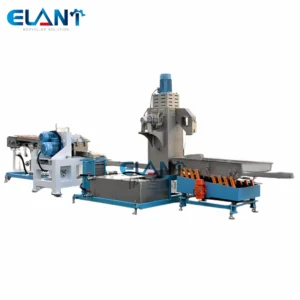
You load a fresh batch of washed PET flakes into the extruder. Within 20 minutes, the screw torque spikes, the die pressure swings wildly, and the strand line breaks — again. Your operator checks the drying time. It looks fine. What he didn’t check is whether those flakes were crystallized first. That single skipped step is the root cause of the problem, and it happens in facilities across the U.S. every week.
PET flakes must be crystallized before pelletizing because amorphous PET softens at roughly 70–80 °C and agglomerates into a sticky mass inside any conventional hopper dryer long before it reaches processing temperature. Crystallization raises the glass-transition threshold so the material can be safely dried at 160–180 °C — the moisture level required to prevent hydrolytic degradation during extrusion.
Quick takeaways
- Amorphous PET flakes stick together and block dryer hoppers at temperatures above ~75 °C — crystallization eliminates that failure mode.
- Crystallized PET can tolerate the 160–180 °C drying temperatures needed to hit the ≤50 ppm moisture target before extrusion.
- The crystallization step typically runs 30–60 minutes at 120–140 °C with continuous agitation in a drum-type crystallizer.
- Skipping crystallization leads to bridging, screw slippage, IV (intrinsic viscosity) drop, and off-spec PET pellets.
- Total pre-processing time before the extruder: 1.5–3 hours depending on flake thickness and initial moisture.
Before You Start PET Bottle Recycling
What you need to verify before touching the crystallizer:
- Incoming PET bottle flakes are washed, sorted, and sized (ideally 8–14 mm²; oversized pieces crystallize unevenly), and they should come from used PET bottles or used bottles—typically post consumer pet bottles—that were properly sorted and washed.
- You know the initial moisture content — test with a Karl Fischer or capacitance moisture meter; typical post-wash flakes run 3,000–6,000 ppm water.
- Your facility has a rotary drum or fluidized bed crystallizer rated for continuous or batch operation at 120–160 °C.
- Your downstream dryer (usually a dehumidifying hopper dryer) is sized to hold crystallized flakes at 160–180 °C for 4–6 hours.
- You have an IV meter or melt-flow index tester available to verify final pellet quality against the line’s target output.
If any of those are missing — especially the crystallizer itself — read the PET crystallizer section before proceeding. Running washed flakes straight to a hopper dryer, or having them fed directly from washing into hot drying, and hoping for the best is the single most common mistake we see quoted in U.S. recycling equipment RFQs that come to us at Elant.
Step 1: Understand Why Amorphous PET Cannot Be Dried Directly
Why this matters: PET fresh from bottle washing exists almost entirely in an amorphous state — the polymer chains are randomly tangled with no organized crystalline structure. The glass-transition temperature (Tg) of amorphous PET sits at approximately 70–80 °C. The moment you push drying temperature above that threshold, the surface of each flake softens, becomes tacky, and individual pieces fuse together. Inside a hopper dryer, this produces bridging — a plug of fused material that blocks material flow, stalls the process, and frequently damages the dryer’s interior agitation paddles.
The paradox: PET must be dried to ≤50 ppm moisture (some food-grade applications require ≤30 ppm) to prevent hydrolytic chain scission during melt processing. That requires temperatures of 160–180 °C for several hours. At those temperatures, amorphous PET doesn’t dry — it welds itself into an unusable mass.
Crystallization breaks this paradox. Once the PET flakes are crystallized, the glass-transition temperature[1] effectively ceases to control softening behavior in a practical sense — the crystalline structure holds the polymer chains in place up to the melting point (~250 °C), meaning the material can sit in a 160 °C dryer for hours without agglomeration.
Common mistake: Operators who come from PVC or HDPE processing assume all plastics can be dried the same way. PET is uniquely sensitive to this because its Tg is low enough to cause trouble at normal drying temperatures while its moisture sensitivity is high enough to demand those same temperatures. The two properties are in direct conflict — and crystallization is the only way to resolve them.
Step 2: Run the Crystallization Stage Correctly
Why this matters: The crystallization step is not simply “heat the flakes.” Temperature uniformity, residence time, and agitation all affect the degree of crystallinity — and under-crystallized flakes will still partially agglomerate in the downstream dryer.
How to run it:
- Load flakes into the rotary drum or fluid-bed crystallizer. Fill to no more than 60–70% of rated capacity; overcrowding reduces agitation effectiveness and creates uncrystallized cold spots.
- Set inlet temperature to 120–140 °C. This range is above the Tg but well below the melting point, allowing the polymer chains to reorganize into crystalline structures progressively.
- Maintain continuous agitation. Rotation speed on a drum crystallizer typically runs 8–15 RPM. The agitation prevents flakes from contacting each other long enough to fuse during the transition through the Tg range. Good crystallization also supports stable feeding later by keeping flakes free-flowing and improving consistent material flow into the extruder.
- Hold for 30–60 minutes. Thinner flakes (from thin-wall PET bottles) crystallize faster; sheet-grade or thick-wall flakes may need the full hour. Visually, crystallized PET flakes shift from transparent flakes to opaque white — a fast visual QC check on the line.
- Verify degree of crystallinity if quality is critical. DSC (differential scanning calorimetry) testing on a sample can confirm crystallinity ≥ 35–40%, which is the working threshold for stable hopper drying.
💡 Pro tip: If your crystallizer discharges directly into the hopper dryer via a pneumatic conveying line, confirm the conveying air temperature doesn’t drop below 100 °C before the flakes enter the dryer. A cold drop reintroduces moisture uptake and partially reverses surface crystallinity.
Common mistake: Running the crystallizer without agitation — or with a broken agitation mechanism — at temperatures above 100 °C. This is how facilities get a solid block of fused PET instead of free-flowing crystallized flakes. Always inspect agitation paddles before each shift, especially on older drum-type units.
Step 3: Dry the Crystallized PET Flakes
Why this matters: Crystallization makes drying possible — it doesn’t do the drying itself. Crystallized flakes can tolerate the higher temperatures used in dehumidification processes. You still need to reduce moisture to ≤50 ppm before the material hits the extruder screw, or hydrolysis will cleave polymer chains, dropping IV and producing brittle, low-value PET pellets.
How to dry correctly:
- Transfer crystallized flakes to a dehumidifying hopper dryer. Desiccant-wheel dryers are standard; dew point at dryer outlet should be ≤ −40 °C (−40 °F), and proper crystallization improves drying efficiency in the hopper. Some lines use a spin dryer after washing as a mechanical pre-drying step before hopper drying.
- Set drying temperature to 160–180 °C for a minimum of 4 hours for standard 8–12 mm flakes. Some rPET (recycled PET) processors targeting food-contact applications run 6 hours.
- Use LIFO (last-in, first-out) hoppers only. If your facility has a gravity hopper that feeds FIFO, under-dried material at the bottom reaches the extruder before the residence time target is met.
- Spot-check moisture with an inline capacitance sensor or pull a sample every 30 minutes during startup. Do not assume time alone equals dryness — hopper load, ambient humidity, and flake surface area all affect the actual rate.
⚠️ Warning: Overdrying is also a real risk. Extended drying above 180 °C, especially in the presence of residual oxygen, causes thermal-oxidative degradation — yellowing of the final PET pellets and IV loss. If your product requires clarity, keep drying temperature at the low end of the range and use inert gas blankets if the application justifies the cost; tighter drying control also helps recycled PET perform closer to virgin PET.
Step 4: Feed Dried Flakes to the Pelletizing Extruder
Why this matters: Everything upstream protects IV and melt quality. The extrusion step is where you convert cleaned, crystallized, dried PET flakes into uniform PET pellets — the form most processors, compounders, and fiber producers making products such as seat belts actually want to buy, whether the line uses a single screw extruder or twin screw extruder depending on throughput and melt-conditioning needs.
Operating checklist for the extruder feed:
- Confirm melt temperature in the 265–285 °C range for standard PET. Going above 295 °C accelerates thermal degradation.
- Screw L/D ratio of 32:1 to 36:1 is typical for rPET flake processing; shorter screws don’t provide enough residence time for uniform melting of irregular flake sizes.
- Stable feeding at the feed throat is critical to avoid surging and maintain melt stability through the screw.
- Melt filtration before the die removes impurities and contaminants, and fine filtration may be required for higher-spec pellets.
- Vacuum degassing removes residual moisture from the melt before pellet formation.
- Use a strand pelletizer or underwater pelletizer depending on your target pellet geometry. Some strand lines use water spray cooling before cutting, while underwater systems cut at the die face. Underwater systems produce more uniform pellets (±0.1 mm diameter variation is achievable) and are preferred for fiber-grade and bottle-grade applications. Some producers run solid state polymerization after pelletizing when they need high IV pellets.
- Pull a pellet sample every 15 minutes during the first two hours of a new batch run. Check for color (yellowing = degradation), surface bubbles (moisture was too high), and fines (die temperature inconsistency).
PET Crystallizer: What to Look For Before Buying or Specifying One
This section earns its word count because we find that most U.S. buyers treat the crystallizer as an afterthought — a bolt-on before the dryer — and then deal with process instability for the next two years.
A PET crystallizer is a continuous or batch mechanical device that heats amorphous PET flakes to the 120–140 °C crystallization range while applying mechanical agitation to prevent inter-particle sticking. The two dominant designs in North American rPET lines are rotary drum crystallizers and fluid-bed (fluidized air, sometimes called fluidized bed) crystallizers.
Rotary drum crystallizers are lower energy per kilogram processed and easier to maintain — fewer moving parts, and the drum itself is serviceable in-house. In overall recycling plant design, they’re the standard choice for output rates of 500–3,000 kg/h. The trade-off is that drum speed must be calibrated to flake size: fine PET fines (under 4 mm) tumble too aggressively and abrade; oversized chunks don’t get sufficient surface exposure.
Fluid-bed crystallizers use hot air flow to suspend flakes while heating them — processing is faster (some designs achieve full crystallization in 15–20 minutes) and handling of mixed flake sizes is more forgiving. They draw significantly more energy, and the hot air circuit requires regular filter maintenance to keep fines out of the air stream. For lines targeting food-contact rPET where cycle consistency matters more than operating cost, fluid-bed units are worth the premium.
What to ask a crystallizer vendor before wiring a deposit:
- What is the minimum and maximum flake size the unit handles without agglomeration?
- What is the guaranteed degree of crystallinity (% by DSC) at the rated throughput?
- How is temperature uniformity measured across the drum cross-section — and what’s the spec tolerance (±5 °C is reasonable; ±15 °C is not)?
- What does the agitation drive train look like, and what is the mean time between maintenance intervals?
- Does the unit come with an integrated dust/fines separation system, or is that a separate scope item?
We’ve specified crystallizers from manufacturers including Starlinger, Erema, and several OEMs for our customers’ rPET lines. The single most consistent finding: undersized crystallizers are the bottleneck that limits the entire pelletizing line’s output — not the extruder. Spec the crystallizer at 115–120% of your target throughput or target output to give yourself room without a full-line stall if the upstream washing system runs hot for a shift.
📝 Note: If you’re sourcing crystallizer + dryer + extruder as a package, confirm the OEM has sized all three pieces as a matched system. Mismatched residence times — where the crystallizer outputs faster than the dryer can accept — are a recurring problem in piecemeal-sourced lines and lead to either fused material in the dryer or crystallizer idle time burning energy for no output.
PET Flakes vs. PET Pellets: What the Processing Difference Means for Your Buyers
The distinction matters for pricing and downstream qualification. PET flakes are heterogeneous in size, density, and residual contamination level — they require this full pre-processing chain before any melt application. PET pellets are homogenized: consistent IV (typically reported as 0.72–0.84 dL/g for bottle-grade), uniform geometry, and predictable melt-flow behavior, which makes them suitable for downstream conversion into high-quality sheet materials.
End markets pay a significant premium for pellets over flakes. As of mid-2026, food-contact rPET pellets trade at a roughly $0.15–0.25/lb premium over clean washed PET flakes in U.S. spot markets [[5]](LINK 1). That premium entirely justifies the crystallization and drying investment for any facility running above 1,000 kg/h.

rPET Value by Processing Stage (USD/lb, illustrative mid-2026 U.S. spot range)
| Item | Value |
|---|---|
| Washed Flakes | 0.28 |
| Crystallized+Dried Flakes | 0.33 |
| Standard rPET Pellets | 0.48 |
| Food-Contact rPET Pellets | 0.58 |
| Processing Stage | Approx. USD/lb (Mid-2026) | Primary Use |
|---|---|---|
| Washed PET flakes | $0.25–0.32 | Direct fiber spinning (limited) |
| Crystallized + dried flakes | $0.30–0.36 | Specialty extrusion, sheet |
| Standard rPET pellets | $0.44–0.52 | Strapping, fiber, packaging |
| Food-contact rPET pellets | $0.52–0.62 | Bottle-to-bottle, food packaging, thin-walled containers |
At What Temperature Does PET Crystallize?
PET crystallization occurs within a specific thermal window: the onset begins around 100–110 °C as chains gain mobility above Tg, peaks between 120–140 °C where nucleation and crystal growth are fastest, and stops well below the melting point of ~250 °C. Industrial crystallizers target 120–140 °C because below 110 °C the rate is too slow to be economical, and above 150 °C the risk of localized surface sticking increases without proportional crystallinity gain. The crystallization kinetics of PET[2] are well-documented in polymer literature — the rate follows an Avrami-type model, meaning early residence time at temperature gives you the most crystallinity per minute, with diminishing returns beyond ~40 minutes for standard bottle-grade flakes.
The Pelletizing Process: What Happens Inside the Twin Screw Extruder
Pelletizing PET plastic follows a defined sequence regardless of extruder brand, and in bottle recycling PET is handled as a polyester resin. Dried crystallized flakes enter the feed throat as the starting material for pellet formation, are conveyed and melted by the rotating screw, pass through a screen pack (typically 40–80 mesh for rPET to catch residual contamination) and melt-cleaning stages that remove remaining contaminants before the die, then exit through a die plate with multiple circular openings. A strand pelletizer pulls the strands across a water-cooling bath and through a rotating cutting head; an underwater pelletizer cuts directly at the die face in a water-flood environment. The resulting PET pellets are dried in a centrifugal dryer and screened before bagging or bulk container filling. In higher-purity recycling setups, the melt purification, cooling, and pellet handling sequence may be repeated multiple times. These lines can process post-consumer PET and other sorted waste streams. They may also be configured for waste materials such as industrial PET scrap. The underwater pelletizing process[[3]](LINK 2) produces more uniform pellets but requires tighter die temperature control than strand systems. For rPET operations where pellet geometry consistency affects downstream processing (fiber spinning in particular), underwater systems are worth evaluating from year one, and the more uniform pellets can also support uses such as injection molding.
How Long Does PET Take to Decompose?
This PAA appears in searches related to PET processing but addresses environmental context rather than the recycling workflow above. Unrecycled PET in a landfill environment takes an estimated 400–500 years to decompose[4] under ambient conditions, per environmental degradation studies. That’s the core reason rPET pelletizing lines exist: bottle-to-bottle and bottle-to-fiber recycling diverts material that would otherwise persist for centuries. Crystallization and pelletizing — the process this guide covers — are what make that reclaimed PET usable in new manufacturing rather than a slow-degrading liability.
Troubleshooting
Problem 1: Flakes clumping in the hopper dryer despite crystallizationCause: Incomplete crystallization — degree of crystallinity below ~30%, usually because of inadequate residence time in the crystallizer or agitation failure. Properly crystallized PET is easier and faster to dry than amorphous material, so clumping often points to an upstream crystallization issue, not only a dryer issue. Fix: Pull a sample before the dryer and run a quick visual check — crystallized flakes should be opaque white, not translucent. Reduce crystallizer throughput by 15–20% to increase residence time, or inspect agitation mechanism for wear.
Problem 2: Excessive IV drop in finished PET pellets (below 0.72 dL/g when starting from 0.78+ flakes)Cause: Residual moisture above 50 ppm entering the extruder, causing hydrolytic degradation of the polymer chain. Fix: Extend dryer residence time, verify dew point at dryer outlet (target ≤ −40 °C), and confirm hopper is operating LIFO. Check for air leaks in the dryer circuit that allow ambient humidity ingress, and keep moisture and contaminants at low levels to protect IV and support high quality recycled PET in the finished pellets. Severe hydrolysis can also make it difficult or impossible to produce high intrinsic viscosity pellets.
Problem 3: Yellow or off-color PET pelletsCause: Thermal-oxidative degradation — either drying temperature too high (above 185 °C) for too long, or melt processing temperature above 290–295 °C. Fix: Reduce drying temperature to the 160–170 °C range, confirm extruder zone temperatures at barrel sensors, and check for localized hot spots near the die. If IV has already fallen too far, some plants use chain extension or upstream rebuilding with ethylene glycol in chemical-recycling routes instead of relying on mechanical reprocessing alone. Adding antioxidant additives (e.g., Irganox 1010 at 0.1–0.2 wt%) can mitigate oxidative degradation for borderline heat-sensitive batches.
What to Do Next
If you’re specifying or upgrading a rPET line and need to size the crystallizer, dryer, and extruder as an integrated system across the full recycling process, our team at Elant has worked through these configurations with U.S. recyclers at scales from 300 kg/h to over 3,000 kg/h. We can help you verify vendor specs before committing to equipment purchases so the line converts post-consumer feedstock into consistent recycled materials and dependable raw materials for manufacturing — the crystallizer sizing question alone has saved customers from bottlenecks that would have capped their entire line output at commissioning.
Explore related sourcing guidance: PET pelletizing machine guide and PET washing line equipment specifications.
Key Facts at a Glance: Intrinsic Viscosity and PET Processing
| Parameter | Specification |
|---|---|
| Amorphous PET glass-transition temp (Tg) | ~70–80 °C |
| Crystallization temperature range | 120–140 °C |
| Crystallization residence time | 30–60 minutes (drum crystallizer) |
| Target degree of crystallinity before drying | ≥35–40% (DSC) |
| Drying temperature (post-crystallization) | 160–180 °C |
| Drying residence time | 4–6 hours |
| Target moisture before extrusion | ≤50 ppm (≤30 ppm food-contact) |
| Dryer dew point target | ≤ −40 °C (−40 °F) |
| Extrusion melt temperature (PET) | 265–285 °C |
| Typical bottle-grade rPET pellet IV | 0.72–0.84 dL/g |
FAQ
What is the difference between PET flakes and pellets?
PET flakes are irregularly shaped fragments produced by shredding and washing used PET bottles or film. Pellets are uniform, cylindrical granules produced by melting and re-extruding those flakes. Pellets have consistent bulk density, moisture content, and melt flow behavior, making them far easier to process in downstream equipment. Flakes vary in size, shape, and can still contain labels and other contaminants, which is why crystallization and drying are essential steps before converting them into pellets for recycled polyester.
At what temperature does PET crystallize?
PET crystallizes most efficiently between 150°C and 190°C (302°F to 374°F), which also prevents PET flakes from sticking together during processing. Below 150°C the crystallization rate is too slow to be practical. Above 190°C the material approaches its melt temperature and loses the solid-state structure needed for proper crystallization. Most industrial crystallizers target 160°C to 180°C with gentle agitation to prevent flakes from fusing together. Holding flakes in this range for 30 to 60 minutes typically raises crystallinity from roughly 5% to over 35%, helping preserve pet material that would otherwise remain too amorphous or low intrinsic viscosity for stable downstream processing.
What is the process of pelletizing plastic?
Pelletizing feeds dried, crystallized plastic into an extruder in a controlled manner to keep the melt stable, where heat and screw pressure melt and homogenize it. The melt is pushed through a die plate, forming continuous strands or a melt curtain. Many lines also include vacuum degassing to remove residual moisture from the melt. Those strands are cooled in a water bath or air stream, then cut into uniform pellets by a rotating blade. For PET specifically, the plastic must be crystallized and dried to a moisture level below 50 ppm before entering the extruder, otherwise hydrolytic degradation reduces molecular weight and ruins pellet quality; this sequence is what makes the output suitable for demanding uses such as new bottles.
How Does the Moisture Level of PET Bottle Flakes Affect Molecular Weight During Pelletizing?
The moisture level of PET bottle flakes directly impacts molecular weight retention during extrusion. Excess moisture can trigger hydrolytic degradation, causing polymer chains to break and reducing molecular weight. Maintaining moisture levels below the recommended threshold before pelletizing helps preserve material performance and improves the quality of the final recycled PET pellets.
Why Is Fine Filtration Important When Processing Bottle Flakes into High-Quality PET Pellets?
Fine filtration removes residual contaminants, paper fibers, aluminum fragments, and degraded polymer particles that may remain after washing. When processing bottle flakes into high-quality PET pellets, fine filtration improves melt cleanliness, reduces black specks, and helps manufacturers meet stricter specifications for packaging, fiber, and food-grade applications.
What Is the Relationship Between High Intrinsic Viscosity and Molecular Weight in Recycled PET?
High intrinsic viscosity generally indicates higher molecular weight within the PET polymer structure. Materials with high intrinsic viscosity often provide better mechanical strength, impact resistance, and processing stability. Maintaining molecular weight during drying and extrusion is essential for producing premium recycled PET suitable for demanding end-use applications.
Can Low Intrinsic Viscosity PET Bottle Flakes Still Be Recycled Successfully?
Yes, low intrinsic viscosity PET bottle flakes can still be recycled, but their processing window may be narrower. Lower IV material typically exhibits reduced chain length and lower mechanical performance. Some recyclers use specialized processing methods or post-treatment technologies to improve material properties before converting the flakes into pellets or finished products.
How Does Ethylene Glycol Influence PET Recycling and Polymer Recovery?
Ethylene glycol is one of the fundamental building blocks of PET resin. During certain chemical recycling processes, ethylene glycol can be used to depolymerize PET and recover valuable raw materials. In mechanical recycling operations, understanding the role of ethylene glycol helps explain how degradation and molecular structure changes affect recycled PET quality.
What Quality Checks Should Be Performed on PET Bottle Flakes Before Pellet Production?
Before pellet production, recyclers should evaluate PET bottle flakes for moisture level, contamination content, particle size consistency, color uniformity, and intrinsic viscosity. These quality checks help identify processing risks early and improve pellet consistency, productivity, and downstream manufacturing performance.
Why Do Manufacturers Target High Intrinsic Viscosity PET Pellets for Food-Grade Applications?
Food-grade applications often require high intrinsic viscosity PET pellets because they offer improved strength, better processing stability, and enhanced performance during bottle manufacturing. Higher IV values typically indicate that molecular weight has been preserved throughout the recycling process, which is critical for demanding packaging applications.
How Can Processors Prevent Molecular Weight Loss When Converting Bottle Flakes into PET Pellets?
Processors can minimize molecular weight loss by controlling moisture levels, optimizing drying conditions, maintaining stable extrusion temperatures, and implementing effective fine filtration. These measures help reduce hydrolysis and thermal degradation, allowing bottle flakes to be converted into higher-value PET pellets with more consistent quality.
Sources
[1] Crystallization of Poly(ethylene terephthalate): A Review — mdpi.com
[2] Crystallization of Poly(ethylene terephthalate): A Review – PMC — pmc.ncbi.nlm.nih.gov
[3] A Comparison of Underwater Pelletizers with Other Types … — cowellextrusion.com
[4] Polyethylene terephthalate (PET) recycling: A review — sciencedirect.com
[5] Recycled Plastics Market Size, Share & 2031 Outlook — mordorintelligence.com